Key takeaways
- Fungus gnat larvae (Bradysia spp.) live in the top 2 to 3 inches of moist potting soil, feeding on fungi, organic matter, and delicate root hairs.
- Adult gnats are weak fliers that do not bite humans, but females lay up to 200 eggs in damp, organic-rich container mixes.
- Allow the top 2 inches (5 cm) of potting soil to dry out completely between waterings; dry soil desiccates eggs and halts larval development.
- Apply Bacillus thuringiensis subsp. israelensis (BTI) as a soil drench weekly for 3 consecutive weeks to destroy larvae naturally.
- Use yellow sticky traps at the soil surface to capture adult gnats and monitor population declines.
Quick answer: To get rid of fungus gnats, allow the top 2 inches of potting soil to dry out thoroughly and apply a biological BTI (Bacillus thuringiensis subsp. israelensis) soil drench weekly for three weeks. Combine with yellow sticky traps to capture egg-laying adults and break the breeding cycle.
Few indoor gardening problems are as frustrating as an infestation of fungus gnats (Bradysia and Sciara species). Whether hovering around beloved houseplants, emerging from indoor seedling trays, or buzzing near windows, these small, dark flies multiply rapidly in warm, indoor environments.
While adult fungus gnats are harmless to humans and pets, their subterranean larvae present a genuine threat to plant health. Hatching in the moist, warm upper layers of potting soil, translucent gnat larvae feed voraciously on soil fungi, decaying organic matter, and the tender root hairs of young seedlings and houseplants.
Heavy larval infestations stunt plant growth, cause lower leaves to yellow and drop, and create entry wounds for root-rot pathogens like Pythium (an oomycete water mould) and Fusarium (a true fungus).
By understanding the gnat life cycle, adjusting watering mechanics, and deploying targeted biological controls, you can clear fungus gnats from your plants without reaching for chemical sprays.
Understanding the fungus gnat life cycle
Targeting fungus gnats effectively requires disrupting both the airborne adult and subterranean larval stages:
+-----------------------------------------------------------------------+
|                    FUNGUS GNAT 4-STAGE LIFE CYCLE                     |
+-------------------+-----------------------+---------------------------+
| STAGE             | DURATION & HABITAT    | VULNERABILITY             |
+-------------------+-----------------------+---------------------------+
| Egg               | 3-6 days in wet soil  | Killed by dry soil        |
| Larva (Maggot)    | 10-14 days in top 5cm | Killed by BTI & nematodes |
| Pupa              | 3-5 days in subsoil   | Protected stage           |
| Adult Fly         | 7-10 days in air      | Trapped on yellow cards   |
+-------------------+-----------------------+---------------------------+
1. Egg Stage
Adult female gnats deposit clusters of 100 to 200 microscopic eggs in the top 1 to 2 inches (2.5 to 5 cm) of moist, organic potting soil. Eggs require constant moisture to hatch; if the soil surface dries out, eggs quickly desiccate and perish.
2. Larval Stage
Larvae emerge as translucent, legless white maggots (roughly 5 mm long) with distinct, shiny black head capsules. Over two weeks, they feed actively on root hairs and fungal mycelium in the root zone. When seedling roots are chewed, plants wilt despite moist soil conditions.
3. Pupal and Adult Stages
Larvae pupate in the soil before emerging as slender, mosquito-like adult gnats measuring roughly 1/8 inch (3 mm) in length. Adults live for about a week, mating immediately to restart the cycle. Because the entire life cycle takes only 17 to 24 days at room temperature (20°C to 24°C / 68°F to 75°F), overlapping generations quickly build massive populations in heated homes.
Step 1: Moisture control and bottom watering
Excessive moisture is the primary driver of fungus gnat infestations. Adjusting your irrigation routine eliminates their breeding habitat:
[ Conventional Top Watering ] ---> Wet topsoil layer --> Ideal gnat breeding ground
[ Bottom Watering Method ]    ---> Dry top 5 cm       --> Moist roots + Dead gnat eggs
The Dry-Out Rule
Before applying treatments, allow the top 2 inches (5 cm) of potting mix to dry out thoroughly between waterings. Use your finger or a wooden moisture probe to confirm dryness. Withholding water starves young larvae and prevents freshly laid eggs from hatching.
Switching to Bottom Watering
Transition indoor containers to bottom watering:
- Place the container in a sink, basin, or deep saucer filled with 2.5 to 5 cm (1 to 2 inches) of water.
- Allow the potting soil to draw water upward through the bottom drainage holes via capillary action for 20 to 30 minutes until the lower root ball is hydrated.
- Remove the pot and discard any standing runoff from the saucer.
- Bottom watering keeps the top 2 inches of soil completely dry while keeping the lower root zone properly hydrated. For general indoor plant care, see our guide on rooftop and patio container gardening.
Step 2: Biological larvicide treatment with BTI
Biological control using Bacillus thuringiensis subsp. israelensis (BTI) is the most reliable organic treatment for larvae:
+---------------------------------------------------------------------------------------------------------+
|                                         THE BTI DRENCH PROTOCOL                                         |
+---------------------------------------------------------------------------------------------------------+
|  Material: BTI granules (Mosquito Bits) or liquid biological drench                                     |
|  Preparation: Steep BTI granules at the rate on the label (Mosquito Bits directs about 4 tbsp per gal)  |
|  Steeping: Let sit for 20-30 minutes; strain out solid granules                                         |
|  Application: Drench potting soil thoroughly weekly for 3 weeks                                         |
+---------------------------------------------------------------------------------------------------------+
How BTI Works
BTI is active only against the larvae of a narrow group of flies — fungus gnats, mosquitoes and black flies — and is not toxic to humans, pets, earthworms or plants. When gnat larvae ingest these microscopic proteins, the alkaline environment in their digestive tract activates the toxin, destroying their gut lining within 24 to 48 hours.
Application Steps
- Soak BTI granules (such as Mosquito Bits) in warm water for 20 to 30 minutes to extract the active bacterial spores. Rates differ between brands and between granules and liquid concentrates, so follow the label on the product you bought.
- Strain out the floating granules to prevent mold from forming on container surfaces.
- Use the treated water to drench the potting soil thoroughly.
- Repeat the drench once a week for three consecutive weeks. Repeating weekly for three weeks catches the larvae hatching from eggs that survived the first drench, before they can pupate. Treat every pot in the room on the same schedule, or survivors in an untreated pot will restart the cycle.
Step 3: Trapping adults and applying physical sand barriers
Combining larval controls with adult trapping stops egg-laying immediately:
[ Yellow Sticky Traps ] ----> Place at soil level to capture flying adults
[ Horticultural Sand ]  ----> 1 cm dry sand layer prevents females laying eggs
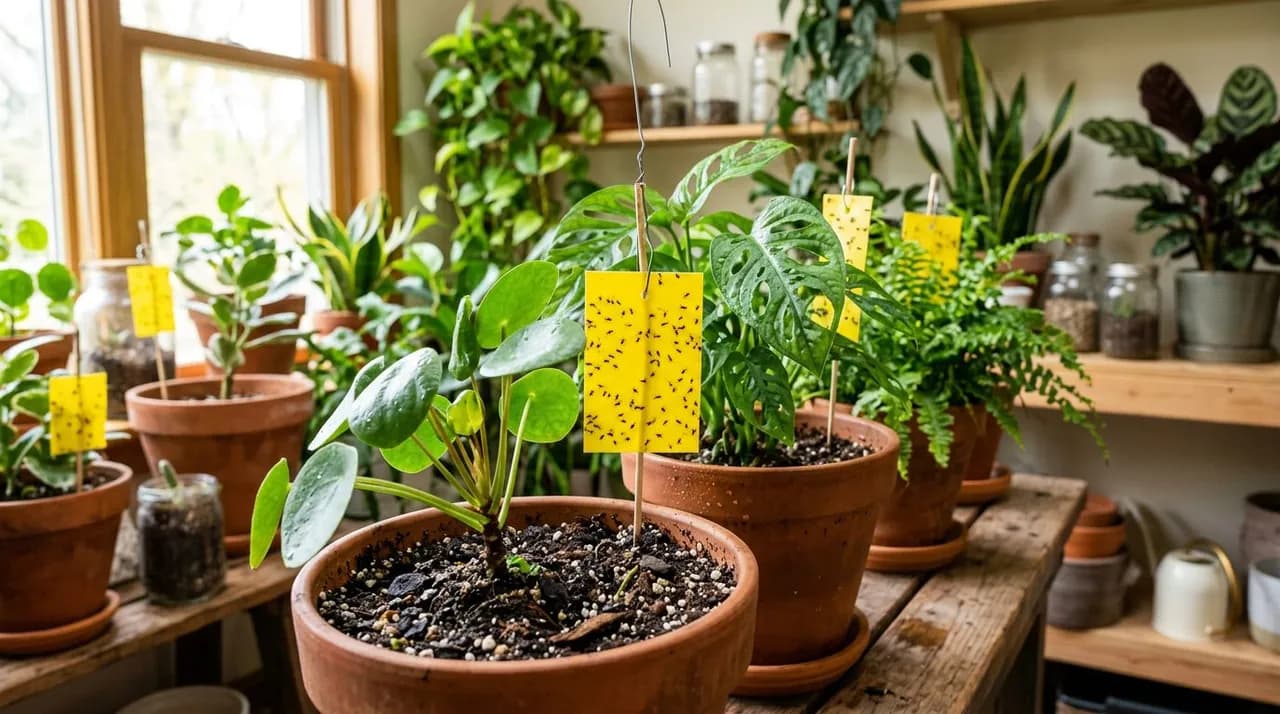
1. Yellow Sticky Cards
Adult fungus gnats are strongly attracted to the visual wavelength of bright yellow:
- Cut yellow sticky cards into small squares and mount them on wooden stakes positioned horizontally just 1 to 2 inches above the soil surface.
- Sticky cards capture egg-laying females before they can deposit fresh broods, providing a clear visual metric of population decline.
2. Physical Top-Dressing Barrier
Apply a 1 cm (0.5 inch) layer of coarse horticultural sand or fine aquarium gravel over the surface of the potting mix. Diatomaceous earth is sometimes suggested here, but it stops working the moment it gets damp, so grit is the more reliable barrier. Coarse sand dries out instantly after watering and creates an abrasive physical barrier that prevents female gnats from reaching the moist organic soil beneath. Avoid adding raw food scraps or uncomposted grounds that attract pests, as detailed in our guide on coffee grounds for plants.
Beneficial nematodes and predatory soil mites
For extensive indoor plant collections, greenhouses, or indoor seed-starting setups, biological predators provide continuous protection:
- Beneficial Nematodes (Steinernema feltiae): Microscopic parasitic roundworms applied as a water drench. They actively seek out gnat larvae in the soil, enter their bodies, and release symbiotic bacteria that kill the host within 48 hours. They reproduce inside the pest cadaver, releasing thousands of new nematodes to patrol the potting mix.
- Predatory Soil Mites (Stratiolaelaps scimitus, formerly sold as Hypoaspis miles): Commercially reared predatory mites that patrol the upper soil profile, consuming gnat larvae, thrips pupae, and springtails. They establish self-sustaining populations in moist potting soil.
To maintain vigorous seedlings and indoor starts, explore our guides on seed starting for beginners and integrated pest management for home gardens.