Key takeaways
- Peppers (Capsicum species) are naturally tender tropical perennials that live for several years when protected from freezing winter temperatures.
- Overwintered second-year pepper plants develop thick woody stems and typically flower and crop several weeks earlier than spring-sown seedlings.
- Bring pepper plants indoors before nighttime temperatures drop below 45°F to 50°F (7°C to 10°C) to prevent cold stress.
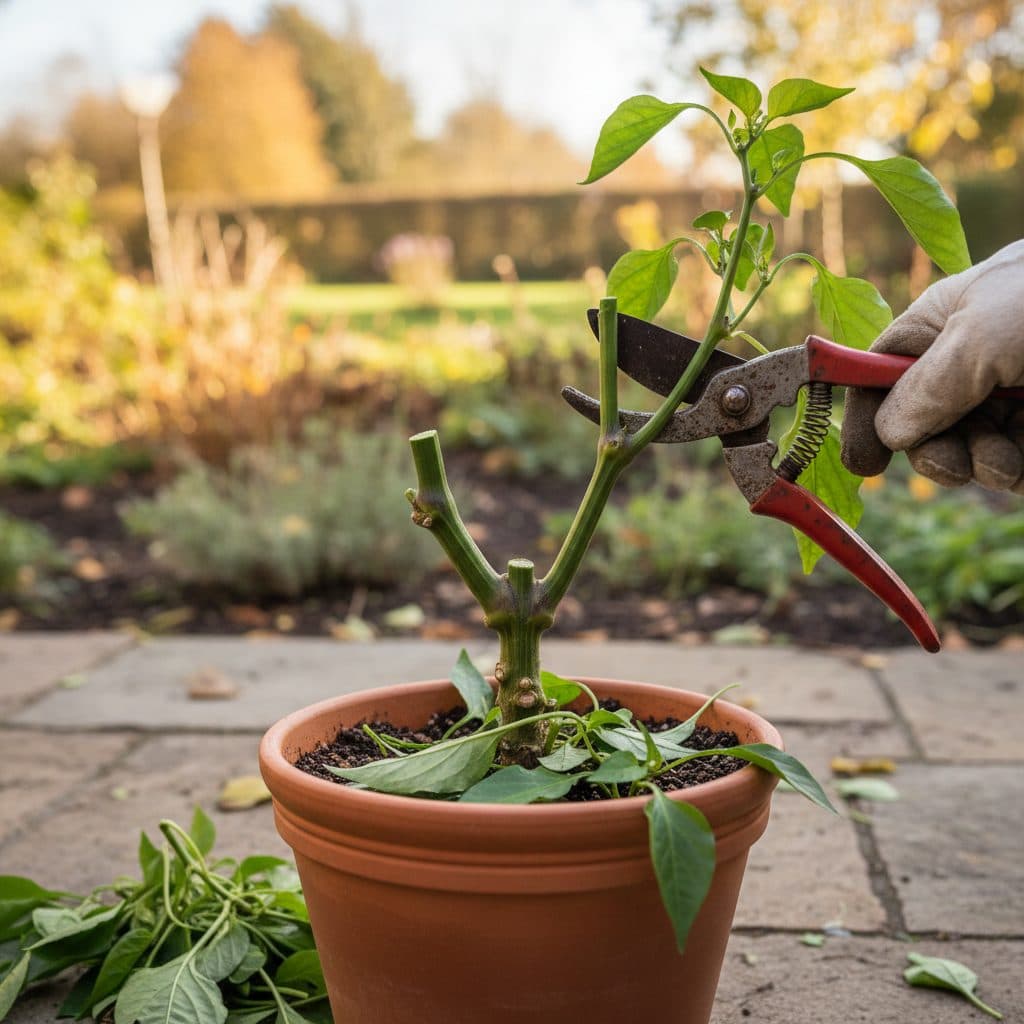
- Prune the canopy aggressively back to the main structural "Y" nodes, stripping remaining leaves to force the plant into semi-dormancy and prevent indoor pest infestations.
- Store dormant plants in a cool location at 55°F to 65°F (13°C to 18°C) and water sparingly only once every two to three weeks to avoid root rot.
Quick answer: To overwinter pepper plants, dig up garden plants or bring potted containers indoors before the first fall frost, prune all branches back to a compact 4 to 6-inch Y-shaped framework, and strip off all remaining leaves. Store the dormant plant in a cool 55°F to 65°F room with minimal light, and water only once every two to three weeks until spring.
Most gardeners treat bell peppers, jalapeños, and habaneros as tender summer annuals that die with the first autumn frost. However, understanding overwintering pepper plants allows you to tap into their true botanical nature: all cultivated pepper species (*Capsicum annuum, *C. chinense, C. baccatum, C. frutescens, and C. pubescens) are long-lived tropical perennials.
Starting peppers from seed every spring requires weeks of indoor heating mats, grow lights, and slow early growth. In contrast, an overwintered pepper plant enters its second spring with an established root system and a thick, woody stem.
When awakened in spring, second-year plants burst into vigorous growth, flower weeks ahead of seedlings, and produce substantially heavier harvests across the summer.
+-----------------------------------------------------------------+
|              ANNUAL SEEDLINGS VS OVERWINTERED PLANTS            |
|                                                                 |
|   FACTOR           FIRST-YEAR SEEDLING      SECOND-YEAR ROOTS   |
|   ------           -------------------      -----------------   |
|   Early Growth     Slow (needs heat mat)    Rapid root surge    |
|   First Flowering  Mid to late summer       Late spring         |
|   Stem Caliper     Slender green stem       Thick woody base    |
|   Overall Yield    Standard yield           Usually heavier     |
|   Harvest Window   Standard season window   Longer (early start)|
+-----------------------------------------------------------------+
Why are pepper plants perennial?
In their native tropical habitats throughout Central and South America, wild peppers never experience frost. They grow into large woody shrubs that produce fruit continuously for five to ten years.
In temperate climates, sub-freezing winter temperatures kill the soft foliage and freeze water inside plant vascular tissues. By bringing the root system into a frost-free environment and inducing a period of rest (semi-dormancy), you protect the plant's core vascular structure until warm weather returns.
Species like Capsicum chinense (habaneros, ghost peppers, scotch bonnets) and Capsicum baccatum (aji varieties) are particularly slow to mature from seed, often requiring 100 to 120 days of warm weather to ripen. Overwintering these slow-maturing varieties gives them the necessary head start to yield bountiful ripe fruit even in short northern summers. To compare cold tolerance thresholds across garden crops, check our list of frost-tolerant vegetables.
+-----------------------------------------------------------------+
|              CAPSICUM SPECIES OVERWINTERING POTENTIAL           |
|                                                                 |
|   SPECIES              COMMON VARIETIES    MATURITY BENEFIT     |
|   -------              ----------------    ----------------     |
|   *C. annuum*          Jalapeño, Bell, ThaiFast early flush     |
|   *C. chinense*        Habanero, Ghost     Earlier, heavier flush|
|   *C. baccatum*        Aji Lemon, Bishop   Tree-like canopy     |
|   *C. pubescens*       Rocoto, Manzano     Cold tolerance       |
+-----------------------------------------------------------------+
How do you prepare and prune pepper plants for winter dormancy?
Preparing pepper plants properly before bringing them indoors helps them survive winter dormancy.
Step 1: Timing the move
Monitor local weather forecasts in early autumn. Bring your plants indoors when overnight temperatures consistently drop to 45°F to 50°F (7°C to 10°C), well before the first hard freeze strikes.
Step 2: Aggressive structural pruning
Using sharp, sanitized bypass pruners, cut the entire canopy back aggressively.
- Cut main branches back to just above the primary "Y" forks on the main trunk, leaving a compact framework 4 to 6 inches (10 to 15 cm) tall.
- Remove all remaining green leaves, soft top growth, flowers, and immature peppers.
- Stripping the leaves prevents the plant from attempting to support excess foliage in dim indoor light and eliminates hiding places for outdoor pests like aphids and spider mites.
+-------------------------------------------------------------+
|              PEPPER PRUNING FRAMEWORK FOR DORMANCY          |
|                                                             |
|                     (Cut Here) \   / (Cut Here)             |
|                                 \ /                         |
|                                  Y  <- Primary Node         |
|                                  |                          |
|                                  |  (4-6 inches tall)       |
|                                  |                          |
|                                  |                          |
|                             ===========                     |
|                             [ Pot/Soil]                     |
+-------------------------------------------------------------+
Step 3: Root pruning and repotting
If your peppers were growing directly in garden soil:
- Dig a wide circle around the root ball with a spade and lift the plant gently.
- Shake or gently wash most of the field soil off the roots so you leave soil-dwelling pests such as root aphids and grubs behind — keep as much fine root intact as you can.
- Trim back long, rambling roots so the root ball fits comfortably into a clean 1 to 2-gallon plastic nursery container.
- Repot using fresh, clean, well-draining potting mix. For general container overwintering principles, review overwintering container gardens in northern zones.
How do you care for dormant pepper plants indoors?
During dormancy, pepper plants require very little attention. Over-caring, especially overwatering, is the most common cause of overwintering failure.
- Temperature: Store dormant containers in a cool room, basement, unheated garage, or utility area where temperatures remain between 55°F and 65°F (13°C to 18°C). Avoid freezing locations below 40°F (4°C) and hot rooms above 75°F (24°C).
- Lighting: Dormant leafless plants do not require intense grow lights. A spot near a north or east-facing window or indirect basement ambient light is sufficient.
- Watering schedule: Because the plant has no leaves to transpire moisture, its water consumption drops to near zero. Water sparingly only once every two to three weeks, applying just enough moisture to keep the root ball from turning into dust. Never leave pots sitting in standing drain water.
- Fertilizer: Apply zero fertilizer during the winter dormancy period. Adding nitrogen prompts weak, pale growth that attracts sap-sucking insects.
+-------------------------------------------------------------+
|              WINTER DORMANCY CARE CHECKLIST                 |
|                                                             |
|   TEMPERATURE: 55°F to 65°F (13°C to 18°C)                  |
|   LIGHTING:    Low to indirect ambient light                |
|   WATERING:    Sparingly every 14-21 days (dry soil)        |
|   FERTILIZER:  None until active spring growth              |
|   PEST CHECK:  Inspect weekly for signs of aphids           |
+-------------------------------------------------------------+
How do you wake up peppers and transition them outdoors in spring?
Begin waking up your overwintered peppers roughly six to eight weeks before your area's average last spring frost date.
- Increase light and warmth: Move pots into a warm, sunny south-facing window or place them directly beneath LED grow lights at room temperature (70°F / 21°C).
- Resume watering and light feeding: Water the soil thoroughly until runoff appears. Apply a half-strength organic liquid kelp or fish emulsion fertilizer to stimulate dormant buds along the woody stem. For balanced organic nutrient choices, explore organic fertilizers for hot weather vegetables.
- Pinch early flowers: Within two to three weeks, new green shoots will emerge from the nodes. Pinch off any premature flower buds that appear in early spring so the plant directs energy into building foliage and new stems.
- Hardening off: Once outdoor nighttime temperatures stay consistently above 55°F (13°C), harden off your plants by moving them into partial shade outdoors for a few hours daily, gradually increasing exposure to full sun over seven to ten days.
For maximizing container yields in small spaces, compare vertical training techniques in our guide to vining crops in pots.