Key takeaways
- US homes average 30-40% relative humidity in winter, significantly lower than tropical plant needs of 60-80%.
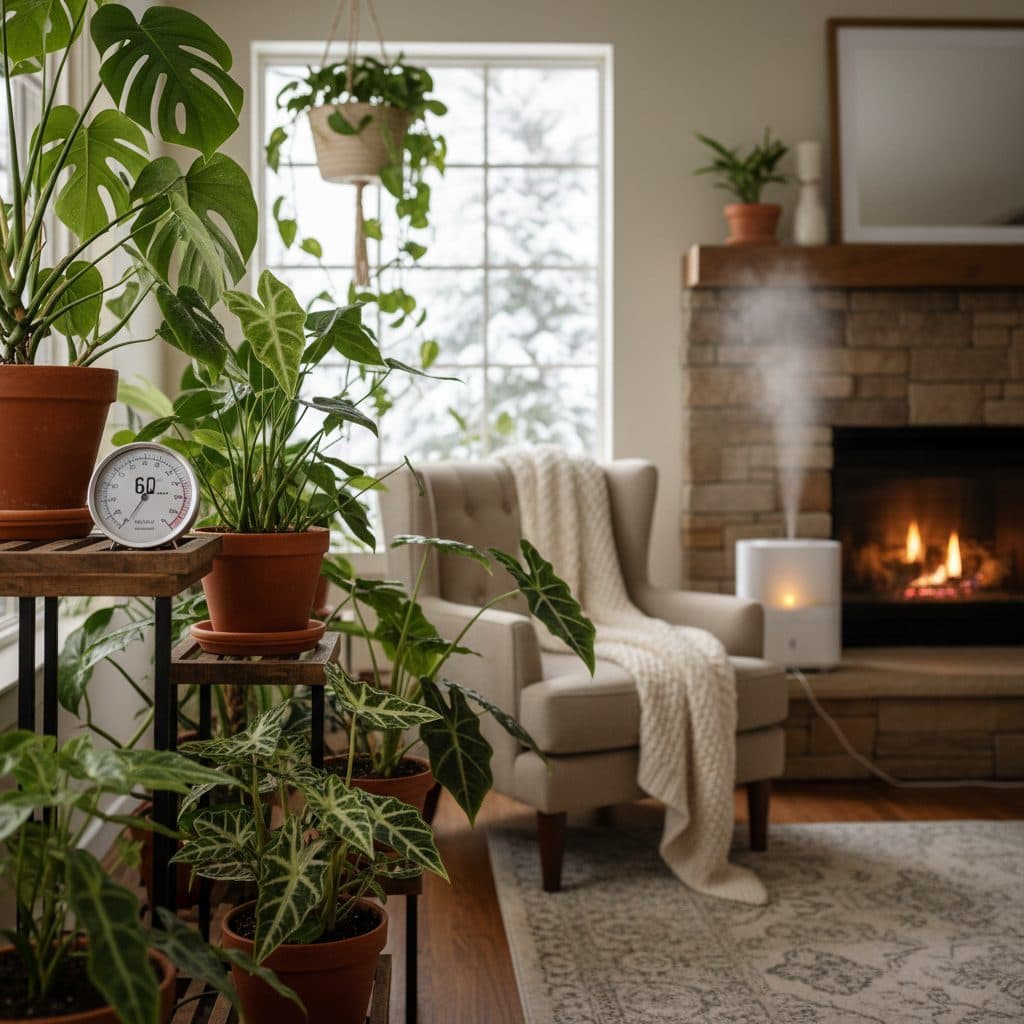
- Utilize a hygrometer to monitor humidity, aiming for 50-60% in the air right around the plants rather than across the whole house.
- Effective methods for boosting humidity include pebble trays, grouping plants, and using dedicated humidifiers.
- Misting provides only temporary relief, increasing humidity for a mere 15-30 minutes.
- Low humidity environments, below 40%, significantly increase tropical houseplants’ susceptibility to common pests like spider mites.
- Consider advanced solutions such as grow tents or sealed terrariums for highly sensitive plants in extremely dry conditions.
Quick answer: Tropical houseplants thrive in 60-80% humidity, but US winter homes average 30-40%. To keep them healthy, monitor humidity with a hygrometer, aim for 50-60% around the plants, and use methods like pebble trays or humidifiers to increase moisture.
Across much of the US, from USDA zone 5 in the Midwest to zone 7 along the East Coast, winter brings a unique challenge for tropical houseplants: extremely dry indoor air. When temperatures drop outside, we crank up our heating systems, often reducing indoor relative humidity to a meager 30% or 40%. This is a far cry from the 60% to 80% humidity these plants naturally experience in their native tropical environments. That gap creates significant stress for species like the popular Monstera deliciosa or a delicate Prayer Plant (Maranta leuconeura).
This stark contrast can lead to a host of problems, from crispy leaf edges on a Fiddle Leaf Fig (Ficus lyrata) to stunted growth and increased pest susceptibility. Understanding and actively managing this humidity gap matters for keeping your indoor jungle thriving through the colder months, especially when average outdoor humidity in places like Arizona can drop below 20% in winter. With a few practical strategies, you can transform your home into a more hospitable environment for your tropical collection, even if you live in a region with 10 inches of annual rainfall.
The winter humidity challenge in US homes
The primary culprit behind dry indoor air during US winters is our heating systems. Whether you use forced-air furnaces, baseboard heaters, or wood-burning stoves, they all tend to remove moisture from the air. In a typical heated home in a northern state like Minnesota or Wisconsin, indoor relative humidity can easily drop to 30% or even 20% when outdoor temperatures are below freezing. This is a significant departure from the 70% to 90% humidity levels found in the rainforests where many of our favorite houseplants originate, such as the Amazon basin or Southeast Asian jungles.
How dry air harms your plants
When the air is too dry, plants lose moisture through their leaves faster than their roots can absorb it, a process called transpiration. This leads to several visible symptoms: crispy leaf edges, particularly on plants with thin leaves like Calatheas or Ferns; stunted new growth; and browning leaf tips. For some plants, like the popular Bird of Paradise (Strelitzia reginae), low humidity can prevent new leaves from unfurling properly, causing them to tear. Furthermore, dry air is a breeding ground for common houseplant pests. Spider mites, for example, thrive in low humidity environments, reproducing rapidly when relative humidity drops below 40% and temperatures are above 68°F. They can cause significant damage to a plant in just a few weeks, often leaving tell-tale webbing on the undersides of leaves.
- Crispy or brown leaf edges
- Stunted or deformed new growth
- Increased susceptibility to spider mites
- Failure of new leaves to unfurl
- Overall plant stress and decline
Measuring and monitoring indoor humidity
You can’t manage what you don’t measure. The first step in beating dry winter air is to accurately assess your home’s current humidity levels. A simple and affordable tool for this is a hygrometer, which measures relative humidity in the air. You can find digital hygrometers for as little as 10 to 15 dollars, and many modern thermostats or weather stations include one. Place the hygrometer near your plants, ideally within 2 to 3 feet, to get a reading that reflects their immediate environment, not just the general room average. Check it at different times of the day, especially in the morning and evening, as humidity can fluctuate by 5% to 10%.
Ideal humidity ranges for common plants
While most tropical plants prefer 60-80% humidity, some are more forgiving than others. For example, a Golden Pothos (Epipremnum aureum) or a Snake Plant (Sansevieria trifasciata) can tolerate humidity as low as 40% without showing significant signs of stress, making them good choices for beginners. However, more sensitive species like a Fittonia (Nerve Plant) or a Maidenhair Fern (Adiantum capillus-veneris) will truly struggle below 55% relative humidity and will thrive closer to 70%. Aim for 50% to 60% in the air immediately around the plants as a general target for a mixed tropical collection. Pushing a whole room past that in winter is hard on the building, so make up the difference locally with pebble trays, grouping or a cabinet rather than by wetting the entire house. Regular monitoring, perhaps once or twice daily, will help you understand your home’s specific patterns. Just as you monitor soil moisture with a soil moisture meter, a hygrometer is essential for air conditions.
- Hygrometer: Digital or analog device to measure humidity.
- Target Range: 55-70% for most tropical plants.
- Placement: Near plants, 2-3 feet away.
- Frequency: Check daily, especially morning and evening.
- Tolerance: Some plants tolerate 40%, others need 55%+.
Simple strategies to boost humidity
Once you know your baseline humidity, you can start implementing strategies to increase it. Not all methods are equally effective, but a combination often yields the best results. One of the simplest and most widely recommended methods is the pebble tray. Fill a shallow tray with pebbles and add water until it’s just below the top of the pebbles. Place your potted plant on top of the pebbles, ensuring the pot’s base does not sit in the water. As the water evaporates, it adds moisture to the air directly around the plant. A pebble tray lifts humidity slightly in the few inches of air directly above the water surface. Remember to refill the tray every 1 to 2 days, depending on your home’s dryness.
Grouping plants and misting
Another effective, low-cost method is grouping plants together. Plants naturally release moisture through their leaves, and when several are placed close, they create a microclimate with higher localized humidity. Grouped plants noticeably raise the humidity of the air immediately around them. Misting your plants with a spray bottle is a common practice, but its effectiveness is often overstated. While it feels good and can provide a very temporary boost, the added humidity typically dissipates within 15 to 30 minutes. For plants like Orchids or Ferns that appreciate leaf moisture, it’s more about cleaning leaves and providing a brief refresh than a sustained humidity increase. If you do mist, use distilled or filtered water to avoid mineral deposits, mist in the morning so the leaves dry before nightfall, and treat it as leaf cleaning rather than humidity control.
- Pebble trays: Increase local humidity by 5-10%.
- Grouping plants: Creates a humid microclimate, 5-15% increase.
- Misting: Provides temporary relief, lasts 15-30 minutes.
- Terrariums: Excellent for small, high-humidity plants.
- Avoid direct heat: Keep plants away from vents and radiators.
Advanced solutions and pest prevention
For serious plant enthusiasts or those with highly sensitive tropical species, more robust solutions might be necessary to combat consistently low humidity, especially in homes in dry climates like Colorado or Nevada. A dedicated room humidifier is one of the most effective ways to increase overall ambient humidity. Ultrasonic humidifiers are quiet and produce a cool mist, while evaporative humidifiers use a fan to blow air through a wet wick filter. A room humidifier is the most reliable way to lift ambient humidity. In a cold-climate winter, though, keep the room in the 40-50% range and watch your windows: if condensation forms on the glass or the frames, the air is too wet for the building and you should dial the humidifier back and create the extra humidity locally instead, with trays, grouping or an enclosure. Remember to clean your humidifier regularly, typically once a week, to prevent mold and bacterial growth, and use distilled water to avoid mineral dust.
Grow tents, terrariums, and pest management
For plants that demand very high and stable humidity, such as rare aroids and miniature ferns, consider a sealed environment. Small terrariums or cloches can provide a miniature greenhouse effect for one or two plants, maintaining humidity levels above 80%. For a larger collection, a reflective indoor grow tent offers a controlled environment where you can easily manage temperature and humidity. These tents, often 2×2 feet or larger, hold humidity easily, so pair one with a small fan — still, wet air is what brings on powdery mildew and bacterial leaf spot. Finally, remember that good humidity management is a key part of pest prevention. Spider mites, in particular, dislike high humidity. Maintaining relative humidity around 50% makes conditions less favorable for them and slows their build-up, saving you the headache of treating an infestation that can strip a plant over a few weeks. For those interested in larger scale climate control, exploring concepts from four-season greenhouse design can offer inspiration.
- Room humidifiers: Increase ambient humidity by 10-20%.
- Terrariums: Create high-humidity microclimates (80%+).
- Grow tents: Controlled environments for larger collections.
- Pest prevention: Humidity above 50% deters spider mites.
- Maintenance: Clean humidifiers weekly, use distilled water.
Comparing Indoor Humidity Boosting Methods
Method | Cost | Effectiveness (Local RH Increase) | Maintenance |
|---|---|---|---|
Misting | Low (spray bottle $5-10) | Temporary (15-30 minutes) | Daily (1-2 times) |
Pebble Tray | Low (tray $10-20) | Moderate (5-10%) | Refill water every 1-2 days |
Grouping Plants | None | Moderate (5-15%) | None beyond regular care |
Room Humidifier | Medium ($40-150) | High (10-20% ambient) | Weekly cleaning, daily refills |
Terrarium/Grow Tent | High ($50-300+) | Very High (80%+) for specific plants | Occasional cleaning, monitoring |
Winter Humidity Drop: Average US home humidity can drop from 50-60% in summer to 30-40% in winter due to heating systems.
Pest Prevention: Maintaining indoor humidity above 50% can significantly reduce the risk of spider mite infestations, which thrive in dry air below 40%.
Frequently asked questions
What is the ideal humidity range for most tropical houseplants?
Most tropical houseplants thrive in relative humidity levels between 60% and 80%. However, many can tolerate a range of 55% to 70% without significant stress, especially if other growing conditions like light and watering are optimal.
How can I tell if my houseplant needs more humidity?
Common signs include crispy or brown leaf edges, particularly on new growth or thinner leaves, and leaves failing to unfurl properly. You might also notice increased pest activity, such as spider mites, which thrive in environments below 40% humidity.
Is misting an effective way to increase humidity?
Misting provides only a very temporary increase in humidity, typically lasting just 15 to 30 minutes. While it can offer a brief refresh and help clean leaves, it is not a sustained solution for significantly raising ambient humidity levels in a room.
What is a hygrometer and why do I need one?
A hygrometer is a device that measures relative humidity. You need one to accurately monitor your indoor air conditions, allowing you to confirm if your home’s humidity is below the ideal 55-70% range for your tropical plants and to gauge the effectiveness of your humidity-boosting efforts.
Can too much humidity be bad for houseplants?
Yes, consistently very high humidity (above 85-90%) combined with poor air circulation can lead to fungal issues like powdery mildew or bacterial leaf spot. Aim for a balanced range, generally not exceeding 80% for most common houseplants, and ensure good airflow around your plants.
How often should I clean my humidifier?
To prevent the growth of mold, bacteria, and the release of mineral dust, it’s recommended to clean your humidifier thoroughly at least once a week. Use distilled water to minimize mineral buildup, especially if you live in an area with hard water.
References
- Happy houseplants : how to grow and maintain your indoor plants / by Elizabeth Walker. (1992). Happy houseplants : how to grow and maintain your indoor plants / by Elizabeth Walker..
- Indoor Houseplants (2003). Indoor Houseplants.
- USDA Natural Resources Conservation Service (2024). USDA Natural Resources Conservation Service.
- EPA — Soak Up the Rain (2024). EPA — Soak Up the Rain.
- SARE — Sustainable Agriculture Research & Education (2023). SARE — Sustainable Agriculture Research & Education.
- ATTRA / NCAT Sustainable Agriculture (2023). ATTRA / NCAT Sustainable Agriculture.