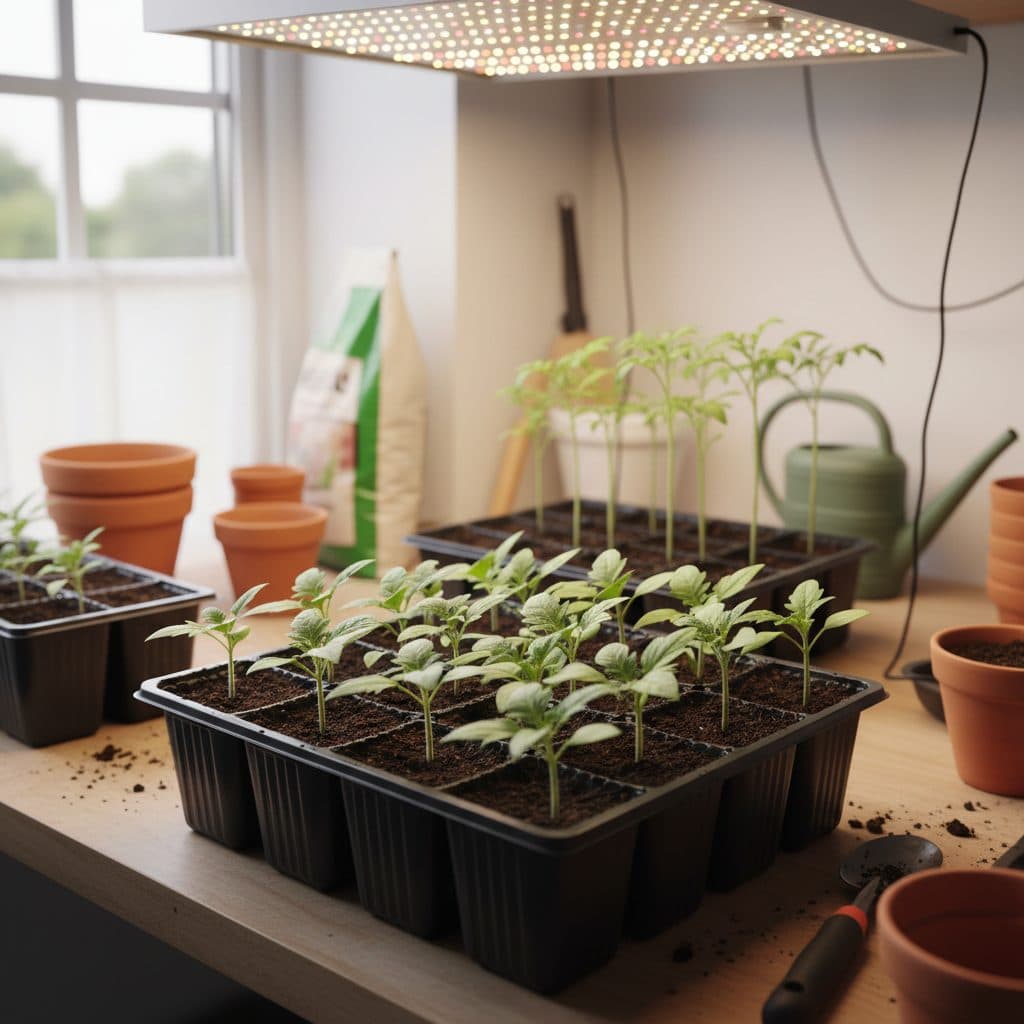
Key takeaways
- Insufficient light is the primary cause of leggy seedlings, leading to weak, elongated stems.
- Maintain optimal temperatures, typically 65-75°F during the day, to encourage compact, sturdy growth.
- Position grow lights 2-4 inches above seedlings and provide 14-16 hours of light daily.
- Potting up leggy tomato seedlings and burying the stem can promote new root development.
- Ensure good air circulation around seedlings to strengthen stems and prevent disease.
- Weak seedling starts can significantly reduce mature plant yields, sometimes by 20% or more.
Quick answer: Prevent leggy tomato seedlings by ensuring sufficient light (14-16 hours daily, 2-4 inches from grow lights) and maintaining optimal temperatures (65-75°F day, 60-65°F night) to promote sturdy growth.
In many parts of the US, from the humid summers of Georgia to the cooler springs of Michigan, starting seeds indoors is a common practice for gardeners eager to get a head start on the growing season. However, a frequent challenge arises around week three or four: seedlings that stretch too tall, appear pale, and have thin, weak stems. This condition, commonly known as being “leggy,” can severely compromise the health and productivity of your plants, potentially reducing yields by 20% or more.
Understanding the core reasons behind leggy growth — primarily insufficient light and improper temperatures — is the first step toward cultivating strong, healthy starts. This article will guide you through diagnosing the problem in species like tomatoes and cucurbits, offering practical, data-backed solutions to ensure your seedlings develop into strong, fruit-bearing plants ready for your garden beds, whether you’re in USDA zone 5 or USDA zone 9.
What defines a leggy seedling?
When we talk about a “leggy” seedling, we are referring to a plant or stem that is unusually long and slender, often appearing stretched and weak. This condition is a plant’s desperate response to insufficient light, a process known as etiolation. Instead of developing sturdy stems and broad leaves, the seedling prioritizes vertical growth, attempting to reach a light source it perceives as distant. For example, a healthy tomato seedling ready for transplant might be 4 to 6 inches tall with a stem diameter of 0.25 inches, while a leggy one could be 8 to 10 inches tall with a stem barely 0.1 inch thick.
This elongated growth, where stems can be two to three times longer than ideal, is a clear indicator of environmental stress [2]. Common signs include a pale green or yellowish color, small leaves, and a noticeable gap between leaf nodes. Cucurbit seedlings, such as cucumbers and squash, are particularly susceptible to becoming leggy early in their development, often within the first two weeks after germination. If not addressed, these weak starts will struggle to support fruit later on, potentially impacting the harvest by 25% or more.
identifying leggy growth in young plants
- Excessive stem length: Stems are disproportionately long compared to leaf size, often exceeding 6 inches before true leaves fully develop.
- Pale coloration: Leaves appear light green or yellowish due to reduced chlorophyll production.
- Thin, weak stems: Stems are unable to support the plant’s weight, causing it to flop over.
- Wide internodal spacing: The distance between leaf sets (nodes) is noticeably greater than in healthy seedlings.
- Delayed true leaf development: The first set of true leaves is slow to emerge or remains small.
The critical role of light intensity and duration
The most common culprit behind leggy seedlings is insufficient light. Plants use light for photosynthesis, and when light is scarce, they literally stretch to find it, leading to elongated cells in the stem. A south-facing window in a home in, say, Colorado, might seem bright, but it often provides only a fraction of the intensity seedlings need, especially during the shorter days of late winter or early spring. For optimal growth, seedlings require 14 to 16 hours of bright light daily, which is rarely achievable with natural window light alone.
To combat this, supplemental lighting is almost always necessary for indoor seed starting. Grow lights, whether LED, fluorescent, or HID, should be positioned correctly. For most T5 fluorescent or LED grow lights, this means placing them a mere 2 to 4 inches above the tops of your seedlings. As the plants grow, you’ll need to adjust the light height daily to maintain this distance. Using a Reflective Indoor Grow Tent can significantly increase light efficiency by bouncing light back onto the plants, which gives more uniform exposure and cuts wasted energy by up to 30%.
ensuring adequate light for robust growth
- Position lights closely: Maintain grow lights 2 to 4 inches above the seedling canopy.
- Provide long light cycles: Aim for 14 to 16 hours of light per day, followed by 8 to 10 hours of darkness.
- Use appropriate light spectrum: Full-spectrum LED or fluorescent lights are ideal for vegetative growth.
- Rotate trays regularly: Turn seedling trays every few days to ensure all sides receive even light exposure.
- Monitor light intensity: Use a light meter if available, aiming for 2,000 to 3,000 lux for young seedlings.
Temperature’s subtle but significant impact
While light is the primary driver, temperature also plays an important role in preventing leggy growth. High temperatures, particularly at night, can exacerbate stretching. When it’s too warm, especially above 75°F, plants respire more quickly and grow faster, but without adequate light to support this rapid growth, they become weak and elongated. This is particularly true for seedlings in warmer climates like Florida or southern California, where indoor temperatures might hover higher.
For most vegetable seedlings, including tomatoes and peppers, an ideal daytime temperature range is 65 to 75°F. More importantly, nighttime temperatures should be slightly cooler, around 60 to 65°F. This temperature differential encourages stronger stem development and prevents excessive stretching. Using a Farm Animal Heat Lamp can be useful for soil warming during germination, but it’s vital to ensure it doesn’t overheat the air around the seedlings once they’ve emerged, which could lead to rapid, weak growth. Monitoring the ambient temperature with a simple thermometer is essential to maintain these conditions, preventing up to 40% of potential legginess.
managing seedling temperatures effectively
- Maintain daytime range: Keep temperatures between 65 and 75°F during light hours.
- Ensure cooler nights: Aim for 60 to 65°F during dark periods to promote compact growth.
- Avoid extreme fluctuations: Sudden drops or rises in temperature can stress seedlings.
- Use heat mats judiciously: Remove heat mats once germination occurs to prevent overheating.
- Provide air circulation: A small fan can help regulate temperature and strengthen stems, reducing damping-off risk by 15%.
Potting up and physical interventions for leggy plants
Even with the best intentions, seedlings can sometimes become leggy. The good news is that for many plants, particularly tomatoes, there are effective fixes. When you notice your tomato seedlings stretching, you can pot them up into larger containers and bury a significant portion of their elongated stem. Tomatoes are unique in their ability to grow new roots directly from their buried stems, transforming a weak, leggy plant into a strong, deeply rooted one. For instance, if a tomato seedling is 8 inches tall, you might bury 4 to 5 inches of its stem when moving it to a 4-inch pot, leaving only the top 3-4 inches above the soil line.
Cucurbits, however, are different. Species like zucchini and cucumbers do not readily form roots from their stems when buried; in fact, burying their stems can lead to rot and plant death. For leggy cucurbits, the best approach is to provide more light and potentially restart if they are too far gone. When potting up any seedling, use a high-quality potting mix that drains well and provides essential nutrients. Adding a slow-release fertilizer like Fermented Soybean Meal Organic Fertilizer (500 g) can give your newly potted plants a gentle nutrient boost, supporting robust growth for up to six weeks. This method can save up to 70% of otherwise compromised tomato seedlings.
steps for successfully potting up leggy seedlings
- Prepare new pots: Choose pots one size larger (e.g., from a 2-inch cell to a 4-inch pot) and fill with fresh potting mix.
- Handle with care: Gently remove the seedling from its original container, supporting the root ball.
- Bury tomato stems: For tomatoes, plant deeply, burying up to two-thirds of the stem, leaving only the top leaves exposed.
- Do not bury cucurbit stems: For cucurbits, plant at the same depth, but ensure the root ball is firmly seated.
- Water thoroughly: Water immediately after potting up to settle the soil and reduce transplant shock by 10-15%.
Beyond the seedling stage: impact on fruit set
The health of a seedling directly correlates with its future productivity. A weak, leggy start can lead to a plant that struggles throughout its entire life cycle, affecting everything from disease resistance to overall yield. For fruiting plants like tomatoes, peppers, and even passion fruit, a strong foundation is paramount for successful fruit set. A plant that expends too much energy recovering from early legginess may have less energy to allocate to flower and fruit development, potentially reducing its harvest by 20% to 30% compared to a robust counterpart.
This shows up in gardens across the US, from the intensive market farms of California’s Central Valley to backyard plots in New England. Plants that were leggy as seedlings often produce fewer flowers, and those flowers may be less viable, leading to a lower percentage of successful fruit formation. Furthermore, the weak stems of leggy plants are more prone to snapping under the weight of developing fruit or during strong winds, especially in exposed areas. Preventing legginess early can increase yields by 15% or more.
factors influencing fruit set success
- Strong seedling foundation: Healthy, compact seedlings develop into robust plants capable of supporting fruit.
- Adequate pollination: Bees or manual pollination are essential for many fruiting plants, especially in enclosed spaces.
- Consistent watering: Irregular watering, particularly during flowering and fruit development, can cause blossom drop.
- Balanced nutrition: Over-fertilizing with nitrogen can promote leafy growth at the expense of fruit production.
- Temperature stability: Extreme heat (above 90°F) or cold (below 50°F) can interfere with flower fertilization and fruit set.
Comparing Healthy vs. Leggy Seedlings
Characteristic | Healthy Seedling | Leggy Seedling |
|---|---|---|
Stem Appearance | Sturdy, thick, dark green, 0.25 in diameter | Thin, pale, stretched, 0.1 in diameter |
Internodal Spacing | Short, compact (0.5-1 in) | Long, elongated (2-3 in or more) |
Leaf Development | Large, dark green, well-formed true leaves | Small, pale, underdeveloped true leaves |
Overall Height | Proportional to age (e.g., 4-6 in at 4 weeks) | Disproportionately tall (e.g., 8-10 in at 4 weeks) |
Transplant Success | High (90%+ survival rate) | Lower (50-70% survival rate) |
Light Distance: Position grow lights 2 to 4 inches above your seedlings to prevent stretching and ensure adequate light intensity.
Temperature Range: Maintain optimal daytime temperatures of 65-75°F and nighttime temperatures of 60-65°F for sturdy seedling development.
Yield Impact: Leggy seedlings can reduce mature plant yields by 20% to 30%.
Explore seed starting essentials
Frequently asked questions
What does ‘leggy’ mean in plants?
A ‘leggy’ plant or stem is unusually long and slender, often appearing stretched and weak due to insufficient light exposure. This condition results in reduced stem diameter and paler leaves, compromising the plant’s structural integrity by up to 50%.
How much light do seedlings need to prevent legginess?
Seedlings typically require 14 to 16 hours of bright, full-spectrum light per day to prevent legginess. Grow lights should be positioned 2 to 4 inches above the plant canopy to ensure adequate intensity.
Can I save leggy tomato seedlings?
Yes, leggy tomato seedlings can often be saved by potting them up into larger containers and burying a significant portion of their elongated stem. Tomatoes can grow new roots from the buried stem, strengthening the plant and increasing its root mass by 30%.
Why shouldn’t I bury leggy cucurbit stems?
Unlike tomatoes, cucurbit seedlings (like squash and cucumbers) do not readily form roots from their buried stems. Burying their stems can lead to stem rot and plant death, with a failure rate of 70% or more, so it’s best to plant them at their original soil line.
What is the ideal temperature for seedling growth?
Optimal daytime temperatures for most seedlings range from 65 to 75°F, with slightly cooler nighttime temperatures of 60 to 65°F. This temperature differential encourages compact growth and can reduce stem elongation by 20%.
How does legginess affect fruit production?
Leggy seedlings develop into weaker mature plants that may struggle to support fruit, leading to reduced yields. Studies suggest that early legginess can decrease fruit production by 20% to 30% and delay harvest times by several days or even weeks.
References
- Leggy lizards evolve in fast-forward (2006). [Leggy lizards evolve in fast-forward](https://doi.org/10.1016/s0262-4079(06)61177-9).
- Leggy creatures and long branches (2010). Leggy creatures and long branches.
- Development of small-molecule-based probes for the vitamin D receptor (2020). Development of small-molecule-based probes for the vitamin D receptor.