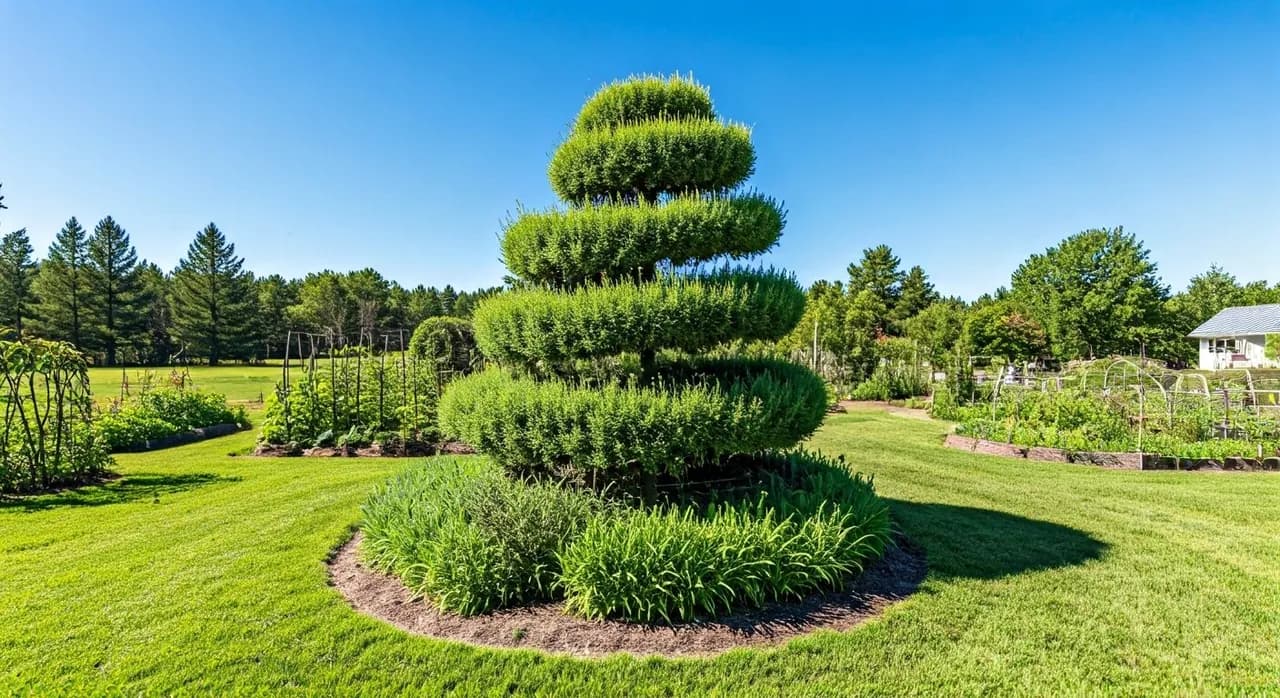
Key takeaways
- Herb spirals create four distinct microclimates (hot/dry, temperate, cool/moist, and wet) within a small footprint.
- The vertical, spiral design, often 3 feet high, adds sloped planting surface and lets one small footprint hold herbs with very different sun and water needs.
- Stone and brick in the walls store daytime heat and release it overnight, which takes the edge off spring and fall cold at the top of the spiral.
- Matching specific herb needs to the spiral’s microclimates ensures optimal growth and a diverse, productive harvest.
Quick answer: An herb spiral is a three-dimensional permaculture structure that maximizes planting space and creates diverse microclimates (hot/dry, temperate, cool/moist, wet) within a small footprint, allowing for a wide variety of herbs to thrive. This design packs several distinct growing conditions into a footprint you can reach across from the outside.
Across the United States, from the arid landscapes of Arizona to the humid plains of Georgia, gardeners are constantly seeking ways to maximize their growing space. A typical backyard in a USDA zone 6 region might offer a limited footprint, perhaps 1,500 square feet, for cultivation. An herb spiral offers a clever solution, creating a diverse planting area that can host over 20 different plant species in a compact footprint, often as small as 30 square feet.
This permaculture design principle, rooted in efficient resource use, allows a single structure to provide a range of growing conditions (wet, dry, sunny, and shady) all within a few feet. By understanding how the spiral shape interacts with sun exposure and water flow, growers can cultivate a broader array of herbs than a flat bed of the same size would permit.
understanding the herb spiral design
In a typical suburban yard in a USDA zone 7 climate, a flat herb bed might only offer uniform conditions, limiting the types of plants that thrive. An herb spiral, however, is a three-dimensional structure, usually a circular or oval mound that spirals upwards, often reaching 3 feet in height at its peak. This design, inspired by natural forms, creates a gradient of microclimates from its base to its apex, offering varied conditions for a diverse range of plants. A well-built spiral with a base diameter of 6 to 8 feet gives you roughly 30 square feet of planting surface, split across several distinct growing conditions rather than one uniform bed.
The core idea is to mimic the varied conditions found in natural landscapes, where slight changes in elevation or orientation can lead to distinct growing environments. For instance, the top of the spiral will be drier and sunnier, while the base will retain more moisture and offer some shade. This allows for the cultivation of herbs with vastly different needs, from sun-loving rosemary to moisture-loving mint, all within a small area. A single spiral can carry enough culinary herbs to cover regular household cooking, which is where most of its payback shows up.
the benefits of a spiral structure
The advantages extend beyond just space efficiency. The vertical design improves drainage, preventing root rot for many herbs, and makes harvesting easier on the back and knees. It also concentrates nutrients in a smaller volume of soil, which can be enriched with organic matter like composted wood chips or aged manure. Concentrating good soil into a small volume gives herbs a better rooting environment than the same effort spread thinly across a large bed. Furthermore, the thermal mass of the stones or bricks used in construction can absorb solar energy during the day, releasing it slowly at night, which can extend the growing season by several weeks in cooler regions, such as USDA zone 5.
- Optimized space: A 6-foot diameter spiral turns one small footprint into several different growing conditions.
- Diverse microclimates: Creates 4 distinct growing zones for varied plant needs.
- Improved drainage: Vertical design prevents waterlogging, essential for many Mediterranean herbs.
- Easier access: Elevated beds reduce bending and kneeling during planting and harvesting.
- Enhanced aesthetics: A visually appealing garden feature, often becoming a focal point.
designing for distinct microclimates
The genius of the herb spiral lies in its ability to create four primary microclimates, each suited to different plant requirements. Consider a spiral built in a USDA zone 8 garden in the Pacific Northwest. The top, south-facing side of the spiral receives the most direct sunlight, often for 8 to 10 hours a day, and dries out quickly. This is your hot, dry zone. As you move down the spiral, the north-facing side will naturally be shadier and cooler, retaining moisture longer — the cool, moist zone. The base of the spiral, especially if a small pond or bog area is incorporated, becomes the wet zone, while the middle sections offer a temperate, well-drained zone.
Orientation matters. In the Northern Hemisphere, placing the highest point of the spiral towards the south will maximize sun exposure for the plants at the top. The materials used for construction also play a role; dark stones like basalt or slate absorb more solar radiation, increasing the temperature of the surrounding soil by several degrees Fahrenheit. This thermal mass can be particularly beneficial in cooler climates, such as those in USDA zone 4, extending the growing season for heat-loving herbs by up to 3 weeks.
understanding water and sun gradients
Water distribution follows the same gradient. Gravity naturally pulls water downwards, so the top of the spiral will be the driest, while the base will be the wettest. You can improve this by creating a small depression or a mini-pond at the very bottom, providing a habitat for water-loving plants like mint or watercress. The soil composition should also vary: a sandy, well-draining mix at the top for drought-tolerant herbs, and a richer, more moisture-retentive loam at the base. Adding 30% perlite to the top soil mix can improve drainage significantly. Regularly checking soil moisture with a tool like a Soil Moisture Meter can help you fine-tune watering for each zone.
- Top (South-facing): Hottest, driest, full sun for 8+ hours. Ideal for Mediterranean herbs.
- Middle (East/West-facing): Temperate, well-drained, 6-8 hours of sun. Suitable for general culinary herbs.
- Bottom (North-facing): Cooler, shadier, retains more moisture. Good for herbs needing partial shade.
- Base/Pond: Wettest, potentially boggy. Perfect for water-loving plants.
building your herb spiral
Constructing an herb spiral is a rewarding project that can be completed over a weekend with a few basic tools and materials. For a typical 6-foot diameter spiral, you’ll need about 1.5 to 2 cubic yards of building material such as bricks, stones, or reclaimed concrete pieces. In regions like the Midwest, where limestone is abundant, this material can often be sourced affordably. Begin by marking out the base circle, usually 6 to 8 feet in diameter, and then lay down a layer of cardboard or newspaper to suppress weeds, extending 12 inches beyond your marked perimeter. This initial weed barrier smothers most of the turf and weed seed already on the site.
Next, begin stacking your chosen material in a spiral pattern, gradually building upwards. The walls should be slightly sloped inwards for stability, with a base width of at least 10 inches tapering to 6 inches at the top. As you build, fill the interior with layers of coarse material like gravel or broken pottery at the bottom for drainage, followed by a mix of soil, compost, and organic matter. A good starting soil mix might be 50% topsoil, 30% compost, and 20% sand or perlite to ensure good drainage while retaining nutrients. For a 3-foot high spiral, you might use 1 to 1.5 cubic yards of this soil mix.
material selection and layering
Choosing your construction materials is a balance of aesthetics, cost, and function. Natural stones offer excellent thermal mass and a rustic look, while reclaimed bricks can be a cost-effective option, often available cheaply, sometimes free, from local demolition sites. Avoid using treated lumber, as chemicals can leach into the soil. As you fill the spiral, pay attention to the soil composition for each microclimate. The top 12 inches of the spiral should have the most well-draining, sandier soil for drought-tolerant plants, while the lower sections can have richer, more moisture-retentive soil. Incorporating a small pond liner, about 18 inches in diameter and 12 inches deep, at the very base can create a dedicated wet zone for aquatic herbs. Keep it planted and topped up rather than left stagnant, or tip and refill it weekly — an undisturbed open basin this size breeds mosquitoes. Adding this wet zone lets you grow bog and marginal plants that none of the other zones can support.
- Site preparation: Clear a 10-foot diameter area to ensure full sun exposure for at least 6 hours.
- Base outline: Mark a 6-8 foot diameter circle and lay down a weed barrier.
- Wall construction: Begin stacking stones or bricks in a spiral, building upwards to 3 feet.
- Internal filling: Layer coarse drainage material, then a rich soil mix, varying for microclimates.
- Optional pond: Install a small pond liner at the base for a wet zone.
planting for success in each zone
Once your herb spiral is built and the soil has settled for a few days, it’s time to plant. Match each herb's needs to the microclimate you've created. For instance, in the hot, dry zone at the top and south-facing side of the spiral, herbs native to Mediterranean climates thrive. Think of rosemary, thyme, oregano, and lavender, which prefer full sun and well-drained, even sandy, soil. These plants often require less frequent watering, perhaps once every 7 to 10 days during dry spells in a USDA zone 9 summer. You can find more information on specific plant needs in our Permaculture Garden Plan.
Moving down to the temperate, well-drained zone in the middle sections, you can plant common culinary herbs like parsley, basil, chives, and dill. These prefer consistent moisture but still need good drainage and 6 to 8 hours of sunlight daily. In a temperate climate like USDA zone 6, these herbs might need watering every 3 to 5 days, depending on rainfall. Consider grouping herbs that flower here, since the flowers pull in hoverflies and parasitic wasps that work on aphids elsewhere in the garden.
selecting herbs for varied conditions
The cool, moist zone on the north-facing side and lower sections is perfect for herbs that appreciate some afternoon shade and more consistent moisture. Cilantro, mint (in a contained pot to prevent spreading), lemon balm, and calendula often do well here. These herbs can suffer from scorching in full, intense sun, especially in regions with hot summers, such as those in USDA zone 8. Finally, if you’ve incorporated a small pond or bog at the very base, the wet zone is ideal for watercress, mint varieties, or even some edible aquatic plants. Remember that mint can be aggressive; planting it in a pot submerged in the wet zone can prevent it from taking over the entire spiral, keeping its growth contained to a 12-inch diameter area.
- Top (Hot/Dry): Rosemary, Thyme, Oregano, Lavender, Sage, Marjoram.
- Middle (Temperate/Well-drained): Parsley, Basil, Chives, Dill, Tarragon, Chamomile.
- Bottom (Cool/Moist): Cilantro, Lemon Balm, Mint (in pot), Calendula, Sorrel.
- Base (Wet/Boggy): Watercress, some mint varieties (in pot).
maintenance and harvesting for longevity
Maintaining an herb spiral is generally straightforward, requiring less effort than a traditional flat garden bed once established. Regular watering is essential, though the frequency will vary significantly across the different microclimates. The top, dry zone might only need watering every 7 to 10 days in a hot summer in USDA zone 7, while the bottom, moist zone could benefit from water every 2 to 3 days. Monitoring soil moisture with a Soil Moisture Meter helps, since the top and the base of a spiral dry out at very different rates.
Fertilization should be minimal for most herbs, as they often thrive in less rich soil. However, a light application of a balanced organic fertilizer, such as a fermented soybean meal (like Fermented Soybean Meal Organic Fertilizer (500 g)), once or twice during the growing season can boost vigor. Apply about 1 tablespoon per square foot around the base of plants in the temperate and moist zones. Pruning is essential for encouraging bushier growth and preventing herbs from flowering prematurely, which can diminish flavor. Pinch back basil every 2 weeks, for example, to keep it vegetative and stretch the harvest well past the point where an unpinched plant would flower and stall.
extending the harvest and winterizing
Harvesting herbs regularly encourages new growth. For most leafy herbs, aim to harvest about one-third of the plant at a time. Many herbs, especially those in the temperate and moist zones, can be harvested multiple times throughout the growing season, from spring through fall in a USDA zone 6 climate. For winter protection in colder regions, mound a layer of straw or leaves 6 to 12 inches deep around your perennials, keeping it off the crowns themselves. Woody Mediterranean herbs like thyme, sage and oregano rot if their crowns sit buried and damp all winter; they want insulation over the root zone and open air at the center of the plant. This insulation buffers roots against the freeze-thaw cycles that heave plants out of the ground, which is often the difference between survival and loss for borderline-hardy perennials. You can also dry or dehydrate your herbs for long-term storage, a process detailed in our article on Dehydrating food.
- Watering: Adjust frequency based on microclimate; dry zone every 7-10 days, wet zone every 2-3 days.
- Pruning: Pinch back herbs regularly to promote bushier growth and delay flowering.
- Fertilizing: Apply a light organic fertilizer once or twice per season, especially for heavy feeders.
- Weeding: Remove weeds promptly to prevent competition for nutrients and water.
- Winter protection: In colder USDA zones (4-6), mound 6-12 inches of mulch around perennials rather than over their crowns.
Microclimate conditions and suitable herbs in a spiral
Microclimate | Sun Exposure | Moisture Level | Example Herbs |
|---|---|---|---|
Hot, Dry (Top) | 8+ hours | Low | Rosemary, Thyme, Oregano |
Temperate, Well-drained (Middle) | 6-8 hours | Medium | Basil, Parsley, Chives |
Cool, Moist (Bottom) | 4-6 hours | High | Cilantro, Lemon Balm, Mint |
Wet (Base) | Boggy | Very High | Watercress |
Space Saver: A 6-foot diameter herb spiral can provide 30 square feet of planting space, supporting over 20 different herb varieties.
Thermal Mass: Stones in a spiral absorb solar energy through the day and release it overnight, softening late frosts at the top of the structure.
Frequently asked questions
How much space does an herb spiral require?
A typical herb spiral needs a base diameter of 6 to 8 feet, creating approximately 30 square feet of planting area. This compact design can host over 20 different herb species.
What materials are best for building an herb spiral?
Natural stones, bricks, or reclaimed concrete are excellent choices for building the walls, providing thermal mass and stability. You’ll need about 1.5 to 2 cubic yards of material for a standard 3-foot high spiral.
How do I ensure proper drainage in an herb spiral?
Incorporate a layer of gravel or broken pottery at the bottom of the spiral, and use a soil mix with 20% to 30% sand or perlite, especially in the upper sections, to promote good drainage.
Can I grow all types of herbs in one spiral?
Yes, the herb spiral’s design creates distinct microclimates—hot/dry, temperate, cool/moist, and wet—allowing you to grow a wide variety of herbs, from sun-loving rosemary to moisture-loving mint.
How often should I water an herb spiral?
Watering frequency varies by zone: the top, dry zone might need water every 7-10 days, while the bottom, wet zone could require it every 2-3 days. Monitor soil moisture closely.
How does an herb spiral extend the growing season?
The thermal mass of the construction materials absorbs solar heat during the day, releasing it at night. That stored heat softens late frosts at the top of the structure, which is where it matters most in cooler USDA zones like 5.
References
- Herb lore (1936). Herb lore.