Most cover-crop articles hand you the same shortlist no matter where you garden, then leave you to discover the hard way that your “reliable” winter legume melts at the first frost, or that the species everyone recommends simply will not break dormancy in your short season. In a no-dig bed the stakes are higher, because you are not turning the residue under. The cover crop has to either be killed cleanly on the surface or live on as a permanent living mulch between your crops. Get the species wrong for your climate and you inherit either bare soil or a weed.
This guide sorts nitrogen-fixing legumes the way they actually behave: by verified cold-hardiness. We anchor each pick to its USDA zone, its UK RHS rating (H1 tender to H7 very hardy) and its broad Australian climate band, so the same logic works whether you garden in Ohio, Oxfordshire or Otago. The single most important variable is frost: it decides whether a legume overwinters as a living mulch, dies obligingly to leave a self-mulching residue, or has to be squeezed into a frost-free window.
Why hardiness, not the calendar, drives the choice

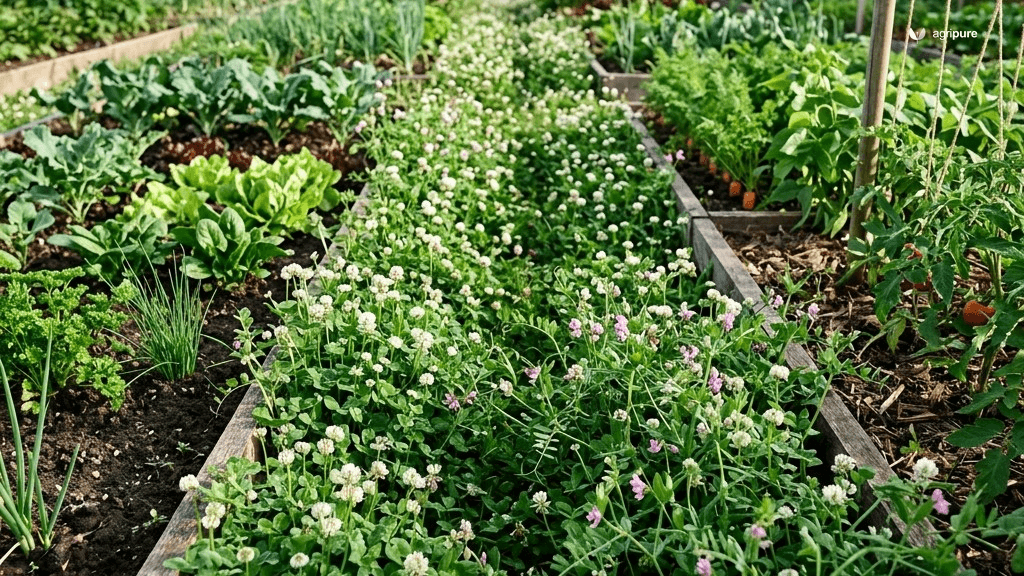
Crimson clover used as a living cover crop to fix nitrogen and protect soil biology.
A legume’s job in a no-dig system is to fix atmospheric nitrogen through its root nodules and then either keep covering the soil or hand that nitrogen to the next crop as it breaks down. Both outcomes hinge on frost behaviour:
- Winter-hardy legumes (USDA 3-9, RHS H6-H7) survive the cold and are deliberately terminated in spring. You crimp, mow or tarp them at flowering and plant straight into the residue.
- Frost-killed legumes are sown into warm soil, build biomass fast, and are killed for free by the first hard frost, leaving a surface mulch over winter.
- Tender perennials and tropicals (USDA 9-12, RHS H1-H2) never see frost in their range and are managed by cutting, not killing.
Match the mechanism to your zone and termination becomes almost automatic. Mismatch it and you spend the season fighting the plant.
Cold and temperate zones (USDA 3-7 / RHS H6-H7)
This is winter-hardy legume country, and the workhorses are vetch and the perennial clovers.
Hairy vetch (Vicia villosa): USDA 4-9, RHS H6
Hairy vetch is the most winter-hardy of the commercial vetches and the default temperate-winter legume. This sprawling climber is rated for roughly USDA zones 3-9, though survival depends heavily on drainage and snow cover: plants on poorly drained ground winter-kill far more readily than those on free-draining soil, and it struggles to overwinter in the colder northern Midwest. Sow in late summer or early autumn so it establishes before dormancy, which in a mid-Atlantic climate runs roughly mid-December to mid-March.
Termination: the timing is unforgiving. Vetch is easiest to kill once it flowers, but if you wait too long it sets hard seed and becomes a weed. Crimp or flail-mow at full bloom in spring; done right, the surface mat mineralises nitrogen into the following summer crop and suppresses weeds. Done early, before full flower, it simply regrows.
White and red clover: USDA 3-9/10, RHS H6-H7
For a true living mulch rather than a kill-and-plant crop, the perennial clovers are unbeatable. White clover (Trifolium repens, RHS H7) is hardy across roughly USDA 3-10 and is the classic choice for the permanent strip between rows of vegetables, fruit bushes or trees: a low, persistent, shade-tolerant nitrogen producer with a dense shallow root mass that holds soil and shrugs off foot traffic once established. Red clover (Trifolium pratense, RHS H6) is hardy across roughly USDA zones 3-8 and is a more upright short-lived perennial, often grown as a biennial, that builds a heavier slug of nitrogen over a single overwintered season.
Termination: white clover usually is not terminated at all; you mow it to keep it below your crops. When you do reset a bed, crimp or smother it under cardboard. Both species are managed by mowing rather than a single kill, which is exactly what a no-dig living mulch wants.
Alfalfa and black medick for the long game
Alfalfa (Medicago sativa, RHS H7, roughly USDA 3-11) is more of a deep-rooted perennial soil-builder than a bed mulch, but it is the most cold-tolerant of the lot and excellent on arid-zone and mediterranean ground where its taproot mines moisture and nutrients. For a lower-growing self-seeding option, black medick (Medicago lupulina, also H7) tucks neatly into paths and bed edges.
Legume | USDA | RHS | Role in no-dig | How it ends |
|---|---|---|---|---|
Hairy vetch | 4-9 | H6 | Overwinter, crimp in spring | Mow/crimp at full flower |
White clover | 3-10 | H7 | Permanent living mulch | Mowed, not killed |
Red clover | 4-8 | H6 | Overwinter N builder | Crimp before seed set |
Alfalfa | 3-11 | H7 | Deep-rooted perennial | Repeated cutting |
Warm-temperate and subtropical zones (USDA 8-9 / RHS H2-H3)
Where winters are mild but summers are long and hot, the strategy flips toward fast warm-season legumes that you sow in spring or summer and either cut or let frost finish.
Berseem clover (Trifolium alexandrinum): USDA 8-11, RHS H3
Berseem clover, the Egyptian clover cultivated in the Nile Valley for millennia, is the quick-growing warm-season counterpart to the temperate clovers. It is frost-sensitive and should be sown only after frost risk has passed, but it returns the favour with prodigious nitrogen: as a green manure it can supply on the order of 300-400 kg N per hectare to a following crop. In cooler zones (3-5) it works as a summer nitrogen-fixer in the frost-free window; in zones 6-10 as a warm-season cover. Newer cold-tolerant selections push its frost tolerance well below freezing, but the species default is tender.
Termination: in its warm range, mow before it sets seed; toward the cool edge of its range, the first frost terminates it and leaves the residue on the surface.
Sunn hemp (Crotalaria juncea): USDA 10-12, RHS H1c
Sunn hemp is the heavyweight of summer cover cropping. Sown into warm soil it can produce over 5,000 lb of biomass and around 100-120 lb of nitrogen per acre in just 60-90 days, outproducing crimson clover and hairy vetch by a wide margin, and it actively suppresses root-knot nematodes. It needs eight to twelve frost-free weeks; it tolerates only the lightest frost (down to about -2 C) before growth and nitrogen fixation collapse.
Termination: this is where sunn hemp shines in no-dig. Roll or crimp it at flowering to lay down a thick surface sheet-mulch; trials show vegetable crops planted into that mulch matching conventional yields. In zones 8-9 a frost will also kill it, but crimping at flower gives you the most usable residue before it turns woody.
Tropical and frost-free zones (USDA 9-12 / RHS H1-H2)
Where frost never arrives, you lose the free kill switch, so these legumes are managed entirely by cutting, slashing or smothering. The upside is year-round growth.
Cowpea (Vigna unguiculata): USDA 9-12, RHS H2
Cowpea is the backbone legume of tropical and subtropical farming systems and an outstanding fast living mulch. Field-grown varieties fix substantial nitrogen, with measured averages around 74-116 kg N per hectare depending on cultivar and rhizobium strain. Its spreading habit smothers weeds quickly, protects soil from erosion, and adds nutrients as it decomposes; it also tolerates the heat and drought of arid and warm-temperate margins.
Termination: slash or mow before pods harden and leave the residue as a mulch, or cut-and-come-again as a semi-permanent groundcover between rows. Inoculating seed with the right Bradyrhizobium markedly raises its nitrogen contribution.
Lablab (Lablab purpureus): USDA 10-11, RHS H1c
Lablab, or hyacinth bean, is a vigorous twining climber for the true tropics and subtropics. It is more drought-hardy and longer-lived than cowpea, scrambling over trellises, fences or rough ground to deliver shade, nitrogen and edible pods at once, which makes it a favourite multi-functional legume in food-forest understoreys.
Termination: as a non-frost climber, manage it by cutting back hard. Slash it to the ground to release a mulch flush, or keep it trimmed as a living screen.
More tropical options
For permanent ground in zones 10-12, consider centro (Centrosema pubescens) and siratro (Macroptilium atropurpureum) as creeping perennial cover legumes, and velvet bean (Mucuna pruriens) where you want a heavy weed-smothering annual smother crop. All are managed by slashing, never by frost.
Putting it together for your bed
Decide first whether you want a crop you kill (overwinter then crimp in temperate zones; sow-and-frost-kill in warm-temperate zones) or a living mulch you simply mow (white clover in the cold, cowpea or lablab in the heat). Then pick from the species verified for your zone rather than the generic shortlist. A no-dig bed rewards this precision: the right legume fixes nitrogen, builds organic matter and feeds soil biology without you ever lifting a spade.
Frequently asked questions
Can I grow hairy vetch as a living mulch I never kill?
Not reliably. Hairy vetch is bred to overwinter and then be terminated at flowering; left uncut it sets hard seed and turns weedy. For a true mow-only living mulch in temperate zones, perennial white clover is the better choice.
What legume should I use if I want frost to do the killing for me?
In warm-temperate and subtropical zones (USDA 8-9), sow a tender summer legume like berseem clover or sunn hemp into warm soil; the first hard frost terminates it and leaves a surface mulch. This only works where you actually get frost, so it is not an option in true tropical zones (USDA 10-12), where you must cut or slash instead.
How do I terminate cover crops without digging?
Roller-crimping at flowering is the no-dig standard: it crushes stems so the crop dies in place as a sheet mulch. Repeated mowing works for clovers, and tarping or cardboard smothers anything stubborn. Always terminate before viable seed sets to avoid volunteers.
Sources
- SARE, Managing Cover Crops Profitably – Hairy Vetch and White Clover profiles
- USDA NRCS Plant Guide – Hairy Vetch (Vicia villosa)
- USDA NRCS – Sunn Hemp: A Cover Crop for Southern Farming Systems
- Trifolium alexandrinum (berseem clover) – hardiness and nitrogen contribution
- Nitrogen-fixing traits in cowpea (Vigna unguiculata) accessions – PMC