Key takeaways
- Australian native stingless bees (Tetragonula and Austroplebeia) are gentle, social pollinators that cannot sting.
- They are native to warm subtropical, tropical, and warm coastal temperate regions of eastern and northern Australia.
- Colonies stay inside their hive below 18°C and require thermal shelter when winter temperatures dip below 10°C.
- Standard Original Australian Tetragonula Hive (OATH) boxes enable clean hive division and modest honey harvesting.
- A mature native beehive produces approximately 1 kg of prized, tangy sugarbag honey per year.
Quick answer: Keeping native stingless bees in Australia involves housing species like Tetragonula carbonaria or Austroplebeia australis in a standard OATH timber hive placed in morning sun and afternoon shade. These stingless social pollinators thrive in warm subtropical and coastal regions, generally requiring no feeding once established in good habitat, and providing pollination for fruit trees, macadamias, and veggies.
Australia is home to more than 1,700 described species of native bees, of which just eleven are social, stingless species. Belonging primarily to the genera Tetragonula (formerly Trigona) and Austroplebeia, these tiny black bees, measuring just 4 mm in length, live in complex, highly organized colonies containing thousands of workers and a single queen. Learning about native stingless bees in Australia offers gardeners a dependable pollinator that is safe around children, pets, and suburban backyards.
Unlike introduced European honeybees (Apis mellifera), native stingless bees possess a vestigial sting that cannot penetrate human skin. They defend their colony through sheer numbers, sealing hive crevices with antibacterial propolis and resin. Keeping a native hive on your property supports local biodiversity and improves fruit set on backyard citrus, mangoes, and vegetable patches.
Key Australian stingless bee species
While Australia has several stingless bee species, two dominate backyard beekeeping and pollination:
+---------------------+-----------------------+---------------------------------------+
| Bee Species         | Native Geographic Range| Brood Structure & Personality        |
+---------------------+-----------------------+---------------------------------------+
| Tetragonula         | Bega (far south coast | Distinct spiral brood disc; active    |
| carbonaria          | NSW) north coastal QLD| resin collector; resilient defensive  |
+---------------------+-----------------------+---------------------------------------+
| Tetragonula         | Central & North QLD,  | Patterned cluster brood; excellent    |
| hockingsi           | Northern Territory    | heat tolerance in tropical regions    |
+---------------------+-----------------------+---------------------------------------+
| Austroplebeia       | Inland QLD, Northern  | Loose cluster brood; docile, slower   |
| australis           | NSW, parts of NT      | to build; excellent dry heat tolerance|
+---------------------+-----------------------+---------------------------------------+
Tetragonula carbonaria (the carbonaria bee)
This is the most common species for home beekeeping in New South Wales and southeastern Queensland. Inside the hive, T. carbonaria constructs an architectural spiral brood comb out of cerumen (a blend of beeswax and tree resin). They are vigorous foragers, operating from early morning until dusk whenever temperatures exceed 18°C.
Austroplebeia australis (the australis bee)
Distinguished by fine cream-colored markings on the side of their thorax, these bees are calm and build cluster-style brood nests instead of flat spirals. They handle arid inland heat well and seal their hive entrance with a delicate lace-like resin curtain at night.
For general comparison with European beekeeping equipment, see our overview on beekeeping for beginners and natural beekeeping getting started.
Climate requirements and hive positioning
Because native stingless bees evolved in warm tropical and subtropical rainforests, managing their thermal environment is the single most important factor in their survival.
+-----------------------------------------------------------------------------------+
|  [Temperature Thresholds for Native Stingless Bees]                               |
|                                                                                   |
|  - Above 35°C  ===> Heat Stress: Wax pots soften; hive needs deep afternoon shade |
| - 18°C to 35°C===> Active Foraging: Optimum pollination and nectar collection     |
| - 14°C to 18°C===> Sluggish Activity: Minimal flight; internal hive maintenance   |
|  - Below 10°C  ===> Dormancy / Risk: Colonies cannot generate heat; need shelter  |
+-----------------------------------------------------------------------------------+
Geographic distribution limits
Native stingless bees naturally occur from the Bega Valley on the south coast of New South Wales, northward through coastal Queensland, across the Top End of the Northern Territory, and into the Kimberley in Western Australia. They do not survive unaided in cold-winter regions such as Melbourne, Adelaide, Tasmania and the alpine tablelands, and keeping hives outside a species' natural range is discouraged: colonies dwindle, and moving T. hockingsi and T. carbonaria into each other's territory can trigger lethal fighting swarms where the two meet. Check your state's rules before buying or moving a hive: taking a nest from the bush needs a permit in Queensland and New South Wales, and interstate movement is restricted.
Optimal hive placement in the garden
- Morning sun, afternoon shade: Position the hive box facing north or northeast. Morning sun warms the hive entrance, encouraging bees to begin foraging early. Afternoon shade, provided by a deciduous tree or shade awning, protects the box from scorching western summer sun.
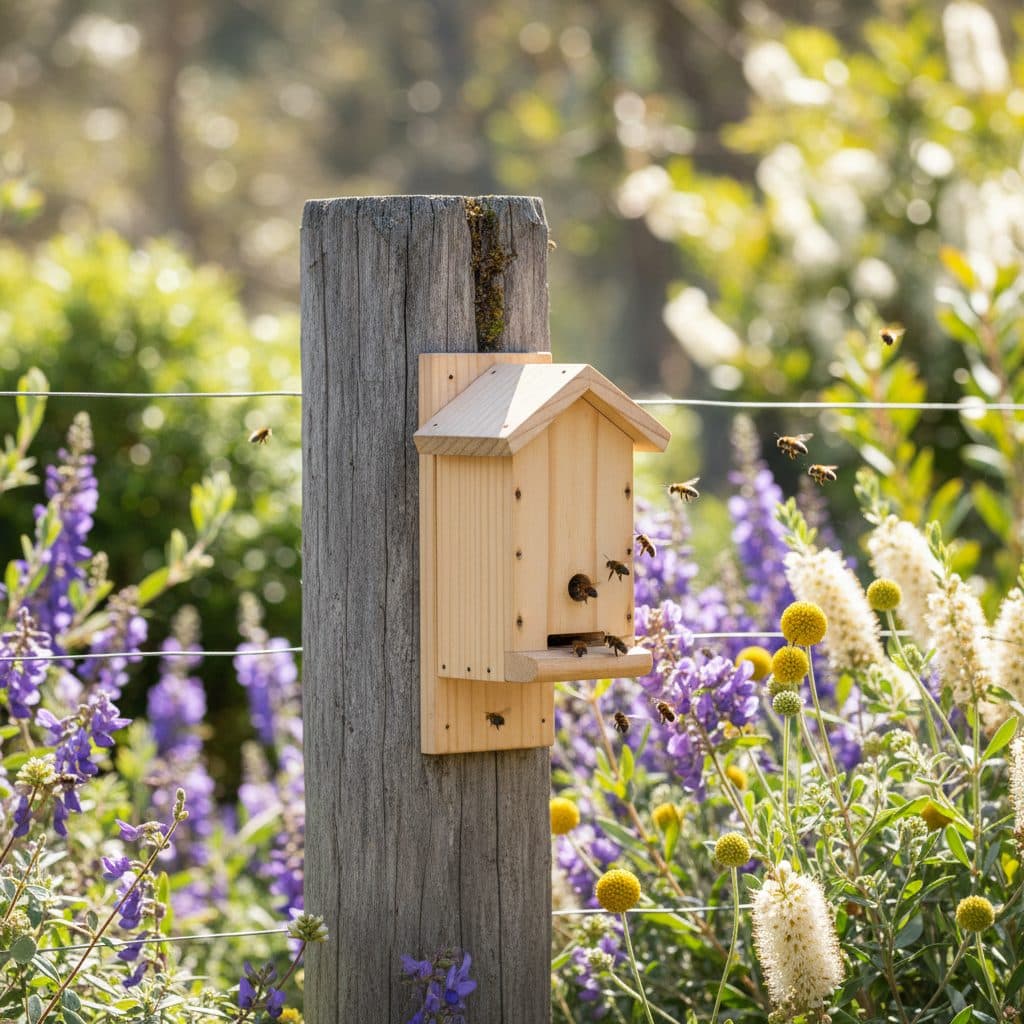
- Elevation and security: Mount the hive on a sturdy post or shelf 1 to 1.5 metres above the ground. This keeps the entrance clear of tall weeds and out of reach of cane toads.
- Shelter from driving rain: Fit an insulated metal or marine-ply over-roof with an overhang to prevent rain from driving into the entry hole.
Hive construction: the OATH standard box
Modern Australian native beekeeping relies on the OATH (Original Australian Trigona Hive, coined before the 2013 move of the Australian species to Tetragonula) design developed by Tim Heard and native bee pioneers.
+-----------------------------------------------------------------------------------+
|  [OATH Hive Box Structure]                                                        |
|                                                                                   |
|  +--------------------+                                                           |
|  |  HONEY SUPER (Top) | ===> Removable 80 mm depth box for honey harvesting       |
|  +====================+ ===> Separator Board with small bee access holes          |
|  |  TOP BROOD (Middle)| ===> Upper half of brood chamber (Splits here)            |
|  +--------------------+                                                           |
|  |  LOWER BROOD (Base)| ===> Lower brood chamber + landing board & entrance hole  |
|  +--------------------+                                                           |
+-----------------------------------------------------------------------------------+
Constructed from 25 mm to 35 mm thick untreated hoop pine or cypress timber, the OATH box provides necessary thermal insulation. The hive is divided horizontally into two brood halves and an optional top honey super separated by a splitter board.
Colony division and hive splitting
When a native beehive becomes strong and completely fills its box (typically after 12 to 18 months in the subtropics, or two to three years in cooler coastal districts), the colony can be split to create two separate hives.
The splitting procedure:
- Timing: Split hives only during warm spring or early summer months (September to December in temperate zones, through February in the subtropics) when abundant nectar and pollen are available. The temperature must be above 22°C on the day of the split.
- Opening the box: Cut through the exterior tape and gently lever the top and bottom brood boxes apart with a hive tool. The spiral brood comb will cleanly split in half, leaving pupae and food stores in both sections.
- Mating boxes: Pair each half with an empty matching OATH box section, tape the seams with weather-proof duct tape, and close the units.
- Queen rearing: The half containing the original queen will continue seamlessly. The queenless half will identify an unmated virgin queen or advance a young queen cell to lead the new colony.
Small hive beetle (Aethina tumida) is the main risk to a split hive. Split only strong, populous colonies, work quickly, tape and close the boxes the same day, keep the entrance small while the halves rebuild, and check both boxes for beetle activity and slime over the following weeks. Phorid flies attack disturbed hives the same way.
For orchard integration, pair native bee hives with your seasonal orchard care; see when to prune fruit trees australia and foundational pruning techniques in how to prune fruit trees.
Harvesting sugarbag honey
The honey produced by Australian native stingless bees, traditionally called sugarbag by Indigenous Australians, is a traditional food and prized harvest.
- Unique composition & storage: Sugarbag honey is runnier than European honey, with high natural moisture, high acidity (low pH), and a distinct, complex sweet-tangy citrus flavor. Because of that water content, sugarbag honey ferments if left on the shelf: refrigerate or freeze it as soon as it is harvested. Like all raw honey, sugarbag should not be given to infants under 12 months because of the risk of infant botulism.
- Harvest realities: Unlike European honeybees that produce 20 to 30 kg of honey per hive annually, a single mature native stingless beehive yields only 500 grams to 1 kg of honey per year.
- Extraction method: Honey is harvested exclusively from the top honey super using clean food-grade syringes or gentle gravity draining, so the lower brood nest and winter survival stores remain undisturbed.
Garden pollination benefits
Native stingless bees are valuable pollinators for Australian vegetable patches and home orchards:
- Not buzz pollinators: Unlike blue-banded bees (Amegilla spp.), stingless bees cannot sonicate, so they do little for tomatoes, capsicums and eggplants, whose pollen is locked in poricidal anthers. They excel instead on small open flowers: macadamia, lychee, mango, citrus, brassicas and cucurbits.
- High-value fruit crops: Tetragonula carbonaria is a proven macadamia pollinator and is increasingly deployed commercially alongside honey bees. It also contributes to fruit set on mangoes, lychees, avocados and watermelons.
- Gentle suburban companions: Because they cannot sting, you can place a hive right beside a patio table, vegetable garden path, or children's play area safely, though a knocked hive will produce biting, crawling defenders, so keep it clear of mower, ball and doorway traffic.