Key takeaways
- Plant dormant bare-rooted deciduous fruit trees during winter dormancy, from June to August (ideally July to August before bud swell) across temperate and cool Australian climate regions.
- Plant evergreen subtropical fruit trees like citrus, avocados, and mangoes in early-to-mid spring (September to November) once soil warms, or early autumn (March to April).
- In the wet-dry tropics and subtropics (Darwin, Cairns, Brisbane), plant container-grown evergreen and tropical fruit trees (citrus, mango, avocado) either at the start of the summer wet season (November to January) to utilize natural monsoonal rainfall, or in early autumn (March to April) once intense heat abates.
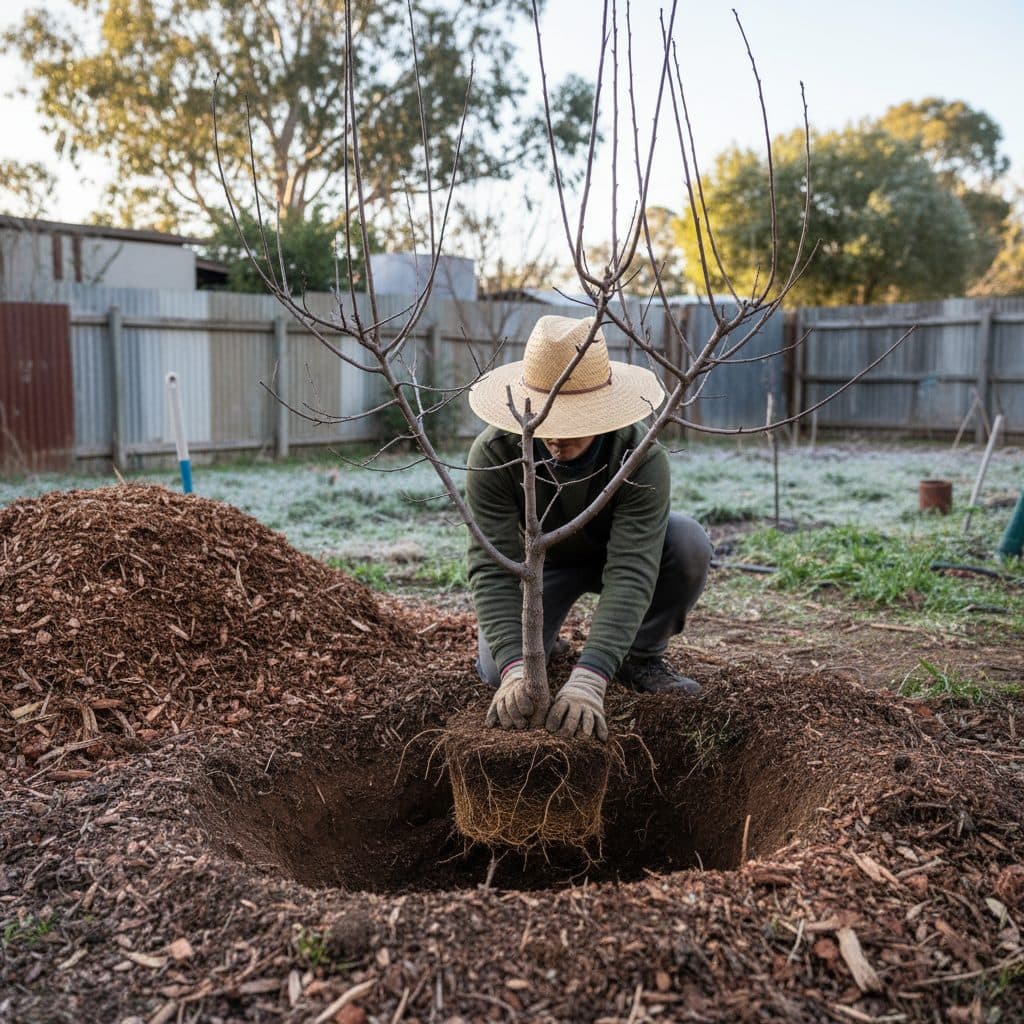
- Prune bare-rooted trees back by roughly one-third immediately after winter planting to balance the top branches with trimmed root systems.
- Backfill the planting hole with 100% native excavated soil; apply compost, aged manure, and organic mulch as a surface top-dressing around the drip line rather than mixing heavy amendments into the hole.
- Protect developing fruit crops from native wildlife like possums using licensed exclusion netting and physical trunk collars.
Quick answer: In Australia, the best time to plant deciduous fruit trees (apples, pears, peaches, plums) is mid-winter (June to August) when trees are dormant and sold bare-rooted. For evergreen and subtropical species (citrus, avocados, olives, mangoes), plant in spring (September to November) or early autumn (March to April) when the soil is warm and frost risk has passed.
Planting fruit trees is one of the most productive additions you can make to an Australian home orchard or backyard veggie patch. A carefully chosen collection of fruit trees provides fresh, seasonal harvests across the entire year, from summer stone fruit to winter mandarins.
However, understanding when to plant fruit trees australia depends heavily on whether you are planting dormant bare-rooted stock or potted evergreen species, as well as your local Australian climate region. Because Australia spans from cold alpine valleys to tropical northern coasts, synchronizing your planting with Southern Hemisphere seasonal rhythms ensures strong root establishment before summer heat waves arrive.
+-------------------------------------------------------------+
|              AUSTRALIAN FRUIT TREE PLANTING CALENDAR        |
|                                                             |
|   SEASON             TREE TYPE               CLIMATES       |
|   ------             ---------               --------       |
|   Winter (Jun-Aug)   Bare-Root Deciduous     Cool, Temperate|
|                      (Stone fruit, Pome)     Mediterranean  |
|                                                             |
|   Spring (Sep-Nov)   Evergreen Subtropical   All Climates   |
|                      (Citrus, Avocado, Fig)  Warm Temperate |
|                                                             |
|   Wet Season         Tropical Species        Tropical,      |
|   (Nov-Jan)          (Mango, Papaya, Guava)  Subtropical    |
|                                                             |
|   Autumn (Mar-May)   Potted Deciduous/Citrus Temperate, Arid|
+-------------------------------------------------------------+
Bare-root vs potted fruit trees: seasonal windows
Australian nurseries supply fruit trees in two primary formats, each requiring a distinct planting schedule.
+-------------------------------------------------------------+
|                  BARE-ROOT VS POTTED TREES                  |
|                                                             |
|   BARE-ROOTED FRUIT TREES (Winter Only: June to August):    |
|   - Field-grown trees dug up during winter dormancy         |
|   - Roots packed in moist sawdust or damp coir              |
|   - Economical choice; rapid root establishment in soil     |
|   - Examples: Apples, Pears, Peaches, Nectarines, Plums     |
|                                                             |
|   POTTED / CONTAINER TREES (Year-Round, Best in Spring):    |
|   - Grown in potting mix with established root balls        |
|   - Plant in spring (September-November) or autumn (March)  |
|   - Avoid planting during extreme midsummer heat            |
|   - Examples: Lemons, Limes, Oranges, Avocados, Olives      |
+-------------------------------------------------------------+
Winter bare-root planting (June to August)
Deciduous fruit trees drop their leaves and enter deep dormancy as temperatures drop in late autumn. Between June and August, specialized nurseries dig these dormant trees from the field and sell them with bare root systems. Bare-root trees are generally substantially cheaper than potted specimens of equivalent age and adapt quickly to native soil without suffering from root circling or container shock.
Planting bare-root trees in mid-winter offers major benefits: the trees suffer zero transplant shock because they are asleep, the root system is easy to inspect and prune, and the tree establishes a network of fine feeder roots into the surrounding soil weeks before spring bud burst.
Spring and autumn potted planting
Evergreen fruit trees (such as citrus, avocados, olives, and feijoas) never enter full winter dormancy. Planting them into cold, waterlogged winter soil can cause root rot. Instead, plant potted evergreens in early spring (September to October) once the soil temperature rises above 15°C, or in early autumn (March to April) while the ground retains summer warmth.
To compare comprehensive citrus management throughout the year, see our detailed guide on growing citrus in Australia.
Timing by Australian climate region
Australia's diverse regional climates require tailored planting calendars to match local rainfall and temperature patterns.
Australian Climate Region | Representative Regions | Best Deciduous Window | Best Evergreen / Subtropical Window |
|---|---|---|---|
Cool & Cold Temperate | Tasmania, Ballarat, Orange, Canberra | July to August (Winter) | October to November (Late Spring) |
Temperate & Mediterranean | Melbourne, Adelaide, Sydney, Perth | June to July (Mid-Winter) | September to October (Spring) |
Subtropical | Brisbane, Northern NSW, Sunshine Coast | June to July (Low-Chill Only) | August to October or March to April |
Tropical | Cairns, Darwin, Broome, Townsville | Not suitable for temperate fruit | November to January (Start of Wet Season) |
Arid & Semi-Arid | Alice Springs, Dubbo, Riverland | June to July (Winter) | March to May (Autumn avoids summer heat) |
Cool and temperate regions
In southern Australia, cool winter temperatures deliver the necessary "chill hours" (cumulative hours between 0°C and 7°C) required for deciduous trees like cherries, European plums, and heritage apples to set fruit. Plant bare-root stock in July and August so roots settle before spring blossoms open in September.
Subtropical and tropical regions
In coastal Queensland and northern New South Wales, winter is mild and relatively dry. Choose low-chill cultivars (such as 'Flordaprince' peach, 'Sunwright' nectarine, or 'Gulf Ruby' plum requiring 150 to 300 chill hours) in coastal NSW and Queensland; standard temperate varieties require 600 to 1,000+ winter chill hours and will fail to fruit reliably in warm climates.
For tropical species like mangoes, bananas, and papayas, wait until the first monsoon rains arrive in November or December to provide natural humidity and deep soil moisture.
To plan your seasonal vegetable and orchard integration, explore our recommendations for what to plant in spring in Australia.
Soil preparation and step-by-step planting guide
Proper planting technique ensures your young fruit tree anchors securely and develops a deep, drought-resilient root system.
+-------------------------------------------------------------+
|                 FRUIT TREE PLANTING CROSS-SECTION           |
|                                                             |
|   [ 7.5 cm Coarse Woodchip Mulch (Clear of Trunk) ]         |
|   ~~~~~~~~~~~~~~~   |
|   [ Graft Union: Sits 10 cm Above Soil Line ]  /\           |
|                                               /  \          |
|   ====[======================================]==== Soil Line|
|       |  Root Spread: Radiate outward        |              |
|       |  Hole Depth: Same depth as root ball |              |
|       |  Hole Width: Twice the root spread   |              |
|   ----+--------------------------------------+------------  |
|   [ 100% Native Soil Backfill; Top-Dress Compost on Surface]|
+-------------------------------------------------------------+
Step 1: Digging the hole correctly
Dig a hole twice as wide as the root spread, but no deeper than the root system itself. If you dig the hole too deep, the loosened soil beneath the tree will settle over time, causing the tree to sink and burying the graft union. In heavy Australian clay soils, avoid digging a smooth-sided "bucket" that traps stagnant water; rough up the sides and base of the hole with a garden fork to let roots penetrate outward.
Step 2: Preparing bare roots
Remove the tree from its sawdust packing and soak the roots in a bucket of water with a dash of liquid seaweed tonic for two to four hours before planting. Trim any broken, bruised, or circling roots cleanly with sharp bypass secateurs.
Step 3: Planting and backfilling
- Create a small mound of soil in the centre of the planting hole.
- Set the tree on the mound, spreading the roots evenly downward and outward in all directions.
- Ensure the graft union sits at least 10 cm above the finished ground level.
- Backfill with 100% native excavated soil (avoid mixing rich compost into the hole to prevent a 'bathtub' effect). Firm the soil gently with your boot to eliminate large air pockets, but avoid heavy compaction. Apply compost, aged manure, and mulch over the soil surface around the drip line.
For foundational orchard principles, review our step-by-step methodology in how to plant a fruit tree correctly.
Step 4: Watering and formative winter pruning
Build a raised earthen saucer around the perimeter of the root area to hold water. Fill the basin with 20 litres of water to settle the soil around fine roots.
For bare-rooted deciduous trees, perform an initial formative cut: prune the central leader or main structural branches back by approximately one-third. This balances the canopy with the trimmed root system and encourages low, strong branch scaffolding that makes future fruit harvesting easy without tall ladders.
Post-planting care: mulching, watering, and summer protection
Young fruit trees require attentive management during their first Australian summer.
+-------------------------------------------------------------+
|                FIRST-YEAR SUMMER SURVIVAL CHECKLIST         |
|                                                             |
|   1. Deep Weekly Soaking:                                   |
|   - 20 to 30 litres per tree once or twice weekly in summer |
|                                                             |
|   2. Mulch Blanket:                                         |
|   - 7.5 cm coarse arborist woodchips; 10 cm collar gap      |
|                                                             |
|   3. White Trunk Paint:                                     |
|   - 50/50 water and white interior water-based paint        |
|   - Shields young bark from blistering summer sunburn       |
|                                                             |
|   4. Wildlife Exclusion:                                    |
|   - Install trunk guards and licensed exclusion netting     |
+-------------------------------------------------------------+
Mulching and weed suppression
Apply a 7.5 cm layer of coarse organic mulch, such as arborist woodchips, pine bark, or pea straw, around the entire drip line. Keep the mulch pulled back 10 cm away from the wooden trunk to prevent collar rot. Mulching reduces soil evaporation by up to 70 percent and buffers root systems against intense summer heat.
Deep watering routines
Young trees have shallow root networks that dry out rapidly in 35°C+ summer heat. Provide a deep soaking of 20 to 30 litres of water once a week (or twice weekly during heatwaves) rather than frequent shallow sprinklings. For comprehensive watering strategies during hot dry spells, read our guide on deep watering fruit trees in drought.
To protect young foliage and ripening fruit from extreme heatwave scorch, explore techniques in protecting fruit trees in a heatwave.
Managing pests and protecting crops from native wildlife
Growing fruit in Australia means sharing the landscape with native wildlife and regional insect pests.
- Possum protection: Possums are protected native wildlife in all Australian states and territories. It is illegal to harm, trap without a licence, or relocate possums. Protect backyard trees by wrapping smooth sheet metal or plastic collars (60 cm wide) around tree trunks at a height of 1.5 metres to prevent climbing, and install sturdy exclusion netting over freestanding tree frames.
- Queensland fruit fly (Bactrocera tryoni): In eastern and northern Australia, fruit fly is a major biosecurity concern. Movement of untreated homegrown fruit across declared biosecurity regions is legally restricted. Check with your state Department of Primary Industries or Agriculture authority for regional movement rules. Protect ripening fruit organically using fine mesh exclusion bags (mesh size < 1 mm) placed over individual fruit clusters or entire trees immediately after petal fall.
- Grafting and propagation: To expand your orchard varieties over time, see our home guide to grafting fruit trees at home.