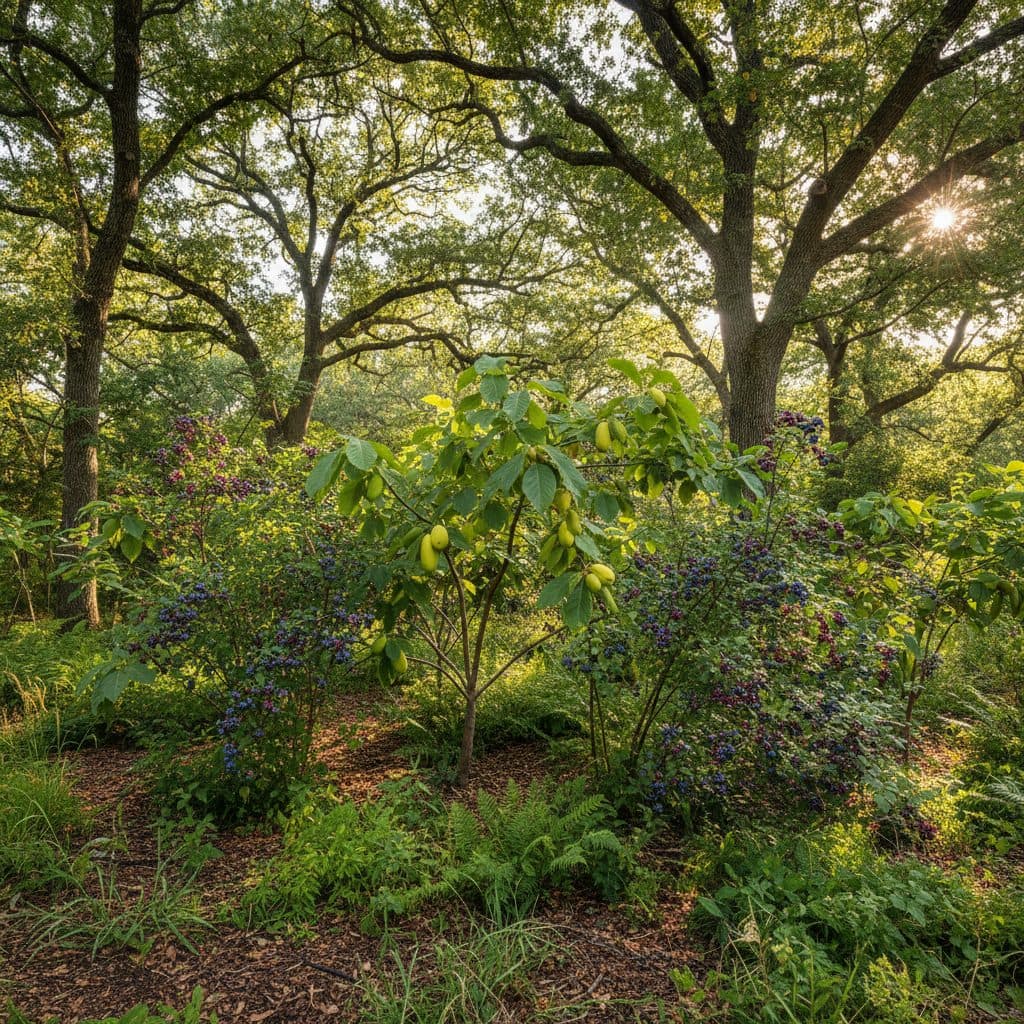
Key takeaways
- Understory fruit trees produce crops in partial shade or dappled sunlight beneath an established forest canopy.
- Species such as pawpaw, serviceberry, medlar, and cornelian cherry are naturally adapted to lower forest strata.
- Most shade-tolerant fruiting species require at least three to four hours of direct sun or all-day filtered light to flower and set fruit.
- Canopy tree roots create moisture and nutrient competition that requires generous organic mulch and targeted watering during establishment.
- Airflow beneath the overstory must be maintained through selective pruning to prevent fungal issues in humid microclimates.
- Never introduce aggressive non-native shrubs into an understory guild without checking regional conservation lists.
Quick answer: Understory fruit trees are small, shade-tolerant edible species that produce fruit beneath the upper canopy of taller trees. Adapted to dappled sunlight and edge environments, species like pawpaw, serviceberry, medlar, and cornelian cherry thrive on three to five hours of light per day, allowing growers to stack yields vertically without clearing mature timber.
Standard orchard management assumes every fruit tree demands eight to ten hours of unfiltered sunlight. While this remains true for commercial peaches, standard apples, and sweet cherries, it ignores the ecological structure of natural woodlands. In multi-layered ecosystems, diverse small trees and fruiting shrubs thrive beneath taller forest canopies.
Integrating understory fruit trees into a home landscape or homestead design allows you to produce food in woodland borders, shaded backyards, and mature food forest guilds. Rather than viewing mature shade trees as obstacles to agriculture, you can use their canopy to shelter delicate crops from intense afternoon heat.
Success with understory food forest species depends on matching each plant to its precise light threshold, soil biology, and moisture requirements. Understanding how to manage light penetration and root zones ensures these lower-tier trees remain productive over decades.
Understanding the understory layer in a food forest
In forest ecology, the understory occupies the vertical space between the forest floor and the overarching canopy. This layer experiences filtered light, buffered temperatures, reduced wind speeds, and higher relative humidity compared to open fields.
When designing a perennial food system, learning what is a food forest provides a clear framework for how distinct vertical layers interact. In agroforestry models and syntropic systems, vertical stratification allows multiple species to share the same footprint without competing directly for the same resources. To understand how these strata function across different tiers, explore syntropic farming layers for light allocation principles.
+-------------------------------------------------------------+
| OVERSTORY CANOPY (Oak, Hickory, Chinese/hybrid Chestnut)    |
| 100% Sunlight at Top                                        |
+-------------------------------------------------------------+
               \       |       /       (Filtered Sunlight)
                \      |      /
+-------------------------------------------------------------+
|        UNDERSTORY FRUIT TREES (Pawpaw, Serviceberry, Medlar)|
|        40% to 70% Ambient Dappled Sunlight                  |
+-------------------------------------------------------------+
               \       |       /
+-------------------------------------------------------------+
|        SHRUB LAYER (Currants, Gooseberries, Elderberries)   |
|        20% to 40% Ambient Sunlight                          |
+-------------------------------------------------------------+
Understory fruit trees are genetically adapted to capture diffuse radiation. Their leaves often possess broader surface areas and higher chlorophyll concentrations than sun-loving species. However, shade tolerance has distinct limits. Deep, heavy shade beneath dense evergreen conifer groves or unthinned maple thickets suppresses flower bud initiation. The goal is dappled sunlight or direct morning light paired with afternoon shade.
Top shade-tolerant understory fruit trees
Selecting the right species is the most critical decision when planting beneath an established canopy. The following cold-hardy and temperate species offer dependable fruit production in partial shade.
Pawpaw (Asimina triloba)
The pawpaw is North America's largest native edible fruit. In wild river valleys, young pawpaws grow as classic understory fruit trees beneath tall hardwoods.
- Light needs: Young trees require partial shade for their first two years to protect delicate foliage from sunburn. Mature trees crop far more heavily in partial to full sun. In open, dappled understory with around four hours of sun they will still fruit, but more lightly — and because their fly pollinators are unreliable, many growers hand-pollinate with a small brush to get a dependable set.
- Soil and moisture: Prefers deep, fertile, moisture-retentive loam rich in decomposed leaf mold with a neutral to slightly acidic pH.
- Pollination: Pawpaw flowers are protogynous and fly-pollinated. Plant at least two genetically distinct varieties within eight meters of each other to ensure cross-pollination.
- Flavor and habit: Produces custardy fruit with notes of banana, mango, and vanilla. Trees reach four to seven meters in height.
Serviceberry / Juneberry (Amelanchier spp.)
Serviceberries are resilient native understory trees and multi-stem shrubs that produce sweet, blueberry-like pomes in early summer.
- Light needs: Thrives in dappled forest edges, woodland clearings, and partial shade. While full sun maximizes berry density, serviceberries fruit well under light deciduous canopies.
- Soil and moisture: Highly adaptable to varied soil types, from sandy loams to heavy clays, provided drainage is adequate.
- Hardiness: Exceptionally cold-hardy across northern and continental climates (USDA Zones 3 through 8).
- Landscape value: Offers white spring blossoms, colorful autumn foliage, and high wildlife value alongside edible yields. Where eastern redcedar or ornamental junipers are close by, expect cedar-quince rust on the fruit; siting away from junipers is the practical control.
Medlar (Mespilus germanica)
Medlar is an ancient pome fruit cultivated for centuries across Europe and temperate regions.
- Light needs: Grows naturally as a small understory tree or large shrub reaching three to five meters. Performs well in partial shade and dappled light where hot summer sun might otherwise scorch delicate leaves.
- Fruiting and use: Bears hard, russet-colored fruits that are harvested in late autumn after light frost and allowed to soften in cool storage until they develop the texture and flavor of spiced applesauce.
- Care: Self-fertile and generally trouble-free, though as a pome fruit it can take fire blight in regions where that is active. Reliably hardy to about USDA Zone 5.
Cornelian Cherry (Cornus mas)
Despite its common name, the cornelian cherry is a species of dogwood that produces bright red, tart, oblong fruits used for preserves, syrups, and fresh eating when fully ripe.
- Light needs: Highly tolerant of partial shade and woodland margins, making it a dependable choice beneath high-canopy trees.
- Bloom period: Produces cheerful yellow blooms very early in late winter before canopy trees leaf out, capturing early sunlight.
- Pollination: Largely self-incompatible. Plant two different cultivars, or a cultivar plus a seedling, for a real crop — a single cornelian cherry will bloom well and set little fruit.
- Soil tolerance: Thrives in alkaline and clay soils where other small fruit trees struggle.
High-yielding fruit bushes for shade
Beneath small understory trees, the shrub layer provides additional opportunities to stack edible crops. These species handle lower light levels than tree crops.
Shrub Species | Botanical Name | Light Requirement | Harvest Season |
|---|---|---|---|
Red & White Currant | Ribes rubrum | Partial shade to morning sun | Early summer |
Blackcurrant | Ribes nigrum | Dappled shade, cool roots | Mid summer |
Gooseberry | Ribes uva-crispa | Morning sun, afternoon shade | Mid summer |
American Elderberry | Sambucus canadensis | Partial shade to full sun | Late summer |
Before planting Ribes in the US, check your state department of agriculture. Several states still restrict currants — blackcurrant especially — because they host white pine blister rust, which kills five-needle pines such as eastern and western white pine. Where planting is allowed but white pines are nearby, choose a rust-immune blackcurrant cultivar.
Currants and gooseberries (Ribes species) originate in woodland conditions and suffer heat stress when exposed to intense, unshaded afternoon sun in hot climates. Planting them beneath the eastern or northern drip line of understory fruit trees provides the cooling shade they require.
Elderberries (Sambucus spp.) thrive along moist woodland margins. Their dark purple berries make excellent syrups and cooked preserves, though berries must be cooked before consumption to neutralize naturally occurring glycosides.
When establishing diverse layers, avoid planting aggressive, invasive non-natives. Species like autumn olive (Elaeagnus umbellata) were historically recommended for nitrogen fixation but are now prohibited in many states due to their ecological damage. Instead, prioritize non-invasive native and well-behaved cultivated varieties.
Managing root competition and soil moisture
The primary challenge of growing understory fruit trees is not always lack of sunlight; it is often competition for water and soil nutrients from the established overstory canopy.
Mature forest trees possess extensive lateral root systems that absorb surface moisture rapidly. If your overstory is black walnut, plan around juglone. Pawpaw, serviceberry and elderberry are generally listed as tolerant, but check any species before planting inside a black walnut's root zone. To give young understory plantings an advantage:
- Plant within natural canopy gaps: Look for areas where a mature tree branch fell or where the overstory is sparse. These light chimneys channel extra rain and sunlight to the forest floor.
- Establish pocket planting basins: When digging planting holes, avoid severing major structural roots of existing canopy trees. Excavate pockets between root paths and backfill with native soil blended with mature compost.
- Apply deep organic mulches: Cover the planting area with a 7 to 10 cm layer of coarse wood chips and shredded leaves, keeping mulch 10 cm away from tree trunks. Reviewing organic mulches and their uses helps select materials that feed beneficial mycorrhizal fungi.
- Targeted early irrigation: Provide consistent deep watering during the first two to three growing seasons using drip lines or soaker hoses placed under the mulch.
       Understory Tree Root Zone & Moisture Barrier

                [Understory Fruit Tree Trunk]
                            |
       +--------------------+--------------------+
  =====|   7-10 cm Coarse Organic Mulch Layer    |=====
  -----+-----------------------------------------+-----
       | Soil Surface: Decomposed Leaf Mold      |
       |                                         |
       |   (o) Fine Feeder Roots Spread Outward  |
       |                                         |
  ~~~~~+~~~~~~~~~~~~~+~~~~~
       | Deep Canopy Root Zone (Filtered Draw)   |
Support your fruit trees with deep-rooted dynamic accumulators rather than shallow invasive ground covers. Russian comfrey 'Bocking 14' (Symphytum × uplandicum) is the standard choice because it does not set viable seed. It still regrows from every root fragment, so site it once, deliberately, and do not cultivate through it. Avoid seed-setting common comfrey (Symphytum officinale), which will sow itself through the whole guild.
Pruning and light management in understory systems
Balancing canopy shade requires active light management. Left unmanaged, an expanding overstory canopy can gradually reduce light levels below the minimum threshold required for fruit production.
Crown lifting and canopy thinning
Crown lifting involves removing the lowest lateral branches of mature overstory trees up to a height of three to five meters. This simple pruning technique allows low-angle morning and late-afternoon sunlight to sweep horizontally across understory fruit trees while retaining overhead midday shade.
Thinning select secondary branches within the upper canopy creates a dappled light effect without compromising the health of the mature timber. Take no more than about a quarter of the live crown in any one season, thin evenly rather than stripping the interior, and hire a certified arborist for anything you cannot safely reach from the ground.
Formative pruning for understory trees
Understory fruit trees naturally stretch toward available light windows, which can lead to lanky or unbalanced branch architecture. Applying proper formative pruning for young fruit trees establishes a strong central leader or open-center framework early.
- Prune out weak, crossing, or inward-growing branches during late winter dormancy.
- Thin the center of understory trees to maximize air movement. High humidity and low airflow in sheltered understories increase susceptibility to fungal leaf spot and powdery mildew.
- Protect young, thin-barked trunks from winter temperature swings. Even in shaded settings, sudden winter sun exposure can cause problems; review preventing sunscald on trees to protect young stems during winter dormancy.
By observing natural woodland patterns and selecting resilient, shade-tolerant species, you can turn underutilized shaded land into a productive, multi-layered food forest. At agripure, practical agroforestry designs prove that thoughtful plant placement and soil stewardship create abundant yields across every layer of the garden.