Key takeaways
- Pruning schedules in Australia follow the Southern Hemisphere seasonal cycle.
- Pome fruit (apples and pears) are pruned during winter dormancy between June and August.
- Stone fruit (peaches, nectarines, apricots, and plums) are pruned immediately after harvest in late summer to early autumn (January to March) to prevent bacterial canker and silver leaf.
- Citrus trees require pruning in late winter to early spring after the main fruit crop is picked.
- Summer pruning checks excessive vegetative vigour and promotes flowering spurs for the following season.
Quick answer: In Australia, timing fruit tree pruning depends on the botanical category of the tree. Deciduous pome fruit such as apples and pears are pruned during winter dormancy between June and August, whereas stone fruit should be pruned immediately after harvest in late summer to early autumn to avoid bacterial canker and silver leaf. Citrus trees are pruned in late winter or early spring after harvest.
Maintaining a productive home orchard across Australia requires understanding how our seasonal rhythm shapes tree physiology. Pruning is not a single annual chore to complete in mid-winter; cutting different species at the wrong time of year can invite devastating fungal infections or strip away next season's blossom buds. Knowing when to prune fruit trees in australia ensures robust tree structure, abundant fruit set, and long-term tree health.
Because Australia ranges from cool alpine valleys in Tasmania and Victoria to humid subtropical regions in Queensland and coastal New South Wales, pruning timing must also account for local humidity and rainfall patterns. Adjusting your pruning calendar by tree group and climate prevents common orchard setbacks.
The Australian seasonal pruning calendar
Pruning timings in the Southern Hemisphere are completely inverted from Northern Hemisphere schedules. Understanding which trees need winter cutting versus summer pruning guides orchard management.
+---------------------+-----------------------+---------------------------------------------+
| Fruit Tree Group    | Optimal Pruning Window| Primary Objectives                          |
+---------------------+-----------------------+---------------------------------------------+
| Pome Fruit (Apples) | Winter (June–August)  | Frame structure, remove dead wood           |
| Pome Fruit (Pears)  | Winter (June–August)  | Thin spurs, open central canopy             |
| Stone Fruit         | Late Summer (Jan–Mar) | Control size; prevent canker & silver leaf  |
| Citrus              | Late Winter to Spring | Skirt lower canopy, remove water shoots     |
| Figs and Mulberries | Late Winter           | Encourage vigorous new fruiting wood        |
| Evergreen Subtropics| Immediately post-harvest| Shape canopy, thin congested interior     |
+---------------------+-----------------------+---------------------------------------------+
To understand foundational cutting angles and tool mechanics, explore our companion overview on how to prune fruit trees.
Winter pruning: apples, pears, and quinces (June to August)
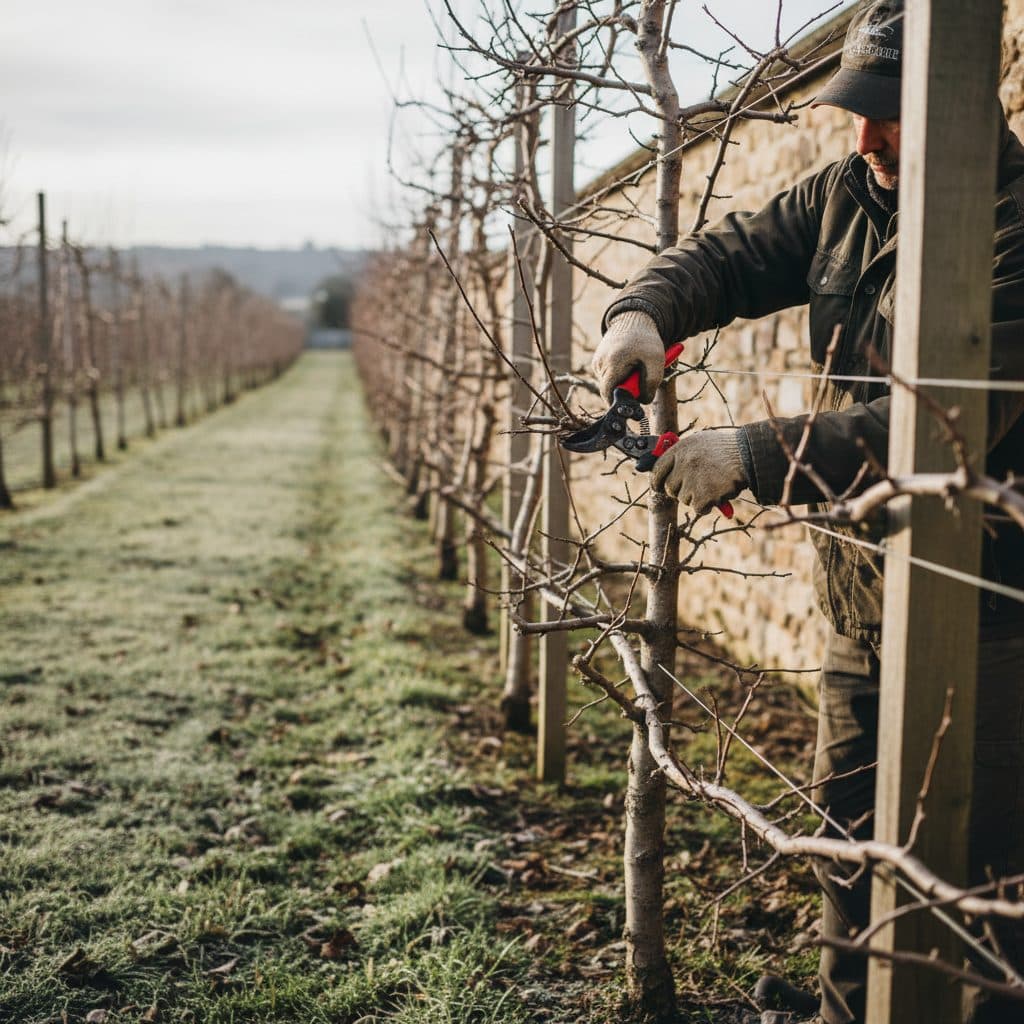
Deciduous pome fruit trees enter complete dormancy during the cool winter months of June, July, and August across southern and eastern Australia. With the leaves gone, the bare branch framework is clearly visible, making winter the ideal time for structural pruning.
Objectives during winter dormancy
- Establish structural framework: On young trees, develop strong scaffold branches angled at roughly 45 degrees from the central trunk to support heavy future crops. For juvenile tree shaping, consult our guide on formative pruning for young fruit trees.
- The three Ds: Remove all dead, damaged, and diseased wood back to healthy green tissue.
- Open the canopy: Remove branches that cross or rub against each other, as well as upright water shoots growing directly inward toward the centre of the tree. A vase-shaped or open-centre canopy allows winter sunlight and airflow to penetrate, reducing humid conditions that foster apple scab (Venturia inaequalis).
- Spur management: Apples and pears fruit on short, stubby wood called fruiting spurs that produce crops for several years. Thin out congested, aged spur clusters to encourage larger, well-spaced fruit.
Summer pruning: stone fruit and vigour control (December to February)
Stone fruit species (including peaches, nectarines, apricots, plums, and cherries) should generally not be heavily pruned during cold, wet winter months in most parts of Australia.
Why avoid winter pruning for stone fruit?
Winter pruning wounds on stone fruit expose moist vascular tissue to airborne pathogens, particularly bacterial canker (Pseudomonas syringae) and silver leaf (Chondrostereum purpureum), whose spores spread during wet winter weather. During cold, damp winter conditions, the tree's immune response is sluggish, allowing pathogens to enter fresh cuts and establish vascular infections that can kill entire limbs.
Pruning stone fruit in late summer (January to March) or immediately post-harvest allows wounds to dry out and callus rapidly in warm, dry weather. Summer pruning also removes leafy canopy growth before autumn, which naturally suppresses excess vegetative vigour and keeps trees at a manageable picking height.
Always maintain strict tool hygiene between cuts; see our protocol on how to sterilize pruners to stop plant disease.
When to prune citrus trees in Australia
Citrus trees (including lemons, limes, oranges, mandarins, and grapefruits) are subtropical evergreens that do not undergo true deciduous dormancy. Consequently, their pruning requirements differ substantially from temperate fruit trees.
The optimal time to prune citrus is in late winter to early spring (August to September in temperate regions, slightly earlier in warm subtropical zones), ideally just after the primary winter crop has been harvested and before the heavy spring blossom flush begins.
+---------------------+-----------------------+---------------------------------------+
| Citrus Pruning Task | Recommended Timing    | Method                                |
+---------------------+-----------------------+---------------------------------------+
| Skirting Lower Skirt| Late Winter (August)  | Lift branches 30 to 50 cm off ground  |
| Removing Gall Wasp  | Late Winter to Spring | Shave or cut galls before October emergence|
| Water Shoot Removal | Spring and Summer     | Cut flush to branch at base           |
| Dead Wood Cleanout  | Anytime               | Remove dead twigs throughout canopy   |
+---------------------+-----------------------+---------------------------------------+
Essential citrus pruning practices:
- Skirting: Prune lower branches so foliage sits at least 30 to 50 cm above ground level. This prevents soil-borne water moulds (Phytophthora) from splashing onto leaves and fruit during heavy rains and blocks easy access for crawling pests.
- Citrus gall wasp management: In regions affected by citrus gall wasp (Bruchophagus fellis), prune out galls before adults emerge in late winter / early spring (by late August in warm coastal districts). Never compost or mulch galled twigs; bag them in heavy black plastic and bake them in full sun for several weeks, or burn them where permitted, to kill the larvae inside.
- Canopy thinning: Lightly thin the dense outer shell of foliage to allow dappled sunlight into the interior branches, which discourages scale insects and sooty mould.
Regional climate adaptations across Australia
Because Australia encompasses diverse climate zones, adjust your pruning calendar based on local conditions:
- Cool / Cold zones (Tasmania, Victorian Ranges, NSW Southern Tablelands): Winter pruning can extend well into August, as bud burst occurs later in spring. Summer pruning should be completed by late January so cuts heal before early autumn chills.
- Temperate zones (Melbourne, Adelaide, Sydney, Perth): Winter pruning runs smoothly throughout June and July. Stone fruit summer pruning is best done in February after harvest.
- Subtropical zones (Southeast Queensland, Northern NSW): Pruning must account for high summer humidity. Prune subtropical species (mangoes, avocados, custard apples) immediately after harvest in late summer or early autumn to stimulate new flowering flushes while avoiding excessive wet-season fungal spore flushes.
In hot inland and arid regions, avoid exposing main structural limbs to harsh western sun during midsummer, as sunburn can crack bark and invite borers. In heat-prone areas, reference our strategies on protecting fruit trees during a heatwave.
Essential pruning tools and proper cutting technique
Using high-quality, sharp tools produces clean cuts that heal rapidly without tearing bark.
- Bypass secateurs: For twigs and small branches up to 2 cm in diameter.
- Loppers: For branches between 2 cm and 4 cm, providing leverage for clean single cuts.
- Curved pruning saw: For large scaffold limbs greater than 4 cm.
Always cut just above an outward-facing bud at a 45-degree angle sloping away from the bud. This directs rainwater away from the growing tip and directs new spring growth outward, preventing clutter in the centre of the tree.