Key takeaways
- Select a pump with sufficient head height and flow rate, typically 100-200 gallons per hour for a small NFT system, ensuring 24/7 operation.
- Size your reservoir to hold at least 0.5 gallons of nutrient solution per plant, plus a 20% buffer, for stable nutrient concentrations.
- Maintain a channel slope between 1:30 and 1:40 (a 3 to 4 inch drop per 10 feet) to ensure even nutrient film distribution.
- Regularly monitor and adjust pH and EC levels in your nutrient solution to maintain optimal plant health and growth.
- Consider system scalability and future plant needs when initially designing your NFT setup to avoid costly upgrades.
- Properly insulating channels and reservoirs damps nutrient solution temperature swings, benefiting root health.
Quick answer: To optimize NFT hydroponics, select a pump with sufficient head and flow (100-200 GPH), size the reservoir for 0.5 gallons per plant plus a 20% buffer, and maintain a channel slope between 1:30 and 1:40.
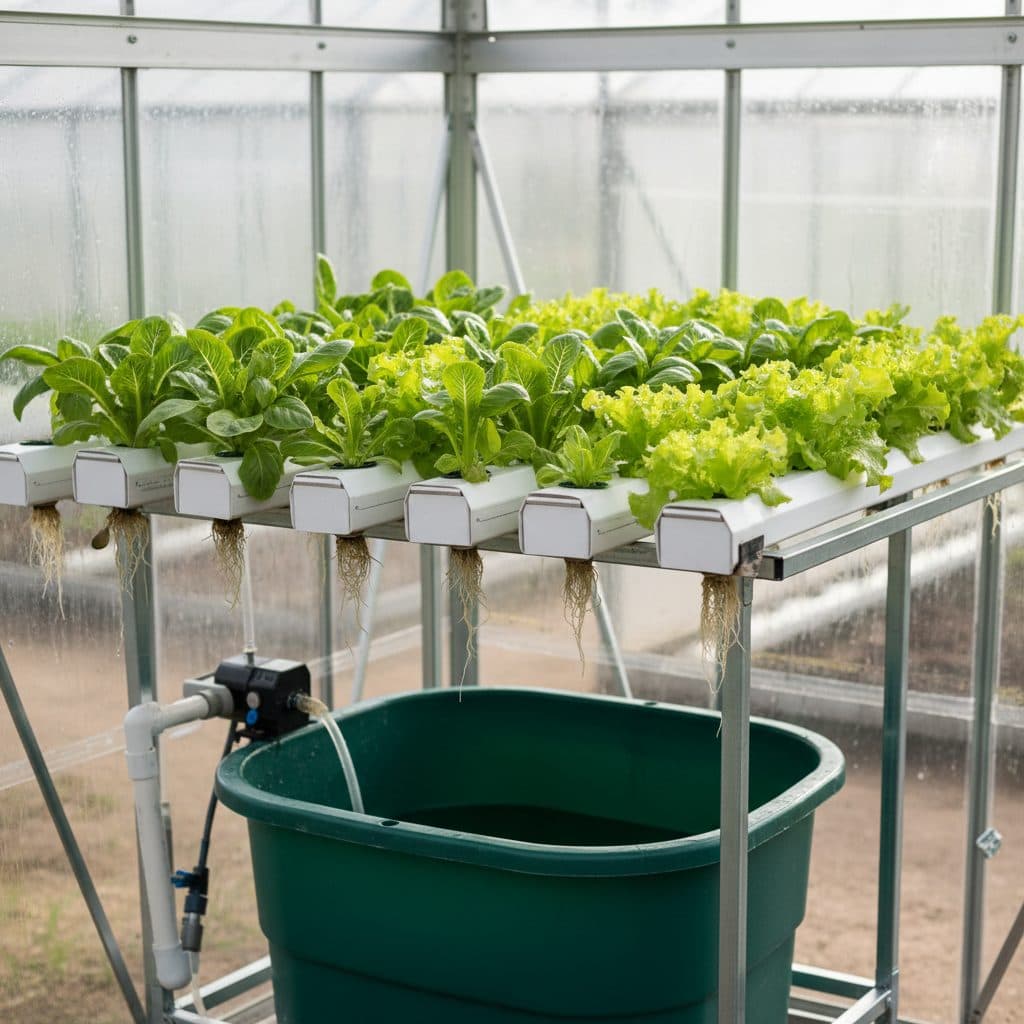
In places like central California or the fertile valleys of Pennsylvania, where traditional farming faces water constraints or limited arable land, Nutrient Film Technique (NFT) hydroponics offers a compelling alternative for growing leafy greens and herbs. A well-designed NFT system can produce more lettuce per square foot than soil-based methods, and because it recirculates its solution it uses substantially less water. However, an NFT setup depends on three main components: the pump, the reservoir, and the channel slope. Getting these elements right from the start can mean the difference between a thriving crop and a struggling one, impacting everything from nutrient delivery to root health and overall plant yield.
For growers in USDA zones 6 through 9, where year-round growing in a controlled environment is feasible, understanding these mechanics is paramount. For instance, a properly sloped channel ensures a thin, consistent film of nutrient solution flows over plant roots, providing essential oxygen and nutrients without waterlogging. A 50-gallon reservoir can support 100 small plants for several days, minimizing daily maintenance. Target measurements and sizing formulas allow growers to match these components to their crop volume and growing space.
Selecting the right pump for consistent nutrient delivery
The pump is the heart of any NFT system, responsible for circulating the nutrient solution from the reservoir to the channels. For a typical home or small commercial NFT setup, a submersible centrifugal pump is often the most practical choice due to its quiet operation and efficiency. When selecting a pump, two specifications determine fit: flow rate and head height. For a system with 50 feet of channels, a pump rated for 100 to 200 gallons per hour (GPH) at the required head height is a good starting point. Head height refers to the maximum vertical distance the pump can push water, which directly impacts the actual flow rate at your system’s highest point.
understanding pump head and flow rate
To calculate your required head height, measure the vertical distance from the water level in your reservoir to the highest point the water needs to reach in your channels. Add an additional 1 to 2 feet for frictional losses in plumbing, especially if you’re using long runs of 0.5-inch tubing. For example, if your channels are 3 feet above your reservoir, aim for a pump with a minimum head rating of 4 to 5 feet. Many pumps provide a flow rate chart that shows GPH at various head heights, which is more useful than the maximum GPH rating at zero head. A pump designed for continuous duty is essential, as NFT systems typically run 24 hours a day, seven days a week, to ensure constant nutrient access for plants like romaine lettuce or basil. Consider a pump with a 1/20 horsepower motor for systems up to 200 gallons.
- Calculate total head height, including friction loss.
- Choose a pump with adequate GPH at the calculated head.
- Opt for a submersible pump for quiet operation.
- Ensure the pump is rated for continuous duty, and run it from a GFCI-protected outlet: it is a mains-powered device sitting in water, 24 hours a day.
- Consider a backup pump for critical systems, especially if growing high-value crops.
For larger systems or those with significant vertical lift, a more powerful pump, possibly an external model, might be necessary. Always check the pump’s power consumption, measured in watts, as it will be running constantly and contribute to your operational costs. A 50-watt pump running continuously will consume 1.2 kWh per day, about 440 kWh over a year; multiply that by your utility's per-kWh rate to get the running cost.
Sizing your reservoir for nutrient stability
A general rule of thumb for NFT systems is to provide at least 0.5 gallons of nutrient solution per plant, plus a 20% buffer for evaporation and fluctuations. For example, a system with 100 lettuce plants would ideally require a 60-gallon reservoir (50 gallons for plants + 10 gallons buffer), allowing for sufficient volume to prevent rapid changes in solution chemistry.
factors influencing reservoir size
Larger reservoirs offer greater stability. A 100-gallon reservoir, compared to a 20-gallon one, will experience slower shifts in pH and electrical conductivity (EC) as plants absorb water and nutrients. This stability reduces the frequency of adjustments, saving time and resources. In warmer climates, like Florida or Arizona, a larger reservoir can also help mitigate temperature swings, which can stress plant roots if the solution gets too warm (it should ideally stay between 65°F and 72°F). Covering the reservoir with an opaque lid is essential to prevent algae growth, which competes with plants for nutrients and can clog pumps and channels. For those using an indoor grow tent, ensuring the reservoir fits within the tent’s footprint is a practical consideration.
- Allocate at least 0.5 gallons per plant.
- Add a 20% buffer for stability.
- Choose opaque, food-grade plastic to prevent algae.
- Ensure easy access for monitoring and refilling.
- Consider a drain valve for easier solution changes.
Regular monitoring of pH and EC is non-negotiable. For most leafy greens, a pH range of 5.5 to 6.5 is optimal, and EC levels might range from 1.2 to 1.8 mS/cm. A 50-gallon reservoir might need pH adjustments every two to three days, while a 10-gallon reservoir could require daily checks. The larger the reservoir, the less frequently you’ll need to add water or adjust nutrient levels, making your system more forgiving and less labor-intensive over a 30-day growing cycle.
Achieving the ideal channel slope for NFT systems
Channel slope is often overlooked during system design, but it dictates how evenly solution flows over roots and controls oxygen availability. Too steep a slope, and the water rushes through, leaving roots dry in places and potentially causing nutrient deficiencies. Too shallow, and the water pools, leading to stagnant conditions, root rot, and oxygen deprivation. The sweet spot for most NFT systems is a gentle slope between 1:30 and 1:40, meaning for every 30 to 40 inches of channel length, there should be a 1-inch drop. For a 10-foot (120-inch) channel, this translates to a drop of 3 to 4 inches from one end to the other.
methods for precise slope adjustment
Achieving this precise slope requires careful measurement and adjustment during setup. A carpenter’s level or a digital level can be invaluable tools. For longer channels, a string line level can provide accuracy over greater distances. In a commercial greenhouse in Ohio, growers often use adjustable channel stands or shims to fine-tune the slope across dozens of 12-foot channels, ensuring a consistent flow rate of about 0.25 to 0.5 gallons per minute per channel. This controlled flow creates the thin film necessary for optimal root aeration. Incorrect slope can lead to noticeable yield reductions from uneven nutrient distribution and root stress.
- Aim for a 1:30 to 1:40 slope (1 inch drop per 30-40 inches).
- Use a level for precise measurements.
- Adjust channels with shims or adjustable stands.
- Ensure smooth, unobstructed flow.
- Check slope after loading channels with plants, as weight can alter it.
For systems with multiple channels, matching the slope across every run provides uniform plant growth. Variations of even 0.5 inches over a 10-foot span can lead to noticeable differences in plant size and health. In areas prone to settling, such as some parts of the Mississippi Delta, it’s wise to re-check your channel slopes periodically, perhaps every six months, to ensure they remain consistent. This attention to detail can significantly improve the health and productivity of your crops, from leafy greens to strawberries.
Integrating components for a cohesive NFT system
Designing an NFT system involves more than just selecting individual components; it’s about integrating them into a cohesive, efficient unit. The pump, reservoir, and channels must work in harmony to deliver a consistent, oxygenated nutrient film to your plants. For instance, a 100 GPH pump might be perfect for a system with 10 channels, each 8 feet long, provided the total head height is within the pump’s effective range. The nutrient solution, once pumped to the highest point, flows through the channels via gravity and returns to the reservoir, completing the cycle. This recirculating nature means that any issues with one component can quickly impact the entire system.
maintenance and monitoring for optimal performance
Regular maintenance is crucial for long-term success. This includes cleaning the reservoir every two to four weeks to prevent biofilm buildup and replacing the entire nutrient solution every 7 to 14 days, depending on plant size and nutrient uptake. For growers in warmer states like Texas or Arizona, where ambient temperatures can reach 90°F, insulating the reservoir and channels can help maintain solution temperatures below 75°F, preventing root disease. You can also use a garden pressure sprayer for cleaning or applying foliar nutrients, though NFT primarily focuses on root feeding. Monitoring pH and EC daily with a reliable meter keeps the nutrient balance within acceptable thresholds.
- Clean the reservoir every 2-4 weeks.
- Replace nutrient solution every 7-14 days.
- Monitor pH and EC daily.
- Inspect pump and tubing for clogs or leaks weekly.
- Ensure channels are free of debris and algae.
When planning your system, consider future expansion. Building a modular system allows you to add more channels or a larger reservoir as your needs grow, without having to completely redesign your initial setup. For example, starting with a 50-gallon reservoir and a pump capable of handling 5 feet of head and 200 GPH gives you flexibility to expand from 50 to 100 plants. This modular approach, common among growers in regions like the Pacific Northwest, accommodates 5 to 10 harvests of lettuce annually without requiring full rebuilds.
NFT system component considerations
Component | Small System (20-50 plants) | Medium System (50-150 plants) |
|---|---|---|
Pump Flow Rate (GPH) | 50-100 GPH at 3-4 ft head | 100-250 GPH at 4-6 ft head |
Reservoir Size (Gallons) | 10-25 gallons | 25-75 gallons |
Channel Slope (Drop per 10 ft) | 3-4 inches | 3-4 inches |
Monitoring Frequency | Every 1-2 days | Daily |
Water Savings: because an NFT system recirculates its nutrient solution rather than losing it to soil drainage and evaporation, it uses substantially less water than open-field irrigation of the same crop.
Yield Increase: NFT lets you space plants tighter than field rows and turn more crops per year, so yield per square foot is generally higher than conventional field production.
Frequently asked questions
How often should I change the nutrient solution in my NFT reservoir?
For most NFT systems, it’s recommended to completely drain and replace the nutrient solution every 7 to 14 days. This prevents nutrient imbalances and mineral buildup so plants maintain steady growth.
Can I use tap water for my NFT system?
Yes, tap water can be used, but it’s important to test its pH and EC levels first. If your tap water has high chlorine, let it sit for 24 hours to off-gas, or use a carbon filter. Hard water, common in many US cities, might require pH adjustments more frequently, sometimes daily for a 20-gallon system.
What is the ideal flow rate for NFT channels?
The ideal flow rate for NFT channels is a thin, continuous film, typically around 0.25 to 0.5 gallons per minute per channel. This ensures roots receive both water and oxygen without becoming waterlogged. Too fast a flow deepens the stream from a thin film into a running channel, submerging the root mat and cutting its oxygen supply.
How do I prevent algae growth in my NFT system?
To prevent algae, ensure all parts of your system, especially the reservoir and channels, are opaque and block light. Algae needs light to grow. Covering the reservoir with a dark lid is the single most effective step, and regularly cleaning channels helps too.
What temperature should the nutrient solution be?
Maintain your nutrient solution temperature between 65°F and 72°F (18°C and 22°C) for most plants. Temperatures outside this range, particularly above 75°F, can reduce dissolved oxygen and increase the risk of root diseases, slowing growth.
Is a filter necessary for my NFT pump?
Yes, a pre-filter on your pump is highly recommended to prevent debris, plant roots, or algae from clogging the pump or irrigation lines. A simple mesh bag or sponge filter keeps grit and root fragments off the impeller and maintains consistent flow to your channels.
References
- USDA Natural Resources Conservation Service (2024). USDA Natural Resources Conservation Service.
- SARE — Sustainable Agriculture Research & Education (2023). SARE — Sustainable Agriculture Research & Education.
- ATTRA / NCAT Sustainable Agriculture (2023). ATTRA / NCAT Sustainable Agriculture.
- USDA National Agroforestry Center (2023). USDA National Agroforestry Center.