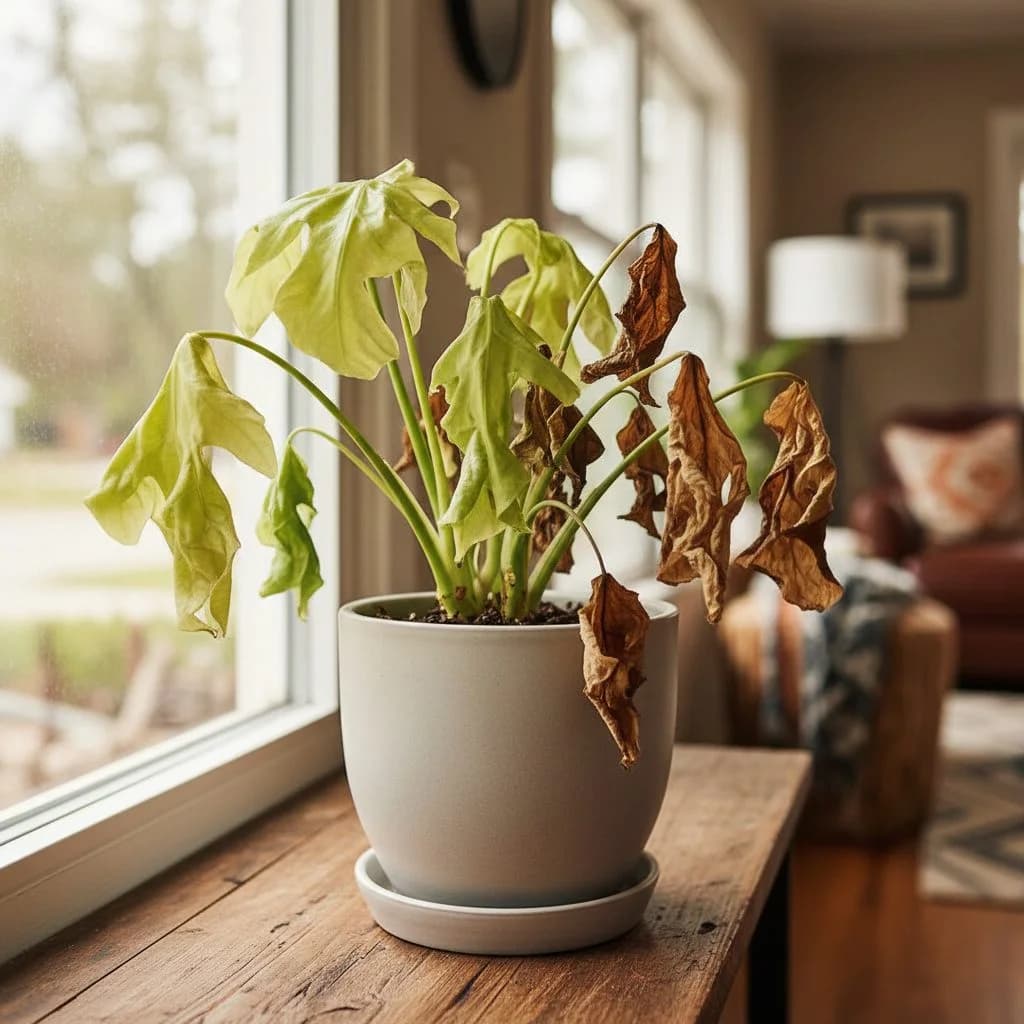
Key takeaways
- Both overwatering and underwatering can present with similar symptoms like yellowing leaves and wilting, making diagnosis challenging.
- Overwatering often leads to root rot due to lack of oxygen, impacting plants like Money Plants (Epipremnum Aureum) and container-grown kale.
- Underwatering causes cellular collapse and dehydration, particularly affecting drought-sensitive species like Douglas-fir seedlings.
- Assess soil moisture by touch, using a finger or a moisture meter, to a depth of 2-3 inches before watering.
- Choose appropriate pot sizes and ensure adequate drainage holes to prevent water accumulation in the root zone.
- Adjust watering schedules based on plant species, pot material, environmental conditions, and USDA hardiness zone.
Quick answer: Identifying plant stress from overwatering or underwatering involves assessing soil moisture by touch and observing specific symptoms. Overwatering often leads to root rot and mushy leaves, while underwatering causes cellular collapse and dry, brittle foliage.
In many US homes, from a small apartment in New York City to a sprawling house in USDA zone 8, indoor plants bring life and color. However, a common challenge for growers is diagnosing plant distress, particularly when symptoms of overwatering and underwatering appear nearly identical. Both conditions can lead to yellowing leaves, wilting, and stunted growth, leaving many plant enthusiasts scratching their heads.
Understanding the subtle differences and implementing effective care strategies can prevent significant plant loss. For instance, research on container-grown kale (Brassica oleracea L. acephala) in 2023 showed that overwatering can be just as detrimental as underwatering, which shows the delicate balance plant health needs [2]. This guide will help you decipher these confusing signals and maintain a thriving indoor garden.
The confusing symptoms: why they look alike
Many plant owners across the United States, whether in a humid Florida climate or a dry Arizona desert, struggle with plant symptoms that seem contradictory. A common observation is that both too much and too little water can cause leaves to turn yellow or brown, and the entire plant to wilt. For example, a Money Plant (Epipremnum Aureum) might display drooping leaves whether its soil is waterlogged or bone dry. This visual similarity stems from the plant’s physiological response to stress, where cells lose turgor pressure, leading to a collapsed appearance. In fact, an AI caretaker system designed for Money Plants aims to prevent overwatering, indicating its prevalence as a problem [4].
Understanding plant stress responses
When a plant experiences water stress, its ability to transport nutrients and perform photosynthesis is severely compromised. With overwatering, roots are deprived of oxygen, leading to cell death and an inability to absorb water, ironically causing dehydration symptoms. Conversely, underwatering directly leads to a lack of water for cellular functions. A study on interior Douglas-fir seedlings (Pseudotsuga menziesii) in 2024 demonstrated how both periodic underwatering and complete withholding of water significantly impacted their growth and survival, showing the narrow margin for error [1].
- Yellowing leaves: Often starts at lower leaves, indicating nutrient deficiency or root issues.
- Wilting or drooping: Loss of turgor pressure in cells, making stems and leaves limp.
- Stunted growth: Reduced overall plant development due to chronic stress.
- Brown leaf tips or edges: Can signify either too much or too little water, or nutrient burn.
- Leaf drop: A plant’s last resort to conserve resources under severe stress.
Overwatering: the silent killer
Overwatering, defined as the application of excessive water to plants, is a leading cause of houseplant demise in US homes [3]. This condition is particularly prevalent in regions with high humidity or for plants in non-porous containers. When soil remains saturated for extended periods, typically more than 24-48 hours, the roots are starved of oxygen. This anaerobic environment promotes the growth of harmful fungi and bacteria, leading to root rot. For instance, domestic plum tree rootstocks (Prunus domestica) grown in floodplain soils showed reduced resistance to periodic overwatering, which shows how vulnerable root systems are [5].
Recognizing the signs of too much water
The symptoms of overwatering often mimic those of underwatering, but with subtle differences. Leaves may turn yellow, then brown, and feel soft or mushy. The soil itself might appear dark and heavy, with a distinct musty odor indicating decay. You might also notice small fungus gnats, which thrive in consistently moist conditions. A pot that feels significantly heavier than expected after a few days suggests water retention issues. A plant's watering needs vary significantly based on its pot size, type, and environment.
- Mushy, soft leaves: Often yellowing, then turning brown or black.
- Stunted growth with yellowing: New growth may be small and discolored.
- Foul odor from soil: A clear sign of anaerobic decomposition and root rot.
- Fungus gnats: Small, dark flies hovering around the soil surface.
- Soil that never dries out: Stays wet for more than 5-7 days after watering.
Underwatering: the slow decline
Underwatering occurs when a plant does not receive enough moisture to sustain its physiological processes, a common issue in dry climates or for growers who forget to water. This leads to cellular dehydration, where plant cells lose turgor pressure and collapse, causing the plant to wilt. Plants in small pots or terracotta containers, which promote faster evaporation, are particularly susceptible. For example, a small 4-inch terracotta pot might need watering every 2-3 days, while a larger 10-inch plastic pot can only need it once a week. This is especially true in regions like the arid Southwest, where humidity can drop below 20%.
Identifying the signs of too little water
The signs of underwatering typically include dry, crispy leaves that may turn yellow or brown, often starting from the edges or tips. The soil will feel light and completely dry to the touch, sometimes pulling away from the sides of the pot. The plant will appear limp and lifeless, but unlike overwatered plants, the stems and leaves will feel brittle rather than mushy. A quick check of the pot’s weight can be a good indicator; a significantly lighter pot suggests a need for water. Drought-tolerant plants, such as those discussed in Drought tolerant plants: how to choose them by zone and water them right, are better equipped to handle these conditions, but even they have limits.
- Crispy, dry leaves: Often brown or yellow, starting from the edges.
- Brittle stems: Stems and leaves feel stiff and break easily.
- Lightweight pot: The pot feels noticeably light when lifted.
- Soil pulling away from pot: Indicates extreme dryness and shrinkage.
- Slow or no new growth: Plant conserves energy, halting development.
How to diagnose and prevent water issues
Accurate diagnosis is the first step to recovery. The most reliable method is to check the soil moisture directly. Insert your finger about 2-3 inches into the soil. If it feels wet, hold off on watering. If it feels dry, it’s time to water. For larger pots, a moisture meter can provide a more precise reading. Consider the plant’s specific needs; for example, a succulent in USDA zone 9 might only need water every 3-4 weeks, while a fern in a similar zone can need it every 3-5 days. The USDA Natural Resources Conservation Service provides useful data on soil types and their water retention capabilities, which can inform watering practices [6].
Practical prevention strategies
Prevention is always better than cure. Start with the right pot size and material—a 6-inch plant in a 12-inch pot will retain too much moisture, increasing overwatering risk. Ensure all pots have drainage holes; without them, water accumulates at the bottom, suffocating roots. When watering, do so thoroughly until water drains from the bottom, then discard any excess water in the saucer after 15-30 minutes. This ensures the entire root ball is hydrated. For plants in grow tents, like those found at Reflective Indoor Grow Tent, humidity and temperature control also affect water needs. Remember, it’s generally safer to underwater slightly than to overwater significantly, as plants can often recover from a brief dry spell more easily than from root rot.
- Finger test: Insert finger 2-3 inches into soil; water if dry.
- Moisture meter: Use for accurate readings, especially in larger pots.
- Proper drainage: Always use pots with drainage holes and remove excess water.
- Appropriate pot size: Match pot size to plant size to avoid excess soil moisture.
- Water thoroughly, then drain: Ensure roots get enough water without sitting in it.
Long-term plant health and recovery
Once you’ve identified and corrected a watering issue, the plant’s recovery depends on the severity of the damage and the species. A moderately underwatered plant, like a Pothos, might perk up within a few hours of a good soak. However, a severely overwatered plant with advanced root rot may take weeks or even months to show new, healthy growth, if it recovers at all. For plants with significant root rot, repotting into fresh, well-draining soil and pruning away damaged roots can improve chances of survival. Always use a potting mix designed for houseplants, often containing perlite or vermiculite for better aeration.
Building a resilient watering routine
Developing a consistent, yet flexible, watering routine matters. Instead of watering on a strict schedule, water when the plant needs it, based on the soil moisture test. Consider factors like ambient temperature (a plant in a 75°F room will dry out faster than one in a 65°F room), humidity (a plant in 60% humidity needs less frequent watering than one in 30% humidity), and pot material (clay pots dry faster than plastic). Grouping plants with similar watering needs can simplify care, a concept similar to Companion planting: what to plant together (and what to keep apart). Over time, you’ll learn to recognize the subtle cues your plants provide, for a healthier indoor garden that thrives for many years.
- Assess damage: Prune dead or mushy roots and leaves to promote new growth.
- Repot if necessary: Use fresh, well-draining soil, especially after severe overwatering.
- Monitor closely: Observe plant response for 2-4 weeks after intervention.
- Adjust for environment: Factor in room temperature, humidity, and light levels.
- Learn plant cues: Develop an intuitive understanding of your specific plants’ needs over time.
Overwatering vs. Underwatering: Main differences
Symptom/Characteristic | Overwatering | Underwatering |
|---|---|---|
Leaf appearance | Yellow, soft, mushy, may turn black | Yellow, crispy, dry, may turn brown |
Leaf texture | Soft, limp, swollen | Brittle, dry, shriveled |
Soil appearance | Consistently wet, heavy, often moldy | Bone dry, light, pulls away from pot |
Root appearance | Brown/black, mushy, foul odor | Dry, brittle, shriveled, often white |
Pot weight | Heavy | Light |
Recovery time | Weeks to months, if at all | Hours to days, often quick |
Root rot risk: Overwatering is a leading cause of houseplant death due to root rot, which occurs when roots are deprived of oxygen for extended periods.
Soil moisture check: Always check soil moisture 2-3 inches deep before watering; a moisture meter can provide a more objective reading.
References
- Drought tolerance to overwatering, periodic underwatering and complete withholding of water in interior Douglas-fir seedlings (2024).
- Overwatering may be as detrimental as underwatering in container-grown kale (Brassica oleracea L. acephala) (2023).
- Vision-Driven Agentic AI Caretaker for Autonomous Overwatering Prevention in Indoor Money Plants(Epipremnum Aureum) (2026).
- Resistance of domestic plum tree rootstocks against periodic overwatering of floodplain soils (2023).
- USDA Natural Resources Conservation Service (2024).