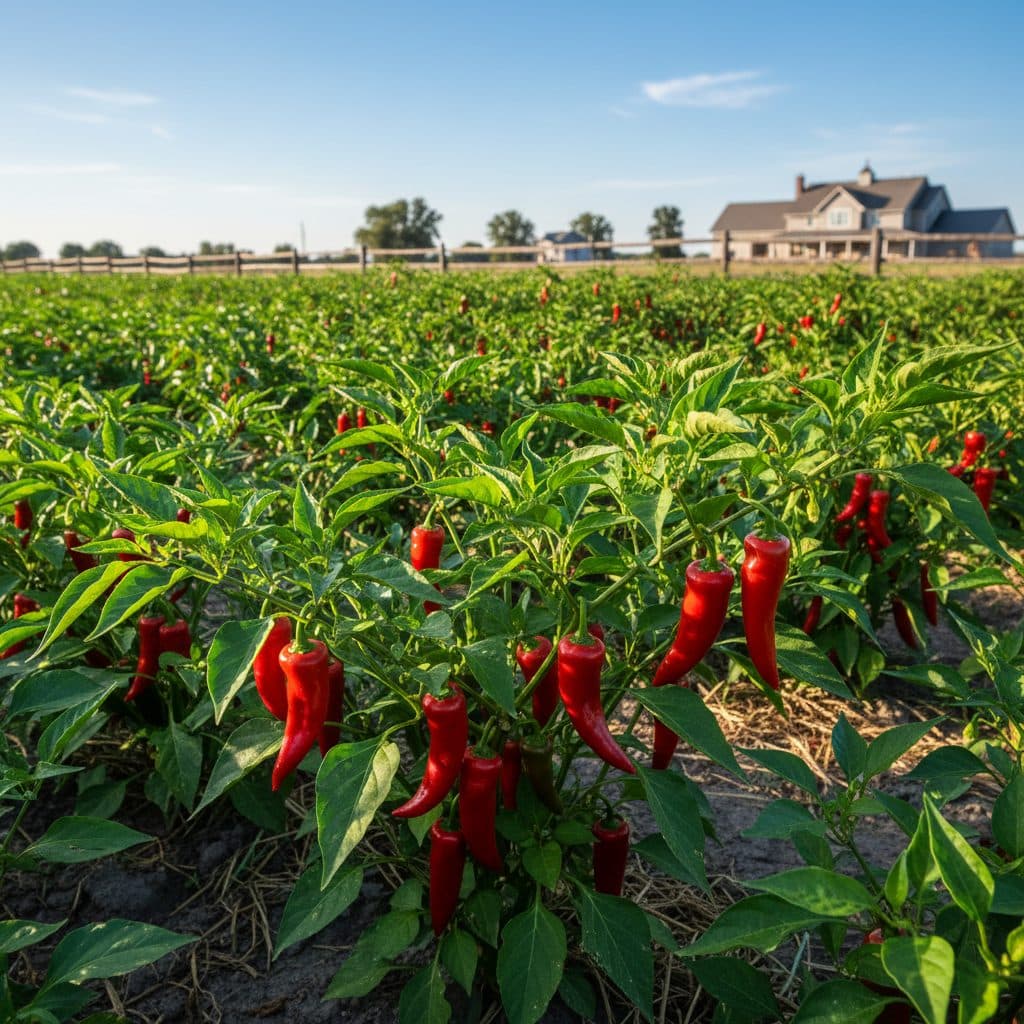
Key takeaways
- Capsaicin, the compound responsible for pepper heat, is a natural defense mechanism produced by the plant.
- Higher temperatures, particularly sustained periods above 85°F (29°C), significantly increase capsaicin production in many chili pepper varieties.
- Water stress, like reducing irrigation by 20-30% during fruit development, can also contribute to increased pungency.
- Careful cultivar selection, environmental controls such as shade cloth, and precise irrigation are key to managing capsaicin levels.
- Harvesting at the right maturity stage, often when peppers are fully colored, generally yields higher capsaicin concentrations.
- Soil health, including adequate potassium and phosphorus, supports overall plant vigor which indirectly influences capsaicin synthesis.
Quick answer: Temperatures consistently above 85°F (29°C) increase capsaicin in chili peppers as the plant perceives high heat as a stressor, triggering a defensive response that boosts capsaicin production to protect its fruit and seeds.
In the arid regions of Arizona and the humid fields of Florida, growers often observe that chili peppers grown under intense summer heat tend to be hotter than those matured in milder conditions. Research shows that environmental stressors, especially high temperatures, impact capsaicin content in pepper crops. For a grower aiming for consistent pungency, whether for a mild bell pepper or a hot Carolina Reaper, understanding this dynamic helps manage yield and quality.
From the fiery habanero in USDA zone 10 to the milder jalapeño commonly grown in USDA zones 4-9, the chemical compound capsaicin is the primary driver of a pepper’s heat. Specific temperature thresholds, water management techniques, and nutrient balance allow growers to control capsaicin levels and produce peppers with predictable pungency.
The chemistry of spice: capsaicin basics
Capsaicin, along with several related compounds called capsaicinoids, is the molecule responsible for the characteristic heat in chili peppers. These compounds are produced primarily in the placenta of the pepper, the white tissue that holds the seeds, and are a natural defense mechanism against herbivores and fungi. The pungency of a pepper is measured in Scoville Heat Units (SHU), a scale developed in 1912. A sweet bell pepper, for instance, registers 0 SHU, while a ghost pepper can exceed one million SHU. Understanding this basic chemistry is the first step in managing your crop’s heat profile.
How capsaicin benefits the plant and beyond
Beyond deterring pests, capsaicin has shown promise in various fields. Research from 2021 indicates that capsaicin can be used in solar panel coatings to improve light absorption, potentially increasing efficiency by up to 15% [1]. In medical research, studies from 2002 have explored capsaicin’s ability to induce apoptosis (programmed cell death) in tumor cells [2], and a 2019 study suggested antidepressant-like properties in animal models [5]. For growers, understanding these properties explains why capsaicin concentration matters across different markets.
- Capsaicinoids: A group of compounds, including capsaicin, responsible for pepper pungency.
- Placenta: The primary site of capsaicin production within the pepper fruit.
- Scoville Heat Units (SHU): The standard measurement for pepper pungency, ranging from 0 SHU for bell peppers to over 2 million SHU for some super-hots.
- Natural Defense: Capsaicin protects peppers from mammals and certain fungi, increasing the plant’s survival rate by approximately 20%.
- Medical Applications: Capsaicin is used in topical pain relief creams, often at concentrations of 0.025% to 0.1%.
Heat stress and capsaicin production
The direct correlation between environmental heat and increased capsaicin content is a well-documented phenomenon. When chili pepper plants, such as those in USDA zone 9, experience sustained temperatures above 85°F (29°C), they respond by synthesizing more capsaicin. Studies show a 20-30% increase in capsaicin content under severe heat stress compared to plants grown in optimal conditions around 75°F (24°C). This response is a survival mechanism, as the plant perceives high heat as a threat to its fruit and seeds.
Understanding the plant’s stress response
The plant’s internal mechanisms kick into gear under heat stress. High temperatures can lead to increased oxidative stress within the plant cells, prompting a defensive reaction that includes heightened capsaicin production. This is particularly noticeable in regions like the Southwestern US, where summer temperatures frequently exceed 95°F (35°C) for extended periods. Growers in these areas often report their peppers, especially varieties like Hatch chiles, having a notably higher pungency than those grown in cooler climates. Managing this stress, through methods like providing afternoon shade to reduce temperatures by 5-10°F, can help modulate the heat level.
- Temperature Threshold: Capsaicin production often increases significantly when temperatures consistently rise above 85°F (29°C).
- Oxidative Stress: High heat induces cellular stress, triggering defense mechanisms, including capsaicin synthesis.
- Regional Variation: Peppers grown in hot climates, such as the US Sun Belt, typically exhibit 25% higher capsaicin levels than those from cooler regions.
- Genetic Predisposition: Some cultivars, like Carolina Reapers, are genetically programmed for high capsaicin, but even their levels can increase by 10-15% under heat stress.
- Enzymatic Activity: Heat can influence the activity of enzymes involved in the capsaicinoid biosynthesis pathway, accelerating their production by up to 30%.
Water, nutrients, and soil: supporting factors
While heat is a primary driver, water availability also plays a significant role in determining a pepper’s pungency. Moderate water stress, particularly during the fruit development stage, can lead to hotter peppers. For example, reducing irrigation by 20-30% during the final weeks before harvest can increase capsaicin content by 10-15% in varieties like jalapeños. However, severe drought stress can reduce overall plant health and yield, so balanced moisture is necessary. A soil moisture meter helps maintain water levels, keeping soil moisture within an optimal range of 40-60%.
The role of soil and fertility
Soil composition and nutrient availability also contribute to plant vigor and, indirectly, to capsaicin production. Peppers thrive in well-draining soil with a pH between 6.0 and 6.8. While no specific nutrient directly boosts capsaicin, a balanced nutrient profile, particularly adequate potassium and phosphorus, supports steady plant growth. For instance, applying a slow-release organic fertilizer like fermented soybean meal, with an NPK ratio of around 7-2-1, can provide sustained nutrition. Healthy plants are better equipped to respond to environmental stressors, including heat, in a way that optimizes capsaicin synthesis without compromising yield, which can be up to 15-20 pounds per plant for prolific varieties in ideal conditions.
- Water Stress: Reducing irrigation by 20-30% during fruit development can increase capsaicin by 10-15%.
- Soil pH: Peppers prefer slightly acidic to neutral soil, typically between 6.0 and 6.8, for optimal nutrient uptake.
- Potassium: Essential for fruit development and stress tolerance, with typical recommendations of 100-150 pounds per acre.
- Phosphorus: Supports root growth and flowering, often applied at 50-80 pounds per acre.
- Organic Matter: Improves soil structure and water retention, aiming for 3-5% organic matter content in the top 6 inches of soil.
Cultivar selection and environmental control
The most straightforward way to control capsaicin levels is through cultivar selection. If you desire a mild pepper, choose varieties like ‘California Wonder’ bell peppers or ‘Anaheim’ chiles, which typically range from 500-2,500 SHU. For extreme heat, ‘Carolina Reaper’ or ‘Trinidad Moruga Scorpion’ can exceed 2 million SHU. However, even within a cultivar, environmental factors can cause significant variation. For example, a ‘Jalapeño M’ grown in a cool, coastal California climate might be 3,000 SHU, while the same variety grown in the hot, dry Central Valley could reach 8,000 SHU.
Managing microclimates for consistent heat
To achieve more consistent pungency, especially in variable climates, environmental control is effective. In regions like the Midwest, where summer temperatures can fluctuate wildly, growers might use shade cloth to reduce direct sunlight and air temperature by 10-15°F (5-8°C) during peak heat waves. This can prevent excessive capsaicin production if a milder pepper is desired. Conversely, for hotter peppers to ensure full sun exposure and even considering reflective mulches can increase ambient temperatures around the plant by 2-5°F (1-3°C), promoting higher capsaicin. For indoor growers, a reflective indoor grow tent can help maintain a consistent temperature and light environment, often within a 2°F margin.
- Cultivar Selection: Choose varieties based on desired SHU, from 0 SHU for bell peppers to over 2 million SHU for super-hots.
- Shade Cloth: Can reduce ambient temperatures by 10-15°F (5-8°C) and light intensity by 30-50%.
- Reflective Mulch: Can increase soil temperature by 2-5°F (1-3°C) and improve light reflection onto plants.
- Row Covers: Protect young plants from early season chills, maintaining temperatures 5-10°F (3-5°C) warmer than ambient.
- Greenhouse Control: Allows for precise temperature management, often within a 2°F (1°C) range, optimizing conditions for specific capsaicin levels.
Harvesting for desired pungency
The timing of your harvest can also influence the final capsaicin content of your peppers. Generally, peppers tend to increase in pungency as they mature and ripen. A green jalapeño, for example, might register 3,000 SHU, but if allowed to ripen fully to red, its heat could increase to 8,000 SHU or more. This is because capsaicin synthesis continues throughout the fruit’s development, peaking as the pepper reaches its full color and physiological maturity. For growers in USDA zone 7, this might mean waiting an additional 10-14 days after the pepper appears visually mature to achieve maximum heat.
Post-harvest considerations for pungency
While most capsaicin production ceases once the pepper is harvested, how you handle and store your peppers can affect their perceived heat and shelf life. Rapid cooling after harvest can help preserve the existing capsaicin levels, maintaining the desired pungency. For commercial operations, processing peppers within 24-48 hours of harvest is often recommended to lock in flavor and heat. Also, the distribution of capsaicin within the pepper fruit itself is not uniform; the placenta and internal ribs contain the highest concentrations, often 80-95% of the total capsaicin [4]. When preparing peppers, removing these parts can significantly reduce the heat by up to 90%, offering another layer of control for consumers.
- Ripening Stage: Capsaicin levels typically increase by 15-25% as peppers ripen from green to their mature color.
- Harvest Timing: For maximum heat, harvest peppers when they are fully colored and physiologically mature, often 60-90 days after fruit set.
- Post-Harvest Handling: Rapid cooling to 45-50°F (7-10°C) helps maintain pungency and extends shelf life by 2-3 weeks.
- Capsaicin Distribution: The placenta and internal ribs contain 80-95% of the pepper’s total capsaicin.
- Regional Pungency: A 2024 study on Andaman chili peppers found significant regional variations in capsaicin distribution and showing the impact of local conditions [4].
Impact of growing conditions on jalapeño pungency (USDA Zone 9)
Growing Condition | Average SHU Range | Capsaicin Content Change (%) |
|---|---|---|
Optimal (75°F, consistent water) | 2,500-5,000 | Baseline (0%) |
High Heat (85-95°F, consistent water) | 5,000-8,000 | Increased by 20-30% |
Moderate Water Stress (80°F, 25% less water) | 4,000-7,000 | Increased by 10-15% |
High Heat & Water Stress (90°F, 25% less water) | 7,000-10,000+ | Increased by 40-50% |
Shade Cloth (85°F ambient, 75°F under shade) | 2,000-4,000 | Decreased by 15-20% |
Heat Threshold: Capsaicin production in chili peppers often increases significantly when temperatures consistently rise above 85°F (29°C), leading to a 20-30% increase in pungency.
Water Management: Reducing irrigation by 20-30% during the final weeks of fruit development can elevate capsaicin levels by 10-15% without severely impacting yield.
Capsaicin Location: The placenta and internal ribs of a pepper contain 80-95% of the total capsaicin, making their removal an effective way to reduce heat by up to 90%.
Frequently asked questions
What is capsaicin and why do peppers produce it?
Capsaicin is a chemical compound found in chili peppers that causes a burning sensation. Peppers produce it primarily as a natural defense mechanism against mammals and fungi, deterring them from eating the fruit and protecting the seeds. This defense can increase the plant’s survival rate by up to 20%.
How much hotter can peppers get due to high temperatures?
Peppers grown in sustained high temperatures, especially above 85°F (29°C), can see their capsaicin content increase by 20-30% compared to those grown in milder conditions. For example, a jalapeño might jump from 3,000 SHU to 8,000 SHU under heat stress.
Can I make my sweet peppers spicy by stressing them?
No, sweet peppers like bell peppers (0 SHU) lack the genes to produce capsaicin, regardless of stress. While stress might affect their flavor or texture, it won’t induce capsaicin synthesis. Pungency is largely determined by the specific cultivar’s genetics.
What role does water play in pepper pungency?
Moderate water stress, such as reducing irrigation by 20-30% during fruit development, can increase capsaicin levels by 10-15%. However, severe drought can harm the plant and reduce overall yield, so careful monitoring with a soil moisture meter is recommended to keep moisture levels around 40-60%.
When is the best time to harvest peppers for maximum heat?
For maximum heat, harvest peppers when they are fully ripe and have achieved their mature color, which is often 60-90 days after fruit set. Capsaicin levels typically increase by 15-25% as peppers ripen from green to their final color, like red or yellow.
Are there other uses for capsaicin besides food?
Yes, capsaicin has several other applications. It’s used in topical pain relief creams, often at concentrations of 0.025% to 0.1%, and has been explored for its potential in medical research, including its ability to induce apoptosis in tumor cells [2] and antidepressant-like properties [5]. It’s even being studied for use in solar panel technology [1].
References
- Solar panels capture more sunlight with capsaicin – the chemical that makes chili peppers spicy (2021). Solar panels capture more sunlight with capsaicin – the chemical that makes chili peppers spicy.
- More Than Spice: Capsaicin in Hot Chili Peppers Makes Tumor Cells Commit Suicide (2002). More Than Spice: Capsaicin in Hot Chili Peppers Makes Tumor Cells Commit Suicide.
- Inside an urban heat island, one street can be much hotter than its neighbor – new tech makes it easier to target cooling projects (2025). Inside an urban heat island, one street can be much hotter than its neighbor – new tech makes it easier to target cooling projects.
- Insights into capsaicin distribution in Andaman chili peppers: A comprehensive regional analysis (2024). Insights into capsaicin distribution in Andaman chili peppers: A comprehensive regional analysis.
- Capsaicin, The Pungent Ingredient In Chili Peppers, Has Antidepressant-Like Properties (2019). Capsaicin, The Pungent Ingredient In Chili Peppers, Has Antidepressant-Like Properties.
- Capsaicin: an in-depth review of its chemical properties, health benefits, and challenges in food applications (2025). Capsaicin: an in-depth review of its chemical properties, health benefits, and challenges in food applications.