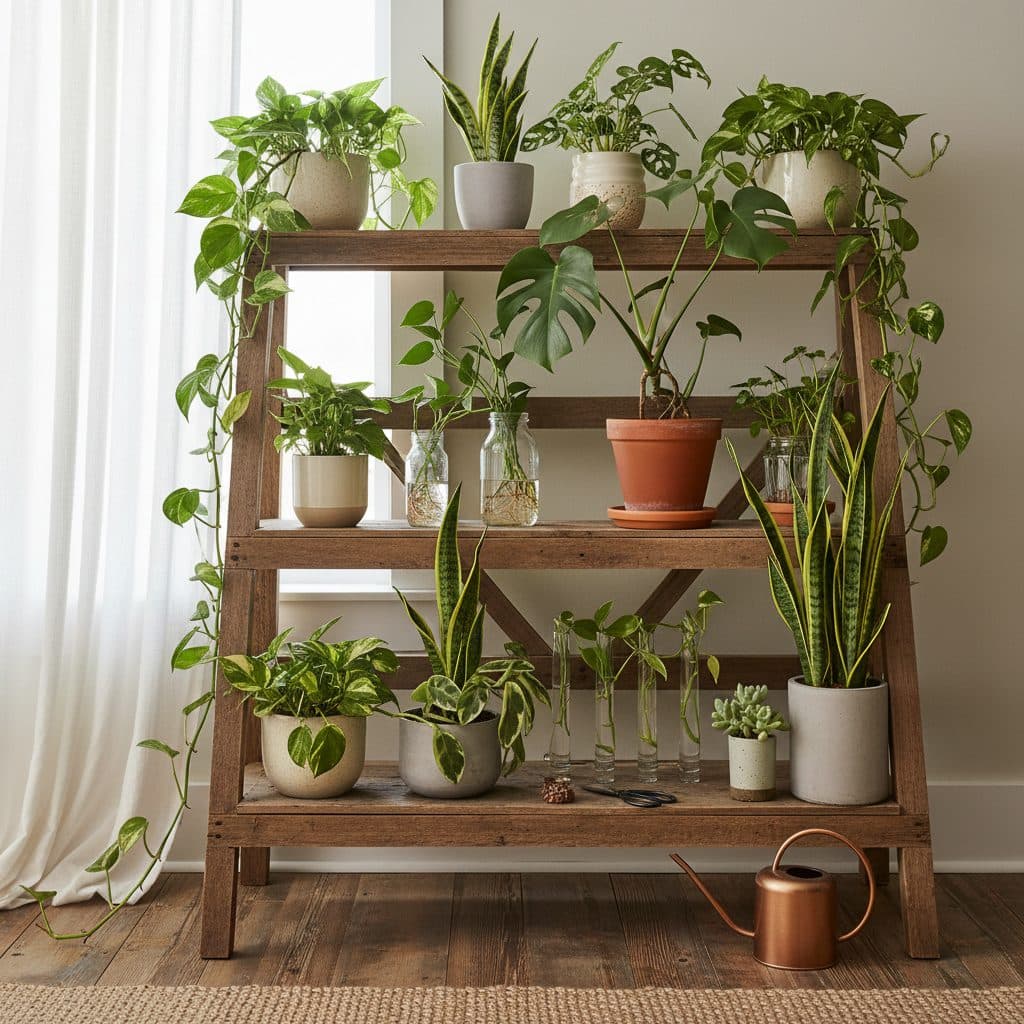
Key takeaways
- Water propagation offers visual root development and is often faster for initial rooting.
- Soil propagation provides a more stable environment for long-term growth and nutrient uptake.
- Pothos and philodendrons root readily in water within 2-4 weeks, often with success rates up to 90%.
- Monstera and snake plants benefit from higher humidity and careful soil selection for rooting, taking 6-8 weeks.
- Transitioning water-rooted cuttings to soil requires gradual acclimatization over 7-10 days to prevent shock.
- Sterile tools and proper node placement are critical for successful propagation, yielding high success rates.
Quick answer: Houseplant propagation involves taking cuttings and rooting them in either water or soil. Water propagation offers visual root development and faster initial rooting, while soil propagation provides a more stable environment for long-term growth and nutrient uptake.
Propagating pothos, philodendron, monstera and snake plants all happens indoors, so home growers anywhere in the country can do it whatever their outdoor hardiness zone. This practice allows for more plants at little cost, turning a single specimen into multiple gifts or additions to the home.
Understanding the differences between water and soil propagation methods matters for success, especially for common houseplants such as pothos, philodendron, monstera, and snake plants. Each method offers distinct advantages and challenges that affect rooting speed, plant health, and long-term viability. This guide covers these techniques, with practical advice for growers aiming for a high success rate.
The fundamentals of plant propagation
Propagation of houseplants primarily involves taking stem or leaf cuttings that contain nodes. A node is an important point on a stem where leaves, aerial roots, or branches emerge, and it holds the meristematic cells necessary for new growth. For instance, a pothos cutting should have at least one node, though two or three nodes often lead to a more robust root system within 3-4 weeks. Many aroids, like Monstera deliciosa, have prominent aerial roots, and including one in a cutting gives it a head start.
Successful propagation starts with clean, sharp tools to make precise cuts, minimizing damage and disease risk. A sterilized pair of pruning shears or a sharp knife is essential; wiping blades with 70% isopropyl alcohol between cuts can prevent the spread of pathogens. While rooting hormones can improve strike rates on some species, many common houseplants, especially pothos and philodendrons, root readily without them.
Essential tools for successful cuttings
Before you begin, gather your supplies. Having everything ready can streamline the process and improve your chances of success. For example, a good quality soil moisture meter can help you monitor conditions for soil propagation, ensuring optimal hydration without overwatering.
- Sharp, clean pruning shears or a knife for precise cuts.
- Small containers or jars for water propagation, holding 8-16 fluid ounces.
- Well-draining potting mix for soil propagation, typically containing 50% peat or coir.
- Rooting hormone, if desired, to encourage faster root development.
- Gloves to protect hands from plant sap. All four plants in this guide earn the caution: pothos, philodendron and monstera are aroids, and their sap carries needle-like calcium oxalate crystals that irritate skin and badly irritate mouths and eyes. All three are toxic to cats and dogs if chewed, and so is snake plant, which contains saponins. Keep cuttings, trimmings and rooting jars where pets and small children cannot reach them, and wash your hands after cutting.
Water propagation: advantages and techniques
Water propagation is a popular method, particularly for beginners, because it allows for direct observation of root development and generally requires less initial effort than soil. Pothos (Epipremnum aureum) and many Philodendron species, such as Philodendron hederaceum, are particularly successful in water, often showing root development within 10-14 days. This method is effective for up to 90% of cuttings when conditions are right, including consistent water changes every 3-5 days.
To propagate in water, select a healthy stem cutting, ensuring it has at least one node submerged in water and a few leaves above the waterline to facilitate photosynthesis. Use non-chlorinated water, or let tap water sit out for 24 hours to allow chlorine to dissipate. Place the cutting in a clear glass container in a location with bright, indirect light, maintaining an ambient temperature between 68-75°F. For example, a south-facing window in a home in Ohio, set back 2-3 feet, would provide ideal light.
Optimizing water rooting for success
While water propagation is straightforward, a few key practices can significantly improve your success rate. For instance, using smaller containers (e.g., 4-6 oz jars) can help maintain higher humidity around the cutting, which is beneficial for initial root formation.
- Change water every 3-5 days to prevent bacterial growth and replenish oxygen.
- Ensure at least one node is fully submerged, but avoid submerging leaves, which can rot.
- Provide bright, indirect light; direct sun can overheat the water and stress the cutting.
- Maintain consistent room temperatures, ideally between 70-75°F, for optimal growth.
- Consider adding a drop of liquid fertilizer after 2-3 weeks, diluted to 1/4 strength, to support new growth.
Soil propagation: advantages and techniques
Propagating directly into soil offers several long-term benefits, primarily providing a stable environment with immediate access to nutrients and better support for the developing root system. This method is often preferred for plants that are sensitive to transplant shock or those that develop stronger root systems in soil from the outset, such as snake plants (Sansevieria trifasciata). For snake plants, a leaf cutting can root successfully in soil, often taking 6-8 weeks to show new growth, compared to 3-4 weeks for pothos in water.
The key to successful soil propagation lies in using a well-draining, aerated potting mix. A common blend includes 50% peat moss or coco coir, 25% perlite, and 25% vermiculite, ensuring good moisture retention without becoming waterlogged. For example, a grower in USDA zone 9 in California might use a mix tailored for succulents, which provides excellent drainage. After inserting the cutting 1-2 inches deep into the moist soil, maintain consistent humidity around 70-80% for the first 4-6 weeks, which can be achieved with a humidity dome or plastic bag.
Creating the ideal soil environment
The right soil mix is crucial for encouraging root development and preventing rot. A sterile, light mix prevents fungal issues and allows delicate roots to penetrate easily. Monitoring soil moisture is vital; a 3-in-1 soil meter can help prevent overwatering, a common pitfall.
- Use a sterile, well-draining potting mix, such as a blend with 50% coco coir and 50% perlite.
- Ensure the pot has drainage holes to prevent waterlogging, which invites root rot.
- Keep the soil consistently moist but not saturated; allow the top 0.5 inch to dry slightly between waterings.
- Provide bottom heat using a seedling heat mat, maintaining soil temperatures around 75-80°F, which speeds rooting noticeably.
- Place cuttings in bright, indirect light, similar to water propagation, to support photosynthesis without scorching leaves.
Transitioning water-rooted cuttings to soil
The transition from water to soil is a critical phase for water-rooted cuttings, as they must adapt from a purely aquatic environment to a terrestrial one. Roots developed in water are often more fragile and less efficient at absorbing nutrients from soil, making them susceptible to shock if not acclimatized properly. For instance, a pothos cutting with 2-3 inch roots, if abruptly moved to dry soil, might experience significant leaf drop within 3-5 days.
To minimize transplant shock, gradually introduce the cutting to soil conditions. Begin by adding a small amount of potting mix to the water over a period of 1-2 weeks, or by placing the potted cutting in a high-humidity environment, such as a clear plastic bag, for 7-10 days. When potting, use a small pot, typically 4-6 inches in diameter, filled with a light, well-draining potting mix similar to that used for soil propagation. Ensure the root ball is gently placed and covered, avoiding deep planting that could suffocate the roots.
Post-transplant care for success
After transplanting, consistent care is paramount for the cutting to establish itself in its new medium. This period typically lasts 2-4 weeks, during which the plant is most vulnerable. Maintaining high humidity and consistent moisture without overwatering matters most during this period.
- Keep the soil consistently moist for the first 2-3 weeks, but never waterlogged, to ease the transition.
- Maintain high humidity (60-70%) around the plant for 1-2 weeks using a humidity dome or pebble tray.
- Provide bright, indirect light, avoiding direct sun exposure that can scorch delicate new leaves.
- Withhold fertilizer for the first 3-4 weeks after transplanting to prevent root burn.
- Monitor for signs of stress, such as wilting or yellowing leaves, and adjust care as needed within 24-48 hours.
Troubleshooting common propagation issues
Even with careful attention, propagation can present challenges. One of the most frequent issues is rot, which sets in whenever conditions are too wet or air circulation is poor. This often manifests as blackening stems or mushy leaves, typically within the first 5-7 days of propagation. Rot is particularly common in water propagation if water isn’t changed frequently, or in soil propagation if the mix is too dense or overwatered.
Another common problem is a lack of rooting, where cuttings fail to produce roots even after several weeks. This can be due to insufficient light, low temperatures (below 65°F), or using a cutting without a viable node. For example, a snake plant leaf cutting might fail to root if the cut end is allowed to dry out too much before planting, or if it’s planted in cold, wet soil in a northern state like Minnesota during winter. Adjusting environmental factors, such as increasing ambient temperature by 5-10°F or moving to a brighter spot, can often resolve these issues within 1-2 weeks.
Preventing common propagation failures
Proactive measures are often the best defense against propagation problems. Understanding the specific needs of each plant, such as the preference for high humidity for Monstera cuttings, can significantly increase success rates.
- Ensure proper drainage in soil propagation to prevent waterlogging and fungal diseases.
- Sterilize all tools before each use to avoid introducing pathogens to fresh cuts.
- Provide adequate light; too little light slows or halts root development.
- Maintain appropriate temperatures; most tropical houseplants root best between 70-80°F.
- Avoid overwatering in soil or stagnant water in water propagation to prevent rot within 48 hours.
Comparing water and soil propagation for popular houseplants
Feature | Water Propagation | Soil Propagation |
|---|---|---|
Rooting Speed | Often faster for initial root emergence (2-4 weeks) | Slower initial rooting (4-8 weeks) |
Root Strength | Water roots are more fragile, require acclimatization | Develops stronger, soil-adapted roots from start |
Nutrient Access | Limited to water minerals; requires supplements after 2 weeks | Immediate access to soil nutrients |
Observation | Easy to observe root growth and health | Root growth is hidden, requiring careful monitoring |
Ease of Use | Generally simpler, less prone to overwatering initially | Requires careful moisture management to prevent rot |
Success Rate | High for pothos/philodendron (85-90%); lower for others | High for snake plants/monstera (75-85%) with good mix |
Transplant Shock | Common when moving to soil if not acclimatized | Less common, as roots are already soil-adapted |
Pothos Rooting: Pothos cuttings often show visible root development in water within 10-14 days, with a success rate up to 90%.
Soil Temperature: Maintaining soil temperatures between 75-80°F speeds rooting for many cuttings.
Frequently asked questions
How long does it take for pothos to root in water?
Pothos cuttings typically show visible root development in water within 10-14 days. For best results, ensure the water is changed every 3-5 days and the cutting receives bright, indirect light, maintaining an ambient temperature of 70-75°F.
Can I propagate snake plants from a single leaf?
Yes, snake plants can be propagated from a single leaf cutting, with one important exception. Variegated forms such as ‘Laurentii’ and ‘Golden Hahnii’ carry their yellow margins in a chimeral layer that leaf cuttings do not reproduce, so the pups come up plain green. To keep the variegation, divide the rhizome instead of taking leaf cuttings. Cut a healthy leaf into 2-4 inch sections, keeping track of which end of each section pointed down toward the base of the plant — sections planted upside down will never root. Notching the top edge of each piece as you cut is the easy way to remember. Let them callus for 2-3 days, then plant them 1 inch deep, original bottom end down, in well-draining soil. Rooting can take 6-8 weeks, with new plantlets emerging after 2-3 months.
What is the ideal temperature for rooting plant cuttings?
Most tropical houseplant cuttings root best when ambient temperatures are between 70-80°F. For soil propagation, using a seedling heat mat to maintain soil temperatures in this range noticeably speeds rooting.
How often should I change the water for water propagation?
It’s advisable to change the water for cuttings every 3-5 days. This prevents the buildup of bacteria and replenishes oxygen, which supports healthy root development. Stagnant water can lead to rot within 48 hours.
Why are my cuttings not rooting?
Lack of rooting can stem from several factors, including insufficient light, low temperatures (below 65°F), or using a cutting without a viable node. Ensure your cutting has at least one node, provide bright indirect light, and maintain temperatures around 70-75°F for optimal success rates, often above 80%.
When should I move water-rooted cuttings to soil?
Water-rooted cuttings are generally ready for soil once roots are about 1-2 inches long and starting to branch. Waiting much beyond that works against you: the longer a cutting stays in water, the more water-adapted root mass it has to lose when it moves to soil. Gradual acclimatization over 7-10 days helps prevent transplant shock.
References
- The Factors Influencing The Purchase of Ornamental Plants (Case Study of Monstera and Philodendron Products) (2024). The Factors Influencing The Purchase of Ornamental Plants (Case Study of Monstera and Philodendron Products).
- Araceae (Aglaonema, Anthurium, Caladium, Dieffenbachia, Monstera, Philodendron, Scindapsus, Syngonium) (2026). Araceae (Aglaonema, Anthurium, Caladium, Dieffenbachia, Monstera, Philodendron, Scindapsus, Syngonium).
- Panen dan Penanganan Pascapanen Asparagus umbellatus, Monstera, dan Philodendron di Naaldjwik, Belanda Selatan, Belanda (2019). Panen dan Penanganan Pascapanen Asparagus umbellatus, Monstera, dan Philodendron di Naaldjwik, Belanda Selatan, Belanda.
- Identification of a harvest index for <i>Monstera deliciosa</i> and <i>Philodendron</i> sp. ‘Xantal’ leaves for ornamental use (2022). Identification of a harvest index for <i>Monstera deliciosa</i> and <i>Philodendron</i> sp. ‘Xantal’ leaves for ornamental use.
- Monstera (2007). Monstera.
- USDA Natural Resources Conservation Service (2024). USDA Natural Resources Conservation Service.