support
Money plant
money plant
Epipremnum aureum
- punjab plains
- sindh coast
- pothohar
International hardiness
- USDA 10-12
- RHS H1b
- AU: Tropical, Subtropical
Where it grows — regional guide
| Zones / rating | Regional notes |
|---|---|
USDA 10-12 | Hardy outdoors only in frost-free South Florida and Hawaii (Zones 10 to 12) where it is a prohibited invasive weed; keep strictly indoors elsewhere. |
| Zones / rating | Regional notes |
|---|---|
H1b (10 to 15C) | No region-specific data yet |
| Zones / rating | Regional notes |
|---|---|
Tropical, Subtropical | Grown indoors nationwide; outdoor plantings are strictly cautioned against in tropical Queensland where escaped vines aggressively smother rainforest canopies. |
| Zones / rating | Regional notes |
|---|---|
USDA 10-12 (USDA scale) Canada uses its own zone system; Canadian zones run roughly one lower than USDA. | No region-specific data yet |
| Zones / rating | Regional notes |
|---|---|
Punjab plains, Sindh coast, Pothohar | Pakistan:Widely grown as a container vine in homes across the Punjab plains and Sindh coast; shelter from dry summer winds and keep out of reach of pets. India:Ubiquitous across India as an indoor vine and Vastu plant; thrives in water jars or gritty potting mix, but keep out of reach of pets due to toxic oxalates. |
Money plant (Epipremnum aureum), widely known in western horticulture as golden pothos or devil's ivy, is an evergreen climbing vine belonging to the arum family (Araceae). Indigenous to the volcanic island of Mo'orea in French Polynesia, the species has naturalised across tropical regions worldwide. In South Asian domestic culture, particularly across India and Pakistan, the plant is celebrated as the money plant. It is deeply embedded in urban apartments, offices, and homestead courtyards, where traditional folklore and Vastu Shastra principles associate its vegetative vigour with prosperity and emotional well-being.
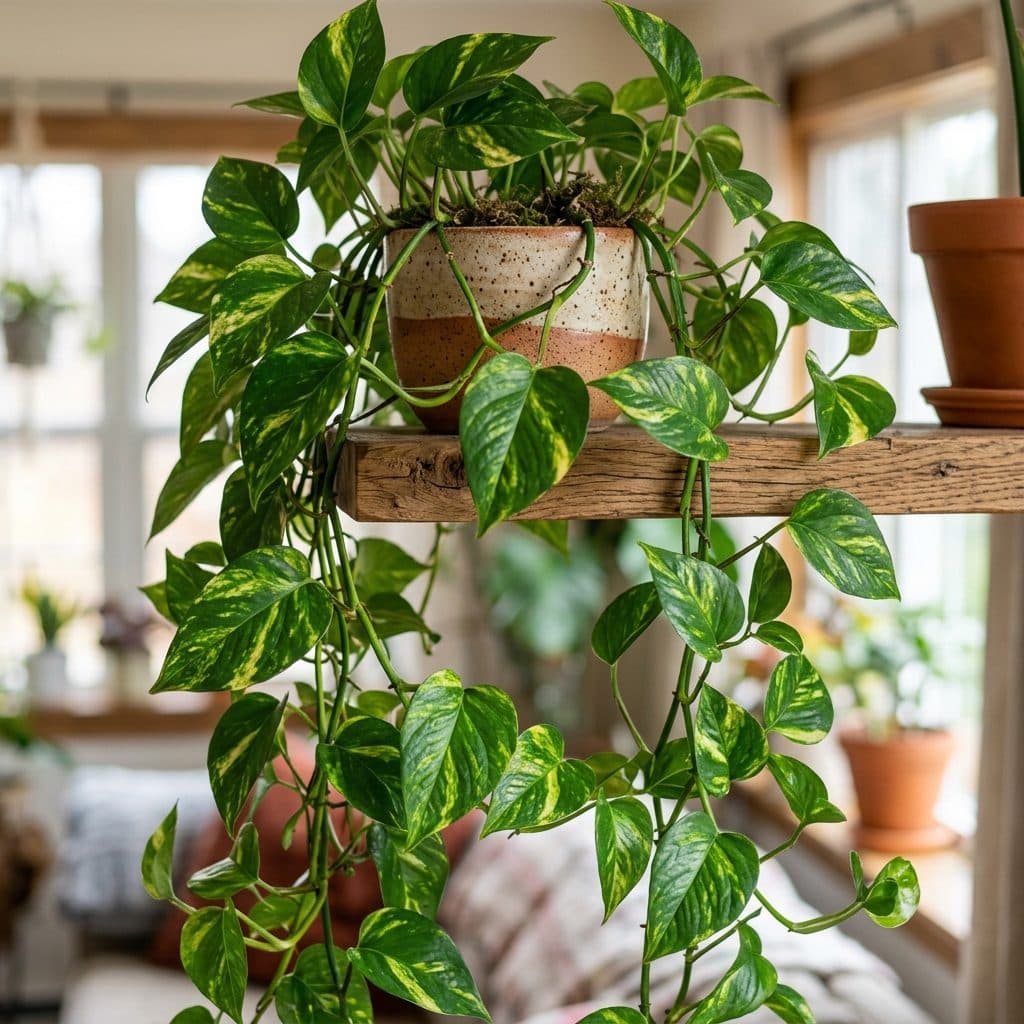
As a hemiepiphyte, Epipremnum aureum exhibits two distinct morphological phases. In its juvenile stage, seen in indoor container culture, it produces trailing stems lined with alternate, heart-shaped leaves displaying splashes of golden-yellow variegation. When granted warm outdoor conditions and allowed to climb tall host trees, the climbing stems thicken, producing stout aerial roots and large leathery leaves resembling those of giant taro. For indoor gardeners, mastering money plant care provides an exceptionally resilient ornamental that thrives alongside container specimens like aloe vera or water hyssop.
Growing money plant
The money plant is a tropical understory climber that thrives in warm, frost-free environments with high ambient humidity and filtered light. The species is reliably winter-hardy outdoors only in USDA Zones 10 to 12, suffering severe chilling injury when temperatures drop below 10 °C (50 °F). Freezing conditions kill foliage and succulent stems within hours. Across temperate and continental climates, it is cultivated exclusively as an indoor houseplant or sheltered patio specimen brought indoors before autumn chills arrive.
Light exposure dictates both leaf colouration and growth rate. The plant flourishes in medium to bright indirect sunlight. Direct summer sun scorches foliage, causing bleached patches and crispy brown leaf margins. Conversely, while Epipremnum aureum tolerates dim corners illuminated solely by artificial light, prolonged low-light conditions cause golden variegation to fade into solid dull green as the plant produces more chlorophyll. For optimal colour, site the plant near an east-facing window.
Substrate and water management require careful balance. When grown in soil, money plant demands a porous, well-aerated potting mixture that drains excess moisture rapidly. A standard blend of equal parts coarse coco peat, compost, perlite, and coarse river sand provides ideal root aeration. Terracotta containers with open drainage holes prevent water from stagnating around the root ball. Allow the top 2 to 3 cm (0.8 to 1.2 in) of soil to dry out between waterings. Overwatering is the primary cause of root rot, typically signalled by money plant yellow leaves accompanied by soft, blackened petiole bases. During hot summer months, watering every four to six days is common, whereas in cool winter periods, watering intervals should be extended to ten to fourteen days.
Growing a money plant in water is an immensely popular alternative to soil cultivation. Select healthy tip cuttings bearing three to four nodes, strip the lowest leaves, and submerge the bottom two nodes in clean water within a glass jar. Place the container in bright indirect light. Replace standing water every seven to ten days to prevent algal growth and maintain oxygenation. A water-grown vine can survive for years; adding two drops of balanced liquid organic fertiliser once a month during spring and summer sustains leaf colour.
To cultivate larger foliage indoors, train climbing stems upward along a damp coir or moss pole. As adventitious aerial roots penetrate the moist support, they absorb moisture and nutrients, signalling the vine to expand leaf surface area. Apply a mild, balanced liquid fertiliser diluted to half-strength once every four weeks during active spring and summer growth.
Harvest and uses
Epipremnum aureum is harvested primarily for vegetative propagation, interior styling, and indoor air filtration. Homesteaders harvest stem cuttings throughout the warm season to multiply plants. Sever a stem segment just below an active node bearing an aerial root nub; these cuttings root within ten to fourteen days when placed in water or damp perlite.
Beyond ornamental value, the plant is widely utilised in indoor phytoremediation. Controlled environmental evaluations, including research from the NASA Clean Air Study, demonstrate that Epipremnum aureum absorbs and metabolises volatile organic compounds, including formaldehyde, benzene, and xylene, from indoor air. Transpiration from its leaves also moderates dry indoor air generated by air conditioning and heating.
In South Asian cultural traditions, the plant holds an esteemed place in Vastu Shastra. According to Vastu guidelines, placing a healthy money plant in the southeast corner of a home—a direction associated with Lord Ganesha and Venus—is believed to attract prosperity and absorb domestic stress. Practitioners advise against placing the vine in northeast zones and recommend removing withered leaves promptly. No part of Epipremnum aureum is edible; all plant tissues must be kept out of culinary preparations.
Identifying money plant
Epipremnum aureum can be identified by the following botanical characteristics:
- Habit and stems: An evergreen trailing or climbing herbaceous vine reaching 2 to 4 m (6.5 to 13 ft) indoors, but climbing up to 20 m (65 ft) outdoors on host trees. Stems are green, flexible, slightly grooved longitudinally, and produce adventitious clasping aerial roots at each node.
- Foliage: In juvenile container form, leaves are alternate, simple, glossy, cordate at the base with an acute apex, measuring 7 to 15 cm (3 to 6 in) long and 5 to 10 cm (2 to 4 in) broad. Leaf colouration is emerald green marbled with creamy white or golden yellow. In adult outdoor climbing forms, leaves become leathery, ovate-elliptic, up to 90 cm (35 in) long, regularly developing deep pinnatifid slits along the margins.
- Petioles: Distinctly channeled with winged margins along the lower half, lacking the persistent dried papery sheaths (cataphylls) typical of climbing philodendrons.
- Inflorescence: A dense spadix enclosed by a boat-shaped spathe, typical of Araceae, but flowers are almost never observed in cultivation due to a genetic block in gibberellin synthesis.
The plant is commonly confused with heartleaf philodendron (Philodendron hederaceum). Pothos is distinguished by grooved petioles, thicker waxy leaves, raised stem ridges, and the absence of loose papery cataphylls. It is also distinguished from satin pothos (Scindapsus pictus), which features matte blue-green leaves adorned with reflective silvery patches.
Cautions
Anyone cultivating or displaying Epipremnum aureum must observe important precautions regarding toxicity and environmental weed risk:
- Insoluble calcium oxalate toxicity: Every part of Epipremnum aureum, including stems, foliage, and roots, contains high concentrations of microscopic, needle-like crystals of insoluble calcium oxalate grouped in bundles called raphides. When chewed, these crystals are forcibly ejected into the soft tissues of the mouth, tongue, and throat. Ingestion by humans, dogs, or cats causes immediate oral pain, burning, profuse salivation, swelling of the lips, tongue, and pharynx, difficulty swallowing, and vomiting. Severe cases can lead to upper airway compromise. Keep container specimens and trailing vines completely out of reach of pets and young children.
- Contact dermatitis: Pruning extensive vines without gloves releases plant sap containing calcium oxalate crystals and proteolytic enzymes, provoking mechanical irritation and dermatitis on sensitive skin. Wear rubber gloves when pruning or repotting large specimens, and wash hands thoroughly with soap and water immediately afterward.
- Severe outdoor invasiveness in tropical ecosystems: In warm, frost-free maritime regions such as South Florida, Hawaii, coastal Queensland, and several Caribbean islands, Epipremnum aureum has escaped cultivation to become an aggressive invasive weed. Climbing lianas encircle native canopy trees, producing massive foliage that shades out host leaves, while the sheer weight of accumulated biomass causes tree limbs and forest canopies to collapse. Fallen stem fragments root effortlessly in leaf litter, creating dense carpet-like monocultures that smother native understory seedlings and ferns. The species is listed as an invasive exotic pest plant in Florida and parts of northern Australia. Never discard pruning trimmings into natural drainage waterways, bushland reserves, or municipal green waste in subtropical or tropical climates.
- Regulatory note: The species is subject to ecological monitoring and planting restrictions in sensitive tropical island ecosystems; check local biosecurity registers before introducing to outdoor landscape settings.
Sources
- Royal Botanic Gardens, Kew. Epipremnum aureum (Linden & André) G.S.Bunting Plants of the World Online.
- NC State Extension Plant Toolbox. Epipremnum aureum
- Missouri Botanical Garden. Epipremnum aureum
- University of Florida IFAS Assessment. Epipremnum aureum