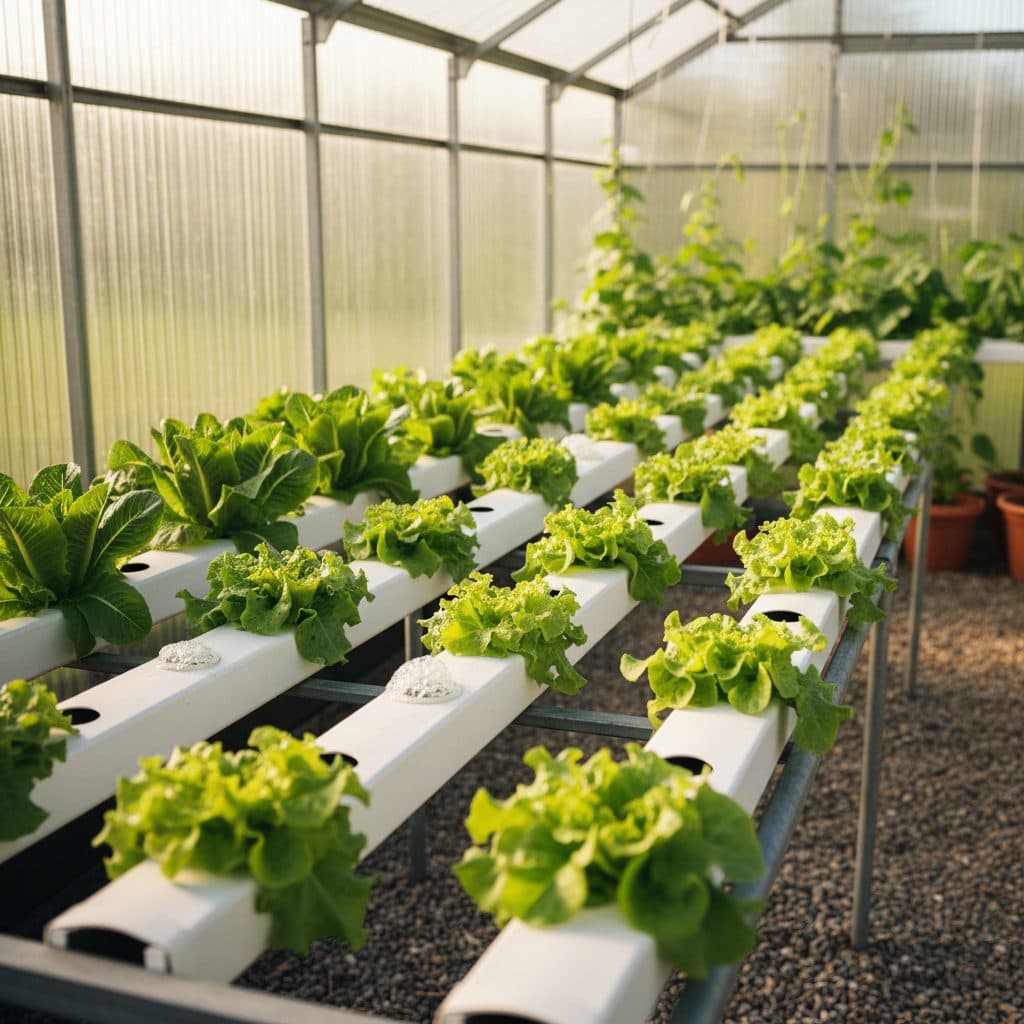
Key takeaways
- Hydroponic NFT systems use far less water than traditional soil farming, because the solution recirculates.
- A typical home-scale PVC-gutter NFT system can be built for $200-$400 and occupy a 4 ft by 8 ft footprint.
- Maintain nutrient solution pH between 5.5 and 6.5 and EC between 1.2 and 1.8 mS/cm for optimal leafy green growth.
- Ensure a consistent 1% to 2% slope in gutters for proper nutrient flow and oxygenation.
- Replace the entire nutrient solution every 7 to 14 days to prevent nutrient imbalances and limit pathogen build-up in the reservoir.
Quick answer: A PVC-gutter Nutrient Film Technique (NFT) system can be built at home to grow lettuce and other leafy greens, significantly reducing water usage by 70-90% compared to traditional soil farming. This method provides consistent harvests in a compact space, making it suitable for various climates like USDA Zone 6.
For growers in arid regions like Arizona, or even in a typical backyard in USDA zone 6, conserving water is a serious consideration. Traditional soil gardening can be water-intensive, but a well-designed hydroponic system offers a viable alternative. Specifically, a Nutrient Film Technique (NFT) system built from PVC gutters recirculates its solution rather than losing it to soil drainage and evaporation, so it needs a fraction of the water conventional field growing does. This method provides a consistent supply of fresh leafy greens, often yielding crops in as little as 30 to 45 days.
This article provides a practical guide for constructing a PVC-gutter NFT system suitable for home use. We will cover everything from selecting the right materials (estimated to cost between $200 and $400 for a small to medium setup) to step-by-step assembly and ongoing maintenance. You can expect to produce several pounds of lettuce, spinach, or other greens each month, even in a compact space measuring just 4 ft by 8 ft.
The case for nutrient film technique
The Nutrient Film Technique, or NFT, stands out as an efficient hydroponic method, particularly for growing fast-growing, shallow-rooted crops like lettuce, spinach, and various herbs. Unlike deep water culture (DWC) systems where roots are submerged, NFT involves a genuinely thin stream of nutrient-rich water (no more than about 1/8 inch or 3 mm deep) flowing over the roots in a slightly sloped channel. This constant flow provides both nutrients and oxygen, which supports healthy root development and prevents root rot, a common issue in less oxygenated systems. For instance, a well-managed NFT system can produce a head of lettuce in 30 to 45 days, significantly faster than the 60 to 90 days often required in soil. For more on other DIY options, see our guide on DIY hydroponic systems.
One of the most compelling reasons to choose NFT is its remarkable water efficiency. Hydroponic systems generally use far less water than soil growing, because the solution recirculates instead of draining away. This translates to substantial savings, especially in regions experiencing drought conditions, such as California’s Central Valley. NFT systems are also space-efficient, allowing for higher plant densities per square foot. A 4 ft by 8 ft setup, for example, can comfortably house 30 to 40 lettuce plants, yielding a continuous supply for a family of four. The closed-loop design also means minimal nutrient runoff, making it an economical choice for long-term operation.
Advantages of NFT for home growers
Beyond water savings, NFT offers several practical benefits for the home grower. The controlled environment minimizes pest and disease issues, reducing the need for pesticides. Nutrient delivery is precise, allowing you to tailor solutions for optimal plant growth. Furthermore, the elevated channels make planting, monitoring, and harvesting much easier on the back, compared to ground-level gardening. These systems are also adaptable; you can scale them up or down based on available space, from a small kitchen setup to a larger outdoor array in a sheltered area.
- Sharply reduced water consumption compared to soil.
- Faster growth cycles, yielding lettuce in 30 to 45 days.
- Efficient use of space, accommodating 30-40 plants in a 32 sq ft area.
- Precise nutrient delivery for optimal plant health.
- Easier harvesting and maintenance due to elevated channels.
Essential components for your NFT system
Before you begin construction, gathering all necessary materials will streamline the building process. The core of this system revolves around standard PVC components, readily available at most hardware stores across the US. For the growing channels, you will need 4-inch or 6-inch PVC gutters, typically sold in 10 ft lengths. A system designed for 30 plants might require three to four 10 ft sections of gutter. The support frame will use 1.5-inch schedule 40 PVC pipe for structural integrity, with about 40 ft needed for a 4 ft by 8 ft footprint.
Beyond the PVC, several other components are needed. A submersible water pump with a flow rate of 150 to 250 gallons per hour (GPH) suits a system of this size to maintain nutrient circulation. You’ll also need a dark-colored reservoir of at least 15 to 20 gallons to hold the nutrient solution and prevent algae growth. Net pots, typically 2-inch or 3-inch diameter, will hold your seedlings. Remember to acquire a high-quality hydroponic nutrient solution, formulated for leafy greens, and a pH testing kit to maintain the optimal range of 5.5 to 6.5.
Detailed parts list
Having a complete list ensures you don’t miss any critical components, which can delay your project by days. Consider purchasing a few extra fittings, like elbows and tees, as they are inexpensive and useful for unexpected adjustments. For the plumbing, you will need 0.5-inch flexible tubing and a few hose clamps. A drill with a 2-inch or 3-inch hole saw (matching your net pot size) is also essential for creating the plant sites in the gutters. Plan to spend approximately $200 to $400 on these materials for a basic setup, depending on local pricing and sales.
- PVC gutters: 4-inch or 6-inch, 3-4 sections of 10 ft.
- PVC pipe (Schedule 40): 1.5-inch diameter, approximately 40 ft.
- Submersible pump: 150-250 GPH flow rate.
- Reservoir: Dark-colored, 15-20 gallon capacity.
- Net pots: 2-inch or 3-inch diameter, 30-40 count.
Constructing the support frame
A sturdy support frame is essential for holding your NFT gutters at the correct slope and height. For a system measuring 4 ft wide by 8 ft long, you will need to cut your 1.5-inch Schedule 40 PVC pipe into several specific lengths. Start by cutting the four vertical legs from 1.5-inch pipe: two at 24 inches for the high end and two at 23 inches for the low end, which builds the drainage slope into the frame and gives a comfortable working height. Next, cut two 8 ft long horizontal base pieces and two 4 ft long cross pieces for the bottom frame. You’ll also need two more 8 ft pieces for the top horizontal supports that will hold the gutters, and plan to cut your 10 ft gutters down to 8 ft so they are carried along their whole length. Use a PVC pipe cutter or a hacksaw for clean, straight cuts, keeping all measurements accurate to within 0.25 inches.
Once all pieces are cut, begin assembling the base. Connect the 8 ft base pieces and 4 ft cross pieces using 1.5-inch PVC elbow fittings to form a rectangular frame. Apply PVC primer and cement to all joints for a strong, watertight bond; this ensures the frame can withstand the weight of water-filled gutters, which can be considerable (each 10 ft gutter section holds roughly 3 to 5 gallons of water). Attach the 24-inch vertical legs to the corners of this base frame using tee fittings. Ensure the legs are plumb and secure before proceeding to the upper structure.
Ensuring proper slope and stability
The success of an NFT system heavily relies on a slight, consistent slope in the gutters, about 1.25 to 2.5 inches over a 10 ft length, which is a 1% to 2% grade. To achieve this, the upper horizontal supports will need to be slightly offset in height. For example, if one end of the 8 ft top support is 24 inches high, the other end should be 23 inches high, creating a 1-inch drop. Use a level to confirm the slope before the cement fully cures. This precise slope ensures the nutrient solution flows steadily without pooling, which can lead to root issues and reduced oxygen levels. A stable frame prevents any shifting that could interrupt this critical flow.
- Cut two 24-inch and two 23-inch vertical legs from 1.5-inch PVC pipe.
- Cut two 8 ft and two 4 ft pieces for the base frame.
- Assemble the base frame using 1.5-inch elbow fittings and PVC cement.
- Attach vertical legs to the base using tee fittings.
- Ensure a 1% to 2% slope, about 1.25 to 2.5 inches over a 10 ft run, for the top supports.
Installing gutters and plumbing
With the frame complete, the next step is to install the PVC gutters that will serve as your growing channels. Securely attach the 4-inch or 6-inch gutters to the top horizontal supports of your frame using U-bolts or strong zip ties so they maintain the pre-set 1% to 2% slope. For a system with three 8 ft gutters, space them approximately 12 inches apart to allow for adequate light penetration and air circulation around the plants. At the higher end of each gutter, drill a 0.5-inch hole for the nutrient solution inlet. At the lower end, cut a larger 2-inch by 2-inch opening or use a specialized end cap with a drain fitting to allow the solution to return to the reservoir.
Next, prepare the gutters for planting. Using a 2-inch or 3-inch hole saw (matching the size of your net pots), drill holes along the top of each gutter. Space these holes about 8 to 10 inches apart for leafy greens like lettuce, allowing each plant sufficient room to grow. For an 8 ft gutter, this spacing will accommodate 10 to 12 plants. Ensure the holes are clean and smooth to prevent damage to plant stems. Once the holes are drilled, rinse the gutters thoroughly with clean water to remove any PVC shavings or debris, which could contaminate your nutrient solution.
Connecting the pump and reservoir
The plumbing system is what brings your NFT setup to life, circulating the nutrient solution. Place your 15 to 20 gallon reservoir directly beneath the lower end of the gutters so the return flow drains directly into it. Position the submersible pump inside the reservoir, and plug it into a GFCI-protected outlet, since this is a mains-powered pump sitting in water. Connect the pump to 0.5-inch flexible tubing, running it up to the higher end of your gutter system. Use a manifold or T-fittings to split the tubing, directing a small stream of nutrient solution into the inlet hole of each gutter. Adjust the pump’s flow rate, if possible, to ensure a gentle, consistent film of water (no more than about 1/8 inch or 3 mm deep) flows through each channel. This continuous flow is critical for delivering oxygen and nutrients to the plant roots. Because the channels hold almost no water, the system has no buffer: if the pump stops or an inlet hole clogs, roots can dry out within hours. Check the flow daily, keep the inlet holes clear, and keep a spare pump on hand.
- Attach 4-inch or 6-inch gutters to the frame with a 1-2% slope.
- Drill 0.5-inch inlet holes at the high end of each gutter.
- Cut 2-inch by 2-inch drain openings at the low end of each gutter.
- Drill 2-inch or 3-inch plant holes, 8-10 inches apart, along the gutters.
- Connect the submersible pump in the 15-20 gallon reservoir to the gutter inlets using 0.5-inch tubing.
From seedling to harvest: managing your NFT system
Once your NFT system is built and tested, it’s time to introduce your leafy greens. Start with healthy seedlings that have developed a small root ball, typically grown in rockwool cubes or coco coir plugs. Gently place these seedlings into the net pots so the roots extend below the net pot and into the gutter channel, ready to meet the nutrient film. For optimal growth, maintain the nutrient solution temperature between 65°F and 75°F. Temperatures outside this range, especially above 80°F, can reduce dissolved oxygen and stress plants, potentially leading to slower growth or disease.
Nutrient solution management requires consistent attention. Regularly monitor the pH and electrical conductivity (EC) of your solution. For most leafy greens, a pH range of 5.5 to 6.5 is ideal, allowing for maximum nutrient uptake. The EC, which measures nutrient concentration, should typically be between 1.2 and 1.8 mS/cm for lettuce and similar greens. Check these parameters daily, or at least every other day, and adjust using pH up/down solutions and concentrated nutrients as needed. Replace the entire nutrient solution every 7 to 14 days to prevent nutrient imbalances and pathogen buildup, one part of food-safe practice alongside clean source water, clean handling and clean contact surfaces.
Lighting and environmental factors
Even in a greenhouse or sunny outdoor location, supplemental lighting can significantly boost yields, especially during shorter winter days in regions like the Pacific Northwest. Aim for 14 to 16 hours of light per day for vigorous growth. If growing indoors, a full-spectrum LED grow light is an efficient choice, drawing about 100 to 200 watts for a 4 ft by 8 ft system. Consider a reflective indoor grow tent for optimal light efficiency. Ensure good air circulation using a small fan to prevent fungal issues and strengthen plant stems. Maintaining consistent environmental conditions (temperature, humidity, and airflow) helps plants produce fresh, high-quality leafy greens, often yielding 2-3 pounds per week from a 30-plant system.
- Start with seedlings in rockwool or coco coir.
- Maintain nutrient solution temperature between 65°F and 75°F.
- Keep pH between 5.5 and 6.5 and EC between 1.2 and 1.8 mS/cm.
- Replace nutrient solution every 7 to 14 days.
- Provide 14 to 16 hours of light daily, using 100-200W LED indoors.
Comparison of hydroponic systems for leafy greens
System Type | Key Characteristics | Best For |
|---|---|---|
Nutrient Film Technique (NFT) | Shallow nutrient film, high oxygenation, efficient water use, continuous flow. | Fast-growing, shallow-rooted greens like lettuce, spinach, and herbs. |
Deep Water Culture (DWC) | Roots submerged in aerated nutrient solution, simple to set up, requires air pump. | Larger, slower-growing plants, but also suitable for many types of greens. |
Kratky Method | Non-circulating, passive system, no pump or electricity required, roots grow into static nutrient solution. | Small-scale, individual plants like lettuce, very low maintenance, ideal for beginners. |
Water Savings: Recirculating hydroponics uses a fraction of the water field growing needs, a real advantage in dry regions like California.
Rapid Harvest: Lettuce in an NFT system can be ready for harvest in 30-45 days, providing a continuous fresh supply for your table.
Frequently asked questions
How often should I change the nutrient solution in my NFT system?
For optimal plant health and to prevent nutrient imbalances or pathogen buildup, you should replace the entire nutrient solution every 7 to 14 days. It is one part of food-safe practice in hydroponic systems, alongside clean source water, clean handling and clean contact surfaces.
What is the ideal pH range for leafy greens in an NFT system?
Most leafy greens thrive in a slightly acidic pH range of 5.5 to 6.5. Regularly checking and adjusting your solution’s pH, ideally daily or every other day, ensures maximum nutrient uptake for your plants.
Can I grow other vegetables besides leafy greens in an NFT system?
While NFT is best for shallow-rooted, fast-growing crops like lettuce and spinach, you can grow some herbs. Larger, fruiting vegetables like tomatoes or peppers typically require different hydroponic methods, such as Dutch buckets or deep water culture, due to their larger root systems and nutrient demands.
How much space does a typical PVC-gutter NFT system require?
A practical home-scale NFT system designed to grow 30-40 lettuce plants might occupy a footprint of about 4 ft by 8 ft. This compact design allows for significant production in a relatively small area, even indoors or on a patio.
What is the average cost to build a PVC-gutter NFT system?
The cost for materials to build a basic PVC-gutter NFT system for home use typically ranges from $200 to $400. This estimate includes PVC pipes, gutters, a pump, reservoir, net pots, and initial nutrient solution.
How can I prevent algae growth in my NFT system?
Algae thrive on light and nutrients. To prevent algae, use a dark-colored reservoir and ensure your gutters are opaque, blocking all light from the nutrient solution. Regularly cleaning your system during solution changes also helps control any minor algae accumulation.