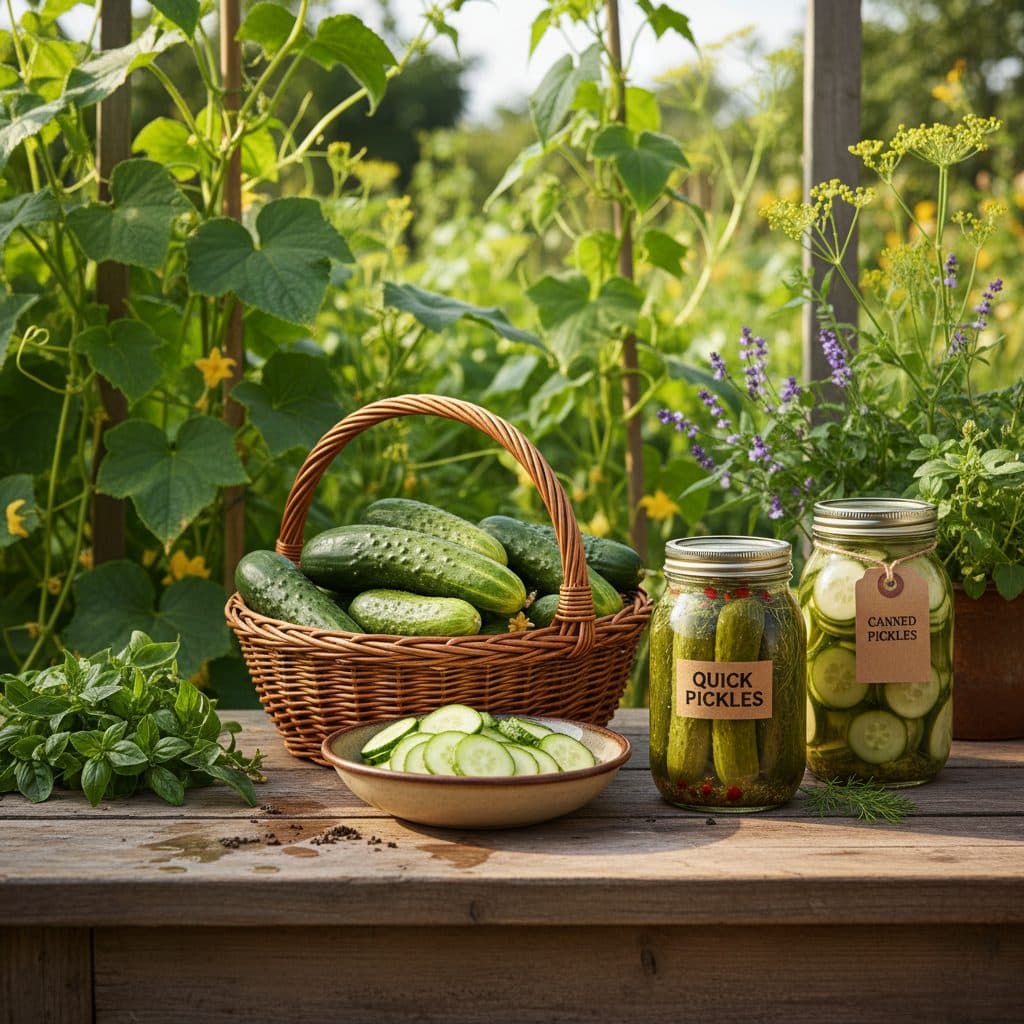
Key takeaways
- Refrigerator pickles offer a quick method, ready in 24 hours, but require cold storage below 40°F and last only 2-3 weeks.
- Shelf-stable vinegar pickles use a hot water bath canning process to create a vacuum seal, allowing storage for 12+ months at room temperature.
- Achieving a pH of 4.6 or lower is what makes shelf-stable canned pickles safe. Refrigerator pickles rely on constant cold instead — their acidity alone will not hold them at room temperature.
- Always use vinegar with a minimum 5% acidity for safe pickling; lower concentrations are not reliable for preservation.
- Proper jar preparation, including clean jars and lids, and correct headspace (1/4 to 1/2 inch), is vital for successful canning.
- Consider your storage space and consumption rate when choosing between quick or shelf-stable pickling techniques for your harvest.
Quick answer: To safely pickle a large cucumber harvest, choose between quick refrigerator pickles for short-term storage or shelf-stable vinegar pickles using a hot water bath for long-term preservation. Both methods require vinegar with at least 5% acidity and a final pH of 4.6 or lower to inhibit harmful bacteria.
When your garden in USDA zone 5 starts producing cucumbers by the bushel — maybe 50 pounds or more in a good season — you quickly realize the need for efficient preservation. Two common ways to turn that bounty into tangy treats are quick refrigerator pickles and shelf-stable vinegar pickles. While both methods rely on vinegar to create that distinctive sour flavor, their preparation, safety, and storage requirements differ significantly, impacting how long your harvest lasts and where you can keep it.
These distinctions matter for home growers aiming to preserve food safely and effectively. Whether you’re processing 10 pounds of pickling cucumbers from a small backyard plot in Ohio or a much larger harvest from a market garden in California, knowing which method suits your needs can prevent spoilage and ensure delicious results. The sections below cover the specifics of each technique, from the brine composition to the final storage conditions.
the convenience of quick refrigerator pickles
Quick refrigerator pickles, sometimes called ‘quickles,’ are a straightforward way to enjoy your cucumber harvest with minimal fuss. This method involves submerging sliced or whole vegetables, often cucumbers, onions, or carrots, in a cold or briefly heated brine made from vinegar, water, salt, and sugar, along with various spices. The entire process, from preparation to being ready to eat, can take as little as 24 hours. For example, a batch of sliced pickling cucumbers from a garden in coastal Oregon might be ready for a sandwich the very next day. The key here is that these pickles are never heat processed in a canner; they rely solely on refrigeration for preservation, making them a good option for smaller batches or immediate consumption.
making safe refrigerator pickles
To make safe refrigerator pickles, start with fresh, firm produce, ideally harvested within 24 hours. A typical brine is equal parts 5% acidity white vinegar and water, plus pickling salt and a little sugar. Take the salt quantity from a tested refrigerator-pickle recipe rather than guessing: salt here is for flavor and texture, not safety, and it is easy to make a batch far too salty to eat. For a 2-quart batch, you’d generally use about 4 cups of liquid. The brine should be brought to a boil, then cooled slightly before pouring over packed vegetables in clean jars. Ensure the vegetables are fully submerged, leaving about one-half inch of headspace. Once cooled, seal the jars and store them in the refrigerator at 40°F or below. These pickles will develop flavor over a few days and are best consumed within two to three weeks for optimal quality and safety [4]. This method is particularly useful for gardeners in USDA zone 7 who might have smaller, continuous harvests rather than one large flush.
- Use fresh, firm produce, ideally 4 to 6 inches long for cucumbers.
- Ensure vinegar has at least 5% acidity for proper preservation.
- Pack vegetables tightly into clean jars, leaving adequate headspace.
- Store continuously at 40°F or colder; do not store at room temperature.
- Consume within 2-3 weeks for the best flavor and safety.
the durability of shelf-stable vinegar pickles
Shelf-stable vinegar pickles are designed for long-term storage outside of refrigeration, making them an excellent choice for preserving a large harvest, such as 30 pounds of cucumbers from a garden in the Central Valley of California. This method involves packing vegetables into jars with a hot brine, then processing the sealed jars in a boiling water bath canner. The heat processing creates a vacuum seal, which, combined with the high acidity of the brine, inhibits the growth of spoilage microorganisms and harmful bacteria like Clostridium botulinum. A properly canned jar of pickles can last for at least one year, often longer, when stored in a cool, dark pantry [4]. This longevity is a significant advantage for those aiming to extend their garden’s bounty through the winter months.
ensuring safety with canning
The cornerstone of safe shelf-stable pickling is maintaining a brine pH of 4.6 or below, which is achieved by using vinegar with a minimum of 5% acidity [4]. For example, a recipe might call for a 2:1 ratio of 5% vinegar to water. After packing jars with vegetables and hot brine, leaving 1/4 inch to 1/2 inch of headspace, the jars are sealed with new lids and processed in a boiling water bath. Processing times vary by recipe, jar size, and altitude; for pint jars of dill pickles, a common processing time is 10 minutes at 0 to 1,000 feet. Above that you must add time. For boiling water bath processes of 20 minutes or less, add 5 minutes at 1,001–3,000 feet, 10 minutes at 3,001–6,000, 15 at 6,001–8,000, and 20 above 8,000. Take the exact adjustment from the tested recipe you are following. The heat from the water bath pasteurizes the jar contents and drives out air, which creates the vacuum seal as the jar cools. It does not sterilize them. Always refer to tested recipes from sources like the National Center for Home Food Preservation to ensure safety, particularly for those in higher elevations like parts of Colorado, where processing times need adjustment. More detailed information on safe canning practices is in our guide to canning salsa.
- Always use tested recipes from reliable sources for processing times and brine ratios.
- Ensure vinegar has a minimum 5% acidity; do not dilute it beyond recipe specifications.
- Use new canning lids and clean, hot jars for proper sealing.
- Process jars in a boiling water bath canner for the specified time, adjusting for altitude.
- Store processed jars in a cool, dark place, ideally below 70°F, for up to 12 months.
critical differences in safety and storage
The primary distinction between quick refrigerator pickles and shelf-stable vinegar pickles lies in their safety mechanisms and subsequent storage requirements. Refrigerator pickles rely on the cold temperature of a refrigerator, typically 40°F or below, to slow bacterial growth. Their acidity, while flavorful, is not sufficient on its own to prevent spoilage at room temperature over extended periods. This means they have a limited shelf life, usually two to three weeks, and must remain chilled. For instance, a batch made in Texas in August would spoil quickly if left on the counter, even with a strong vinegar brine.
understanding pH and processing
Shelf-stable pickles, conversely, achieve their long-term stability through a combination of high acidity (a pH of 4.6 or lower) and heat processing in a boiling water bath canner. This processing step inactivates enzymes, molds, yeasts and vegetative bacteria that cause spoilage. What it does not do is destroy Clostridium botulinum spores — boiling water never gets hot enough for that, which is why low-acid foods need a pressure canner at 240°F instead. Canned pickles are safe because of the acid: at pH 4.6 or below the spores cannot germinate or produce toxin. That is why the vinegar strength and the tested recipe matter more than any other step. The vacuum seal created during canning prevents recontamination. Without this heat treatment, even highly acidic pickles are not considered shelf-stable. For example, a 15-pound harvest of pickling cucumbers from a garden in USDA zone 6, processed correctly, can provide pickles for an entire year, stored in a pantry at 60-70°F. The USDA recommends using only tested recipes for canning to ensure adequate acidification and processing times. For more on preserving a variety of produce, see our guide to fermenting and pickling vegetables.
- Refrigerator pickles require constant refrigeration at 40°F or below; shelf-stable do not.
- Shelf-stable pickles achieve long-term safety through both high acidity and heat processing.
- The pH of shelf-stable pickles must be 4.6 or lower to prevent botulism.
- Refrigerator pickles typically last 2-3 weeks; shelf-stable pickles last 12+ months.
- Heat processing creates a vacuum seal, preventing spoilage and recontamination.
choosing the right method for your harvest
Deciding between quick refrigerator pickles and shelf-stable vinegar pickles often comes down to the size of your harvest, your available storage, and how quickly you plan to consume the pickles. If you have a smaller yield, say 5 to 10 pounds of cucumbers from a patio garden in an urban environment like Chicago, or if you want a quick, fresh-tasting side dish for the next few weeks, refrigerator pickles are an excellent choice. They require less specialized equipment than canning, primarily just jars and a refrigerator, making them accessible to almost any home cook. The upfront time investment is minimal, often less than 30 minutes of active preparation for a batch.
matching method to needs
For larger harvests, perhaps 20 pounds or more of cucumbers from a substantial garden in rural Iowa, or if you aim to preserve food for the long term, shelf-stable canning is the more practical and efficient method. While it requires a boiling water bath canner, canning jars, and new lids, the ability to store dozens of jars at room temperature frees up valuable refrigerator space. This is particularly important for homesteaders or those in USDA zone 4 who rely on preserving summer’s bounty to last through the harsh winter. The initial effort of canning, which might involve several hours for a large batch, pays off in months of accessible, ready-to-eat pickles. Consider your long-term food storage goals; for alternatives to canning, see our guides to root cellaring and to dehydrating food.
- Consider refrigerator pickles for small batches (under 10 pounds) and quick consumption.
- Choose shelf-stable canning for large harvests (over 20 pounds) and long-term storage.
- Assess your available storage space: refrigerator space versus pantry shelves.
- Factor in equipment needs: basic jars for quick pickles, canner and specific jars for shelf-stable.
- Evaluate your time commitment; quick pickles are faster upfront, canning saves time over months.
Comparison of quick refrigerator pickles and shelf-stable vinegar pickles
Feature | Quick Refrigerator Pickles | Shelf-Stable Vinegar Pickles |
|---|---|---|
Preparation Time | 30-60 minutes active, 24 hours to develop flavor | 1-3 hours active, plus canning time |
Equipment Needed | Jars, basic kitchen tools, refrigerator | Canning jars, new lids, boiling water bath canner |
Storage Location | Refrigerator (40°F or below) | Cool, dark pantry (50-70°F) |
Shelf Life (unopened) | 2-3 weeks | 12+ months |
Acidity Requirement | 5% vinegar for flavor/mild preservation | Minimum 5% vinegar, pH 4.6 or lower for safety [4] |
Heat Processing | None | Required (boiling water bath) |
Best For | Small batches, quick consumption, fresh flavor | Large harvests, long-term storage, gifts |
pH for safety: For shelf-stable pickles, maintaining a pH of 4.6 or below is non-negotiable to prevent the growth of harmful bacteria like Clostridium botulinum [4].
Vinegar strength: Always use vinegar with a minimum 5% acidity. Below that the brine may not bring the jar to pH 4.6 or lower, and in a sealed shelf-stable jar that is a botulism risk, not just a spoilage risk.
Frequently asked questions
Can I use less salt in my pickle recipe?
For quick refrigerator pickles, reducing salt might affect flavor but generally not safety, as long as refrigeration is consistent below 40°F. For shelf-stable vinegar pickles, salt is there for flavor and texture, not preservation, so it can be reduced or left out — the acid does the safety work. This does not carry over to fermented or brined pickles, where the salt concentration is itself a safety control and must not be changed.
What kind of vinegar is best for pickling?
Distilled white vinegar with 5% acidity is most commonly recommended for pickling due to its clear color and consistent acidity, which ensures a safe pH of 4.6 or lower [4]. Apple cider vinegar can also be used if it has 5% acidity, but it may darken the pickles and brine. Do not use vinegars of unknown or lower acidity — homemade vinegar, or products bottled at 4 to 4.5 percent such as some rice vinegars — unless a tested recipe specifically calls for them. Always read the label for the acidity figure.
How do I know if my canned pickles are safe to eat?
Always check for a proper seal; the lid should be concave and not flex when pressed. If the lid is bulging, unsealed, or if the contents appear moldy, cloudy, or smell off, discard the pickles immediately without tasting. Properly canned pickles will maintain their quality for at least 12 months when stored at 50-70°F.
Can I reuse canning lids?
No, flat canning lids with sealing compound should only be used once for shelf-stable canning. The sealing compound can degrade during processing, preventing a reliable vacuum seal for future use. Metal screw bands, however, can be reused as long as they are not rusty or bent, often lasting for 5-10 years with proper care.
What is headspace in canning and why is it important?
Headspace is the empty space between the food level and the rim of the canning jar, typically 1/4 inch to 1/2 inch for pickles. It’s critical because it allows for expansion of food during processing and helps create a strong vacuum seal as the jar cools. Too little headspace can cause food to boil out, preventing a seal, while too much can result in an incomplete seal or discolored food at the top.
References
- USDA Natural Resources Conservation Service (2024). USDA Natural Resources Conservation Service.
- EPA — Soak Up the Rain (2024). EPA — Soak Up the Rain.
- SARE — Sustainable Agriculture Research & Education (2023). SARE — Sustainable Agriculture Research & Education.
- National Center for Home Food Preservation, USDA Complete Guide to Home Canning (2015). National Center for Home Food Preservation, USDA Complete Guide to Home Canning.
- USDA National Agroforestry Center (2023). USDA National Agroforestry Center.