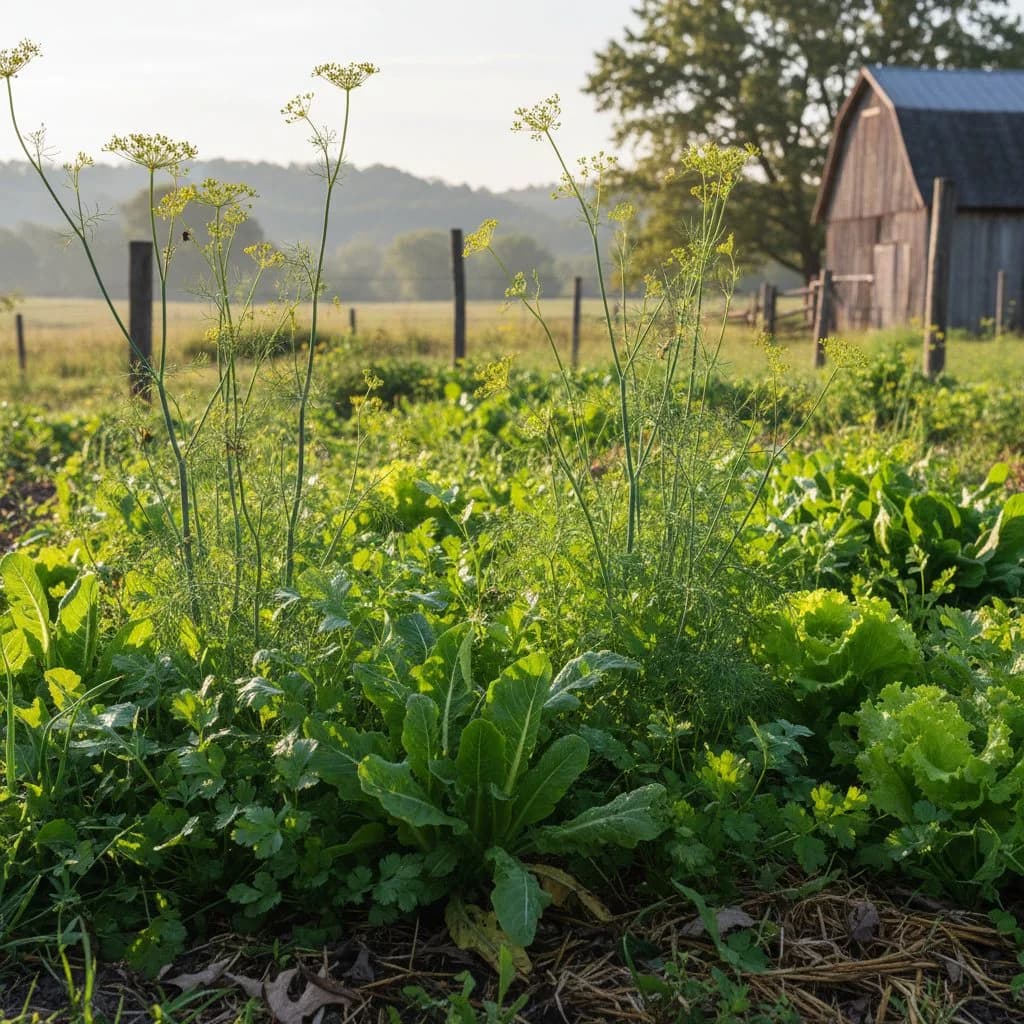
Key takeaways
- Self-sowing plants like dill, cilantro, arugula, and lettuce reduce the need for annual replanting, saving time and effort.
- Understanding the specific germination and growing conditions for each self-sower matters for successful volunteer crops.
- Thinning volunteer seedlings is often necessary to prevent overcrowding and ensure healthy plant development, aiming for 6-12 inches between plants.
- Allowing some plants to bolt and go to seed is essential for the self-sowing cycle to continue in subsequent seasons.
- These plants thrive in a variety of US climates, from the cooler summers of USDA Zone 4 to the warmer conditions of Zone 9, with proper management.
- Strategic placement and minimal soil disturbance help encourage consistent self-seeding year after year.
Quick answer: Self-sowing plants like dill, cilantro, arugula, and lettuce reduce annual replanting, saving time and effort in a low-maintenance kitchen garden. They thrive in USDA Zone 6 when allowed to bolt and reseed naturally.
In many parts of the United States, from the fertile valleys of California to the humid summers of the Southeast, home gardeners are always looking for ways to reduce effort while still enjoying fresh produce. One effective strategy is to cultivate self-sowing vegetables and herbs. These plants, once established, drop their seeds at the end of their growing cycle, allowing new plants to emerge naturally in the following season without direct human intervention. This method can significantly cut down on the time spent on planting and purchasing new seeds each year, potentially saving hours of labor over a growing season.
For growers in regions like USDA Zone 6, where the growing season is reliably long enough for plants to mature and set seed, self-sowers can become a cornerstone of a low-maintenance kitchen garden. We will focus on four popular and relatively easy-to-manage options: dill, cilantro, arugula, and lettuce. Each of these offers distinct culinary uses and has proven track records of successful self-seeding, making them excellent candidates for a more hands-off approach to gardening.
Dill: the aromatic self-seeder
Dill (Anethum graveolens) is a quintessential self-sower, known for its feathery leaves and distinctive aroma, which can be used in everything from pickles to potato salads. Once established, a single dill plant can produce hundreds of seeds, many of which will readily germinate the following spring. In USDA Zones 3-9, dill often appears as a welcome volunteer, especially if the soil is disturbed minimally. To encourage more self-seeding, allow a few plants to mature fully and produce their characteristic umbrella-like seed heads. These seeds will ripen and fall to the ground, ready for the next season’s growth, often germinating when soil temperatures reach 50-70°F.
Managing volunteer dill crops
While dill is eager to self-sow, managing the resulting volunteers is important to prevent overcrowding. Aim for plants to be spaced about 6-9 inches apart for optimal growth and air circulation, which can reduce fungal issues. Thinning can be done by hand, pulling out smaller seedlings when they are 2-3 inches tall. The pulled seedlings can even be used in salads. Dill prefers full sun, meaning at least six hours of direct sunlight per day, and well-drained soil with a pH between 6.0 and 7.0. For more detailed information on growing this herb, consider reviewing our guide on Dill.
- Allow plants to bolt: Let some dill go to seed to ensure future crops.
- Minimal soil disturbance: Avoid deep tilling where dill seeds have dropped.
- Thin seedlings: Space plants 6-9 inches apart for best results.
- Harvest regularly: Encourage new foliage growth by picking leaves often.
- Monitor for pests: Keep an eye out for aphids, especially on young plants.
Cilantro: a cool-season repeater
Cilantro (Coriandrum sativum) is a dual-purpose herb, valued for its fresh leaves in many cuisines and its dried seeds, known as coriander. This herb is a prolific self-sower, particularly in cooler temperatures, making it a favorite for gardeners in USDA Zones 3-10. It tends to bolt quickly in hot weather, which is often seen as a drawback, but for the self-sowing gardener, it is an advantage. Allowing cilantro to flower and produce seeds ensures a continuous supply of new plants, often appearing in waves throughout the spring and fall. In regions like the Pacific Northwest, with its mild summers, cilantro can self-sow almost continuously from April to October.
Encouraging cilantro’s return
To maximize cilantro’s self-sowing potential, it is best to plant it in partial shade during the warmer months, as this can delay bolting by several weeks, allowing more leaf production before seed set. When the plant does bolt, let the seeds fully mature on the plant until they turn brown and dry. Many will fall to the ground, ready to germinate when conditions are right, typically when soil temperatures are between 50-75°F. You can also lightly rake the soil surface to help bury some seeds, protecting them from birds and ensuring better soil contact. For those interested in starting a diverse herb garden, our article on Starting a herb garden offers additional guidance.
- Plant in succession: Stagger plantings every 2-3 weeks for continuous harvest.
- Allow to bolt: Let some plants go to seed to ensure future generations.
- Partial shade: Plant in areas with afternoon shade during hot summers (above 80°F).
- Minimal soil disturbance: Avoid tilling areas where cilantro has gone to seed.
- Water consistently: Maintain even moisture to delay bolting and support growth.
Arugula: the peppery perennial
Arugula (Eruca vesicaria), also known as rocket, is a fast-growing leafy green with a distinct peppery flavor that adds a kick to salads and sandwiches. It is an excellent self-sower, particularly in USDA Zones 4-9, where it can provide multiple harvests throughout the spring and fall. Arugula matures quickly, often in just 20-40 days, and readily bolts in warm weather, sending up a flower stalk that produces small, edible white flowers and then seed pods. These pods contain numerous seeds that will drop and germinate, often leading to a continuous supply of fresh greens without any additional planting effort.
Managing arugula’s spread
While arugula is generally welcome, its vigorous self-sowing can sometimes lead to an overwhelming number of plants. To manage its spread, harvest leaves regularly and consider pulling up some plants before they go to seed if you have more than you need. For the plants you do allow to self-sow, ensure they have enough space — about 4-6 inches between plants — to develop healthy root systems and full leaves. Arugula prefers full sun to partial shade and well-drained soil. It can tolerate a wide range of soil types but thrives in soil rich in organic matter. During hot periods (above 75°F), providing some afternoon shade can prolong the harvest of tender leaves and delay bolting.
- Harvest outer leaves: Pick leaves regularly to encourage more growth.
- Thin crowded seedlings: Aim for 4-6 inches spacing to prevent competition.
- Allow some to bolt: Let a few plants produce seeds for future generations.
- Mulch lightly: A thin layer of mulch can help retain soil moisture and regulate temperature.
- Monitor soil moisture: Keep soil consistently moist, especially during germination.
Lettuce: the leafy volunteer
Lettuce (Lactuca sativa) is a surprisingly good self-sower, especially varieties like Romaine, Butterhead, and loose-leaf types. While many gardeners focus on continuous planting, allowing some lettuce plants to bolt and go to seed can provide a steady supply of new seedlings. In USDA Zones 4-9, lettuce will readily drop seeds that can overwinter and germinate in early spring, or sprout in the fall after summer heat breaks. The key is to recognize the bolting process, where the plant sends up a tall central stalk, produces small yellow flowers, and then fluffy seed heads, similar to dandelions. Each plant can produce hundreds of seeds so a strong volunteer crop.
Cultivating volunteer lettuce
For successful self-sowing lettuce, select a few healthy plants to allow to bolt. Once the seeds are mature and dry, they will disperse naturally. You can gently shake the seed heads over the desired planting area to aid distribution. Lettuce seeds prefer light for germination, so avoid burying them too deeply; a light dusting of soil or simply leaving them on the surface is often sufficient. Volunteer lettuce seedlings typically emerge when soil temperatures are between 40-75°F. Thin these seedlings to about 8-12 inches apart to ensure each plant has ample room to grow into a full head. For more detailed insights into specific lettuce varieties, consult our plant guide on Lettuce.
- Choose open-pollinated varieties: Heirloom or open-pollinated types self-sow more reliably.
- Allow to bolt fully: Let seed heads dry completely on the plant before dispersal.
- Light soil cover: Lettuce seeds need light to germinate, so don’t bury them deep.
- Thin aggressively: Space plants 8-12 inches apart for optimal head development.
- Consistent moisture: Keep the soil evenly moist, especially during germination and early growth.
Self-sowing herb and vegetable comparison
Plant | USDA Zones | Germination Temp (°F) | Days to Maturity | Sun Preference | Typical Spacing (in) |
|---|---|---|---|---|---|
Dill | 3-9 | 50-70 | 60-90 | Full Sun | 6-9 |
Cilantro | 3-10 | 50-75 | 20-30 (leaves) | Full Sun to Partial Shade | 2-3 |
Arugula | 4-9 | 40-70 | 20-40 | Full Sun to Partial Shade | 4-6 |
Lettuce | 4-9 | 40-75 | 40-80 | Full Sun to Partial Shade | 8-12 |
Seed viability: Many self-sown seeds remain viable in the soil for several years so future crops even if a season is missed.
Soil temperature: Optimal soil temperatures for germination of these self-sowers typically range from 40°F to 75°F, varying slightly by species.
References
- Fruits, vegetables, and herbs (2016).
- Fruits, Vegetables, and Herbs (2016).
- The kitchen gardener’s instructor, containing a catalogue of garden and herb seed, with practical directions under each head for the cultivation of culinary veg (1860).
- Copyright (2016).
- Acknowledgments (2016).
- USDA Natural Resources Conservation Service (2024).