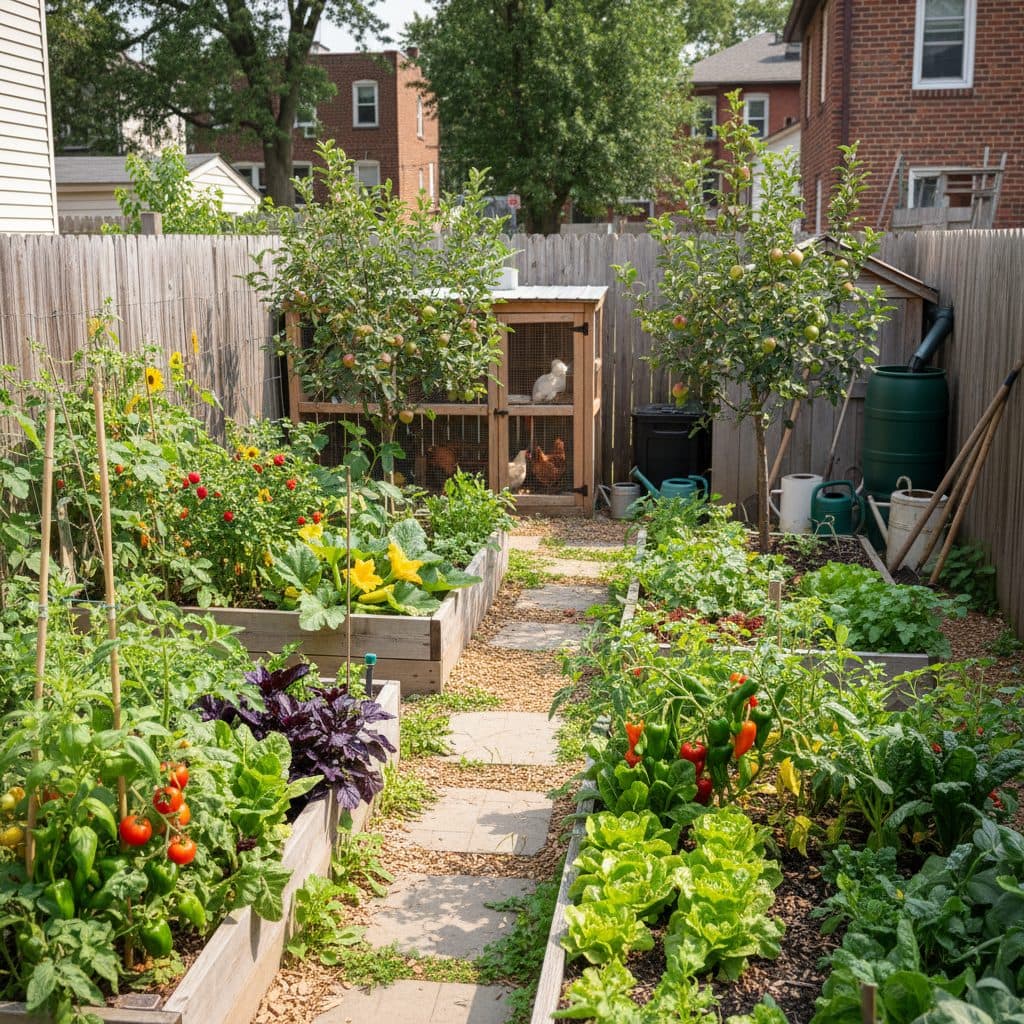
Key takeaways
- A 1/10 acre city lot can support a diverse and productive permaculture system, yielding significant food.
- Site analysis, including sun paths and water flow, is crucial for effective zone and sector planning.
- Building healthy soil through no-dig methods and incorporating water-harvesting swales reduces irrigation needs by up to 30%.
- Food forests and plant guilds maximize space and yield by stacking functions and combining 3-7 mutually supporting species.
- Integrating small livestock like chickens can provide eggs and pest control, and providing manure for compost.
- Careful design can reduce external inputs and increase self-sufficiency on a lot as small as 4,000 square feet.
Quick answer: Designing a permaculture system for a 1/10 acre city lot in USDA zone 6 involves site analysis, zone planning, no-dig soil building, and water harvesting with swales. These techniques maximize yield and self-sufficiency on small urban properties.
Many growers in places like Portland, Oregon, or Asheville, North Carolina, find themselves with a city lot that feels too small to make a real impact on their food production. However, a parcel under 1/10 acre (approximately 4,356 square feet) offers significant potential for a productive permaculture system. Applying design principles can maximize yield, conserve resources, and build a resilient ecosystem even within a 50 by 80 foot footprint. The goal is to create a functional, beautiful, and low-maintenance landscape that provides for your household’s needs.
Permaculture principles are adaptable to urban environments, as demonstrated by projects in cities globally since the 1990s [3]. By carefully observing your site and implementing thoughtful design, you can transform a typical backyard in USDA zone 6 into a thriving food forest, a water-wise garden, and a habitat for beneficial life. Understanding your site and integrating diverse elements helps establish these systems.
Understanding your site and design zones
Before any digging begins on your 1/10 acre city lot, a thorough site analysis is essential. This involves observing sun patterns throughout the year, tracking how many hours of direct sunlight different areas receive, especially during the growing season from April to October. For instance, a south-facing wall in USDA zone 6 might get 8-10 hours of sun, while an area shaded by a neighbor’s two-story house might only get 3 hours. Understanding water flow is equally important; watch how rainwater moves across your property during a 1-inch rain event, noting areas of pooling or rapid runoff. A simple soil test, costing around $20-40, provides practical data on pH levels and nutrient deficiencies to guide soil amendments.
mapping your property’s microclimates
Once you understand your site’s unique characteristics, you can apply the permaculture zone system, which organizes elements based on their frequency of use and required attention [2]. Zone 0 is your home, where you spend 100% of your time. Zone 1, directly adjacent to the home, receives daily attention and might include herbs, salad greens, and a small nursery bed. Zone 2, a bit further out, is visited several times a week for larger vegetable beds or small fruit trees. Zone 3, the least visited, could host larger fruit trees, nut trees, or a small chicken coop, requiring weekly or monthly checks. Even on a 4,000 square foot lot, these zones provide a logical framework for placement. For more on this, see our article on permaculture design.
- Zone 0: The house, where human activity is concentrated.
- Zone 1: Daily access areas, like herb spirals and frequently harvested vegetables.
- Zone 2: Regular access areas, such as main vegetable beds and berry bushes.
- Zone 3: Less frequent access, for larger fruit trees, nut trees, or small animal systems.
- Zone 4: Minimal access, for timber or wild foraging, often not present on small city lots.
Building soil and managing water with swales
The foundation of any productive system, especially on a compact city lot, is healthy soil. Instead of traditional tilling, which can degrade soil structure over time, we focus on no-dig gardening. This method involves layering organic materials directly onto the soil surface, mimicking natural forest processes. Begin by laying down one or two overlapping layers of plain corrugated cardboard, tape and labels removed, to suppress weeds, followed by 6-12 inches of a compost-rich mixture. This approach builds soil organic matter steadily over years while improving water retention and nutrient availability. Added organic matter meaningfully increases how much water soil holds and how fast it takes rain in, which over several seasons reduces how often you need to irrigate. How large the effect is depends heavily on your soil texture.
implementing small-scale swales for water harvesting
Water is a precious resource, and on a 1/10 acre property, every drop counts. Swales (level ditches dug along contours) capture and infiltrate rainwater into the soil, reducing runoff and recharging groundwater. For a small urban lot with a gentle slope of 2-5%, a 6-inch deep, 2-foot wide swale will intercept part of the runoff from a 1,000 square foot roof, but an inch of rain on that roof is roughly 620 gallons, far more than a short swale holds, so plan an overflow route before you dig. Keep any infiltration feature well downslope of your foundation and clear of a basement wall, and have utilities located first. The excavated soil is mounded on the downhill side, forming a berm where trees and shrubs can be planted. A swale this size holds far less than that at any one moment; its job is to slow water down and let it soak into the ground, releasing it to plants over days or weeks. In a typical 50 by 80 foot lot, even one or two strategically placed, 20-foot long swales can make a substantial difference in water management. Learn more about these techniques in our permaculture gardening guide.
- Cardboard layer: Suppresses weeds and breaks down over 6-12 months.
- Compost and organic matter: Builds soil structure and fertility, increasing water retention.
- Mulch layer: Reduces evaporation by 30-50% and regulates soil temperature.
- Beneficial microbes: Thrive in undisturbed soil and support nutrient cycling.
- Mycorrhizal fungi: Extend root systems, improving water and nutrient uptake for plants.
Designing food forests and plant guilds
A permaculture food forest mimics the structure and function of a natural forest, but with edible and useful plants. On a 1/10 acre city lot, this means selecting dwarf or semi-dwarf fruit trees (e.g., ‘Honeycrisp’ apple or ‘Reliance’ peach, suitable for USDA zone 5-8) as the canopy layer, spaced 10-15 feet apart. Apples and pears need a compatible second variety flowering at the same time to set fruit, so plan for two, graft a pollinizer branch onto one, or confirm a neighbour has a suitable tree within range. Peaches, by contrast, are self-fertile. Below these, you’d layer berry bushes (e.g., blueberries, raspberries), then perennial vegetables (e.g., asparagus, rhubarb), groundcovers (e.g., strawberries, clover), and finally, root crops. This vertical stacking maximizes the use of sunlight and space, and yields more from the same ground than a single-layer row garden.
creating productive plant guilds
Plant guilds are communities of 3-7 species that support each other, creating a miniature ecosystem. A classic example around a young fruit tree might include comfrey as chop-and-drop mulch, chives (pest deterrent), nasturtiums (living mulch, attracts pollinators), and clover (nitrogen fixer). Use only the sterile ‘Bocking 14’ cultivar: common comfrey (Symphytum officinale) sets viable seed and on a lot this size will self-sow into the paths, the lawn, and the neighbours' yards. Comfrey of every cultivar contains hepatotoxic pyrrolizidine alkaloids, so it is mulch, never food, tea, or fodder. For instance, an ‘Enterprise’ apple tree (USDA zone 4-7) could be surrounded by a guild consisting of garlic chives for pest control, white clover for nitrogen, and calendula to attract beneficial insects. This approach reduces the need for external inputs like fertilizers and pesticides, supporting a resilient planting. Do not plant autumn olive (Elaeagnus umbellata): it is bird-dispersed, forms dense thickets, and is listed as invasive across much of the Northeast, Midwest, Mid-Atlantic and Southeast, with several states restricting its sale or planting. Goumi (Elaeagnus multiflora) is far better behaved but is still an Elaeagnus, so check your state noxious-weed list before planting either. For a nitrogen fixer that cannot escape a city lot, sow white clover under the trees. You can find detailed plans in our permaculture garden plan article.
- Canopy layer: Dwarf fruit trees (e.g., ‘Bartlett’ pear, ‘Red Haven’ peach) for primary fruit production.
- Shrub layer: Berry bushes (e.g., elderberry, currant) providing secondary harvests and habitat.
- Herbaceous layer: Perennial vegetables and herbs (e.g., oregano, sorrel, walking onions) for ground-level yields. If you want mint, keep it in a sunken pot — in open ground it will take over the whole herbaceous layer.
- Groundcover layer: Spreading plants (e.g., wild strawberries, creeping thyme) to suppress weeds and retain moisture.
- Rhizosphere layer: Root crops (e.g., sunchokes, groundnuts) and beneficial fungi for underground production. Both spread from tubers left in the ground — grow them in a hard-edged bed you can dig out completely, or in a large container, or they will colonise the whole lot within a few seasons.
Integrating animals and energy flows
Even on a small city lot, incorporating small livestock can significantly enhance your permaculture system. A flock of 3-5 chickens, for example, can provide 15-25 eggs per week, while also offering pest control by eating slugs and insects, and producing valuable manure for compost. A standard chicken coop needs roughly 3 to 4 square feet of floor per standard-breed bird inside and at least 8 to 10 square feet per bird in the run, toward the upper end if the birds are shut in during bad weather. Crowding below that brings on feather picking and bullying, and many city codes set their own minimums. Rabbits, another option, can be housed in small, movable tractor-style pens, providing manure and consuming garden waste. These animals help close nutrient loops, turning kitchen scraps and garden debris into nutrient-rich soil amendments and keeping a real share of household organic waste out of the bin.
managing waste and maximizing passive systems
Effective waste management is central to permaculture. Composting kitchen and garden waste reduces landfill contributions by 30-50% and creates nutrient-rich material for your garden. A well-managed compost pile can reach temperatures of 130-160°F, which kills most weed seeds and pathogens in the hot core. Turn the pile so the outer material also passes through that core; an unturned pile is not sanitised throughout, whatever the centre reads. Consider a three-bin system for continuous composting. Additionally, passive solar design principles can be applied to small structures like a greenhouse or shed on your lot. Orienting a small, 6 by 8 foot greenhouse with its long side facing south can capture significant solar energy, extending your growing season by 2-4 weeks in spring and fall without active heating. This approach reduces reliance on external energy inputs and supports self-sufficiency on an urban homestead. You can learn more about this at passive solar design.
- Chickens: Provide eggs, pest control, and manure for compost.
- Rabbits: Produce high-quality manure and consume garden waste.
- Worms (vermicomposting): Break down kitchen scraps into nutrient-rich worm castings.
- Beneficial insects: Attracted by diverse plantings, they control pests naturally.
- Pollinators: Bees and butterflies increase fruit set and overall garden productivity by 20-40%.
Water Savings: Implementing swales and deep mulch on a 4,000 square foot lot can reduce irrigation needs by up to 30% annually.
Increased Yield: A well-designed food forest gets more out of the same 1/10 acre footprint than a single-layer row garden, by stacking crops through the vertical space.
Frequently asked questions
Can I really grow enough food on a 1/10 acre lot?
Yes, with thoughtful permaculture design, a 1/10 acre lot (about 4,356 square feet) can produce a significant portion of a household’s food. Many urban homesteaders report growing hundreds of pounds of produce annually from similar-sized spaces.
How much water can a small swale system save?
A well-designed small swale system, even on a 1/10 acre lot, can capture hundreds of gallons of rainwater from a single 1-inch rain event. This can reduce your reliance on municipal water for irrigation by 20-30% over a growing season, especially in USDA zones with distinct wet and dry periods.
What kind of fruit trees are best for a small urban space?
For a small urban space, dwarf or semi-dwarf fruit trees are ideal, typically growing to 8-15 feet tall. Varieties like ‘Honeycrisp’ apple, ‘Reliance’ peach, or ‘Bartlett’ pear are good choices for USDA zone 6, offering good yields without overwhelming the space.
How many chickens can I keep on a city lot?
Regulations vary by city, but many urban areas allow 3-6 chickens on a typical residential lot. Each chicken requires about 3 square feet of coop space and 10 square feet in an outdoor run, so a flock of 4 chickens would need a minimum 12 square foot coop and 40 square foot run.
Is permaculture more work than traditional gardening on a small lot?
Initially, permaculture design requires more planning and upfront work, such as building soil and installing swales. However, once established, a permaculture system often requires significantly less ongoing maintenance (reducing watering by 30% and weeding by 50%) compared to traditional annual vegetable gardens.
References
- Permaculture principles applied to tropical smallholder farming for enhanced sustainability (2025). Permaculture principles applied to tropical smallholder farming for enhanced sustainability.
- Permaculture in the City: (2013). Permaculture in the City:.
- The View of “Permaculture-City” Considered from the Permaculture Theory and Practices (1997). The View of “Permaculture-City” Considered from the Permaculture Theory and Practices.
- Chapter Seven. Permaculture in the City: Ecological Habitus and the Distributed Ecovillage (2022). Chapter Seven. Permaculture in the City: Ecological Habitus and the Distributed Ecovillage.
- Permaculture principles applied to tropical smallholder farming for enhanced sustainability (2025). Permaculture principles applied to tropical smallholder farming for enhanced sustainability.
- USDA Natural Resources Conservation Service (2024). USDA Natural Resources Conservation Service.