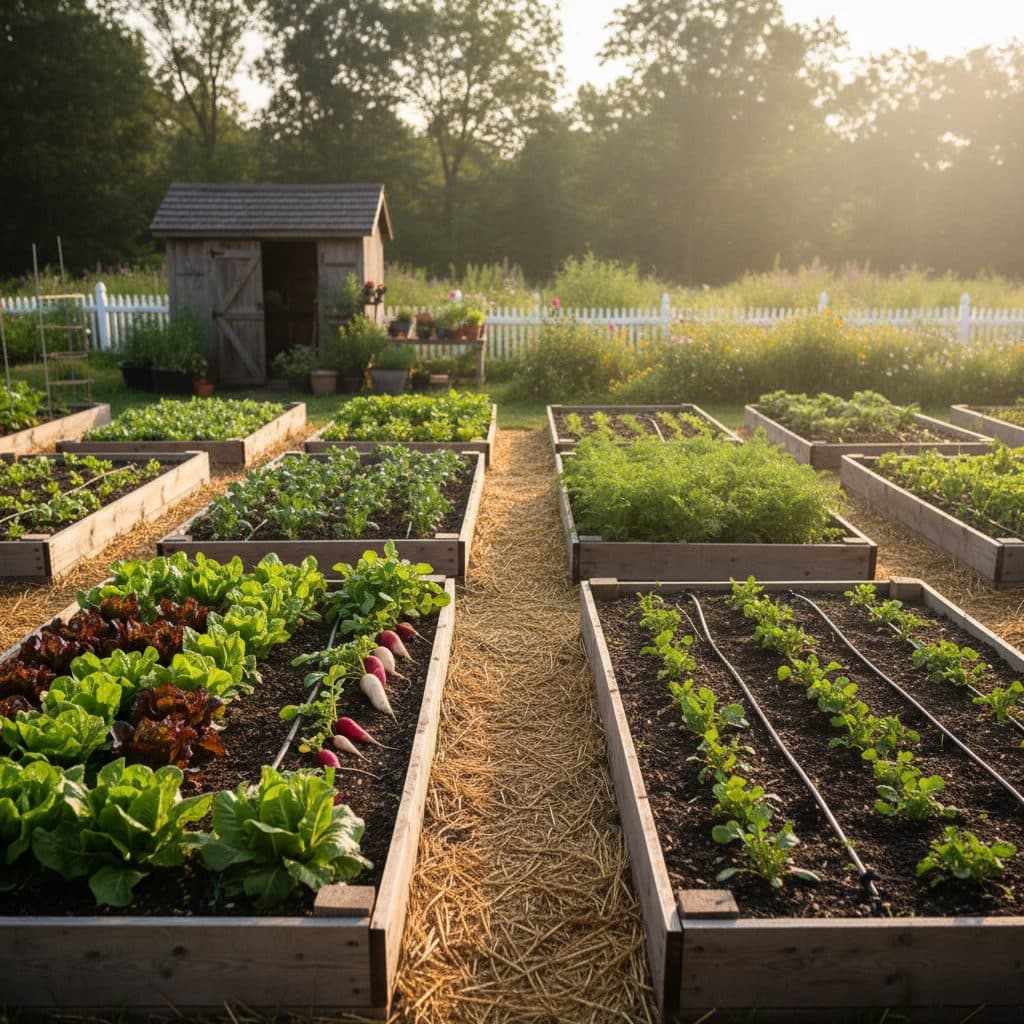
Key takeaways
- Focus production on 0.25 to 1.5 acres using human-scale, bio-intensive techniques to maximize revenue per square foot without heavy tractors. Gross revenue varies widely, often $20,000 to $40,000 per quarter-acre under skilled management with established high-value direct markets, but first-year operations typically gross much less while systems and soil bed tilth are being established.
- Standardize your growing area on 30-inch (75 cm) bed widths with 18-inch (45 cm) pathways to ensure all hand tools, seeders, and row covers fit universally.
- Prioritize high-value, fast-turnaround crops such as cut-and-come-again salad greens, radishes, salad turnips, baby carrots, and bunching herbs.
- Build essential infrastructure early, including a reliable pressurized water supply, a cold-water wash-pack station, and an insulated walk-in cooler.
- Diversify direct-to-consumer sales channels across weekly farmers markets, subscription CSAs, and local restaurant wholesale accounts.
- Implement strict succession planting schedules using spreadsheet mapping to keep every bed occupied throughout the season.
Quick answer: To start a successful market garden, establish standardized 30-inch wide permanent raised beds on 0.25 to 1 acre of well-drained land with reliable water access. Focus on quick-rotation, high-margin crops like baby greens, radishes, and culinary herbs using specialized hand tools, install a wash-pack cooler station, and sell directly through CSAs and farmers markets.
Market gardening bridges the gap between backyard homestead gardening and large-scale industrial agriculture. By applying bio-intensive, human-scale cultivation methods on compact plots of land, growers can produce substantial yields of nutrient-dense vegetables on minimal acreage.
Learning how to start a market garden involves shifting from a hobbyist mindset to a disciplined production and business framework. Market growers focus on standardization, crop turnover speed, ergonomic efficiency, and reliable direct-to-consumer sales instead of growing a few plants of dozens of different varieties.
Whether you are converting a rural homestead pasture, leasing an edge-of-town parcel, or expanding an urban plot, this guide outlines site selection, bed layout, crop economics, and post-harvest infrastructure.
+-------------------------------------------------------------+
|              MARKET GARDEN PRODUCTION WORKFLOW              |
|                                                             |
|   1. LAND SETUP     Standardize 30-inch beds & walkways     |
|   2. CROP PLANNING  Select fast-turnaround, high-value rows |
|   3. SEED & TEND    Precision seeders, drip lines, weeders  |
|   4. HARVEST & PACK Quick cold rinse, spin, CoolBot storage |
|   5. DIRECT SALES   Weekly farmers markets, CSAs, chefs     |
+-------------------------------------------------------------+
How do you select land and lay out standardized beds?
Efficiency in a market garden depends on eliminating wasted motion. Standardizing bed dimensions ensures that all tools, irrigation lines, insect netting, and tarps are completely interchangeable across the entire farm.
+-------------------------------------------------------------+
|                 STANDARDIZED BED GEOMETRY                   |
|                                                             |
|   <- 18" -> <---------- 30" (75 cm) ----------> <- 18" ->   |
|   Pathway   [    Permanent Raised Bed Top     ]   Pathway   |
|   .......   [  Compost Top-Dress (1.5-2 in)   ]   .......   |
|             ===================================             |
|             [ Subsoil Loosened with Broadfork ]             |
+-------------------------------------------------------------+
The 30-inch standard system
- Bed width: 30 inches (75 cm) wide. This width is narrow enough for a grower to comfortably straddle without stepping on cultivated soil, while accommodating common row patterns (such as 2, 3, 4, or 5 rows per bed).
- Pathway width: 18 inches (45 cm). Provides adequate walking space and wheelbarrow clearance while minimizing uncultivated land.
- Bed length: Standardize all beds at 50 feet (15 m) or 100 feet (30 m). This makes calculating seed quantities, compost volumes, irrigation tubing lengths, and expected yields straightforward.
Site requirements
- Solar exposure: Minimum 8 to 10 hours of unobstructed direct daily sunshine.
- Water access: A high-volume, reliable water source delivering clean, potable water under consistent pressure.
- Slope and drainage: Flat to gently sloping ground (1% to 2% grade) with well-drained loam or sandy loam soil. Avoid low-lying frost pockets.
To plan appropriate water catchment and delivery lines across your land, consult our guide on off-grid water systems.
Which crops deliver the highest return per square foot?
Not all vegetables are suited to small-scale commercial market gardens. Low-value, long-season crops like winter squash, dry beans, and field corn require large acreage to turn a profit. Micro-scale market gardens thrive on high-value, fast-maturing crops:
+-------------------------------------------------------------+
|              HIGH-VALUE CROP CLASSIFICATION                 |
|                                                             |
|   CROP CATEGORY         DAYS TO MATURITY    KEY ADVANTAGE   |
|   -------------         ----------------    -------------   |
|   Salad Greens (Mix)    28 - 35 Days        Multiple cuts   |
|   Arugula / Spinach     30 - 40 Days        High demand/wk  |
|   Radishes (French)     21 - 28 Days        Fast bed turnover|
|   Salad Turnips (Hak)   35 - 42 Days        Gourmet market  |
|   Bunching Scallions    50 - 60 Days        Dense row spacing|
|   Culinary Herbs        30 - 45 Days        High profit/lb  |
|   Cherry Tomatoes       65 - 75 Days        Continuous crop |
+-------------------------------------------------------------+- Salad greens (Mesclun, Arugula, Baby Spinach): The backbone of the market garden. Maturing in 30 to 35 days, a single bed can be seeded, cut multiple times, and flipped three to four times per season.
- Specialty root vegetables: Japanese salad turnips (such as 'Hakurei') and French breakfast radishes mature rapidly and sell at premium prices when bunched with fresh green tops.
- Culinary bunching herbs: Cilantro, dill, and sweet basil yield heavy returns from dense multi-row plantings.
- Indeterminate cherry tomatoes: When trained vertically in caterpillar tunnels or unheated high tunnels, cherry tomatoes produce high weekly yields from June through October.
For matching crop cycles to specific regional weather patterns, review the zone 9 planting schedule and soil temperature for planting.
What essential tools and infrastructure do you need?
A market garden relies on specialized, human-scale hand equipment instead of four-wheel tractors:
+-------------------------------------------------------------+
|                 ESSENTIAL MARKET GARDEN TOOLKIT             |
|                                                             |
|   PRODUCTION STAGE      ESSENTIAL EQUIPMENT                 |
|   ----------------      -------------------                 |
|   Bed Preparation       Broadfork, Silage Tarp, Bed Rake    |
|   Precision Seeding     Jang Seeder or Earthway Seeder      |
|   Cultivation & Weed    Wire Weeder, Stirrup / Collinear Hoe|
|   Harvesting            Quick Cut Greens Harvester, Knives  |
|   Wash-Pack             Bubbler Tank, Greens Spinner, Cooler|
+-------------------------------------------------------------+
1. Bed prep and weeding tools
- Silage tarps: Lay 6-mil black UV-treated polyethylene silage tarps over beds for three to six weeks. Tarps kill existing green growth and flush out weed seeds, but persistent perennial roots (quackgrass, bindweed, dock) usually survive and need digging out or longer exclusion.
- The broadfork: Aerates and loosens the topsoil and upper subsoil 10 to 12 inches (25 to 30 cm) deep without inverting soil profiles or bringing buried weed seeds to the surface.
- Precision seeders: Seeders like the Jang JP-1 allow accurate, single-seed spacing down the row, eliminating hours of manual thinning.
- Flame weeders: Propane flame weeders kill tiny flush weeds on stale seedbeds before slow-germinating crops emerge. Safety note: Never flame-weed in dry conditions, on dry straw or woodchip mulches, or near dry peat. Keep an extinguisher or charged hose on hand.
2. The post-harvest wash-pack station
Post-harvest handling determines the shelf-life and professional appearance of your produce:
- Washing tanks: Stock tanks fitted with clean water bubblers to wash greens.
- Greens spinner: Converted commercial washing machines or hand spinners to remove surface moisture, preventing leaf decay.
- Cold storage: A well-insulated walk-in cooler powered by a standard domestic window air conditioner paired with a CoolBot temperature controller, holding produce at 36°F to 38°F (2°C to 3.5°C).
+-------------------------------------------------------------+
|                 WASH-PACK STATION SCHEMATIC                 |
|                                                             |
|   [ Harvest Crates ] ---> [ Bubbler Wash Tank ]             |
|                                   |                         |
|                                   v                         |
|   [ Walk-In Cooler ] <--- [ Greens Spin Dryer ]             |
|   (36°F - 38°F)           [ & Sorting Table   ]             |
+-------------------------------------------------------------+
To manage pest pressure naturally in high-intensity market rows, integrate trap cropping with nasturtiums, squash, and mustard.
How do you establish profitable direct sales channels?
Direct-to-consumer sales capture retail pricing rather than wholesale margins:
+-------------------------------------------------------------+
|                 DIRECT SALES CHANNEL COMPARISON             |
|                                                             |
|   CHANNEL           ADVANTAGE               CHALLENGE       |
|   -------           ---------               ---------       |
|   Farmers Market    Immediate cash flow     Weather / labor |
|   CSA Subscription  Guaranteed early capital Packing logistics|
|   Restaurant Sales  Reliable weekly volume  Strict delivery |
|   On-Farm Stand     Zero transport time     Zoning / footfall|
+-------------------------------------------------------------+- Community Supported Agriculture (CSA): Members pay for a full season of produce upfront in winter or early spring. This provides essential operating cash flow to purchase seeds, potting soil, and amendments before the first harvest.
- Farmers markets: Provides excellent retail price realization, brand exposure, and customer feedback. Focus on pristine visual displays, uniform bunching, and generous sampling.
- Local restaurant accounts: Chefs value consistent quality, clean produce, and unique specialty varieties (such as edible flowers or microgreens). Set up weekly order sheets and deliver on consistent days.
For homesteaders weighing intensive commercial vegetable rows against perennial orchards, examine food forest vs orchard.