Key takeaways
- Water rooting provides convenience but often produces weaker, water-adapted roots that struggle during transplant.
- Soil rooting offers a natural environment but requires careful moisture management and aeration to prevent rot.
- Perlite, especially in subirrigated systems, consistently yields strong, well-aerated roots, with success rates over 90% for many species.
- Optimal rooting temperatures, typically 68-77°F, matter for success regardless of the chosen medium.
- For most herbaceous and softwood cuttings, perlite offers the best balance of moisture retention, aeration, and root development.
- Transitioning rooted cuttings from water or perlite to soil requires a gradual acclimation period to minimize shock.
Quick answer: Perlite consistently yields strong, well-aerated roots for plant cuttings, often outperforming water and soil methods. Its porous structure provides excellent aeration and moisture retention, important for root development and transplant.
Whether the cutting is hibiscus in central Florida, USDA zone 9b, or a tomato on a windowsill further north, the goal is always the same: strong, viable roots that will thrive once transplanted. But the path to those roots isn’t always clear-cut. Growers often debate the merits of water rooting, direct soil rooting, and using inert media like perlite.
This article will break down each method, drawing on research and practical experience to show you which approach consistently delivers the strongest root systems. We’ll explore the science behind why certain media excel, focusing on factors like aeration, moisture, and nutrient availability, which are critical for successful propagation in any climate, from the humid Gulf Coast to the drier intermountain West.
water rooting: convenience with a catch
Water rooting is undeniably simple. You snip a cutting, stick it in a glass of water, and wait. For many houseplant enthusiasts in places like Seattle, Washington, where humidity is often high, it’s a popular starting point for plants like pothos or philodendron. The appeal lies in its visual simplicity and the fact that you can watch the roots develop, which is quite satisfying. However, this method has a significant drawback: the roots that form in water are structurally different from those that develop in soil or a solid medium.
the problem with water-adapted roots
Roots grown in water are adapted to a fully aquatic environment, meaning they are often thinner, more brittle, and less efficient at absorbing nutrients and oxygen from soil. When these water-adapted roots are transplanted into soil, they often experience a severe shock, leading to stunted growth or even death. Water-rooted cuttings are widely reported to transplant poorly without careful acclimation. This is because soil provides a different balance of oxygen and moisture, and the delicate water roots struggle to adapt to the new, often drier, conditions. For example, water spinach naturally thrives in water, but most terrestrial plants do not develop strong, soil-ready roots in a purely liquid medium.
- Ease of setup: Requires minimal equipment, usually just a glass and water.
- Visual appeal: Allows observation of root development.
- Lower success rate for transplant: Water-adapted roots struggle in soil, often leading to transplant shock.
- Oxygen deprivation: Stagnant water can become anaerobic, inhibiting strong root growth.
- Nutrient deficiency: Water alone lacks essential nutrients for sustained development.
soil rooting: the natural but tricky approach
Directly rooting cuttings in soil seems like the most natural method, mimicking how plants propagate in the wild. For many hardy species, especially those with thicker stems, it can be effective. In regions like the fertile Willamette Valley of Oregon, where rich loam is common, growers might find more success with direct soil rooting than in sandy soils of coastal Georgia. However, success hinges on providing the right soil conditions, which are often difficult to achieve consistently for delicate cuttings.
balancing moisture and aeration in soil
The primary challenge with soil rooting is maintaining the delicate balance between moisture and aeration. Cuttings need consistent moisture to prevent wilting, but too much water leads to anaerobic conditions, encouraging rot rather than root development. A good rooting medium should be well-draining yet retain enough moisture. For instance, a typical garden soil often has less than 20% air space, which is insufficient for optimal root oxygenation. Research on soil rooting experiments, such as those detailed in supplemental information [3], often highlights the variability of success due to inconsistent soil moisture and structure. Using a soil moisture meter can help, but even then, the physical structure of the soil can be limiting.
- Natural environment: Mimics natural propagation for some species.
- Risk of rot: Overwatering easily leads to anaerobic conditions and fungal issues.
- Variable success: Dependent on precise soil composition and moisture management.
- Compaction issues: Soil can compact, reducing vital air pockets for roots.
- Pest and disease risk: Soil can harbor pathogens that harm vulnerable cuttings.
perlite: the champion for strong root development
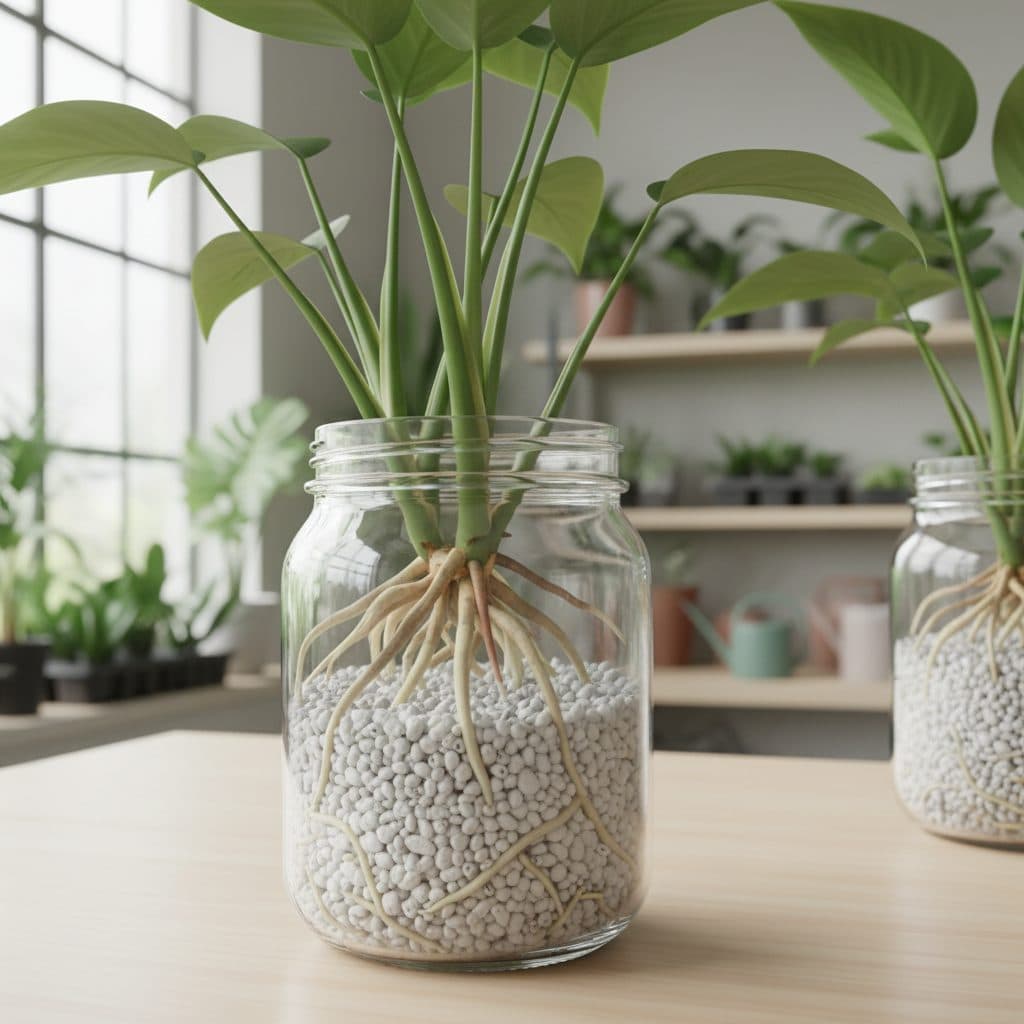
When it comes to consistently producing strong, vigorous roots, perlite often stands out as the superior choice. Perlite is a lightweight, porous volcanic glass that offers an ideal environment for root development. Its structure provides excellent aeration—often 30-50% air space—while still retaining sufficient moisture [3]. This balance matters because roots need oxygen to respire and grow, and excess water suffocates them. In trials for rooting hydrangea varieties in 2023, substrate options including sand + perlite (PP) often showed significantly higher rooting percentages, sometimes over 80%, compared to other mixes.
the science behind perlite’s success
Perlite’s inert nature means it won’t introduce pathogens or alter pH, providing a clean slate for cuttings. Dampen it before you handle it and wear a dust mask — the dry dust is a respiratory irritant, and bags carry a warning to that effect. Its rough surface also provides ample sites for root hairs to anchor and develop. Studies have shown that subirrigated perlite systems, where water is supplied from below, can achieve rooting success rates exceeding 90% for many herbaceous and softwood cuttings, even under minimal mist conditions [2]. This method ensures consistent moisture without waterlogging the cutting base, a common pitfall in other methods. For growers in diverse climates, from the arid Southwest to the humid Southeast, perlite offers a reliable and repeatable method for propagation. Consider adding perlite to your seed starting mix for improved drainage and aeration.
- Superior aeration: High porosity ensures roots get ample oxygen, preventing rot.
- Excellent drainage: Prevents waterlogging while retaining adequate moisture.
- Inert and sterile: Reduces risk of disease and pH fluctuations.
- Consistent results: Research shows high rooting success rates, often over 90% [1].
- Versatile: Suitable for a wide range of herbaceous and softwood cuttings.
choosing the right method for your cuttings
The best rooting method isn’t a one-size-fits-all answer, but for most growers aiming for robust, transplant-ready plants, perlite offers the most consistent and strongest root development. While water rooting is easy, its limitations for long-term plant health are significant. Direct soil rooting can work for some species, but it demands precise environmental control that is often difficult to maintain without specialized equipment. Consider the specific needs of your plant and your growing environment, whether you’re in a small apartment in Chicago or managing acres in rural Kansas.
factors to consider for optimal rooting
When selecting a method, consider the type of cutting—herbaceous, softwood, semi-hardwood, or hardwood. Herbaceous and softwood cuttings, like those from coleus or fuchsia, often respond best to perlite due to their quick rooting nature and need for consistent moisture and aeration. Hardwood cuttings, such as those from grapes or roses, might tolerate direct soil rooting better, especially if treated with rooting hormones and planted in well-drained soil in late fall. Regardless of the medium, maintaining an optimal temperature, typically between 68-77°F (20-25°C), is critical for initiating root growth [1]. Providing supplemental bottom heat improves rooting percentages in cooler environments.
- Cutting type: Herbaceous and softwood cuttings generally prefer perlite.
- Environmental control: Soil and perlite methods benefit from controlled temperature and humidity.
- Transplant success: Perlite-rooted plants typically experience less transplant shock.
- Disease prevention: Sterile media like perlite reduce fungal and bacterial risks.
- Nutrient availability: Perlite requires supplemental nutrients once roots form, unlike nutrient-rich soil.
Comparison of Rooting Methods for Cuttings
Method | Pros | Cons | Root Strength | Typical Success Rate |
|---|---|---|---|---|
Water Rooting | Easy setup, visually satisfying, low cost | Weak, water-adapted roots, high transplant shock, nutrient deficiency | Weakest | 30-60% (transplant success) |
Soil Rooting | Natural environment, some nutrient availability, less shock for hardy species | Risk of rot, inconsistent moisture, compaction, disease risk | Moderate | 40-70% (variable) |
Perlite Rooting | Excellent aeration, consistent moisture, sterile, strong roots, high success | Requires supplemental nutrients, can dry out quickly if not monitored | Strongest | 80-95% (for many species) |
Perlite Air Space: Perlite offers 30-50% air space, providing essential oxygen for root development and preventing anaerobic conditions [3].
Optimal Temperature: Maintaining a rooting medium temperature of 68-77°F (20-25°C) improves rooting success for many cuttings [1].
Frequently asked questions
What is the best temperature for rooting cuttings?
The optimal temperature for rooting most herbaceous and softwood cuttings is between 68-77°F (20-25°C). Maintaining this range improves rooting percentages, as indicated by research on nutritional and temperature effects [1].
How long does it take for cuttings to root in perlite?
Rooting time in perlite varies by species, but many herbaceous and softwood cuttings can develop sufficient roots for transplant within two to four weeks. For example, some hydrangea varieties show over 80% rooting success in perlite-based substrates.
Can I add nutrients to water rooting?
While you can add a very dilute, balanced liquid fertilizer to water rooting, it’s generally not recommended for initial rooting. High nutrient concentrations can burn delicate new roots. It’s better to move water-rooted plants into a potting mix once the roots reach about an inch — go by root length, not the calendar, since long water roots are the most brittle and the hardest to establish in soil.
What kind of perlite should I use for rooting?
Use horticultural perlite, typically available in coarse or medium grades, for rooting. Avoid fine perlite, which can compact and reduce aeration. Perlite is usually sold by volume rather than weight, so check the bag’s listed quarts or cubic feet against the number of pots you plan to fill.
How do I transplant a perlite-rooted cutting?
To transplant a perlite-rooted cutting, gently remove it from the perlite, being careful not to damage the new roots. Plant it into a well-draining potting mix, water thoroughly, and place it in a slightly shaded area for a few days to acclimate. Most cuttings handle this transition well if the roots are already well-developed.
References
- Nutritional and temperature effects on rooting of herbaceous and softwood cuttings held in subirrigated perlite (2023). Nutritional and temperature effects on rooting of herbaceous and softwood cuttings held in subirrigated perlite.
- Supplemental Information 1: Soil rooting experiment data. (2023). Supplemental Information 1: Soil rooting experiment data..
- Comparison of Perlite and Peat:perlite Rooting Media for Rooting Softwood Stem Cuttings in a Subirrigation System with Minimal Mist (1999). Comparison of Perlite and Peat:perlite Rooting Media for Rooting Softwood Stem Cuttings in a Subirrigation System with Minimal Mist.
- Supplemental Information 3: Soil rooting experiment metadata. (2023). Supplemental Information 3: Soil rooting experiment metadata..