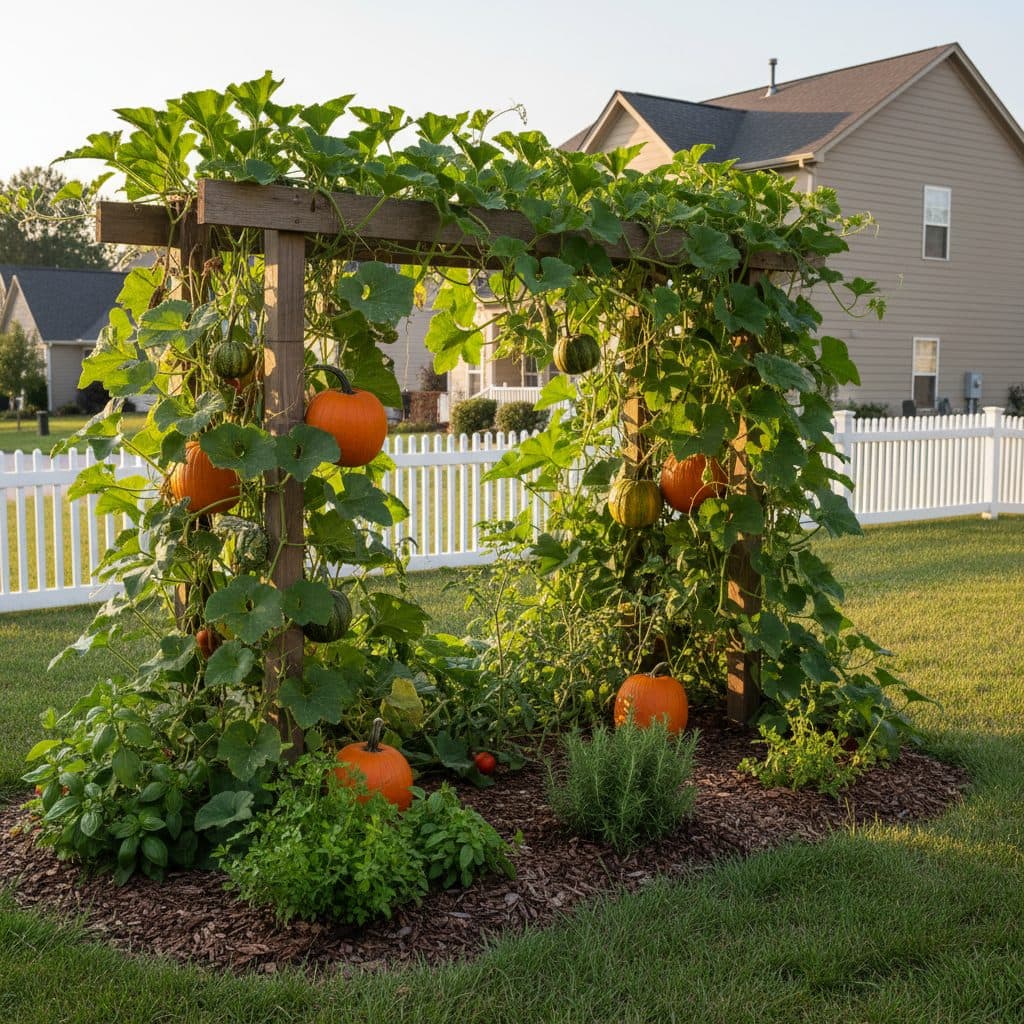
Key takeaways
- Select vining winter squash and pumpkin varieties suited for vertical growth and your local USDA zone, such as ‘Butternut’ or ‘Small Sugar’.
- Construct sturdy trellises capable of carrying the 20-30 pounds of fruit a single mature vine produces, using materials like cattle panels or strong netting.
- Ensure rich, well-draining soil with 3-5% organic matter for optimal plant health and fruit development.
- Provide consistent watering, about 1 inch per week, and fertilize every 3-4 weeks with a balanced organic feed.
- Prune plants to manage growth and hand-pollinate flowers to increase fruit set, aiming for 2-4 fruits per vine.
- Support developing fruits with slings made from old t-shirts or netting when they reach 5-7 pounds to prevent stem breakage.
Quick answer: To grow large winter squash and pumpkins on trellises in USDA Zone 6, select vining varieties like ‘Butternut’ or ‘Small Sugar’, construct sturdy supports capable of holding the 20-30 pounds of fruit a mature vine produces, and provide rich soil with consistent watering and organic fertilizer.
In many US urban and suburban areas, garden space is a premium commodity. A typical residential lot in a city like Portland, Oregon, or Austin, Texas, might offer just 0.15 acres, or around 6,500 square feet, for all outdoor activities, including gardening. This limited footprint often means traditional sprawling crops like winter squash and pumpkins are overlooked. However, with thoughtful planning and vertical gardening techniques, even a small yard or balcony can yield a substantial harvest of these nutritious, long-storing vegetables.
By training vining varieties of winter squash and pumpkins up a sturdy trellis, gardeners can transform a 4 ft by 4 ft garden bed into a productive vertical farm. This approach not only saves valuable ground space but also improves air circulation around plants. This article will guide you through selecting the right varieties, building effective trellises, and providing the care necessary to grow impressive harvests, even if your garden is no larger than a small patio in USDA zone 7.
Choosing the right varieties for vertical growth
Not all winter squash and pumpkins are suitable for trellising. The key is to select vining varieties that produce medium-sized fruits, typically weighing between three and eight pounds. Larger varieties, while tempting, often require exceptionally robust support structures and careful fruit cradling once they reach 10-15 pounds. For gardeners in USDA zones 5 through 9, excellent choices include ‘Butternut’ squash, which typically yields fruits of two to five pounds, and ‘Delicata’ squash, known for its one to two-pound fruits. ‘Small Sugar’ pumpkins are also ideal, usually maturing at six to eight pounds, making them perfect for vertical support.
Vining versus bush varieties
Always check seed packets for growth habit. Vining varieties, often labeled ‘vining’ or ‘runner’, are essential for trellising, as they naturally produce long stems that can be trained upwards. Bush varieties, in contrast, are compact and do not climb, making them unsuitable for this method. Some popular vining types include ‘Waltham Butternut’, ‘Table Queen Acorn’, and ‘Honeynut’ (a small butternut type, ideal for trellising). Consider your local growing season length; varieties like ‘Early Butternut’ mature in about 85 days, while others might need 100-110 days, a crucial factor for regions with shorter summers, such as USDA zone 4.
- ‘Butternut’ squash (2-5 pounds)
- ‘Delicata’ squash (1-2 pounds)
- ‘Small Sugar’ pumpkin (6-8 pounds)
- ‘Table Queen Acorn’ squash (1-3 pounds)
- ‘Tromboncino’ squash (can grow very long, but fruits are slender)
Building and installing a sturdy trellis system
A successful vertical squash garden hinges on a robust trellis. These plants, especially when laden with fruits, can become quite heavy, with a single mature vine potentially supporting 20-30 pounds of produce. A flimsy structure will inevitably collapse, leading to damaged plants and lost harvest. For small yards, a 6 ft tall by 4 ft wide cattle panel, secured firmly to metal T-posts driven 18-24 in into the ground, provides excellent support. This setup can easily accommodate three to four squash plants, planted 18-24 in apart at the base of the trellis.
Trellis materials and placement
Common trellis materials include cattle panels, heavy-duty garden netting with 4-6 in squares, or even reinforced rebar grids. Wooden trellises can work, but ensure the wood is treated for outdoor use and posts are sunk at least 2 ft deep into the soil for stability. Position your trellis in a spot that receives a minimum of six to eight hours of direct sunlight daily, ideally with a north-south orientation to maximize light exposure throughout the day. For container gardening on a balcony, consider a sturdy obelisk trellis or a cage made from concrete reinforcing mesh, ensuring the container is at least 15-20 gallons in volume to support the plant’s root system. You can find useful tools like a Lightweight Garden Hand Trowel for digging post holes.
- Cattle panels (6 ft tall, 4 ft wide)
- Heavy-duty garden netting (4-6 in squares)
- Reinforced rebar grids
- Sturdy wooden trellises (posts 2 ft deep)
- Metal T-posts (driven 18-24 in deep)
Soil preparation and planting techniques
Winter squash and pumpkins are heavy feeders, requiring rich, well-draining soil to thrive. Before planting, amend your garden bed with a generous amount of compost or well-rotted manure, aiming for at least 3-5% organic matter content. This improves soil structure, aeration, and water retention. A soil pH between 6.0 and 6.8 is ideal for optimal nutrient uptake. If you’re unsure about your soil’s composition, a soil test can provide precise recommendations for amendments. For container growing, use a high-quality potting mix blended with compost.
Planting and initial care
Plant seeds or seedlings at the base of your trellis after all danger of frost has passed, typically late May or early June in USDA zone 6. Space plants 18-24 in apart along the trellis. For seeds, plant two to three seeds together, about 1 in deep, and thin to the strongest seedling once they have developed two true leaves. Water thoroughly after planting. Consistent moisture is critical, especially during flowering and fruiting. Aim for 1 in of water per week, either from rain or irrigation. A Soil Moisture Meter can help you monitor soil humidity accurately. Make sure the bed drains freely rather than pooling around the plants.
- Amend soil with 3-5% organic matter
- Target soil pH 6.0-6.8
- Plant seeds 1 in deep, 18-24 in apart
- Thin seedlings to one per spot
- Provide 1 inch of water per week
Training, pruning, and fruit support
As your squash and pumpkin vines grow, they will need guidance to climb the trellis. Begin gently training the main stem upwards once it reaches 12-18 in long, weaving it through the trellis openings or loosely tying it with soft plant ties. Continue this process weekly. Pruning is also important for managing growth and concentrating energy into fruit production. For many varieties, limiting each plant to two to four main vines and allowing two to four fruits per vine will result in larger, healthier squash. Remove any lateral shoots that are not contributing to primary fruit development or are growing away from the trellis.
Supporting heavy fruits
Once fruits begin to develop and reach the size of a tennis ball, or approximately 0.5-1 pound, it’s time to consider support. As they grow heavier, especially those exceeding five to seven pounds, the stem might not be strong enough to hold them without breaking. Create slings using old t-shirts, pantyhose, or sturdy netting. Cradle each developing fruit in a sling and tie the ends securely to the trellis above the fruit. This distributes the weight, preventing stem damage and ensuring the fruit matures properly. Regular inspection for pests and diseases is also crucial; integrated pest management keeps plants healthy with less spraying. For more general advice, consult Vegetable gardening for beginners: your questions answered.
- Train main stems weekly
- Limit to 2-4 main vines per plant
- Allow 2-4 fruits per vine
- Remove non-productive lateral shoots
- Sling fruits once they reach 0.5-1 pound
Watering, fertilizing, and pest management
Consistent watering is paramount for healthy squash and pumpkin plants, especially those growing vertically. The increased air circulation around trellised plants can lead to faster drying of soil, so monitor moisture levels closely. Aim for 1-1.5 in of water per week, delivered slowly and deeply to encourage strong root development. Drip irrigation or soaker hoses are highly efficient, reducing water waste by up to 50% compared to overhead sprinklers and keeping foliage dry, which helps prevent fungal diseases. For container plants, check soil moisture daily during hot periods; they may require watering twice a day when temperatures exceed 85°F.
Nutrient needs and common pests
Squash and pumpkins are heavy feeders. Begin with a balanced organic fertilizer at planting, and then apply a liquid feed every three to four weeks, especially once flowering and fruiting begin. A fertilizer with an N-P-K ratio of 5-10-10 or similar, emphasizing phosphorus and potassium, supports fruit development. Monitor for common pests like squash bugs, cucumber beetles, and vine borers. Inspect plants daily, particularly the undersides of leaves, for eggs or adult insects. Hand-picking squash bugs and their egg clusters can be effective for small infestations. For vine borers, early detection and physical removal are key. Crop rotation — moving squash to a different bed each season, and not returning cucurbits to the same ground for two to three years — also reduces pest and disease carryover.
- Provide 1-1.5 inches of water weekly
- Use drip irrigation to cut water waste
- Fertilize every 3-4 weeks with 5-10-10 NPK
- Inspect daily for squash bugs and cucumber beetles
- Hand-pick squash bugs and their egg clusters
Comparison of Trellised vs. Ground-Grown Squash
Feature | Trellised Squash | Ground-Grown Squash |
|---|---|---|
Space efficiency | High (uses vertical space, 4 sq ft per plant) | Low (requires 20-30 sq ft per plant) |
Air circulation | Excellent (reduces disease by 10-20%) | Poor (higher risk of fungal issues) |
Pest access | Easier inspection and removal (70% more effective) | More difficult to spot and treat pests |
Fruit quality | Cleaner, more uniform shape, less rot | Prone to ground rot and uneven ripening |
Harvest ease | Fruits at eye level, less bending | Requires bending and searching through foliage |
Required support | Sturdy trellis and fruit slings (supports up to 15 lbs) | None, but may need protection from pests |
Space Savings: Growing squash vertically can reduce the ground footprint by around 80%, letting a single plant occupy about 4 sq ft of bed instead of the 20-30 sq ft a sprawling plant covers.
Disease Reduction: Improved air circulation around trellised plants lowers the incidence of fungal diseases like powdery mildew.
Water Efficiency: Drip irrigation systems, ideal for vertical gardens, can reduce water usage by up to 50% compared to traditional overhead watering methods.
Frequently asked questions
How much weight can a typical trellis support for squash?
A cattle panel on driven T-posts will carry several 5-8 pound squash or pumpkins along with their vines; push and lean on the finished structure before you trust fruit to it.
What size container is best for trellising squash?
For trellising squash in containers, select pots that are at least 15-20 gallons in volume. This provides sufficient space for the extensive root system required to support a productive plant and its 10-15 pounds of fruit.
Do I need to hand-pollinate trellised squash?
While not always necessary, hand-pollinating female squash flowers can significantly increase fruit set, especially in areas with low bee activity. Do this in the morning when flowers are open, transferring pollen from male to female flowers.
How often should I fertilize trellised squash plants?
Fertilize trellised squash plants every three to four weeks with a balanced organic fertilizer, particularly once flowering and fruiting begin. This supports the plant’s high nutrient demands, helping it produce 15-25 pounds of fruit per season.
When should I start supporting the developing squash fruits?
Begin supporting developing squash fruits with slings once they reach the size of a tennis ball, or approximately 0.5-1 pound. This proactive measure prevents the stem from breaking as the fruit grows to its full 5-8 pound weight.
References
- USDA Natural Resources Conservation Service (2024). USDA Natural Resources Conservation Service.
- EPA — Soak Up the Rain (2024). EPA — Soak Up the Rain.
- SARE — Sustainable Agriculture Research & Education (2023). SARE — Sustainable Agriculture Research & Education.
- ATTRA / NCAT Sustainable Agriculture (2023). ATTRA / NCAT Sustainable Agriculture.
- USDA National Agroforestry Center (2023). USDA National Agroforestry Center.