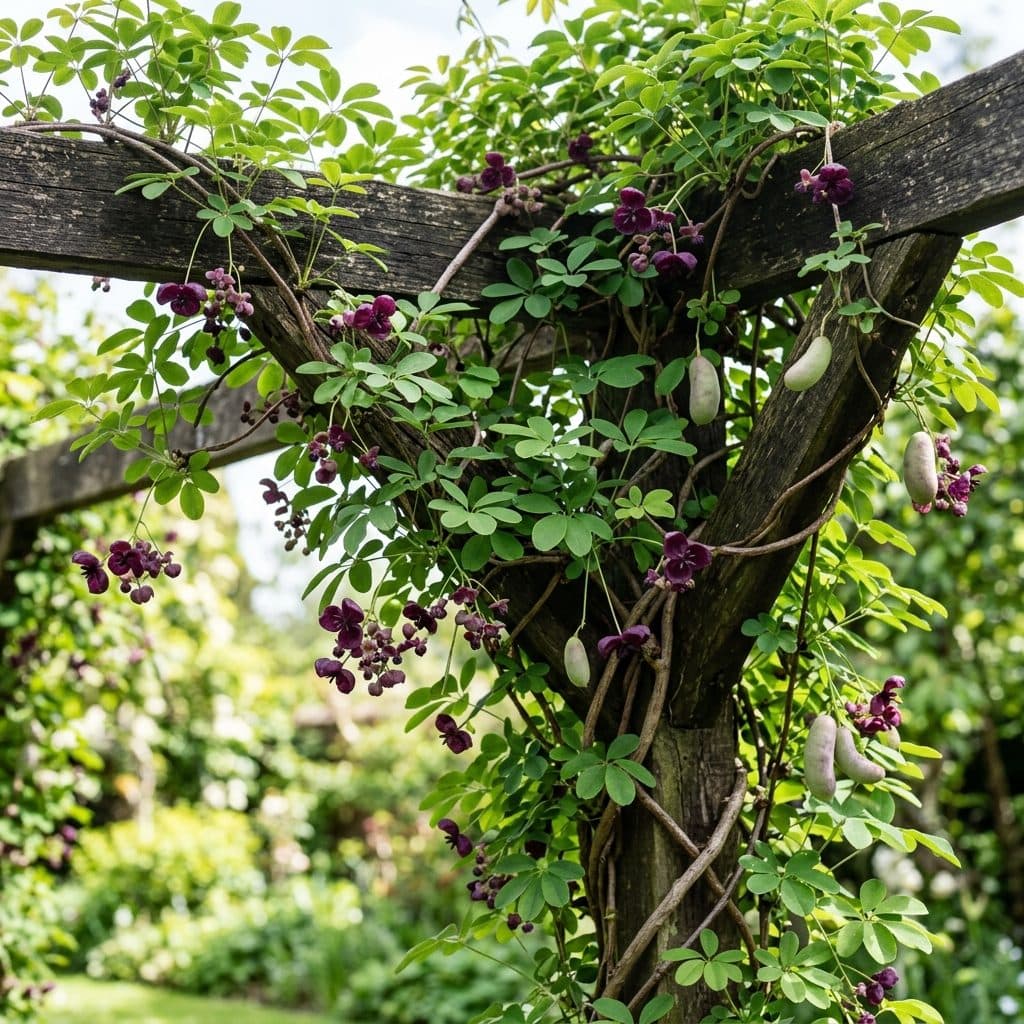
secondary
Chocolate vine
Akebia quinata
International hardiness
- USDA 5-8
- RHS H6
- AU: Cool temperate, Warm temperate
Where it grows — regional guide
| Zones / rating | Regional notes |
|---|---|
USDA 5-8 | Regulated or prohibited as an aggressive invasive species across several eastern and mid-Atlantic states; plant strictly in contained settings away from natural forests. |
| Zones / rating | Regional notes |
|---|---|
H6 (-20 to -15C) | Fully hardy across the UK (RHS H6); trains well over pergolas and arches in sun or semi-shade, producing fragrant blooms from April to May. |
| Zones / rating | Regional notes |
|---|---|
Cool temperate, Warm temperate | Grown in cool-temperate tablelands of Victoria and New South Wales; manage vigorously to prevent vines from escaping cultivation into riparian bushland. |
| Zones / rating | Regional notes |
|---|---|
USDA 5-8 (USDA scale) Canada uses its own zone system; Canadian zones run roughly one lower than USDA. | Hardy in sheltered sites across USDA Zones 5 and 6 in southern Ontario and coastal British Columbia; mulch root systems well in cold winters. |
| Zones / rating | Regional notes |
|---|---|
No region-specific data yet | No region-specific data yet |
Chocolate vine (Akebia quinata), also called five-leaf akebia, is a rampant woody climbing liana in the family Lardizabalaceae. Native to temperate mountain forests and valleys across China, Japan, and Korea, this semi-evergreen vine has long been grown for fragrant spring blooms, traditional medicine, and autumn fruits. The common name reflects the vanilla-chocolate scent exhaled by its maroon flowers.
In permaculture designs, Akebia quinata fills the vertical climbing niche, transforming pergolas and fences into dense screens. Like the fruiting grape or tender passion fruit, it climbs rapidly by twining clockwise. Sited above groundcovers like garden thyme, it adds vertical shade while yielding unusual autumn fruit.
Beyond ornamental foliage, the plant bears fleshy purple pods filled with sweet, translucent pulp. Successful fruit production requires cross-pollination between compatible clones alongside firm growth management.
Growing chocolate vine
Akebia quinata is exceptionally hardy, thriving in USDA Hardiness Zones 5 through 8 with an RHS hardiness rating of H6. Dormant mature vines withstand winter lows down to -20 °C (-4 °F). Foliage stays evergreen in mild maritime winters but drops in cold continental areas, re-emerging in early spring.
The vine tolerates full sun, partial shade, and forest understorey light, though full sun promotes heavy flowering and heat to ripen fruit. It adapts to sandy loams and heavy clays with a pH of 6.0 to 7.5. Good drainage is essential, as waterlogged soil induces root rot. Established roots withstand dry spells, though 2.5 cm (1 in) of water per week in summer aids fruit sizing.
Pollination requires careful planning. Akebia quinata is monoecious, bearing separate male and female flowers in the same raceme, but individual clones are self-incompatible. Solitary vines blossom without setting fruit. Plant two distinct clones or pair the purple form with white-flowered cultivars like 'Alba' or three-leaf akebia (Akebia trifoliata). Hand-pollinating with a soft brush enhances fruit set.
Propagate from semi-hardwood cuttings in summer, hardwood cuttings in autumn, or layering in spring. Seeds need 30 to 60 days of moist stratification at 2 to 4 °C (36 to 39 °F). Space plants 2.5 to 3.5 m (8 to 12 ft) apart on heavy trellises. Stems add 4 to 6 m (13 to 20 ft) in a season, requiring annual winter pruning to maintain light penetration.
Harvest and uses
Chocolate vine typically bears its first fruit two to four seasons after planting, assuming compatible cross-pollinators are present. Pods mature in mid-autumn, usually from late September into November depending on latitude.
The fruit is an oblong, sausage-shaped, fleshy pod measuring 6 to 12 cm (2.4 to 4.7 in) in length and 3 to 5 cm (1.2 to 2 in) in diameter, ripening to a pale violet, dull slate-purple, or soft mauve hue with a glaucous waxy bloom. The hallmark of physiological maturity is fruit dehiscence: when ripe, the thick rind splits naturally along its ventral suture, exposing a central cylindrical core of translucent, gelatinous white pulp embedded with dozens of small, lustrous black seeds.
Harvest pods immediately once the ventral seam begins to open, or clip them just prior to splitting when the skin softens slightly under gentle thumb pressure. Do not allow split fruit to hang on the vine during wet weather, as autumn rains rapidly induce mould on the exposed pulp.
Culinary and traditional uses include:
- Fresh edible pulp: The sweet, jelly-like pulp surrounding the seeds possesses a delicate, refreshing flavour reminiscent of coconut, melon, and litchi. The pulp is eaten fresh out of hand by sucking the gelatinous arils away from the seeds. Avoid chewing or swallowing the hard black seeds, which are intensely bitter.
- Cooked rinds: In traditional Japanese rural cuisine, known as akebi, the thick, bitter purple pods are not discarded. Sliced thinly, parboiled in salted water to leach out soluble tannins, and sautéed with miso, minced meat, and sesame oil, the rind is a savoury autumn vegetable with an appealing slight bitterness similar to bitter gourd.
- Tea and shoots: Young spring shoot tips and tender leaves can be blanched and served as wild spring greens or dried into an aromatic herbal tea.
- Basketry and vinecraft: The tough, pliant, fibrous woody runners have been harvested traditionally for centuries to weave durable carrying baskets, wickerwork furniture, and rustic garden structures.
- Traditional pharmacopoeia: In East Asian phytotherapy, the dried woody stem is utilised under the traditional name Mu Tong as a diuretic and anti-inflammatory agent.
Identifying chocolate vine
Akebia quinata is recognised by several distinctive morphological traits:
- Stems and habit: High-climbing, twining deciduous or semi-evergreen woody vine reaching 9 to 12 m (30 to 40 ft) in height, with smooth, slender, greyish-brown stems marked by prominent round lenticels.
- Foliage: Alternate, palmately compound leaves composed of five (rarely three or four) stalked leaflets radiating from a slender petiole. Leaflets are oblong-obovate, 3 to 6 cm (1.2 to 2.4 in) long, with entire margins, rounded or notched (emarginate) tips, and a smooth, lustrous blue-green upper surface.
- Inflorescences: Drooping axillary racemes 5 to 12 cm (2 to 4.7 in) long, appearing in mid-spring alongside emergent foliage. Each cluster contains one to three large female blossoms, 2.5 to 3 cm (1 to 1.2 in) across, with three fleshy, petal-like chocolate-purple sepals, accompanied by five to ten smaller male blossoms, 1 to 1.5 cm (0.4 to 0.6 in) across, bearing purple anthers and releasing a rich vanilla-chocolate aroma.
- Fruit: Large, fleshy, sausage-shaped follicles 6 to 12 cm (2.4 to 4.7 in) long, ripening to pale violet or purple, splitting along one side to reveal white gelatinous pulp filled with tiny black seeds.
Chocolate vine is distinguished from three-leaf akebia (Akebia trifoliata) by its five leaflets with entire margins (the latter has three leaflets with wavy or coarsely toothed margins). It differs from native wild vines like Virginia creeper (Parthenocissus quinquefolia) by its twining habit rather than adhesive tendril discs, its fleshy purple flowers, and its distinctive splitting sausage-shaped pods.
Cautions
Growers should review several serious ecological, horticultural, and medicinal cautions before introducing chocolate vine:
- Severe ecological invasiveness: Akebia quinata is an aggressive, high-climbing liana capable of forming impenetrable tangled mats over forest understories and suffocating canopy trees. Once established, vegetative runners spread across the forest floor, rooting at every node and outcompeting native shrubs, ferns, and tree saplings. In the United States, chocolate vine is classified or regulated as an invasive exotic pest plant across numerous eastern and mid-Atlantic states, including Maryland, Pennsylvania, Virginia, New Jersey, and Connecticut. Check local noxious weed lists before planting, and avoid establishing vines near natural woodlands, ravine reserves, or riparian corridors.
- Medicinal substitution hazard (nephrotoxicity): In traditional East Asian herbal medicine, Akebia stem is known as Mu Tong. A catastrophic historical substitution occurred where Akebia stems were mistakenly substituted with Aristolochia manshuriensis (Guan Mu Tong) and related birthwort species containing nephrotoxic and carcinogenic aristolochic acids. Ingestion of aristolochic acid causes irreversible renal failure and urothelial carcinoma. Homesteaders must never harvest wild vines for medicinal decoctions or consume uncertified commercial preparations.
- Seed bitterness and saponins: The numerous black seeds suspended in the sweet pulp contain bitter triterpenoid saponins. While the sweet gelatinous aril is pleasant, biting into or grinding the seeds imparts an astringent, unpalatable bitterness that causes mild nausea if ingested in quantity. Spit the seeds out when eating the fresh fruit.
- Structural burden: Mature vines accumulate substantial biomass and moisture. Light garden trellises and domestic gutters will collapse under their weight; grow only on anchored, heavy-duty posts and pergolas.
Sources
- Royal Botanic Gardens, Kew. Akebia quinata (Houtt.) Decne. Plants of the World Online.
- USDA PLANTS Database. Akebia quinata (Houtt.) Decne., chocolate vine
- Plants For A Future. Akebia quinata - (Houtt.) Decne.
- Royal Horticultural Society. Akebia quinata (chocolate vine)
- Missouri Botanical Garden. Akebia quinata