secondary
Hardy kiwi
Actinidia arguta
International hardiness
- USDA 4-8
- RHS H6
- AU: Cool temperate
Where it grows — regional guide
| Zones / rating | Regional notes |
|---|---|
USDA 4-8 | Requires a heavy-duty arbor; protect tender spring shoots from late frost, and check local regulations as vines are invasive in parts of the Northeast. |
| Zones / rating | Regional notes |
|---|---|
H6 (-20 to -15C) | Best positioned on warm south- or west-facing walls or sheltered pergolas; ensure compatible male and female vines are planted together. |
| Zones / rating | Regional notes |
|---|---|
Cool temperate | Suited to cool-climate tablelands of Victoria and New South Wales with adequate winter chilling; provide generous summer irrigation. |
| Zones / rating | Regional notes |
|---|---|
USDA 4-8 (USDA scale) Canada uses its own zone system; Canadian zones run roughly one lower than USDA. | Performs well in southern Ontario, Quebec, and coastal British Columbia; plant in sheltered, elevated sites to avoid frost pockets. |
| Zones / rating | Regional notes |
|---|---|
No region-specific data yet | No region-specific data yet |
Hardy kiwi (Actinidia arguta) is a rampant, deciduous woody vine in the kiwi family (Actinidiaceae), prized for its sweet, bite-sized berries. Native to the mountain woodlands of northeastern China, Korea, Japan, and the Russian Far East, this vigorous liana brings commercial kiwifruit flavor into cold-temperate homesteads where traditional fuzzy kiwis cannot survive the winter. The fruit, often marketed as the kiwi berry, has entirely smooth, edible skin that requires no peeling before consumption.
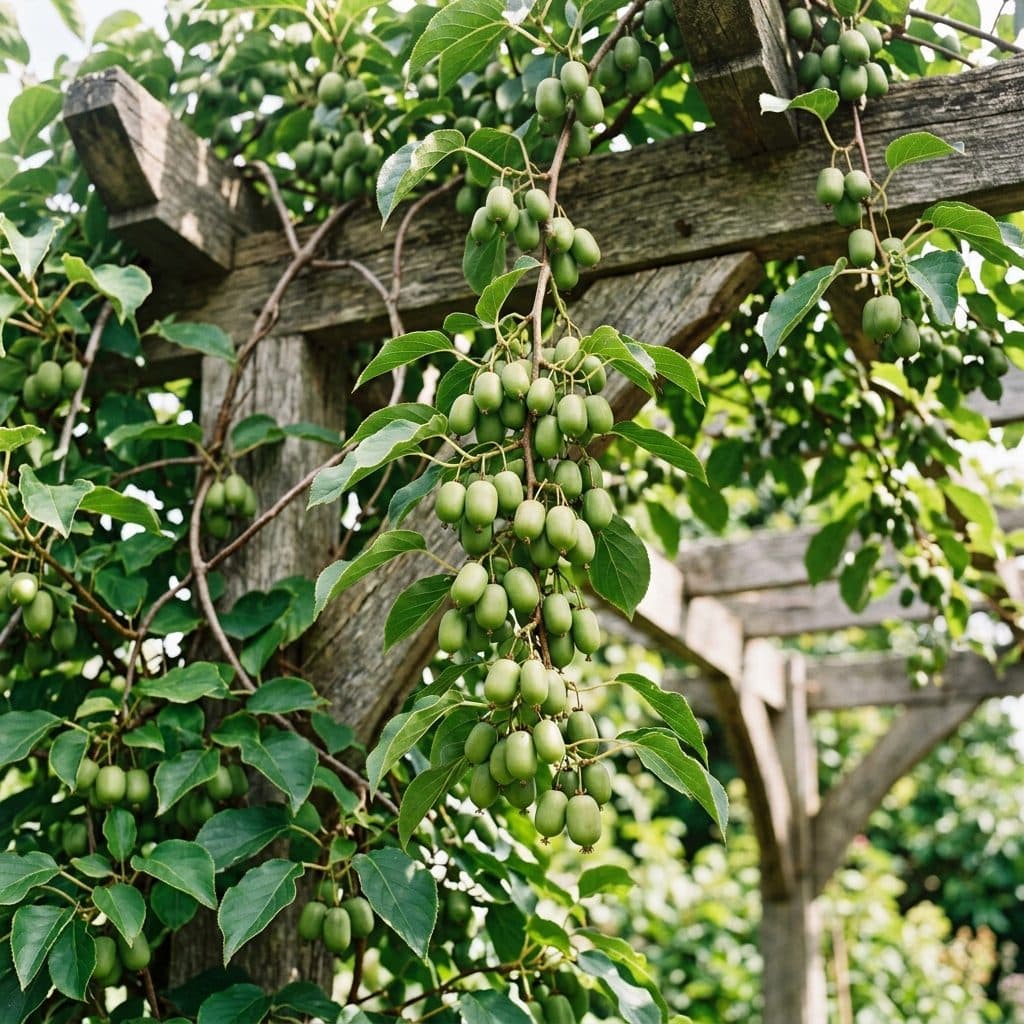
In an edible landscape or permaculture design, hardy kiwi is a productive vertical climber, turning sturdy pergolas, heavy trellises, and fence lines into dense, fruiting canopies. While an herbaceous groundcover like the strawberry provides ground-level fruit, hardy kiwi fills the vertical canopy niche, providing cooling summer shade and abundant autumn harvests. Because individual vines can remain productive for fifty years or more, careful site planning and sturdy structural support are fundamental to long-term success.
The vine is primarily dioecious, meaning male and female reproductive flowers develop on separate plants. To produce fruit, growers must plant at least one compatible male pollinator alongside female cropping vines. Once established, these vigorous climbers yield prolific clusters of grape-sized fruit packed with vitamin C, potassium, and beneficial dietary fibre.
Growing hardy kiwi
Hardy kiwi is exceptionally cold-hardy when fully dormant, with mature wood withstanding winter low temperatures down to -34 °C (-30 °F), corresponding to USDA Hardiness Zones 4 through 8. However, the vine breaks dormancy early in spring. The tender, expanding young shoots and flower buds are vulnerable to late spring frosts, with temperatures dipping below -1 °C (30 °F) readily scorching succulent new growth. Select an elevated planting site with excellent cold-air drainage, avoiding low-lying frost pockets. Positioning vines along the eastern or northern side of a windbreak can delay early budbreak until severe spring frost risks have subsided.
The vine thrives in deep, fertile, moisture-retentive loams with high organic matter and a soil pH between 5.5 and 6.5. Good drainage is critical; hardy kiwi root systems are sensitive to saturated ground and rapidly succumb to Phytophthora root rot in waterlogged soils. Plants require full sun for maximum flower formation and sugar concentration, though they tolerate partial afternoon shade in warm southern zones. Provide 2.5 to 4 cm (1 to 1.5 in) of water per week during the active growing season, particularly while fruit is sizing in midsummer.
Propagate hardy kiwi from rooted softwood cuttings taken in early summer, hardwood cuttings taken in late winter, or purchase grafted bare-root or potted nursery stock. Plant dormant vines in early spring. Because of the plant's dioecious habit, plant one male vine for every six to eight female vines. Space the male centrally within 10 to 15 m (30 to 50 ft) of the females so foraging bees can transfer pollen effectively. Popular female cultivars include 'Ananasnaya' (noted for red-blushed fruit), 'Geneva', and 'Jumbo', while 'Meader' and '74-49' are dependable male pollinators. Self-fertile selections such as 'Issai' exist but produce smaller fruit and yield significantly heavier crops when paired with a male pollinator.
Space plants 3 to 4.5 m (10 to 15 ft) apart in rows spaced 4.5 m (15 ft) apart. The vine's rampant growth requires a substantial support structure, such as a heavy T-bar trellis constructed with 10 cm (4 in) wooden posts and 12-gauge high-tensile wire, or a sturdy timber pergola. Vines commonly reach 6 to 9 m (20 to 30 ft) in length and require systematic pruning. Train a single central trunk up to a wire, then establish two permanent lateral cordons. Perform dormant winter pruning to thin out two-year-old fruiting canes, and prune vigorous summer vegetative shoots back to four to six leaves beyond developing fruit clusters to maintain light penetration.
Harvest and uses
Hardy kiwi vines typically produce their first light crop three to four years after planting, reaching full commercial yields of 20 to 50 kg (44 to 110 lb) per mature vine by their sixth to eighth season. The berries mature in late summer through mid-autumn, usually from September into October depending on the cultivar and local climate.
Unlike tree fruit, hardy kiwi berries do not soften completely on the vine before picking. Harvest the berries while they remain firm but have reached physiological maturity, which can be measured when the seeds inside turn black and soluble solids reach 6 to 8 percent Brix. If picked firm, the fruit can be stored in perforated plastic bags under refrigeration at 0 to 2 °C (32 to 36 °F) for two to four weeks. To prepare the fruit for eating, bring the firm berries to room temperature for two to three days, allowing them to soften and develop full sweetness.
The culinary appeal of hardy kiwi lies in its convenience: the entire berry is popped into the mouth whole, skin and all. The flavor is intensely sweet, aromatic, and complex, without the abrasive texture of commercial fuzzy kiwis. Homesteader kitchens use surplus harvests for fresh fruit salads, dehydrating whole into kiwi raisins, blending into refreshing green smoothies, or simmering into flavorful jams, jellies, and artisan wines.
Identifying hardy kiwi
Hardy kiwi is recognized by its distinctive vegetative, floral, and fruiting characteristics:
- Stems and wood: Vigorous woody twining vine with smooth, brownish-grey bark that develops shallow fissures with age. Cross-sections of one-year-old canes reveal a chambered, lamellate pith.
- Foliage: Leaves are alternate, simple, broadly ovate to oblong-elliptic, measuring 7 to 15 cm (2.8 to 6 in) in length and 5 to 10 cm (2 to 4 in) in width. Blades are dark lustrous green above, paler beneath, with finely serrated margins and striking crimson or reddish petioles.
- Flowers: Creamy-white, nodding, fragrant blossoms measuring 1.5 to 2 cm (0.6 to 0.8 in) across, borne in small axillary cymes in late spring. Female flowers possess a prominent white central ovary with spreading stigmas surrounded by non-functional sterile anthers; male flowers display central stamens with dark purplish-brown anthers and lack an ovary.
- Fruit: Smooth, hairless, oblong to cylindrical berries measuring 2 to 3 cm (0.8 to 1.2 in) long, ripening to a dull green or olive color, sometimes with a bronze or reddish-purple sunburst blush.
Hardy kiwi is distinguished from fuzzy kiwi (Actinidia deliciosa) by its hairless, smooth edible skin, smaller fruit dimensions, and superior winter cold-hardiness. It differs from the related Arctic beauty kiwi (Actinidia kolomikta) by its lack of pink and white leaf variegation and its significantly more vigorous vine architecture.
Cautions
Growers should consider several management and environmental factors before establishing hardy kiwi:
- Invasiveness and ecological spread: Actinidia arguta is a high-climbing liana capable of producing rampant annual growth. In regions of the northeastern United States, including parts of Massachusetts, Vermont, New York, and Pennsylvania, escaped vines have invaded native deciduous woodlands. The vines climb into the forest canopy, shading out native understory species and toppling mature forest trees through sheer weight. The plant is regulated in some jurisdictions; check your local list before planting.
- Structural failure: Standard domestic wire fences and light garden trellises inevitably buckle under the weight of mature vines and heavy snow loads. Only heavy-duty, anchored infrastructure should be used.
- Feline attraction: Hardy kiwi stems and root crowns produce volatile compounds, including actinidine, which trigger behavioral responses in domestic cats similar to catnip. Roaming cats may claw, bite, and dig up young root crowns. Surround young plants with sturdy protective wire hardware cloth for their first two seasons.
- Pest and disease vulnerabilities: While generally resistant to common insect pests, plants are susceptible to root-knot nematodes in sandy soils and Botrytis grey mold on ripening fruit during humid autumn weather.
Sources
- Royal Botanic Gardens, Kew. Actinidia arguta (Siebold & Zucc.) Planch. ex Miq. Plants of the World Online.
- NC State Extension Plant Toolbox. Actinidia arguta
- University of Minnesota Extension. Growing kiwiberry in the home garden
- Penn State Extension. Hardy Kiwi in the Home Fruit Planting
- Oregon State University Extension Service. Growing Kiwifruit