climax
Breadfruit tree
Artocarpus altilis
International hardiness
- USDA 11-12
- RHS H1a
- AU: Tropical
Where it grows — regional guide
| Zones / rating | Regional notes |
|---|---|
USDA 11-12 | Grown in tropical Hawaii, Puerto Rico, and strictly sheltered coastal microclimates of South Florida (USDA 11–12); cannot endure frost or dry chill. |
| Zones / rating | Regional notes |
|---|---|
H1a (above 15C, heated glasshouse) | No region-specific data yet |
| Zones / rating | Regional notes |
|---|---|
Tropical | Thrives only in wet tropical Queensland and the Top End; shelter from dry, cool southern winds and maintain high humidity during establishment. |
| Zones / rating | Regional notes |
|---|---|
USDA 11-12 (USDA scale) Canada uses its own zone system; Canadian zones run roughly one lower than USDA. | No region-specific data yet |
| Zones / rating | Regional notes |
|---|---|
No region-specific data yet | No region-specific data yet |
Breadfruit tree (Artocarpus altilis), known across Polynesia as ulu, is a large tropical evergreen tree in the mulberry and fig family (Moraceae). Believed to have originated in the islands of New Guinea, the Moluccas, and the southwestern Pacific, breadfruit was transported throughout Oceania by Polynesian voyagers as a foundational canoe plant. Renowned for its enormous, deeply cut glossy leaves and prolific crops of starchy, carbohydrate-rich fruit, breadfruit is a primary tropical food security crop. When cooked, the firm, pale starchy flesh closely resembles freshly baked wheat bread or roasted potatoes.
In tropical homestead agroforestry, breadfruit is an emergent climax canopy tree. Its massive branches form an umbrella-like canopy that shades the humid understorey, providing ideal microclimates for lower-storey companion crops such as banana or papaya. A single mature tree produces heavy seasonal yields for fifty to eighty years with minimal annual soil cultivation, conserving topsoil and preventing tropical soil erosion. The abundant fallen leaf litter delivers substantial biomass rich in silica, potassium, and calcium to the forest floor.
Growing breadfruit tree
Breadfruit is an ultra-tropical species, hardy strictly in USDA Zones 11 through 12 and rated RHS H1a. It cannot endure cold conditions: growth ceases at temperatures below 15 °C (59 °F), chilling injury to leaves and flowers occurs at 10 °C (50 °F), and freezing temperatures below 0 °C (32 °F) cause fatal tissue collapse. It demands high relative humidity (70 to 90 percent) and consistent annual rainfall between 1,500 and 3,000 mm (60 to 120 in). While established trees survive brief dry periods of two to three months, sustained drought triggers heavy leaf and fruit drop.
Soil requirements emphasise good depth and drainage. Breadfruit performs best in deep, rich alluvial soils, volcanic loams, and sandy loams with high organic content and a pH between 6.0 and 7.5. It tolerates slight soil salinity near coastal shorelines, provided the soil is loose and well drained. It is intolerant of waterlogged, stagnant soils; stagnant winter moisture quickly induces lethal root decay. Full overhead sunlight is essential for optimum canopy branching and heavy flower set, although young nursery transplants require 30 to 40 percent shade during their first six months in the ground.
The tree grows with great speed under tropical conditions, adding 1 to 1.5 m (3.3 to 5 ft) of height annually to reach mature dimensions of 12 to 20 m (40 to 65 ft) with a trunk diameter up to 1 m (3.3 ft). Most cultivated Pacific varieties are sterile seedless triploids that cannot be propagated by seed. Propagation relies entirely on vegetative techniques: root suckers, root cuttings 2 to 3 cm (0.8 to 1.2 in) thick, air layering (marcottage), or grafting onto seedling rootstocks of seeded wild breadfruit (Artocarpus camansi). Trees established from rooted cuttings begin producing fruit in three to five years. In orchards, space trees at 10 by 10 m (33 to 33 ft) to 12 by 12 m (40 by 40 ft) to accommodate their expansive crowns.
Harvest and uses
A healthy mature breadfruit tree produces 100 to 300 fruits per year, yielding roughly 150 to 400 kg (330 to 880 lb) of nutritious staple food annually. The fruits ripen over several distinct waves during the year depending on regional rainfall patterns.
Harvesting occurs when fruits are mature but firm, indicated by a slight flattening of the surface polygons, small drops of dried white latex crusting on the green rind, and a subtle yellowish-green cast to the skin. Harvesters cut the stem using long poles equipped with cutting blades and catching nets, avoiding ground bruising. Mature green breadfruit is treated as a starchy staple: it can be roasted whole in hot coals until the skin chars, baked in ovens, boiled, steamed, mashed, or fried as chips. The cooked pulp has a soft, starchy texture and a mild, pleasant flavour reminiscent of fresh bread or artichoke hearts.
If allowed to ripen fully on the tree or counter, the flesh softens to a creamy, custard-like consistency and turns sweet, with an aromatic fragrance. Ripe breadfruit is eaten with a spoon or baked into sweet puddings, custards, and traditional Polynesian desserts. Processed into dried flour, breadfruit flour is gluten-free, low-glycaemic, and rich in dietary fibre, potassium, iron, and essential amino acids.
The wood of Artocarpus altilis is golden-yellow, lightweight, straight-grained, and resistant to termites and marine worms. Across the Pacific, it is the premier traditional lumber for constructing outrigger canoe hulls, house rafters, carving bowls, and surfboards. The fibrous inner bark was historically beaten into traditional bark cloth (tapa). Furthermore, male flower spikes contain natural phytochemicals that act as an effective mosquito repellent when burned as a slow-smouldering smudge.
Identifying breadfruit tree
Artocarpus altilis is easily identified by its dramatic tropical foliage and canopy fruit:
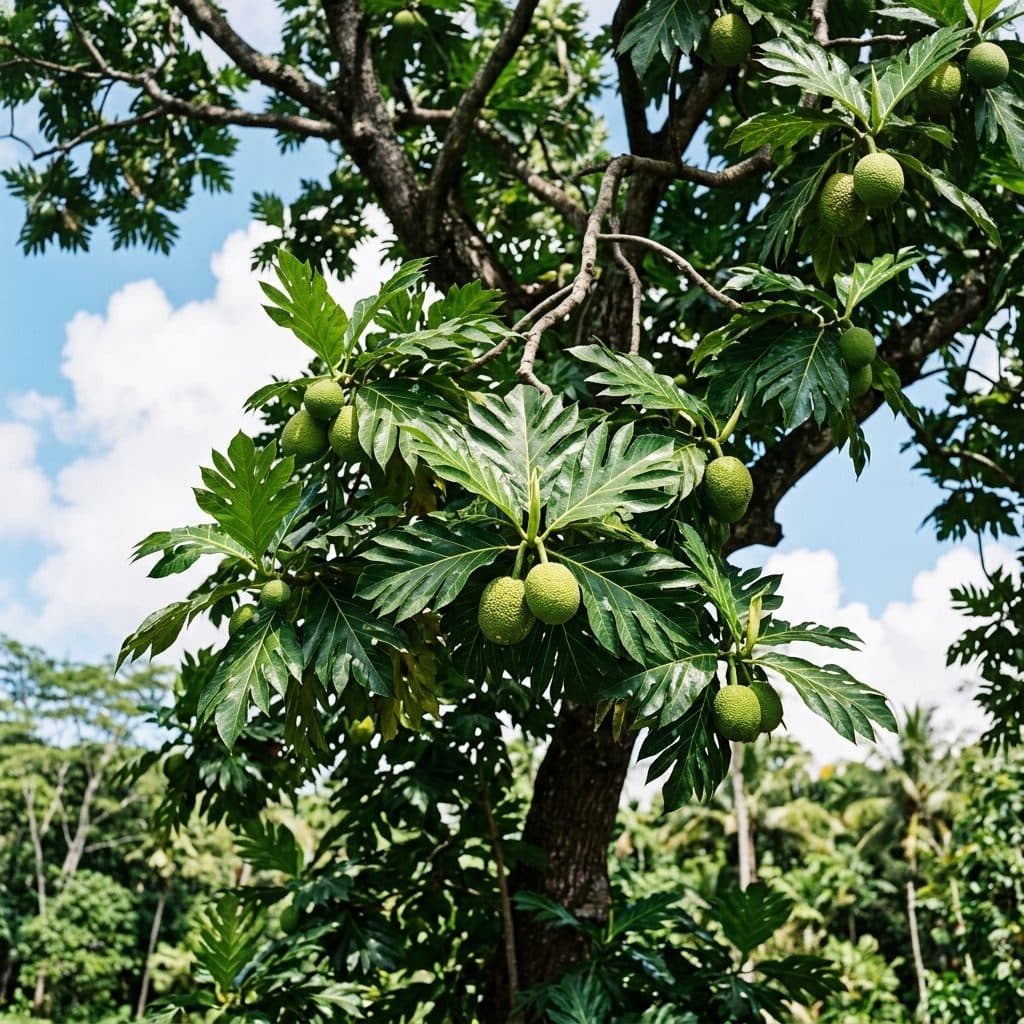
- Leaves: Alternate, large, thick, leathery leaves measuring 30 to 90 cm (12 to 35 in) long and 20 to 50 cm (8 to 20 in) wide. The blade is glossy dark green above, paler beneath with prominent veins, and deeply pinnately divided into 5 to 11 pointed lobes.
- Bark and sap: The trunk is covered with smooth, greyish-brown bark that roughens slightly on older trees. The entire tree is permeated with abundant, thick, sticky white latex that bleeds instantly from broken stems or bruised fruit.
- Flowers: Monoecious. Male flowers form dense, club-shaped, spongy yellow spikes measuring 15 to 30 cm (6 to 12 in) long and 2 to 4 cm (0.8 to 1.6 in) thick, dangling from leaf axils. Female flowers form upright, round to oblong green heads covered with thousands of tiny stigmas, which develop into the compound fruit.
- Fruit: Round, oval, or oblong syncarps measuring 10 to 30 cm (4 to 12 in) in diameter and weighing 1 to 4 kg (2.2 to 8.8 lb). The rind is light green to yellowish-green, patterned with flat to slightly raised hexagonal faces, enclosing dense, pale-yellow, starchy flesh. In seedless cultivars, no hard seeds are present.
Breadfruit is readily distinguished from jackfruit (Artocarpus heterophyllus) by its giant, deeply lobed leaves and by the fact that its fruits hang from outer canopy branch tips, whereas jackfruit has smaller, unlobed leaves and bears massive spiky fruits directly on the main trunk.
Cautions
Growers intending to plant Artocarpus altilis must manage several climatic and physical vulnerabilities:
- Absolute cold intolerance: The species cannot survive in temperate or continental climates. Even in USDA Zone 10, occasional winter cold snaps and chilly nights below 10 °C (50 °F) cause severe leaf defoliation, root dieback, and failure to set fruit. Do not attempt outdoor cultivation outside the true humid tropics or subtropical microclimates with warm winter nights.
- Vulnerability to storm windthrow: Breadfruit wood is relatively soft and brittle, and the enormous surface area of its lobed leaves catches strong winds like a sail. In tropical storms and hurricanes, mature trees frequently suffer heavy limb breakage or complete uprooting. Prune trees regularly to maintain a lower, compact canopy, and plant windbreak rows of sturdier trees on windward perimeters.
- Latex handling precautions: The sticky white latex adheres tenaciously to skin, clothing, and tools. Contact with the eye causes painful chemical irritation. When harvesting or processing breadfruit, wash equipment promptly with vegetable oil followed by hot soapy water. Those with natural rubber latex allergies may experience contact dermatitis.
- Rapid post-harvest ripening: Mature harvested breadfruit softens and ripens within two to four days at ambient tropical temperatures. Once soft, it cannot be used for savoury starchy cooking. Keep harvested fruit submerged in cold fresh water or refrigerate at 12 to 14 °C (54 to 57 °F) to retard ripening.
Sources
- Royal Botanic Gardens, Kew. Artocarpus altilis (Parkinson) Fosberg Plants of the World Online.
- USDA PLANTS Database. Artocarpus altilis (Parkinson) Fosberg - Breadfruit
- University of Florida IFAS Extension. The Breadfruit (Artocarpus altilis)
- Missouri Botanical Garden. Artocarpus altilis
- Plants For A Future. Artocarpus altilis - (Parkinson) Fosberg