Key takeaways
- Jackfruit (Artocarpus heterophyllus) and breadfruit (Artocarpus altilis) are close botanical relatives belonging to the mulberry and fig family (Moraceae).
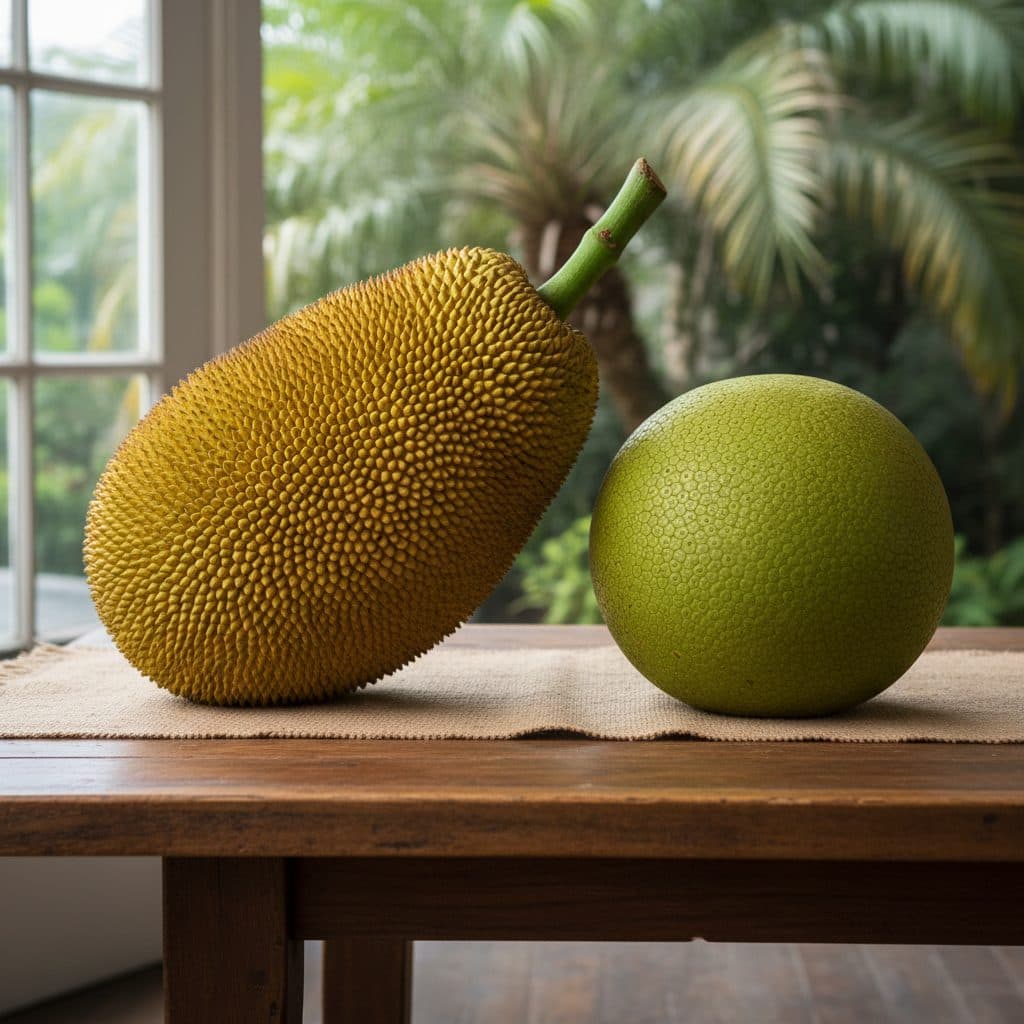
- Jackfruit is the largest tree-borne fruit in the world, typically weighing 5 to 20 kg, exceptionally to 35 kg or more (11 to 44 lbs, up to 77+ lbs), with a thick, spiky rind and individual fleshy yellow arils surrounding edible seeds.
- Breadfruit is smaller and rounder, typically weighing 1 to 3 kg (2 to 6 lbs), featuring a uniform, starchy, seedless or seeded flesh with the texture and culinary use of a potato or freshly baked bread.
- Unripe green jackfruit is fibrous and neutral, making it a popular savory meat substitute, while ripe jackfruit is intensely sweet and aromatic with flavors of banana, pineapple, and mango.
- Breadfruit is consumed almost exclusively as a cooked staple starch (roasted, baked, fried, or boiled) when mature-green, and only becomes soft and sweet when fully over-ripe.
- Both species require frost-free tropical or sheltered subtropical climates with high annual rainfall and deep, well-draining soils.
Quick answer: The main difference between jackfruit and breadfruit is their internal structure, size, and culinary use. Jackfruit is massive and oblong with spiky skin, containing sweet yellow fruit bulbs and large seeds, used as a meat substitute when green and eaten sweet when ripe. Breadfruit is smaller and round with pebbled skin, containing solid, starchy white flesh that is cooked like a potato.
Among tropical tree crops, few genera offer as much food security and culinary versatility as Artocarpus. Originating in tropical rainforests—jackfruit native to South Asia, and breadfruit domesticated in the New Guinea region and carried east across Oceania by Pacific voyagers—both crops have sustained human populations for thousands of years.
Despite their shared botanical lineage within the mulberry family (Moraceae), gardeners, chefs, and food forest designers often confuse the two species. Understanding the distinctions in jackfruit vs breadfruit morphology, flavor profiles, harvest stages, and tree cultivation requirements ensures you select and use the right tree crop for your landscape and kitchen.
+-------------------------------------------------------------+
|              JACKFRUIT VS BREADFRUIT COMPARISON             |
|                                                             |
|   FEATURE          JACKFRUIT                 BREADFRUIT     |
|   -------          ---------                 ----------     |
|   Botanical Name   A. heterophyllus          A. altilis     |
|   Native Origin    Western Ghats (India)     New Guinea/Moluccas
|   Fruit Weight     5 to 20+ kg (11-44+ lbs)  1 to 3 kg (2-6 lbs)
|   Exterior Rind    Hard blunt spikes         Pebbled, smooth|
|   Internal Flesh   Segmented yellow bulbs    Solid starchy pulp
|   Culinary Role    Meat substitute / Sweet   Staple starch  |
|   Seeds            Large, edible (boiled)    Often seedless |
+-------------------------------------------------------------+
Botanical origins and family relationships
Both species belong to the genus Artocarpus within the Moraceae (mulberry/fig) family. Like figs and mulberries, both trees produce a sticky white latex sap when cut and bear compound fruits (syncarps) formed from the fusion of hundreds of individual flowers.
+-------------------------------------------------------------+
|                  THE GENUS ARTOCARPUS SPECIES               |
|                                                             |
|   1. JACKFRUIT (*Artocarpus heterophyllus*):                |
|   - Cauliflorous fruiting habit (Fruit emerges directly     |
|     from the main trunk and thick structural branches)      |
|   - Glossy, entire, unlobed leaves on mature wood           |
|                                                             |
|   2. BREADFRUIT (*Artocarpus altilis*):                     |
|   - Terminal branch fruiting (Fruit hangs from outer twigs) |
|   - Massive, deeply lobed, ornamental "cut" leaves          |
+-------------------------------------------------------------+
Tree habit and leaf morphology
The trees differ visually even when not bearing fruit:
- Jackfruit foliage and flowering: Jackfruit leaves are medium-sized, glossy dark green, and oval with smooth margins. The tree exhibits cauliflory—bearing its massive fruits directly on the main trunk and heavy lower scaffold branches, an evolutionary adaptation capable of supporting fruits weighing upwards of 35 kg (77 lbs).
- Breadfruit foliage and flowering: Breadfruit trees produce enormous, deeply lobed leaves measuring up to 60 to 90 cm (24 to 36 in) long with bold, architectural silhouettes. Fruits hang in clusters of two or three from the terminal ends of high outer branches.
For foundational planting techniques for tropical and warm-climate trees, see our detailed guide on how to plant a fruit tree correctly.
Fruit structure, size, and appearance
Examining the exterior and internal anatomy of the fruit makes identification straightforward.
+-------------------------------------------------------------+
|                 INTERNAL ANATOMY COMPARISON                 |
|                                                             |
|   JACKFRUIT ANATOMY:                                        |
|   +-------------------------------------------------------+ |
|   | [ Spiky Outer Rind (2 cm thick) ]                     | |
|   |   - Central Fibrous Inedible Core (Rag)               | |
|   |   - ( * ) Individual Fleshy Yellow Bulbs (Arils)      | |
|   |   - ( O ) Dense Edible Seed inside each bulb          | |
|   +-------------------------------------------------------+ |
|                                                             |
|   BREADFRUIT ANATOMY:                                       |
|   +-------------------------------------------------------+ |
|   | [ Thin Pebbled Green Skin ]                           | |
|   |   - Small Central Core                                | |
|   |   - Continuous, uniform, solid cream/white flesh      | |
|   |   - Zero individual bulb segmentation                 | |
|   +-------------------------------------------------------+ |
+-------------------------------------------------------------+
Jackfruit structure
A mature jackfruit is massive, oblong to cylindrical, ranging from 30 to 90 cm (12 to 36 in) in length. The exterior rind is covered in thousands of hard, blunt, pyramid-shaped green-to-yellow spikes.
Inside, the fruit is highly segmented: a central sticky core is surrounded by hundreds of individual fleshy bulbs (arils). Each aril encloses a large, smooth seed surrounded by a papery seed coat. Between the edible bulbs lies a network of fibrous, inedible white strands known as "rags."
Breadfruit structure
Breadfruit is much smaller, typically round, spherical, or oval, measuring 15 to 30 cm (6 to 12 in) in diameter. The outer skin is relatively thin, light green to yellowish-green, with a flat, pebbled hexagonal surface pattern rather than sharp spikes.
Inside, breadfruit has a simple, uniform structure. When sliced open, the dense, cream-colored starchy flesh resembles raw potato or dense bread dough, without separate bulbs or thick internal rags. Most cultivated Polynesian and Caribbean breadfruit cultivars are completely seedless, although seeded wild forms (breadnut) exist.
Culinary uses, flavor profiles, and preparation
The culinary applications of jackfruit and breadfruit reflect their distinct textures and sugar contents.
Kitchen Stage | Jackfruit Culinary Use | Breadfruit Culinary Use |
|---|---|---|
Immature / Green | Shreddable savory meat alternative ("pulled jackfruit") | Boiled, fried as chips, added to stews |
Mature / Firm | Curries, stir-fries, savory vegetable dishes | Roasted whole, baked, mashed, fried like potato |
Fully Ripe / Soft | Eaten fresh; intensely sweet; desserts, smoothies | Sweet puddings, fermented doughs (Poi/Mahi) |
Seeds | Boiled or roasted like chestnuts (rich in protein) | Roasted or boiled (if seeded cultivar) |
+-------------------------------------------------------------+
|                 CULINARY FLAVOR PROFILES                    |
|                                                             |
|   UNRIPE JACKFRUIT: Neutral, stringy, fibrous texture;      |
|   readily absorbs savory barbecue sauces, curries, and spices
|                                                             |
|   RIPE JACKFRUIT: Firm, slippery, chewy arils; intensely    |
|   sweet with tropical notes of banana, mango, and pineapple |
|                                                             |
|   MATURE BREADFRUIT: Savory, dense, starchy; tastes like a  |
|   cross between a baked potato, fresh bread, and artichoke  |
+-------------------------------------------------------------+
Cooking with breadfruit
Breadfruit is treated culinarily as a carbohydrate staple rather than a fruit. In the Caribbean and Pacific Islands, mature green breadfruits are roasted directly over open fire embers until the skin chars black, revealing steaming, tender, bread-like white interior flesh. It can be sliced and fried into crispy chips, boiled in salted coconut milk (oil down), or mashed as a nutrient-dense substitute for mashed potatoes.
Cooking with jackfruit
Green jackfruit has achieved worldwide popularity as a plant-based meat alternative. When boiled and shredded, its fibrous texture mimics pulled pork or shredded chicken, absorbing the flavors of braising liquids and barbecue marinades. Ripe jackfruit, in contrast, is eaten raw as a dessert fruit, used in tropical ice creams, or dried into sweet fruit chips.
Nutritional comparison
Both fruits deliver substantial nutritional benefits, providing dietary fiber, essential vitamins, and minerals.
+-------------------------------------------------------------+
|              NUTRITIONAL HIGHLIGHTS (PER 100 GRAMS)         |
|                                                             |
|   JACKFRUIT (Raw / Ripe):                                   |
|   - Calories: ~95 kcal                                      |
|   - Carbohydrates: 23 g (Higher in natural sugars)          |
|- Dietary Fiber: 1.5 g | Protein: 1.7 g                   |
|   - High in Vitamin C, Vitamin B6, and Magnesium            |
|                                                             |
|   BREADFRUIT (Raw / Mature):                                |
|   - Calories: ~103 kcal                                     |
|   - Carbohydrates: 27 g (Higher in complex starches)        |
|- Dietary Fiber: 4.9 g | Protein: 1.1 g                   |
|   - Exceptionally rich in Potassium, Vitamin C, and Fiber   |
+-------------------------------------------------------------+
Breadfruit provides more complex carbohydrates and more than triple the dietary fiber per serving compared to jackfruit, making it a filling staple starch, though its glycaemic index varies considerably with ripeness and how it is cooked. Jackfruit offers higher protein content, particularly when the seeds (which contain roughly 6 to 7 grams of protein per 100 grams) are boiled and eaten.
Growing requirements and climate tolerances
Both species are tropical trees, but they exhibit subtle differences in cold sensitivity and moisture tolerance.
+-------------------------------------------------------------+
|               GROWING REQUIREMENTS COMPARED                 |
|                                                             |
|   TEMPERATURE TOLERANCE:                                    |
|   - Breadfruit: Stalls <15°C (59°F); chill injury ~5°C (41°F)
|   - Jackfruit: Slightly hardier; survives brief dips to 0°C |
|                                                             |
|   SOIL & MOISTURE:                                          |
|   - Both require deep, fertile loam with excellent drainage |
|   - Zero tolerance for stagnant waterlogging / flooded roots|
|                                                             |
|   PROPAGATION:                                              |
|   - Jackfruit: Grown easily from fresh seed or grafting     |
|   - Breadfruit: Propagated via root cuttings or air layering|
+-------------------------------------------------------------+
In tropical lowland climates: Breadfruit reaches 15 to 25 metres (50 to 80 feet); cultivated jackfruit is usually 8 to 15 metres (26 to 50 feet) and is commonly pruned lower to keep the trunk-borne fruit within reach. Both produce continuous harvests with minimal input once established.
In warm subtropical microclimates: Jackfruit can be grown successfully in warm, sheltered subtropical microclimates if protected from frost while young. Breadfruit, however, is strictly tropical: growth stalls below about 15°C (59°F), chilling injury occurs near 5°C (41°F), and any frost is fatal.
Regional planting caveats: Check local status before planting. Jackfruit self-seeds freely in wet tropical forest and is treated as an invasive species in parts of Brazil, where it is removed from protected forest; plant it only where local authorities consider it acceptable.
To maintain tree health through seasonal dry spells, review our strategies in deep watering fruit trees in drought and canopy protection in protecting fruit trees in a heatwave.
To propagate rare seedless breadfruit varieties vegetatively, explore our step-by-step techniques in air layering fruit trees and shrubs and structural maintenance in how to prune fruit trees.
Summary: which tree is right for you?
- Choose Jackfruit if you want a dual-purpose crop (savory meat substitute when young, dessert fruit when ripe), edible protein-rich seeds, and slightly better tolerance for subtropical temperature dips.
- Choose Breadfruit if you live in a frost-free tropical climate and want a high-yielding, complex carbohydrate tree that is a permanent, zero-till staple starch crop.