climax
Jackfruit tree
kathal (کتھل)
Artocarpus heterophyllus
- sindh coast
International hardiness
- USDA 10-12
- RHS H1b
- AU: Tropical, Subtropical
Where it grows — regional guide
| Zones / rating | Regional notes |
|---|---|
USDA 10-12 | Restricted to USDA Zones 10b to 11 in South Florida and Hawaii; trees suffer severe branch dieback if temperatures dip below freezing. |
| Zones / rating | Regional notes |
|---|---|
H1b (10 to 15C) | No region-specific data yet |
| Zones / rating | Regional notes |
|---|---|
Tropical, Subtropical | Cultivated in tropical Queensland, the Northern Territory, and warm subtropical coastal pockets; protect trees from dry winter cold snaps. |
| Zones / rating | Regional notes |
|---|---|
USDA 10-12 (USDA scale) Canada uses its own zone system; Canadian zones run roughly one lower than USDA. | No region-specific data yet |
| Zones / rating | Regional notes |
|---|---|
Sindh coast | Pakistan:Grown successfully in frost-free coastal Sindh and protected gardens in Karachi; young saplings require windbreaks and freeze protection. India:Revered as kathal across the subcontinent; immature fruit is cooked in savoury curries as a meat alternative, while ripe bulbs are eaten fresh. |
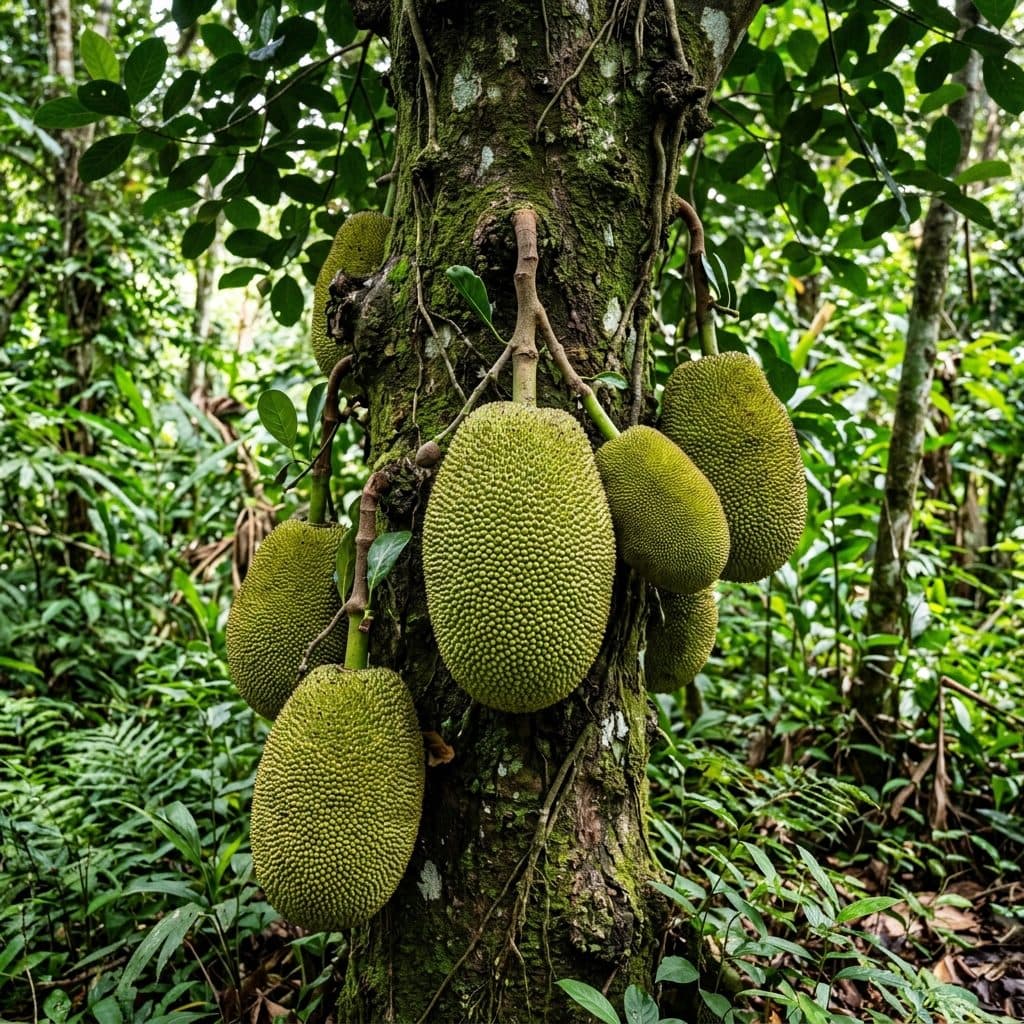
Jackfruit tree (Artocarpus heterophyllus), known across South Asia as kathal, is an imposing, evergreen canopy tree in the mulberry and fig family (Moraceae). Native to the tropical rainforests of the Western Ghats of India and the rainforests of Southeast Asia, jackfruit has been cultivated for thousands of years throughout the humid tropics. It produces the largest tree-borne fruit on Earth, with individual syncarps weighing from 5 to 35 kg (11 to 77 lb) and occasionally exceeding 50 kg (110 lb). With its dense glossy canopy, magnificent timber, and extraordinary food yields, it is a multi-tier food forest species.
In syntropic agroforestry and homestead permaculture, jackfruit is a long-lived, productive climax tree. Its broad evergreen crown intercepts harsh tropical downpours, protecting understorey soil while casting cooling shade over shade-tolerant understorey companions like ginger or turmeric. It forms productive multi-tier guilds alongside overstorey companions like mango and banana. The cauliflorous fruiting habit—bearing immense fruits directly on the main trunk and heavy lower scaffold limbs—minimises wind-leverage damage on outer branches. Fallen leaves, fruit husks, and unpollinated flowers deposit heavy organic mulch that feeds soil mycorrhizae.
Growing jackfruit tree
Jackfruit is strictly a tropical and warm subtropical tree, hardy in USDA Zones 10b through 12 and rated RHS H1b. It is acutely sensitive to freezing temperatures: young saplings are killed outright at -1 °C (30 °F), while mature trees suffer severe leaf scorch and branch dieback at -2 °C (28 °F). Optimum vegetative growth and fruit expansion occur between 24 and 35 °C (75 and 95 °F). It requires annual rainfall of 1,200 to 2,500 mm (47 to 98 in), although established trees withstand dry seasons of three to four months through deep taproots.
Soil drainage is of paramount importance. Jackfruit flourishes in deep, fertile alluvial loams, sandy clay loams, and volcanic soils rich in organic matter with a pH between 6.0 and 7.5. It cannot endure waterlogged conditions; standing water around the root flare for more than forty-eight hours causes rapid root suffocation and lethal Phytophthora root rot. Plantings on hillsides, berms, or raised mounds ensure rapid drainage. The tree demands full sunlight to produce heavy flower panicles, although young saplings benefit from light side shade during their first summer.
Trees attain mature heights of 10 to 20 m (33 to 66 ft) with a trunk diameter of 40 to 80 cm (16 to 31 in) and a dense, rounded crown. Propagation is carried out using seeds, veneer grafting, or approach grafting. Seeds are recalcitrant and lose viability within a month of removal from the fruit; sow fresh seeds immediately into deep containers, as the sensitive taproot resents coiling. Seedlings germinate in two to three weeks and bear fruit in four to seven years. Grafted cultivars begin bearing in two to three years and maintain predictable fruit quality. In orchard or agroforestry rows, space trees at 9 by 9 m (30 by 30 ft) to 12 by 12 m (40 by 40 ft).
Harvest and uses
Jackfruit yields two distinct, highly valued culinary crops from the same tree: immature green fruit and fully ripe fruit. An established mature tree produces 50 to 200 fruits per year, yielding several hundred kilograms of nutritious food.
Immature green jackfruit is harvested when the fruit reaches roughly one-third to one-half its mature size, while the interior seeds and flesh are firm and unripened. Sliced and boiled, the neutral green flesh exhibits a fibrous, shredded texture remarkably similar to pulled pork or chicken. Known as "tree meat", it absorbs curries, marinades, and seasonings beautifully, functioning as a primary plant-based staple across Asia and international culinary markets.
Fully ripe jackfruit is harvested when the rind changes from bright green to yellowish-brown, the flattened spines yield slightly to thumb pressure, and the fruit emits a powerful, sweet, tropical aroma. The fruit is cut open to extract fleshy, golden-yellow arils (bulbs) surrounding each seed. Ripe bulbs are lusciously sweet, with a tropical flavour blending banana, pineapple, and mango, enjoyed fresh, dried, or blended into desserts and smoothies.
The large seeds, measuring 2 to 4 cm (0.8 to 1.6 in) long, are highly nutritious, containing 30 percent carbohydrates and 6 percent protein. They are toxic if eaten raw, but when boiled in salted water or roasted over coals, they develop a texture and nutty flavour resembling sweet chestnuts.
Beyond food, the heartwood of Artocarpus heterophyllus is prized. Freshly cut wood is bright yellow, ageing to a rich, lustrous golden-mahogany. Dense, termite-resistant, and dimensionally stable, it is harvested for fine furniture, musical instruments, structural building posts, and boat construction. The leaves and fruit rind provide excellent, highly digestible fodder for goats and cattle.
Identifying jackfruit tree
Artocarpus heterophyllus is identified by several unmistakable botanical features:
- Bark and latex: The trunk displays smooth, dark greyish-brown bark that roughens with age. Cutting any part of the bark, twigs, or unripe fruit exudes copious, sticky, milky-white latex.
- Leaves: Alternate, simple, glossy dark green, leathery leaves measuring 10 to 20 cm (4 to 8 in) long and 5 to 10 cm (2 to 4 in) wide, elliptic to obovate with entire margins. Leaves on young saplings or vigorous water sprouts are frequently two- or three-lobed, whereas mature canopy leaves are strictly unlobed.
- Flowering: Monoecious cauliflory. Tiny male flowers form dense, oblong, velvety green spikes 5 to 10 cm (2 to 4 in) long on small branches, which turn brown and drop after shedding yellow pollen. Female spikes are larger, barrel-shaped, and emerge directly from short, stout, woody spurs on the main trunk and primary structural limbs.
- Fruit: Massive, oblong to cylindrical syncarps 30 to 90 cm (12 to 35 in) long and 20 to 50 cm (8 to 20 in) in diameter. The outer rind is composed of thousands of fused hexagonal pyramidal spines that soften upon ripening. The interior houses dozens to hundreds of yellow fleshy bulbs embedded in fibrous white rags (perianth strands).
Jackfruit is easily distinguished from its close relative breadfruit (Artocarpus altilis), which has huge, deeply pinnately lobed mature leaves and rounder, smaller fruits hanging from the outer canopy branches rather than directly from the main trunk.
Cautions
Growers cultivating Artocarpus heterophyllus must observe several physical and physiological precautions:
- Falling fruit impact hazard: Mature fruits routinely weigh 10 to 30 kg (22 to 66 lb) and hang high up the main trunk or from large scaffold branches. A falling fruit from a height of 5 to 10 m (16 to 33 ft) poses a lethal blunt-force hazard to humans, pets, and livestock. Never plant jackfruit trees directly above garden walkways, patio seating areas, driveways, or animal shelters.
- Sticky latex and contact dermatitis: All parts of the tree contain abundant sticky latex containing polyisoprene resins. When cutting open jackfruit, the latex clings stubbornly to hands and knives. Coat knives and hands with edible vegetable oil (such as coconut or mustard oil) before butchering fruit to prevent adhesion. Individuals with known natural rubber latex allergies can experience severe cross-reactive contact dermatitis from handling the fruit or sap.
- Raw seed toxicity: Jackfruit seeds contain toxic lectins and trypsin inhibitors in their raw state. Ingesting raw seeds can cause severe gastrointestinal cramps, nausea, and digestive impairment. Seeds must always be thoroughly cooked—either boiled for at least thirty minutes or roasted completely—before human or livestock consumption.
- Frost fatality: In non-tropical zones, do not plant jackfruit in outdoor open positions if winter temperatures dip below freezing. Even a brief frost will defoliate and destroy young plantings.
Sources
- Royal Botanic Gardens, Kew. Artocarpus heterophyllus Lam. Plants of the World Online.
- USDA PLANTS Database. Artocarpus heterophyllus Lam. - Jackfruit
- University of Florida IFAS Extension. The Jackfruit (Artocarpus heterophyllus)
- Missouri Botanical Garden. Artocarpus heterophyllus
- Plants For A Future. Artocarpus heterophyllus - Lam.