climax
Coconut palm
naryal
Cocos nucifera
- sindh coast
International hardiness
- USDA 10-11
- RHS H1a
- AU: Tropical, Subtropical
Where it grows — regional guide
| Zones / rating | Regional notes |
|---|---|
USDA 10-11 | Hardy only in coastal southern Florida (USDA Zone 10b to 11) and Hawaii; lethal yellowing phytoplasma devastated historical Jamaican Tall plantings. |
| Zones / rating | Regional notes |
|---|---|
H1a (above 15C, heated glasshouse) | No region-specific data yet |
| Zones / rating | Regional notes |
|---|---|
Tropical, Subtropical | Widely cultivated across coastal Queensland, Northern Territory, and north Western Australia; plant Dwarf varieties in high-traffic suburban spaces. |
| Zones / rating | Regional notes |
|---|---|
USDA 10-11 (USDA scale) Canada uses its own zone system; Canadian zones run roughly one lower than USDA. | No region-specific data yet |
| Zones / rating | Regional notes |
|---|---|
Sindh coast | Pakistan:Known locally as naryal; successful in frost-free coastal Sindh and Karachi belt, but intolerant of interior winter frosts and saline groundwater crusts. |
Coconut palm (Cocos nucifera) is an iconic, solitary arborescent palm in the palm family (Arecaceae). Revering it as the "tree of life" across maritime cultures, humans have cultivated the species for millennia. Originating along coastal shores of the tropical Indo-Pacific, the palm was dispersed naturally by buoyant ocean currents and intentionally by seafaring voyagers across the tropical Americas, the Caribbean, Africa, and Australasia. Every element of the palm provides sustenance and material utility, yielding refreshing liquid endosperm, calorie-dense edible kernel, structural timber, fibrous thatch, and durable coir fibre.
In tropical homestead agroforestry and syntropic polycultures, the coconut palm is a majestic emergent climax canopy tree. Its soaring crown admits filtered sunlight to diverse lower strata, creating microclimates favourable for mid-tier companions like banana or nitrogen-fixing leguminous groundcovers like centro. With a massive root bole anchored in sandy shores, Cocos nucifera withstands powerful tropical gales and salt spray while stabilising vulnerable coastal dunes against tidal erosion. However, its immense height and heavy falling fruit demand careful spatial planning.
Growing coconut palm
Coconut palms require an equatorial or warm maritime climate, thriving in USDA Hardiness Zones 10 through 11 and rated RHS H1a. The palm cannot tolerate frost. Temperatures dipping below 0 °C (32 °F) destroy fronds and cause fatal damage to the solitary growing tip. Optimal vegetative growth and fruit set occur between 26 and 32 °C (79 and 90 °F), with mean annual temperatures never falling below 20 °C (68 °F). Prolonged cold spells below 15 °C (59 °F) induce physiological chlorosis and halt nut formation. The species demands high humidity and abundant sunshine, needing at least 2,000 hours of sunlight annually. While requiring 1,500 to 2,500 mm (59 to 98 in) of evenly distributed annual rainfall, palms flourish in drier regions where roots access shallow freshwater lenses.
Soil adaptation is broad, provided drainage is flawless. The palm excels in deep alluvial sandy loams, coastal beach sands, weathered volcanic soils, and coral rubble across a pH range of 5.5 to 8.0. It possesses exceptional tolerance for saline coastal soils and brackish groundwater, absorbing sodium chloride to enhance osmotic regulation. However, waterlogged, heavy clays that exclude oxygen cause root rot and stunt trunk development.
Growers choose between two distinct botanical types: Tall varieties (such as 'Jamaican Tall' and 'West African Tall') and Dwarf varieties (such as 'Malayan Dwarf' and 'Fiji Dwarf'). Tall palms are cross-pollinated, attain heights of 20 to 30 m (66 to 98 ft), live for 80 to 100 years, and begin fruiting after six to eight years. Dwarf palms are predominantly self-pollinated, mature at 8 to 15 m (26 to 49 ft), begin bearing within three to four years, and offer practical harvesting height for home gardens alongside notable resistance to lethal yellowing disease.
Propagation is carried out exclusively from seed. Select fully mature, large, symmetrical coconuts that slosh with liquid when shaken. Lay nuts horizontally on their sides, burying one-half to two-thirds of the husk in moist, well-aerated sand or soil. Ensure the stem end is tilted slightly upward. Kept warm at 28 to 32 °C (82 to 90 °F), the shoot emerges through the husk in eight to sixteen weeks. Space Tall palms 8 to 9 m (26 to 30 ft) apart in triangular grids, and Dwarf varieties 6 to 7.5 m (20 to 25 ft) apart.
Harvest and uses
Coconut palms flower continuously, bearing inflorescences and nut bunches at various stages of maturity throughout the year. A healthy, mature palm yields 50 to 100 coconuts annually.
Harvest timing depends on culinary application:
- Tender water coconuts: Harvested at six to seven months after flowering while the outer husk remains completely green. At this stage, the cavity is filled with up to 500 ml (17 fl oz) of sweet, sterile water rich in potassium and electrolytes, lined with a thin, gelatinous layer of soft, digestible pulp.
- Mature copra coconuts: Harvested at eleven to twelve months when the outer husk turns dry and brown. The solid endosperm (meat) has reached maximum thickness and oil content. The meat is consumed raw, grated and squeezed with water to extract coconut milk and cream, or dried into copra for pressing virgin coconut oil.
Beyond the nut meat, the sap tapped from unopened inflorescences (toddy or neera) is consumed fresh, boiled into unrefined palm sugar (jaggery), or fermented into palm wine and vinegar. The fibrous mesocarp yields coir, processed into rope, mats, and horticultural coco-peat. Cleaned hard endocarp shells make durable bowls, buttons, and high-grade activated charcoal. When over-mature palms are felled, the hard outer trunk wood (coco-wood) provides durable building timber, while leaves are woven into durable thatch panels.
Identifying coconut palm
Cocos nucifera is characterised by distinct morphological traits:
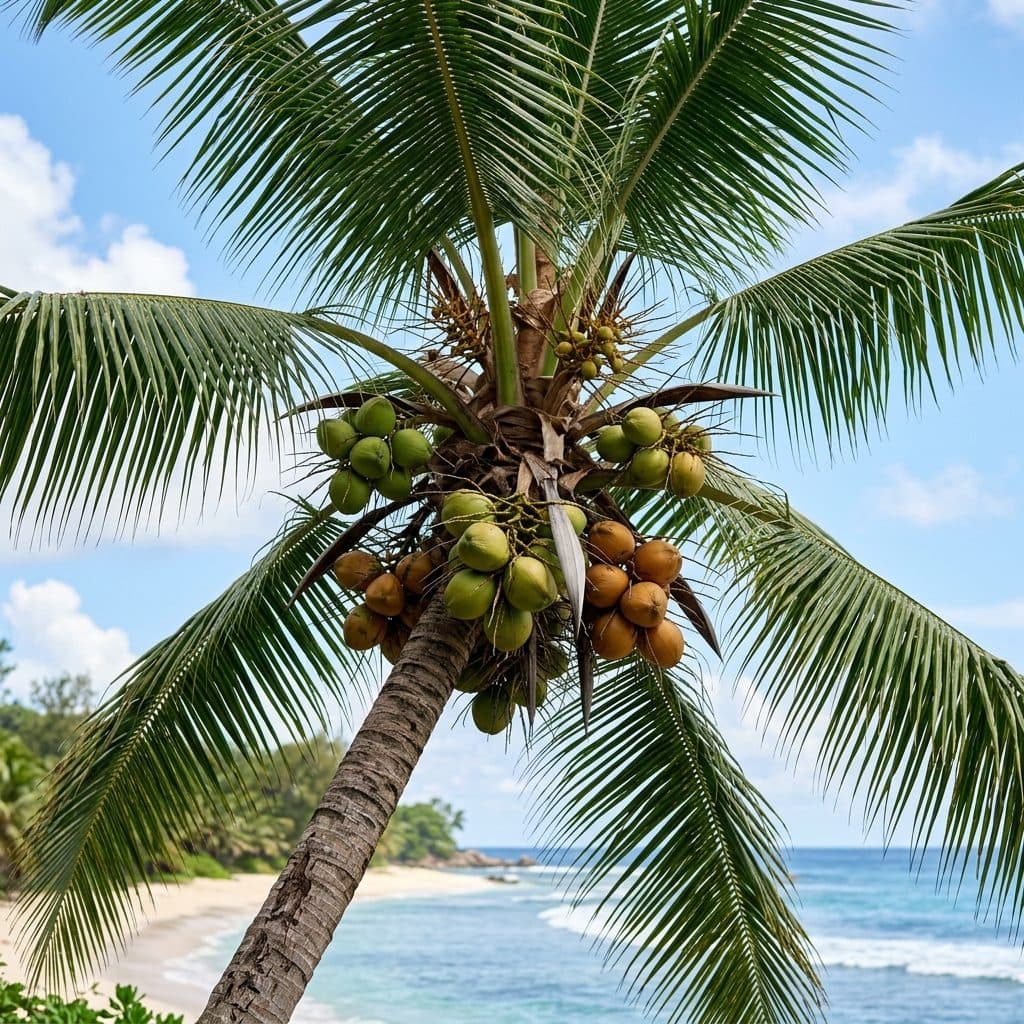
- Trunk: A solitary, unbranched columnar trunk reaching 20 to 30 m (66 to 98 ft) in Tall forms and 8 to 15 m (26 to 49 ft) in Dwarf forms, with a diameter of 30 to 45 cm (12 to 18 in). The trunk is typically grey, ringed with prominent dark leaf scars, and swollen at the soil surface into an inverted root bole measuring up to 1 m (3.3 ft) across. Trunks often curve gracefully toward sunlight.
- Canopy: A terminal, hemispherical crown composed of 25 to 35 pinnate fronds. Each frond measures 4 to 6 m (13 to 20 ft) in length and bears 200 to 250 linear-lanceolate, glossy green leaflets measuring 60 to 100 cm (24 to 39 in) long. The stout petiole is unarmed and attached via a fibrous woven leaf sheath.
- Inflorescence: A branched spadix measuring 1 to 1.5 m (3.3 to 5 ft) long, enclosed initially within a boat-shaped woody spathe emerging from lower leaf axils. The inflorescence bears thousands of small, creamy-yellow male flowers along branch tips and dozens of larger spherical female flowers near the base.
- Fruit: A large, fibrous, ovoid drupe measuring 20 to 30 cm (8 to 12 in) long and weighing 1.5 to 2.5 kg (3.3 to 5.5 lb). It consists of a smooth, waxy exocarp (green, yellow, or bronze), a thick fibrous mesocarp (coir husk), and an exceptionally hard, woody endocarp (shell) containing three distinct circular germination pores ("eyes") at the basal end.
Coconut palm is distinguished from the oil palm (Elaeis guineensis) by its smooth, unarmed petioles and solitary large nuts, and from royal palms (Roystonea) by the absence of a smooth green crownshaft.
Cautions
Growers cultivating coconut palms must account for serious physical and biological hazards:
- Lethal falling coconut impact: A mature coconut weighing 1.5 to 2.5 kg (3.3 to 5.5 lb) dropping from a 20 to 30 m (66 to 98 ft) crown reaches speeds exceeding 80 km/h (50 mph). The kinetic energy delivered causes catastrophic blunt trauma, skull fractures, and fatal injuries. Never position seating, footpaths, driveways, children's play areas, or livestock pens under bearing palms. In home and public landscapes, either regularly harvest mature bunches or plant Dwarf cultivars where canopy height remains manageable.
- Lethal Yellowing (LY) phytoplasma: Caused by a 16SrIV group phytoplasma transmitted by the planthopper Haplaxius crudus, this disease devastated millions of tall palms across Florida and the Caribbean. Symptoms start with premature nut drop, followed by blackened inflorescences, foliar yellowing that advances from oldest to newest fronds, and fatal collapse of the solitary bud within three to six months. Control relies strictly on planting resistant cultivars like 'Malayan Dwarf' and avoiding susceptible 'Jamaican Tall' stock.
- Palm weevil pests: The South American palm weevil (Rhynchophorus palmarum) and red palm weevil (Rhynchophorus ferrugineus) bore into the central bud tissue, destroying vascular systems and leading to crown collapse. Rhinoceros beetles (Oryctes rhinoceros) bore through developing spear leaves, creating characteristic V-shaped frond cuts.
- Severe cold vulnerability: Palms cease nutrient uptake below 15 °C (59 °F). Prolonged temperatures under 8 °C (46 °F) cause necrotic leaf spotting, and freezing temperatures destroy the solitary apical meristem, resulting in palm mortality.
Sources
- Royal Botanic Gardens, Kew. Cocos nucifera L. Plants of the World Online.
- Missouri Botanical Garden. Cocos nucifera
- USDA PLANTS Database. Cocos nucifera L.
- Plants For A Future. Cocos nucifera - L.