Key takeaways
- Understand the natural near-neutral pH (5.8 to 6.8) of coco coir compared to highly acidic sphagnum peat moss.
- Buffer raw coir with a concentrated calcium nitrate and magnesium sulfate solution to prevent nutrient lockout.
- Rinse compressed coir blocks with clean water to leach out the sodium and chloride left by retting, along with the coir's naturally high potassium.
- Use fine coir pith for seed starting, blending with perlite for optimal moisture balance and root aeration.
- Mix coarse coir fiber and chips into container soils to maintain structural pore space and prevent compaction.
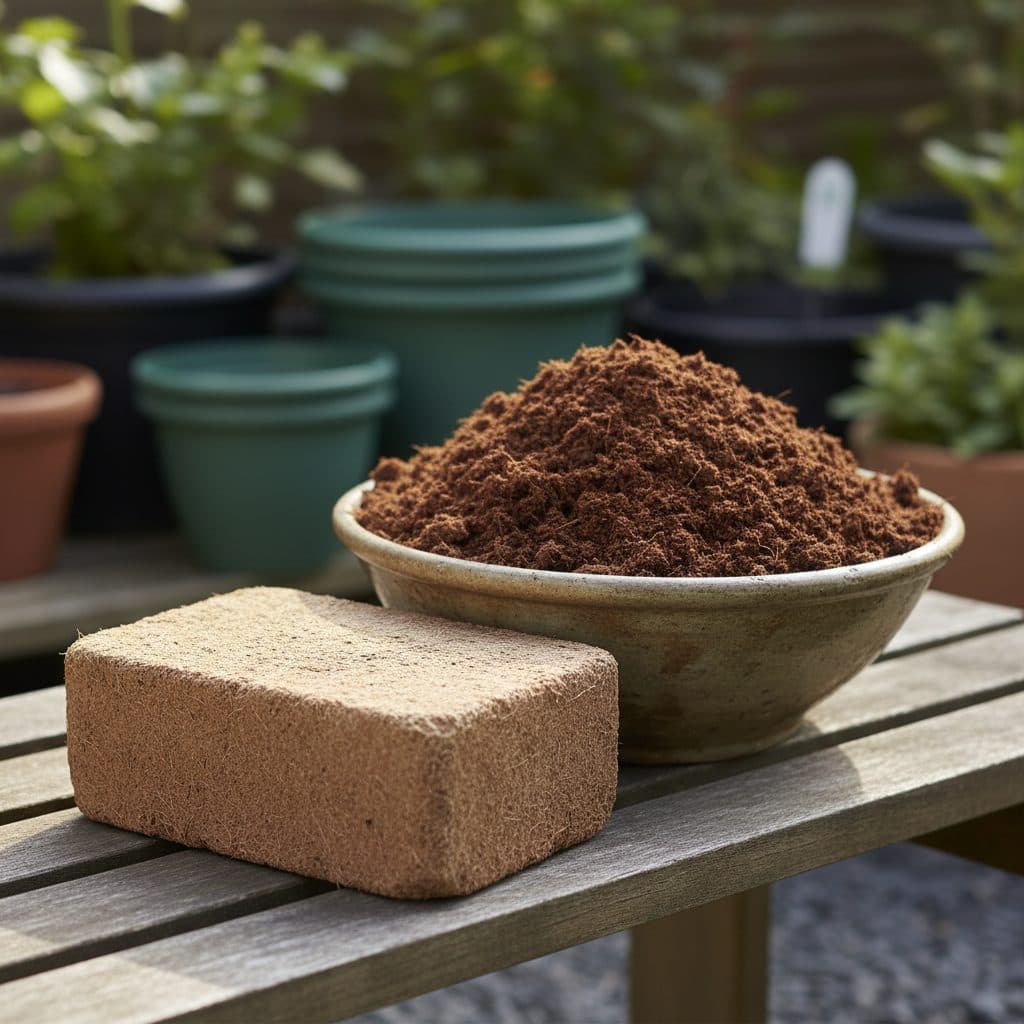
Quick answer: Coco coir is a natural, renewable growing medium made from processed coconut husks that holds up to ten times its weight in water while maintaining excellent root aeration. Unlike acidic peat moss, it features a near-neutral pH (5.8 to 6.8), but raw coir requires washing and calcium-magnesium (Cal-Mag) buffering to prevent nutrient deficiencies in container crops.
As gardeners and commercial growers increasingly seek sustainable, high-performance growing media, coconut coir (also known as coco peat or coir pith) has become a common alternative to sphagnum peat moss. Harvested from the fibrous outer husk (mesocarp) of coconuts (Cocos nucifera), this agricultural byproduct combines exceptional water-holding capacity with structural resistance to physical decomposition.
However, successfully using coco coir requires an understanding of its unique chemical and physical properties. While coir rehydrates effortlessly and maintains an optimal air-to-water ratio for developing roots, raw unbuffered coir possesses complex cation exchange properties that can trap calcium and magnesium, leading to severe nutritional deficiencies if not prepared correctly.
Correctly washing and buffering coir matters whether you are filling seed-starting trays, building a potting mix for raised beds, or running a hydroponic system.
Coco coir vs peat moss: a comprehensive comparison
Gardeners frequently compare coco coir vs peat moss when choosing bulk organic bases for custom potting soils. While both materials hold moisture, their origin, environmental impact, and chemical behaviors differ substantially.
+-------------------+-----------------------------------+-----------------------------------+
| Characteristic    | Coconut Coir Pith                 | Sphagnum Peat Moss                |
+-------------------+-----------------------------------+-----------------------------------+
| Sustainability    | Byproduct of a perennial tree crop| Mined from ancient, slow bogs     |
| Natural pH Level  | 5.8 to 6.8 (Near Neutral)         | 3.5 to 4.5 (Highly Acidic)        |
| Liming Requirement| None required for most crops      | Requires dolomitic lime to buffer |
| Rehydration       | Rapid, absorbs water instantly    | Hydrophobic when dry; needs agent |
| Decomposition Rate| Slow (High lignin content, 45%)   | Moderate (Breaks down faster)     |
| Cation Exchange   | High affinity for Ca2+ and Mg2+   | Balanced mineral exchange profile |
| Salt Content (EC) | Naturally high; requires washing  | Naturally low electrical conduct. |
+-------------------+-----------------------------------+-----------------------------------+
1. Water absorption and hydrophobicity
One of coir's greatest practical benefits is its ease of rehydration. When sphagnum peat moss dries out completely, it becomes hydrophobic, causing irrigation water to bead up and run down the sides of the container. Coir, by contrast, absorbs water instantly and evenly, even after drying out completely between waterings.
2. Naturally balanced pH
Peat moss is naturally acidic (pH 3.5 to 4.5), requiring the addition of agricultural limestone to make it suitable for vegetable crops. Coco coir naturally sits at pH 5.8 to 6.8—the exact range in which most annual vegetables and herbs absorb soil nutrients at peak efficiency.
The chemistry of buffering: preventing calcium lockout
The most critical step in preparing raw coco coir is buffering. Unbuffered coir can strip calcium from your feed and contribute to blossom end rot and stunted growth in container-grown nightshades, on top of the usual cause, uneven watering.
+-------------------------------------------------------------------------------+
|                       THE COIR CATION EXCHANGE MECHANISM                      |
|                                                                               |
|   RAW UNBUFFERED COIR:                                                        |
|   Cation Exchange Sites loaded with Sodium (Na+) and Potassium (K+) ions      |
|                                                                               |
|   WHEN YOU ADD REGULAR NUTRIENT SOLUTION:                                     |
|   Coir grabs Calcium (Ca2+) & Magnesium (Mg2+) from water --> Releases Na+/K+ |
|   Result: Plant roots suffer severe Calcium starvation despite heavy feeding  |
|                                                                               |
|   THE BUFFERING SOLUTION (Cal-Mag Soak):                                      |
|   High-dose Calcium Nitrate displaces Na+/K+ BEFORE planting occurs           |
+-------------------------------------------------------------------------------+
Because coconut palms often grow in coastal, saline environments, raw coir fiber is naturally saturated with sodium (Na+) and potassium (K+) ions bound to its negative cation exchange sites. Coir has a far stronger chemical affinity for divalent cations like calcium (Ca2+) and magnesium (Mg2+).
If you plant directly into unbuffered coir, the medium acts like a chemical sponge, stripping all dissolved calcium and magnesium out of your fertilizer solution and releasing excess potassium and sodium back to the roots.
To understand the leaf symptoms caused by root-level calcium and cold-induced nutrient lockouts, read our guides on tomato blossom end rot calcium water and cold wet soil nutrient deficiency.
Step-by-step: how to wash and buffer coco coir at home
If you purchase dry, compressed coir bricks that are not pre-buffered by the manufacturer, follow this simple chemical preparation protocol:
1. Rehydrate Coir   --> Expand 5 kg dry coir brick in 25 liters clean water
2. Wash & Rinse     --> Flush with fresh water to remove loose sodium chloride
3. Mix Cal-Mag Bath --> Dissolve 40-50 ml Cal-Mag (or 25-30 g calcium nitrate plus 13 g Epsom salts) per 10 L
4. Soak for 24 Hrs  --> Submerge washed coir in the Cal-Mag bath for 24 hours
5. Drain & Use      --> Drain excess liquid; coir is now buffered and plant-ready
1. Rehydration and washing
Place a 5 kg (11 lb) compressed brick into a 30-gallon (115 L) plastic tub. Add 6 to 7 gallons (23 to 26 L) of warm water and let it expand for twenty minutes. Break apart any remaining dry lumps with your hands.
Rinse the expanded coir thoroughly with fresh water and drain through a fine mesh colander or cloth sack. This initial wash leaches out unbound surface sea salts, significantly reducing the electrical conductivity (EC) of the medium.
2. The calcium-magnesium bath
In a separate bucket, prepare your buffering solution:
- Add 15 to 20 ml of liquid Calcium-Magnesium (Cal-Mag) supplement per gallon (3.8 L) of water, OR
- Dissolve 50 g of agricultural-grade Calcium Nitrate and 25 g of Epsom salts (Magnesium Sulfate) per 5 gallons (19 L) of water.
Pour the solution over the washed coir until it is fully submerged. Let the mixture soak for a full 24 hours. During this period, the concentrated calcium and magnesium ions displace the bound sodium and potassium on the coir's cation exchange complex.
Drain the liquid thoroughly. Your coir is now fully buffered, chemically stable, and ready to blend into growing media.
Three types of coco coir and how to use them
Coconut husks are processed into three distinct physical grades, each serving a specific horticultural function:
+-------------------+-------------------+-------------------+-------------------------------------------+
| Coir Grade        | Physical Texture  | Moisture vs Air   | Best Horticultural Application            |
+-------------------+-------------------+-------------------+-------------------------------------------+
| Coir Pith (Peat)  | Fine, spongy dust | 80% Water / 20%Air| Seed starting, microgreens, worm bedding  |
| Coir Fibers       | Long stringy strands| 40% Water / 60%Air| Hanging basket liners, root aeration add. |
| Coir Chips        | Chunky cube nuggets| 50% Water / 50%Air| Orchid bark alternative, perennial pots   |
+-------------------+-------------------+-------------------+-------------------------------------------+
1. Coco coir for seed starting
Fine coir pith suits seed starting because it is free of weed seeds, drains freely and rewets easily. It is not sterile, though — coir is a raw agricultural product and can carry Fusarium, Pythium and fungus gnat larvae, so buy heat-treated stock if damping-off has been a problem. Mix 70% buffered coir pith with 30% horticultural perlite to ensure delicate young rootlets receive ample oxygen while remaining evenly moist. For proper thinning and seedling maintenance after germination, review our guide on seedling care thinning spacing direct sowing.
2. Potting soil blends for raised beds and containers
For general vegetable containers and sub-irrigated wicking systems, blend:
- 40% Buffered Coco Coir (moisture reservoir)
- 40% Mature Organic Compost or Vermicompost (biological nutrition)
- 20% Coarse Perlite or Pumice (aeration and drainage)
To design high-efficiency self-watering sub-irrigated beds using coir-based soils, explore our detailed reference on wicking bed soil mix depth.
Environmental considerations and disposal
Unlike peat bogs, which sequester atmospheric carbon over thousands of years and regenerate at a rate of only 1 mm per year, coconut palms produce continuous harvests of fruit year after year.
After harvesting your crops, coir can be reused for multiple seasons. Moisten spent mix, seal it under clear plastic in full sun for four to six weeks to reduce pathogen and weed-seed load, sift out old root masses, re-amend with fresh compost and a light Cal-Mag drench, and plant again.