secondary
Finger lime
Citrus australasica
International hardiness
- USDA 9-11
- RHS H2
- AU: Subtropical, Tropical, Warm temperate
Where it grows — regional guide
| Zones / rating | Regional notes |
|---|---|
USDA 9-11 | Adaptable to USDA Zones 9 to 11 in southern California, Florida, and south Texas; protect young plants from light frost and provide windbreaks. |
| Zones / rating | Regional notes |
|---|---|
H2 (1 to 5C) | Grown primarily as a specimen container plant across Mediterranean climates; overwinter indoors in northern Europe when temperatures drop below 5 °C. |
| Zones / rating | Regional notes |
|---|---|
Subtropical, Tropical, Warm temperate | Native to the subtropical rainforests of southeast Queensland and northern New South Wales; thrives in sheltered, warm-temperate to subtropical gardens. |
| Zones / rating | Regional notes |
|---|---|
USDA 9-11 (USDA scale) Canada uses its own zone system; Canadian zones run roughly one lower than USDA. | No region-specific data yet |
| Zones / rating | Regional notes |
|---|---|
No region-specific data yet | No region-specific data yet |
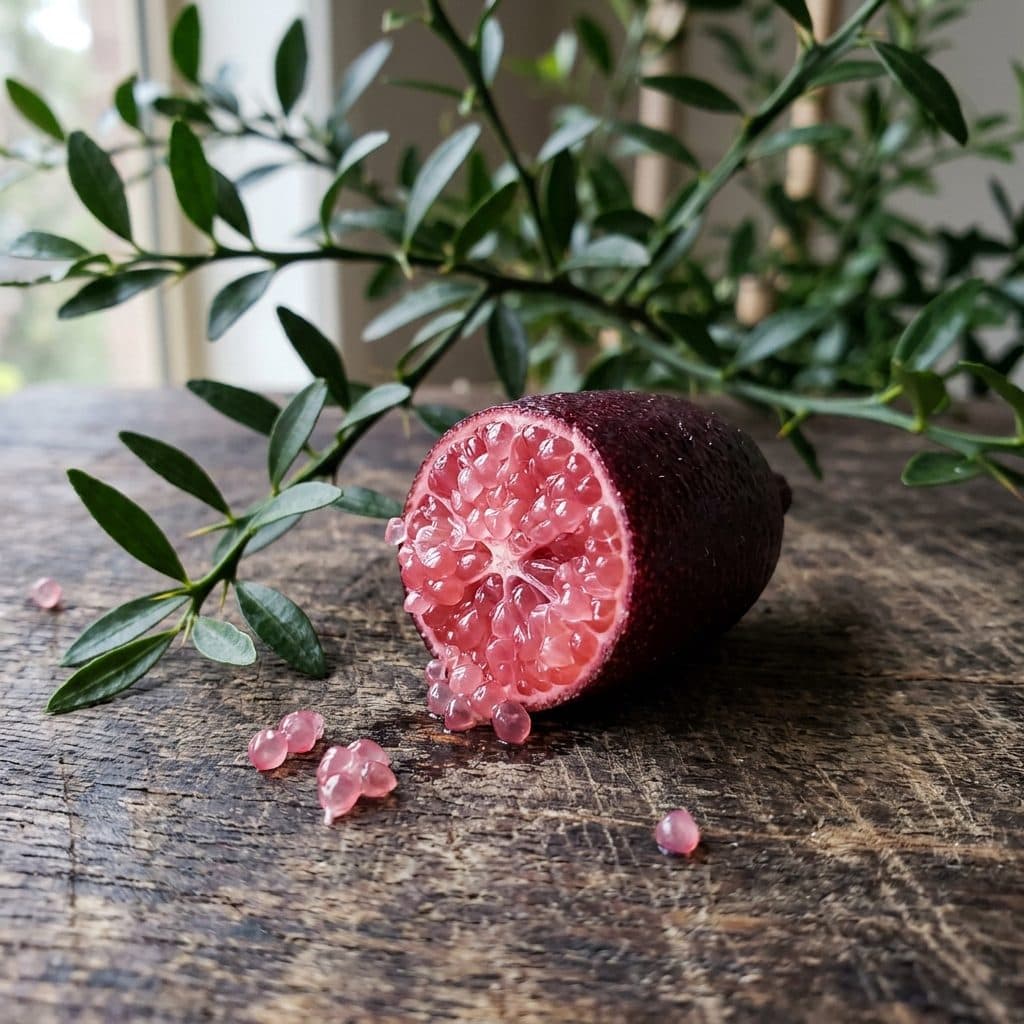
The Australian finger lime (Citrus australasica, historically classified as Microcitrus australasica) is a thorny evergreen understorey shrub or small tree in the citrus family (Rutaceae). Indigenous to the subtropical rainforest margins of eastern Australia, the finger lime has transitioned from a wild bush-tucker delicacy to a premier culinary crop. The plant is celebrated for its slender fruits containing hundreds of spherical juice vesicles termed "citrus caviar". Unlike conventional citrus whose juice sacs form solid segments, finger lime vesicles burst freely from the severed skin, popping on the palate with an intense burst of lime acidity.
In its natural habitat across southeastern Queensland and northern New South Wales, the finger lime thrives in sheltered light beneath taller forest canopies. In homestead food-forest systems, the finger lime occupies a secondary-layer niche, pairing naturally with citrus relatives like Eureka lemon, Persian lime, and bitter orange. The dense, spiny canopy provides nesting habitat for small insectivorous birds that suppress garden pests.
The unique appeal of the finger lime lies in its pulp. When sliced and gently squeezed, compressed translucent globules roll out without leaking juice. These vesicles remain intact over oysters, sashimi, seafood, salads, and desserts, releasing their sharp citrus flavour only when bitten.
Growing finger limes
While finger limes originate in subtropical rainforests, they demonstrate good climate flexibility, enduring light winter frosts down to -2 °C (28 °F) once mature. Young trees are frost-sensitive and require protection during their first two to three winters.
The tree requires fertile, moisture-retentive soils with compost and a pH between 5.5 and 6.5. Good drainage is essential; waterlogged soils encourage root rot caused by Phytophthora. In heavy clay, plant on raised mounds 30 to 45 cm (12 to 18 in) high amended with organic matter and coarse sand.
In cultivation, plants perform best in warm positions receiving morning sun and afternoon shade, or full sun in coastal zones. Summer heat exceeding 38 °C (100 °F) combined with dry winds can scorch foliage and trigger fruit drop; planting behind a windbreak preserves humidity.
Plant grafted trees in spring or early autumn. Space trees 2.5 to 3.5 m (8 to 12 ft) apart. Because wild seedlings take 8 to 15 years to fruit, growers should always plant grafted trees. Rootstocks like trifoliate orange (Poncirus trifoliata) or Troyer citrange provide dwarfing, nematode resistance, and fruit production within two to three years.
Water regularly during late-summer flowering and autumn fruit swelling. Mulch the root zone with 7.5 to 10 cm (3 to 4 in) of woodchips or straw, keeping it clear of the trunk. Feed three times annually—in spring, summer, and autumn—with an organic citrus fertiliser containing trace elements including iron and magnesium.
Prune lightly in late winter after harvest to remove dead, diseased, crossing, and inward-growing branches. Always wear heavy leather gauntlets, as the slender axillary thorns are sharp and rigid.
Harvest and uses
Finger lime fruits mature from late summer into autumn, typically from February to May in the Southern Hemisphere and August to December in the Northern Hemisphere. Fruits do not ripen further once picked; harvest fully ripe fruit that yields slightly to pressure and detaches cleanly with a slight twist.
Cultivars exhibit distinct rind and pulp colours: 'Red Champagne' produces brownish-red skins with glowing red to pink vesicles; 'Alstonville' yields dark green to black fruits with pale green caviar; 'Mia Rose' bears pink vesicles; and 'Chartreuse' produces yellow-green fruit with amber pearls.
Fresh fruit keeps for two weeks at room temperature or up to six weeks refrigerated at 8 to 10 °C (46 to 50 °F). Whole finger limes also freeze cleanly for up to twelve months without losing vesicle texture; frozen fruits can be sliced while partially thawed to scoop out fresh pearls.
In addition to fresh garnishes, the aromatic peel can be dried into citrus seasoning or cooked with whole fruit and sugar into citrus marmalade.
Identifying finger limes
The Australian finger lime is identified by several key botanical characteristics:
- Habit: Densely branched, thorny evergreen shrub or small tree reaching 3 to 6 m (10 to 20 ft) in height, forming a canopy of slender weeping branchlets.
- Thorns: Rigid, sharp axillary spines measuring 10 to 25 mm (0.4 to 1.0 in) in length, present at leaf nodes along branches.
- Leaves: Small, dark glossy green, obovate to wedge-shaped, 1.5 to 4 cm (0.6 to 1.6 in) long and 0.5 to 1.5 cm (0.2 to 0.6 in) wide, with notched tips and citrus-scented oil glands.
- Flowers: Solitary or paired three-petalled white to pale pink blossoms measuring 10 to 14 mm (0.4 to 0.6 in) across, blooming in late summer.
- Fruit: Elongated, cylindrical hesperidium measuring 4 to 10 cm (1.6 to 4 in) long and 1.5 to 3 cm (0.6 to 1.2 in) wide. Rind is thin, oil-dotted, ranging from green and yellow to purple and black.
- Pulp: Five to eight internal locules containing loose, globose juice vesicles measuring 2 to 4 mm (0.08 to 0.16 in) across.
The finger lime differs from the round lime (Citrus australis) in having elongated cylindrical fruits rather than spherical fruit. It differs from Persian lime (Citrus latifolia) and Key lime (Citrus aurantiifolia) by its tiny leaves, fierce spines, and free-rolling caviar vesicles.
Cautions
Cultivating and handling finger limes requires attention to several practical considerations:
- Puncture injuries from thorns: Needle-sharp spines pose a puncture hazard during maintenance and harvesting. Wind can also cause thorns to puncture fruit skins, inviting mold. Always wear thick leather gauntlets and eye protection when handling the canopy.
- Frost sensitivity in young plants: While hardened mature trees tolerate brief light freezes, young plants and soft spring shoots are readily killed by frost. Provide frost covers in marginal temperate climates.
- Native pests: Plants are subject to citrus gall wasp (Bruchophagus fellis), which induces woody galls on stems. Prune and destroy galled stems before adult wasps emerge in spring. Bronze orange bugs and scales should also be monitored.
- Seedling unpredictability: Finger limes from seed exhibit excessive juvenile thorniness, take over a decade to crop, and often yield dry fruit. Always source certified grafted stock.
- Biosecurity regulations: Movement of live citrus plants and budwood is strictly regulated to prevent the spread of citrus canker and huanglongbing (citrus greening). Never transport uncertified citrus material across quarantine borders.
Sources
- Royal Botanic Gardens, Kew. Citrus australasica F.Muell. Plants of the World Online.
- Australian Native Plants Society (Australia). Citrus australasica
- Plants For A Future. Citrus australasica - F.Muell.