climax
Macadamia tree
Macadamia integrifolia
International hardiness
- USDA 9-11
- RHS H2
- AU: Subtropical, Tropical, Warm temperate
Where it grows — regional guide
| Zones / rating | Regional notes |
|---|---|
USDA 9-11 | Grown commercially in Hawaii and southern California (coastal USDA Zones 9b to 11); mature trees withstand light frosts to -2 °C (28 °F) without major loss. |
| Zones / rating | Regional notes |
|---|---|
H2 (1 to 5C) | Treated strictly as an indoor conservatory specimen rated RHS H2; requires winter protection maintaining minimum temperatures above 5 °C (41 °F). |
| Zones / rating | Regional notes |
|---|---|
Subtropical, Tropical, Warm temperate | Indigenous to subtropical rainforests of southeast Queensland and northern New South Wales; irrigate during spring flowering and nut sizing. |
| Zones / rating | Regional notes |
|---|---|
USDA 9-11 (USDA scale) Canada uses its own zone system; Canadian zones run roughly one lower than USDA. | No region-specific data yet |
| Zones / rating | Regional notes |
|---|---|
No region-specific data yet | No region-specific data yet |
Macadamia tree (Macadamia integrifolia), commonly called smooth-shelled macadamia, Queensland nut, or bauple nut, is an evergreen rainforest tree in the protea family (Proteaceae). Indigenous to the subtropical coastal rainforests of southeastern Queensland and northeastern New South Wales in Australia, the tree is celebrated globally for producing one of the finest edible nuts. While wild populations were harvested by Indigenous Australians for generations, modern commercial cultivation gained momentum in Hawaii during the twentieth century before expanding across Australia, South Africa, Central America, and East Africa. The edible kernel is prized for its rich, buttery texture and high concentration of heart-healthy monounsaturated oils.
Within subtropical agroforestry guilds and permaculture orchards, Macadamia integrifolia is a long-lived climax canopy tree. Its dense, dark green foliage provides microclimate buffering, while its specialised root architecture—known as proteoid or cluster roots—enables it to extract poorly soluble nutrients from ancient, weathered soils. When interplanted alongside nitrogen-accumulating support species like pigeon pea and soil-stabilising hedgerows of vetiver, macadamia establishes an ecologically resilient nut orchard. However, successful production demands careful nutrient management and strict awareness of its acute toxicity to domestic dogs.
Growing macadamia tree
Macadamia integrifolia thrives in subtropical and warm maritime climates, performing reliably within USDA Hardiness Zones 9b through 11 and holding an RHS rating of H2. Mature trees tolerate short-lived winter frosts down to -2 °C (28 °F) with minor foliar singeing, but young saplings and spring inflorescences are killed below 0 °C (32 °F). Optimum vegetative growth occurs between 20 and 28 °C (68 and 82 °F). Ambient temperatures exceeding 35 °C (95 °F) severely impair photosynthesis, increase respiration, and trigger heavy nut drop during fruit development. Annual rainfall should measure 1,200 to 2,000 mm (47 to 79 in), with supplementary irrigation applied during dry spring flowering and summer nut sizing to prevent kernel shrivelling.
Soil drainage is paramount. The species requires deep, fertile, volcanic loams, basalt soils, or well-structured alluvial sandy loams with a slightly acidic pH of 5.0 to 6.5. Macadamias develop specialised cluster roots that form dense mats in the upper leaf mulch layer, secreting organic acids to liberate bound phosphorus and micronutrients. Because of this evolutionary adaptation, the tree is exceptionally sensitive to excess phosphorus fertilisation. Applying standard high-phosphate chemical fertilisers induces lethal iron and zinc chlorosis accompanied by severe leaf necrosis. Use strictly low-phosphorus or organic compost formulations. While drought-tolerant once established, the root system is comparatively shallow, necessitating thick organic mulching to conserve surface moisture.
Propagation relies predominantly on grafting. Seedling trees exhibit wide genetic variability, thick uncrackable shells, and require seven to ten years to produce initial nuts. In contrast, commercial cultivars (such as 'HAES 344', 'HAES 741', and 'Beaumont') grafted onto seedling rootstocks via whip-and-tongue or cleft grafting begin bearing in four to five years. Space trees 7 to 10 m (23 to 33 ft) between rows and 4 to 5 m (13 to 16 ft) within rows, allowing ample light penetration between canopies. Prune early to establish a central leader scaffold that resists storm damage.
Harvest and uses
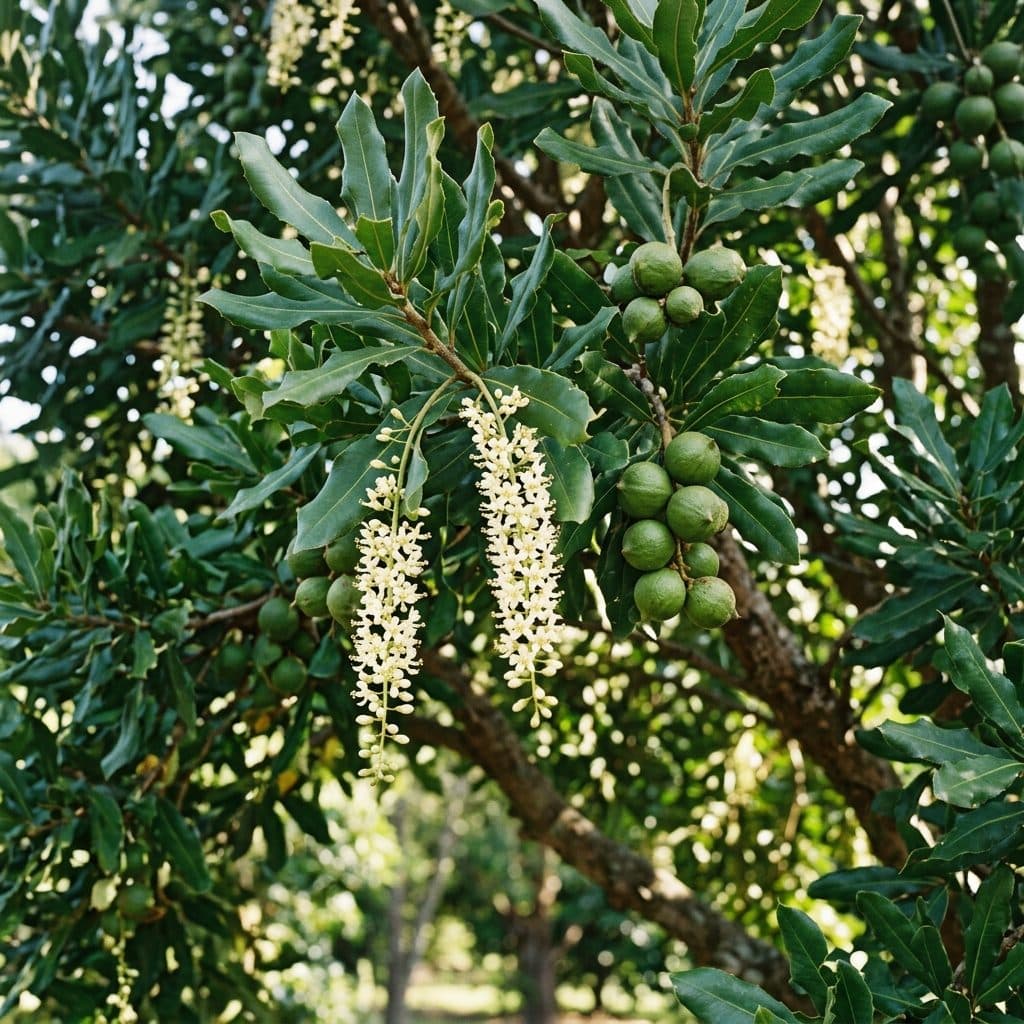
Macadamia trees bloom profusely in late winter and early spring, producing pendulous racemes carrying hundreds of small, creamy-white, nectar-rich flowers. Only a small fraction of pollinated flowers set fruit, which matures over seven to eight months.
Harvesting takes place from autumn through midwinter as mature nuts drop naturally to the orchard floor. Never shake trees vigorously to dislodge green nuts, as immature kernels possess low oil content and dry into unpalatable, shrivelled seeds. Gather fallen nuts from clean, mowed ground at weekly intervals to prevent mould development, rat predation, and premature germination.
Processing involves three essential stages:
- De-husking: Remove the fleshy green outer husk (pericarp) within twenty-four hours of collection using mechanical de-huskers or hand tools. Leaving husks attached generates internal heat that discolours kernels and imparts mouldy taints.
- Curing and drying: Freshly de-husked nuts have a moisture content of roughly 30 percent. Spread them in shallow wire-mesh trays in a dry, well-ventilated, shaded shed for two to three weeks until moisture drops to 10 percent. Finish drying gently in a food dehydrator at 35 to 40 °C (95 to 104 °F) for two to three days until moisture reaches 1.5 percent. Drying shrinks the kernel away from the inner shell wall, allowing clean extraction without crushing the nut meat.
- Cracking: The smooth brown shell (endocarp) is notoriously hard, requiring up to 2,000 kPa (300 psi) of pressure to rupture. Standard kitchen nutcrackers fail completely. Employ specialised screw-type spindle crackers or heavy lever-arm macadamia crackers.
The creamy, crisp kernel contains over 75 percent fat, predominantly oleic and palmitoleic acids. Nuts are eaten raw, roasted, lightly salted, baked into confectionery, or pressed to produce cold-pressed culinary and cosmetic oil. Mature orchard trees yield 15 to 30 kg (33 to 66 lb) of nut-in-shell annually.
Identifying macadamia tree
Macadamia integrifolia is recognised by distinct vegetative, floral, and fruiting characteristics:
- Form: A medium-sized evergreen tree reaching 8 to 15 m (26 to 49 ft) in height, featuring a dense, rounded, dome-like crown spanning 6 to 12 m (20 to 40 ft) across. The trunk is straight with smooth, brown to dark grey bark marked by pale lenticels.
- Leaves: Arranged in regular whorls of three around stiff branches. Leaves are simple, leathery, oblong to obovate, measuring 10 to 25 cm (4 to 10 in) long and 2 to 5 cm (0.8 to 2 in) wide. Mature leaves have smooth, entire margins and a blunt or rounded apex, whereas juvenile foliage bears sharp, spiny teeth. The upper surface is lustrous dark green with prominent pale yellow veins.
- Flowers: Borne in slender, pendulous racemes measuring 15 to 30 cm (6 to 12 in) long, hanging from older leaf axils. Each raceme carries 100 to 500 small, sweetly fragrant, creamy-white or pale pinkish blossoms with four narrow reflexed tepals and a long straight style.
- Fruit: A hard, spherical green follicle measuring 2.5 to 3.5 cm (1 to 1.4 in) across. The outer fibrous husk splits along one suture at maturity, revealing a smooth, spherical, dark brown, stony shell that encloses a single white, oily kernel.
The species is distinguished from rough-shelled macadamia (Macadamia tetraphylla), which features leaves in whorls of four with continuously spiny-serrated margins, pinkish blossoms, and rough, pebbled nutshells.
Cautions
Growers cultivating Macadamia integrifolia must observe critical biological and agronomic precautions:
- Severe canine macadamia toxicosis: Macadamia nuts are profoundly toxic to domestic dogs (Canis familiaris). Ingestion of as little as 2.4 g of nuts per kg of body weight causes acute poisoning within 6 to 24 hours. Symptoms include profound hind-limb weakness, depression, vomiting, severe muscle tremors, joint stiffness, hyperthermia, and abdominal pain. While supportive veterinary care prevents fatality in most cases, poisoning causes severe physiological distress. Never feed macadamias to dogs, and exclude pets from falling orchard nuts.
- Phosphorus fertiliser toxicity: The proteoid root system absorbs phosphorus with extreme efficiency. Applying standard commercial fertilisers with high phosphorus ratings triggers acute phosphate toxicity, causing severe foliar necrosis, chlorosis, and tree death. Use strictly low-phosphorus fertilisers designed for Australian native plants.
- Windthrow and branch breakage: Macadamia wood is exceptionally dense but brittle, and root systems are relatively shallow. Strong gale-force winds snap scaffold limbs or overturn top-heavy trees in saturated soils. Plant robust windbreaks on exposed perimeter boundaries.
- Insect pests: Developing nuts are targeted by macadamia nutborer (Cryptophlebia ombrodelta) and fruit-spotting bugs, which pierce husks and destroy internal kernels.
Sources
- Royal Botanic Gardens, Kew. Macadamia integrifolia Maiden & Betche Plants of the World Online.
- Plants For A Future. Macadamia integrifolia - Maiden.&Betche
- USDA PLANTS Database. Macadamia integrifolia Maiden & Betche
- Missouri Botanical Garden. Macadamia integrifolia