secondary
Davidson's plum
Davidsonia pruriens
International hardiness
- USDA 10-11
- RHS H1b
- AU: Tropical, Subtropical, Warm temperate
Where it grows — regional guide
| Zones / rating | Regional notes |
|---|---|
USDA 10-11 | Can only be grown outdoors in frost-free regions of South Florida, coastal Hawaii, and heated conservatories; protect young foliage from temperatures below 0 °C (32 °F). |
| Zones / rating | Regional notes |
|---|---|
H1b (10 to 15C) | No region-specific data yet |
| Zones / rating | Regional notes |
|---|---|
Tropical, Subtropical, Warm temperate | Indigenous to northeastern Queensland wet tropics; cultivate in moist, sheltered subtropical and tropical sites protected from direct scorching winds and frost. |
| Zones / rating | Regional notes |
|---|---|
USDA 10-11 (USDA scale) Canada uses its own zone system; Canadian zones run roughly one lower than USDA. | No region-specific data yet |
| Zones / rating | Regional notes |
|---|---|
No region-specific data yet | No region-specific data yet |
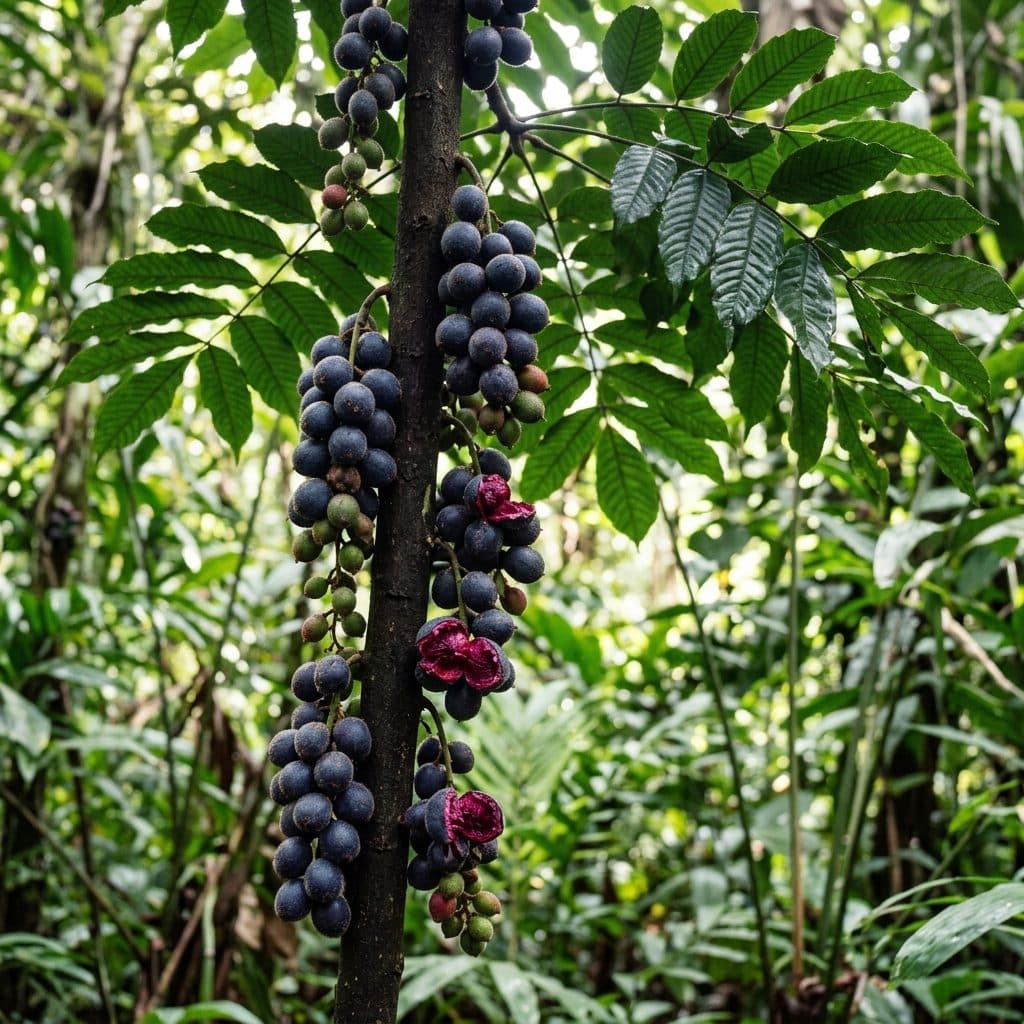
Davidson's plum (Davidsonia pruriens), native to northeastern Queensland rainforests and called Ooray, is an evergreen tree in the family Cunoniaceae. Described botanically by Ferdinand von Mueller in 1867, it is a leading Australian native bush-food crop, producing dark bluish-black plums with crimson flesh directly from its trunk.
In subtropical and tropical food forests, Davidsonia pruriens is a productive understorey tree. Reaching 6 to 12 m (20 to 40 ft) high with a slender, palm-like habit and arching fronds, it fits beneath an established canopy alongside custard apple, vigorous passion fruit vines, and hardy guava bushes. Wind shelter protects its large leaves from shredding.
The fruit contains abundant anthocyanin antioxidants, lutein, and potassium. Successful cultivation requires managing its cauliflorous flowering, extreme acidity, and the protective irritant hairs on young shoots.
Growing Davidson's plum
Davidsonia pruriens is a warm-climate understorey plant adapted to USDA Hardiness Zones 10 through 11 and rated RHS H1b. It has zero frost tolerance; temperatures below 0 °C (32 °F) kill soft terminal shoots. While mature trees endure brief winter dips to 2 °C (36 °F) near the coast, commercial cropping requires temperatures between 20 and 30 °C (68 and 86 °F).
Young trees need partial shade during their first two to three seasons before accepting morning sun. Plant in sheltered sites shielded from hot westerly winds. Soils must be deep, fertile, moisture-retentive volcanic or alluvial loams with an acidic pH of 5.0 to 6.5. Free drainage is essential to avoid Phytophthora root rot. Provide 25 to 50 mm (1 to 2 in) of water weekly in dry spells and apply 8 to 10 cm (3 to 4 in) of woodchip mulch.
Propagate from fresh seed sown in moist mix at 24 to 28 °C (75 to 82 °F); germination takes four to twelve weeks. Alternatively, propagate selections by air-layering (marcotting). Space trees 3.5 to 5 m (11 to 16 ft) apart in rows spaced 5 to 6 m (16 to 20 ft) apart. Preserve the single central trunk to avoid delaying fruiting. Prune only dead fronds and competing trunk suckers.
Harvest and uses
Davidson's plum trees grown from seed typically commence bearing within four to six seasons, while vegetative marcots fruit by their third or fourth year. Mature trees produce between 15 and 40 kg (33 and 88 lb) of fruit per season.
The tree displays cauliflory, producing pendulous inflorescence panicles 30 to 80 cm (12 to 31 in) long directly from the trunk and older woody branches beneath the leaf crown during late spring and summer. The small, deep pinkish-red flowers develop into dense clusters of dark purple fruit that ripen in late summer and autumn, usually between February and May in the Southern Hemisphere.
The fruit is a large, globose to obovoid drupe measuring 4 to 6 cm (1.6 to 2.4 in) in diameter and weighing 40 to 70 g (1.4 to 2.5 oz). When ripe, the thin skin turns from green to dark bluish-purple or near black, covered by a fine glaucous powdery bloom. The interior flesh is soft, juicy, and intensely magenta-red, enclosing two flat, fibrous, wing-like seeds.
Fruit ripens progressively over several weeks. Ripe plums drop naturally from trunk panicles onto the ground. Orchardists lay soft mesh netting beneath the trees to catch falling fruit before it contacts the soil, or gently twist ripe fruit from trunk cushions when it yields slightly to gentle touch. Wash harvested fruit in clean water to rinse away superficial hairs, and freeze whole at -18 °C (0 °F) or process promptly.
Culinary uses centre on its intense acidity and crimson pigmentation:
- Preserves and jams: The high natural pectin and brilliant colour produce outstanding jams, marmalades, and fruit jellies that balance the fruit's natural sharpness with sugar.
- Savoury reductions and glazes: Simmered with native pepperberry, ginger, and red wine, Davidson's plum yields an exquisite piquant sauce for roasted game meats, duck, and pork.
- Beverages: The ruby juice is diluted with carbonated water, brewed into artisan beers, distilled into botanical gin, or blended into sparkling cordials.
- Pastry and dairy: Pureed fruit cuts through rich fats, making an exceptional addition to ice creams, sorbets, cheesecakes, and chocolate ganache.
Identifying Davidson's plum
Davidsonia pruriens is distinguished by several key botanical characteristics:
- Habit: A slender, small to medium evergreen rainforest tree reaching 6 to 12 m (20 to 40 ft) tall, typically with a single, slender trunk and an open, palm-like crown of arching foliage.
- Leaves: Alternate, large pinnately compound leaves measuring 40 to 100 cm (16 to 39 in) long, with eight to sixteen pairs of opposite to sub-opposite leaflets plus a terminal leaflet. Leaflets are oblong-lanceolate, 10 to 25 cm (4 to 10 in) long, with sharply serrated margins and prominent veins.
- Indumentum: Stiff, sharp, reddish-brown irritant trichomes (hairs) densely coat the young stems, leaf rachises, petioles, flower panicles, and exterior surfaces of young fruit.
- Inflorescences: Long, pendulous panicles 30 to 80 cm (12 to 31 in) in length, emerging cauliflorously from dormant buds directly along the main trunk. Flowers are small, four- or five-petalled, and deep pink to dark purplish-red.
- Fruit: Large, plum-shaped berries 4 to 6 cm (1.6 to 2.4 in) across, ripening to a deep bluish-black with a waxy bloom. The flesh is dark blood-red, juicy, and houses two flat, fibrous pyrenes.
Davidsonia pruriens is distinguished from the southern NSW Davidson's plum (Davidsonia jerseyana) by its significantly larger leaflets (10 to 25 cm versus 4 to 8 cm) and larger fruit. It differs from smooth Davidson's plum (Davidsonia johnsonii) by possessing hairy foliage (the latter is hairless) and fertile, viable seeds.
Cautions
Growers should review several physical, nutritional, and environmental factors before planting Davidson's plum:
- Irritant stinging hairs (contact dermatitis): The species epithet pruriens translates from Latin as "causing itching". Young stems, foliage, flower panicles, and unripe fruit are clothed in stiff, sharp, needle-like trichomes. Brushing against the foliage causes acute skin irritation, itching, and contact dermatitis. Gardeners must wear heavy gloves, long sleeves, and protective eyewear when pruning, handling young plants, or collecting fruit.
- Severe acidity and gastric discomfort: The raw fruit possesses an extremely low pH (between 2.5 and 3.0), containing high concentrations of citric, malic, and quinic acids. Ingesting whole raw plums in quantity provokes acute stomach cramps, gastric hyperacidity, and enamel demineralisation. The fruit is almost never consumed as table fruit; it must be diluted or processed with sweeteners.
- Cold and frost intolerance: The species is frost-tender and succumbs quickly to temperatures below freezing. Plant only in sheltered frost-free microclimates.
- Endangered relatives and sourcing: While D. pruriens is widespread in North Queensland, southern relatives D. jerseyana and D. johnsonii are endangered in New South Wales. Source planting material strictly from registered propagation nurseries to protect wild populations.
Sources
- Royal Botanic Gardens, Kew. Davidsonia pruriens F.Muell. Plants of the World Online.
- PlantNET (The NSW Plant Information Network System), Royal Botanic Gardens and Domain Trust, Sydney. Davidsonia pruriens F.Muell.
- Australian Native Plants Society (Australia). Davidsonia pruriens
- Plants For A Future. Davidsonia pruriens - F.Muell.
- Atlas of Living Australia. Davidsonia pruriens F.Muell., Ooray