secondary
Lemon myrtle
Backhousia citriodora
International hardiness
- USDA 9-11
- RHS H2
- AU: Subtropical, Tropical, Warm temperate
Where it grows — regional guide
| Zones / rating | Regional notes |
|---|---|
USDA 9-11 | Thrives outdoors in frost-free regions of southern California, south Florida, and Hawaii; grown in large containers in colder states. |
| Zones / rating | Regional notes |
|---|---|
H2 (1 to 5C) | Cultivated as an ornamental conservatory specimen across the Mediterranean; protect from frost and bring under glass when temperatures drop below 5 °C. |
| Zones / rating | Regional notes |
|---|---|
Subtropical, Tropical, Warm temperate | Native to coastal subtropical rainforests of central and southeastern Queensland; widely grown in gardens across eastern Australia from Sydney to Cairns. |
| Zones / rating | Regional notes |
|---|---|
USDA 9-11 (USDA scale) Canada uses its own zone system; Canadian zones run roughly one lower than USDA. | No region-specific data yet |
| Zones / rating | Regional notes |
|---|---|
No region-specific data yet | No region-specific data yet |
The lemon myrtle tree (Backhousia citriodora) is an evergreen rainforest tree in the myrtle family (Myrtaceae). Endemic to the subtropical coastal rainforests of eastern Australia, lemon myrtle is one of the best-known Australian native herbs. Its crushed foliage emits an intense lemon aroma that surpasses true lemons, lemongrass, and lemon verbena. Phytochemical analysis shows that volatile oil within the leaf glands contains 90 to 98 percent pure citral, making it the highest natural source of citral in the plant kingdom.
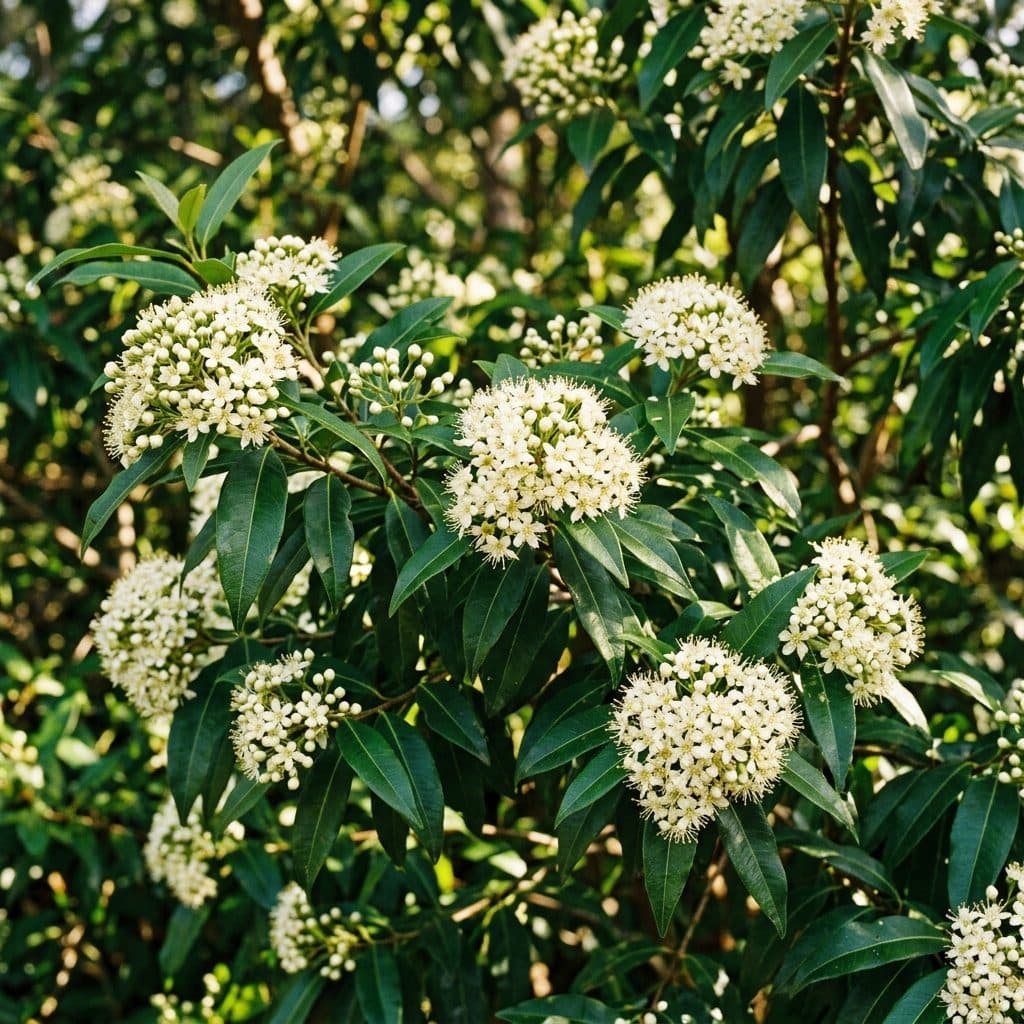
In its natural habitat along coastal valleys between Mackay and Brisbane in Queensland, lemon myrtle grows as an understorey or mid-canopy tree reaching up to 20 m (65 ft) in height. In domestic gardens and syntropic food forests, it typically matures into an ornamental tree or large bushy shrub of 3 to 8 m (10 to 26 ft). Belonging to the same family as aromatic trees like the Indian jamun, lemon myrtle integrates smoothly into multi-tiered polycultures. It provides wind protection and nectar for native bees and pollinators when creamy-white blossoms cover the canopy in summer.
Unlike conventional citrus such as Eureka lemon, whose flavour comes from fruit acid and rind oils, lemon myrtle delivers clean citrus flavour purely through its leaves without acidity. This unique characteristic enables cooks to flavour dairy products—such as cheesecakes, ice creams, and custards—without curdling milk proteins. In savoury cooking, dried leaves complement seafood, poultry rubs, and roasted vegetables alongside herbs like rosemary.
Growing lemon myrtle
Lemon myrtle thrives in warm-temperate, subtropical, and tropical climates. While established trees tolerate brief, light frosts down to -2 °C (28 °F), young plants are tender and suffer damage if exposed to freezing winter temperatures. In frost-prone regions, plant against a protected wall, or cultivate the tree in a large container overwintered under glass.
The species prefers deep, fertile, well-drained loams rich in organic matter, with a pH between 5.5 and 6.5. While it demands consistent moisture, it has poor tolerance for waterlogged clay, which invites root rot caused by Phytophthora fungi. On heavy soils, plant on raised mounds incorporating coarse sand and compost to ensure unimpeded drainage.
Full sun to partial shade suits lemon myrtle well. In coastal environments, full sunlight encourages dense foliage and abundant flowering. In hot inland regions where summer temperatures exceed 35 °C (95 °F), afternoon shade prevents leaf scorch and preserves essential oil content.
Plant potted specimens in spring or early autumn when soil is warm. Space trees 3 to 5 m (10 to 16 ft) apart for standard planting, or 1.5 to 2 m (5 to 6.5 ft) apart for a dense hedge or windbreak.
Water young trees regularly during their first two seasons. Apply organic mulch 7.5 to 10 cm (3 to 4 in) deep over the root zone, keeping it clear of the trunk. Feed in early spring and late summer with an organic native-plant fertiliser or blood and bone; avoid fertilisers with excessive phosphorus, as members of Myrtaceae can be sensitive to concentrated salts.
Pruning maintains a compact size and encourages fresh leaf flushes. Prune lightly after summer flowering to shape the canopy and remove spent flower clusters. For hedging or leaf harvesting, trees respond well to regular clipping, quickly regenerating dense shoots from dormant buds along woody stems.
Harvest and uses
Lemon myrtle foliage can be harvested year-round, with citral concentration peaking during warm weather from late spring through autumn. Always harvest mature, fully expanded, dark green leaves; young reddish growth is low in essential oil and wilts quickly.
Snip small branchlets with clean shears. For fresh culinary use, strip leaves as needed and bruise or chop them before adding to marinades, dressings, or teas. Fresh leaves keep in a sealed container in the refrigerator for two weeks.
Drying preserves the intense aroma. Lay whole leaves on screens in a dark, warm, well-ventilated room below 35 °C (95 °F); drying in direct sun or high heat volatilises aromatic citral, dulling flavour. Once crisp, store leaves whole in airtight glass jars away from light, grinding them immediately before use.
In traditional indigenous medicine, crushed leaves were applied as poultices for skin wounds or inhaled to alleviate headaches. Lemon myrtle essential oil has antimicrobial and antiseptic properties and is used in balms and soaps.
Identifying lemon myrtle
Backhousia citriodora is distinguished by several characteristic botanical features:
- Habit: Medium evergreen tree reaching 6 to 20 m (20 to 65 ft) in wild rainforests, but typically 3 to 8 m (10 to 26 ft) in cultivation, forming a rounded canopy with rough, fibrous brown bark.
- Leaves: Opposite, simple, lanceolate to elliptic, measuring 6 to 12 cm (2.4 to 4.8 in) long and 2 to 4 cm (0.8 to 1.6 in) wide. Foliage is glossy dark green above, paler beneath, with undulating margins.
- Scent: Crushing the leaf immediately releases an intense, pure lemon aroma without eucalyptus or camphorous undertones.
- Flowers: Creamy-white, star-shaped blossoms measuring 5 to 8 mm (0.2 to 0.3 in) across with showy protruding stamens, clustered in dense terminal umbels 5 to 10 cm (2 to 4 in) wide during summer.
- Fruit: Small, dry, bell-shaped capsules measuring 3 to 4 mm (0.12 to 0.16 in) across, enclosing small non-winged seeds.
Lemon myrtle is distinguished from lemon-scented tea tree (Leptospermum petersonii) by its much broader leaves. It differs from lemon-scented gum (Corymbia citriodora) by its smaller stature, opposite leaves, and dense rainforest canopy rather than a tall, open eucalypt form.
Cautions
Cultivating and utilising lemon myrtle requires attention to chemical potency and biosecurity:
- Citral potency: The 90 to 98 percent citral concentration makes lemon myrtle exceptionally potent. Use leaves sparingly; a quarter-teaspoon of ground dry leaf often equals the flavour of an entire tablespoon of fresh lemon zest. Overuse causes bitterness and irritates oral mucous membranes.
- Essential oil hazard: Concentrated lemon myrtle essential oil is a powerful dermal sensitizer. Pure oil should never be ingested, and topical application requires dilution below 1 percent in a carrier oil. Keep concentrated oils away from pets and children.
- Myrtle rust (Austropuccinia psidii): Lemon myrtle is susceptible to myrtle rust, a fungal disease that attacks young expanding shoots. It produces bright powdery yellow pustules that cause shoot distortion. Prune out and destroy infected shoots in sealed bags.
- Frost sensitivity in young plants: Trees under three years old are damaged or killed by frost. Provide physical fleece covers during cold snaps in marginal climates.
- Drainage and root rot: Phytophthora cinnamomi root rot can kill trees in waterlogged ground. Ensure free drainage.
Sources
- Royal Botanic Gardens, Kew. Backhousia citriodora F.Muell. Plants of the World Online.
- Australian Native Plants Society (Australia). Backhousia citriodora
- Plants For A Future. Backhousia citriodora - F.Muell.