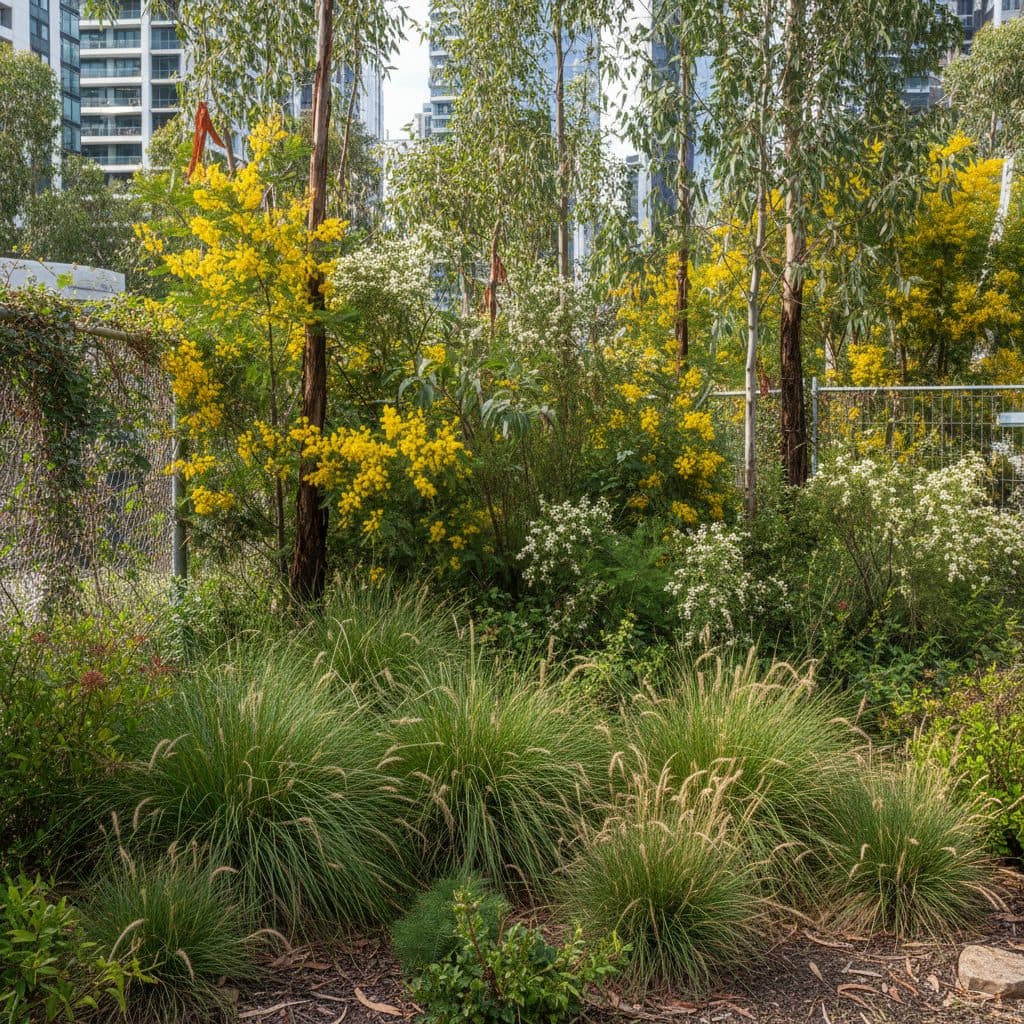
Key takeaways
- The Miyawaki method uses very high planting density to push young trees upward quickly and close the canopy in a few years — faster than a conventionally spaced planting, though the widely quoted 'ten times faster' figure comes from the method's promoters rather than from controlled trials.
- Plant 3 to 5 native tubestock plants per square metre across four vertical forest layers.
- Decompact and amend urban soil up to 1 metre deep with organic matter and compost before planting.
- Select strictly indigenous provenance native species adapted to your local Australian bioregion.
- Provide regular deep watering during dry summer months for the first 1 to 2 years until the canopy closes.
Quick answer: The Miyawaki method is a high-density afforestation technique that plants 3 to 5 indigenous native species per square metre across four vertical layers (canopy, sub-canopy, shrub, and ground cover). In Australia, this method restores compacted urban soils, accelerates native forest establishment, and creates self-sustaining biodiversity pockets within two to three years.
Urban landscapes across Australia face rising temperatures, loss of biodiversity, and severe urban heat island effects. From suburban backyards in Melbourne and Sydney to community school grounds in Brisbane and Perth, conventional tree-planting programs often struggle due to compacted urban soils, low species diversity, and slow growth rates. The miyawaki method offers an effective ecological solution for establishing resilient, multi-layered native pocket forests on small urban plots.
Developed by Japanese botanist and plant ecologist Dr. Akira Miyawaki in the 1970s, this methodology reconstructs native plant communities based on Potential Natural Vegetation (PNV). By mimicking the natural climax succession of undisturbed native bushland, the Miyawaki technique pushes plants into intense competition, which speeds vertical growth, builds dense biomass, and creates rich wildlife habitat.
Whether you have a 50-square-metre schoolyard corner or a rural boundary strip, understanding the soil preparation, species selection, and establishment protocols of the Miyawaki method allows you to cultivate a thriving pocket forest.
Core principles of the Miyawaki forest methodology
The exceptional performance of a Miyawaki forest rests on four fundamental ecological pillars:
- Potential Natural Vegetation (PNV): Plant selections are restricted entirely to species that would naturally occur in the local bioregion without human intervention. This ensures extreme adaptability to local rainfall patterns, soil chemistries, and climate extremes.
- High-density multi-layer planting: Rather than spacing trees metres apart as in conventional forestry, Miyawaki forests are planted at 3 to 5 plants per square metre. This density encourages rapid upward growth as saplings compete for sunlight while shading out weed species.
- Comprehensive soil restoration: Urban soils are typically compacted, low in organic carbon, and biologically dead. The Miyawaki method excavates and remediates soil down to 80 cm to 100 cm, blending organic matter to restore aeration, water penetration, and fungal networks.
- Multi-layer vertical architecture: Every forest plot incorporates four distinct storeys: emergent canopy trees, sub-canopy trees, mid-storey shrubs, and ground-hugging herbs and grasses.
+-------------------------------------------------------------+
|             MIYAWAKI 4-LAYER VERTICAL ARCHITECTURE          |
|                                                             |
| [CANOPY LAYER: 15-30 m]                                     |
| Eucalyptus, Corymbia, Angophora                             |
|                                                             |
| [SUB-CANOPY LAYER: 6-15 m]                                  |
| Acacia (Wattles), Banksia, Melaleuca, Allocasuarina         |
|                                                             |
| [SHRUB LAYER: 2-6 m]                                        |
| Callistemon (Bottlebrush), Leptospermum, Correa, Hakea      |
|                                                             |
| [GROUND LAYER: 0-2 m]                                       |
| Lomandra, Dianella, Poa Grasses, Kennedia Prostrata         |
+-------------------------------------------------------------+
Miyawaki vs food forest: comparing function and design
While both systems stack plants across multiple vertical layers, they serve distinct goals:
- Ecosystem restoration vs food production: Miyawaki forests aim for 100% native biodiversity, microclimate cooling, carbon sequestration, and wildlife habitat. Food forests prioritize edible fruits, nuts, culinary herbs, and managed human yields.
- Maintenance trajectory: A Miyawaki forest needs intensive weeding and watering for the first 18 to 24 months, after which inputs drop sharply. It still needs periodic weed control along its edges, water in severe drought years, removal of hazardous limbs near paths and boundaries, and, in bushfire-prone areas, fuel management. Food forests require ongoing harvesting, seasonal pruning, and fertility management.
- Plant density: Miyawaki plantings are significantly denser (3 to 5 plants per square metre) than food forests (which require wide spacing to allow light to reach fruiting understory shrubs).
Exploring what a food forest is and syntropic farming principles helps clarify how different agroforestry and ecological restoration systems operate.
Selecting indigenous Australian native species by layer
Success requires sourcing tubestock with verified local provenance from native community nurseries. Here is an example species framework for temperate south-eastern Australia (adapt species to your specific local council or state flora list):
1. Canopy layer (Tall trees)
- Eucalyptus ovata (Swamp Gum)
- Eucalyptus melliodora (Yellow Box)
- Corymbia maculata (Spotted Gum)
- Angophora costata (Smooth-barked Apple)
Match canopy species to the plot. On a small suburban or schoolyard site, check setbacks from buildings, fences, paths, sewer lines and overhead powerlines, and consider a smaller-statured local canopy species — large eucalypts near play areas and buildings bring limb-drop and clearance obligations that outlast the planting project.
2. Sub-canopy layer (Small trees)
- Acacia mearnsii (Black Wattle): rapid pioneer nitrogen fixer, but indigenous only to south-eastern Australia; it is an environmental weed elsewhere in the country, so use it only where it is locally native and substitute your own local pioneer wattle otherwise.
- Banksia integrifolia (Coast Banksia): pollinator nectar source
- Melaleuca styphelioides (Prickly Paperbark)
- Allocasuarina littoralis (Black Sheoak): actinorhizal nitrogen fixer (nodulates with Frankia) and ectomycorrhizal host
3. Shrub layer (Medium to large shrubs)
- Melaleuca citrina (Crimson Bottlebrush, formerly Callistemon citrinus)
- Leptospermum continentale (Prickly Tea-tree)
- Correa alba (White Correa)
- Hakea decurrens (Bushy Needlewood)
- Westringia fruticosa (Coastal Rosemary)
4. Ground cover and grass layer (Low perennials)
- Lomandra longifolia (Spiny-headed Mat-rush)
- Dianella revoluta (Flax Lily)
- Poa labillardierei (Common Tussock Grass)
- Kennedia prostrata (Running Postman)
Reviewing fire retardant plants in Australia provides additional insights into selecting resilient indigenous flora.
+-------------------------------------------------------------+
|         MIYAWAKI FOREST COMPOSITION BY LAYER (AU)           |
|                                                             |
| Forest Layer     Height Range   Layer Composition Example   |
| ------------     ------------   -------------------------   |
| Canopy           15 - 30 m      Eucalypts, Corymbia         |
| Sub-Canopy       6 - 15 m       Wattles, Banksia, Paperbark |
| Shrub Layer      2 - 6 m        Bottlebrush, Tea-tree, Hakea|
| Ground Layer     0 - 2 m        Lomandra, Tussock Grasses   |
|                                                             |
| Note: Proportions are set by the reference vegetation —     |
| survey the nearest intact remnant of your local vegetation  |
| community, or use your council's or state's Ecological      |
| Vegetation Class benchmark, and match its layer proportions.|
+-------------------------------------------------------------+
If your property is in a bushfire-prone area or has a BAL rating, site the plot outside your defendable space and away from the house, sheds, boundaries and access routes. A dense pocket forest of eucalypts, tea-trees, paperbarks and bottlebrushes is a continuous high-fuel block; check your council's bushfire overlay and your state fire authority's defendable space requirements before choosing the location.
How to plant a Miyawaki forest step-by-step
Executing a successful tiny forest installation involves methodical site preparation:
- Site assessment and percolation check: Survey the boundary and conduct a soil drainage percolation test to evaluate compaction and water absorption capacity.
- Soil decompaction: Excavate the planting footprint to a depth of 80 cm to 100 cm using an excavator or manual digging. Loosen compacted hardpan layers to allow young roots to penetrate freely.
- Soil amendment: Blend low-phosphorus organic matter (coarse composted bark, aged wood fines, leaf litter) into the native soil to restore structure and aeration. Do NOT use manure, poultry-based compost or standard fertiliser if your mix includes Proteaceae such as Banksia, Hakea or Grevillea: these plants cannot regulate phosphorus uptake and are killed by phosphorus-rich soil. Keep the amendment light rather than the 20-30% used in high-fertility overseas protocols, and avoid creating a wet, rich bed that favours Phytophthora cinnamomi.
- Species mixing and layout: Thoroughly mix your tubestock species across all four layers so that canopy trees, shrubs, and grasses are randomly distributed. Avoid planting monoculture clumps.
- High-density planting: Plant tubestock at a rate of 3 to 5 plants per square metre. Ensure root balls sit flush with the soil surface and firm the earth around each stem.
- Heavy mulching: Immediately apply a 10 cm to 15 cm layer of coarse, untreated native wood mulch across the entire site. Mulch suppresses weeds, cools soil, and preserves moisture during hot weather, as described in mulching strategies to conserve soil moisture. Keep the mulch pulled back from the stems of the tubestock to avoid collar rot.
Establishment care in Australian conditions
The first two years determine the long-term survival of a Miyawaki forest in Australia's demanding climate:
- Deep summer watering: While mature native bushland survives on natural rainfall, young tubestock in high-density plantings require supplemental irrigation during hot, dry summer months. Deeply water the plot two to three times per week during Year 1, tapering to once a week in Year 2.
- Regular weed suppression: Hand-pull invasive weeds monthly during the first 18 months before they can smother young native seedlings. Do not use chemical sprays that damage delicate mycorrhizal fungal networks.
- Monitoring canopy closure: By Month 24 to 36, the trees typically reach 2 to 4 metres in height. Their interconnected crowns shade the ground completely, creating a cool microclimate that suppresses weeds and eliminates the need for supplemental irrigation.
A Miyawaki pocket forest creates a cool, biodiverse refuge that lowers local temperatures, attracts native birds, and re-establishes ecological balance in urban Australia.