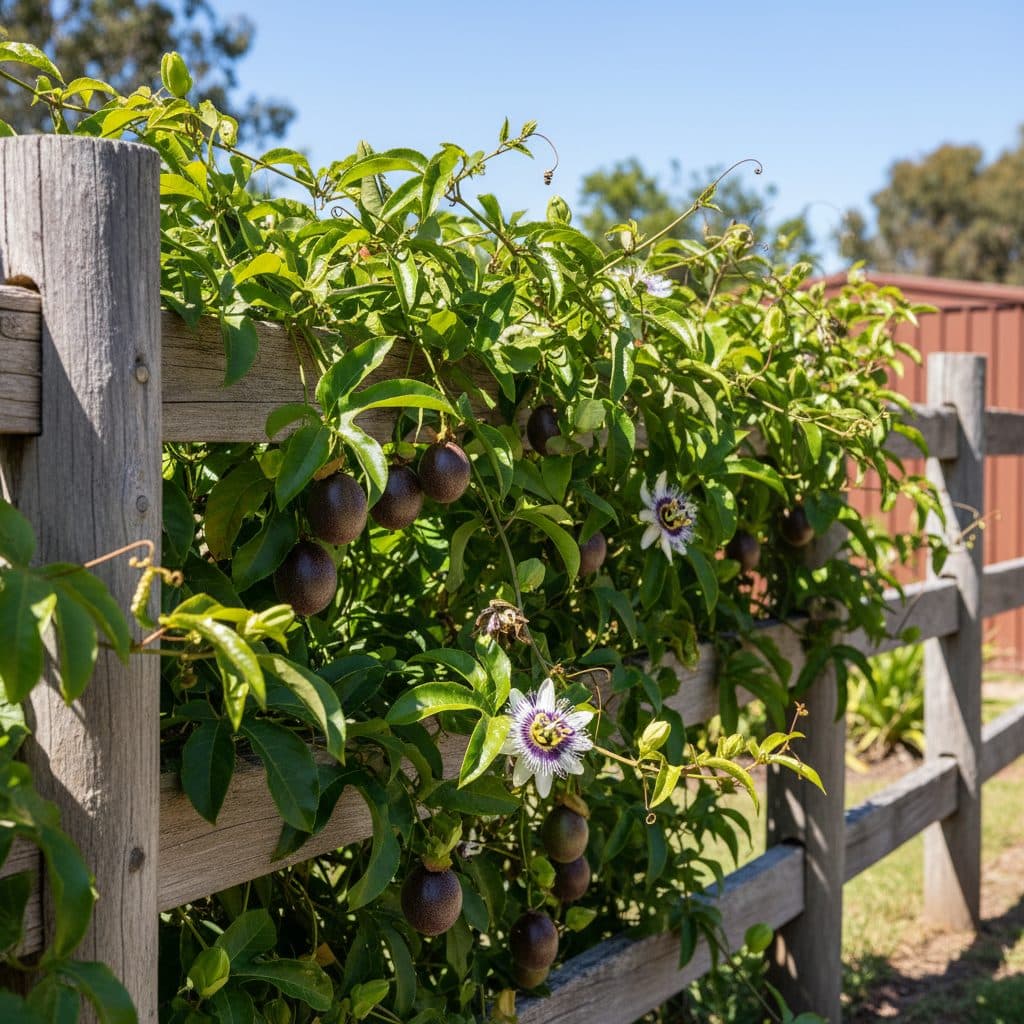
Key takeaways
- Choose Nellie Kelly grafted black passionfruit for temperate and cool southern regions, and Panama Gold or Red for subtropical and tropical climates.
- Plant in spring (September to November) in full sun with protection from cold southerly winds and severe winter frosts.
- Provide a heavy-duty trellis, boundary fence, or pergola capable of supporting a vine weighing up to 50 kg when fully laden with fruit.
- Passionfruit vines are heavy feeders that require high-potassium organic fertiliser and compost applied in spring and mid-summer.
- Prune in early spring (September) once frost danger passes to thin congested older growth and stimulate new flowering wood.
- Identify and remove wild rootstock suckers emerging from below the graft union on grafted Nellie Kelly vines immediately.
Quick answer: To grow passionfruit in Australia, plant a grafted Nellie Kelly or Panama vine in spring in a warm, sunny spot against a sturdy fence or trellis with fertile, free-draining soil. Apply high-potassium organic fertiliser in spring and summer, water deeply during flowering, and harvest heavy purple or gold fruit in summer and autumn.
Passionfruit (Passiflora edulis) is one of the most rewarding and productive perennial climbing vines grown in Australian backyards. With its exotic purple and white flowers, glossy green three-lobed foliage, and intensely aromatic pulp, a single healthy vine can produce hundreds of sweet, tangy fruits each season.
However, passionfruit vines have specific cultural requirements. Known as greedy feeders with shallow, sensitive root systems, they require abundant sunshine, regular moisture during fruit swelling, high potassium nutrition, and annual spring pruning. Understanding how to manage your vine ensures continuous fruiting and prevents common issues like blossom drop and rootstock takeover.
Selecting passionfruit varieties for Australian climates
Choosing the right passionfruit cultivar matched to your regional climate is the foundation of long-term fruiting success.
+-------------------------------------------------------------+
|              AUSTRALIAN PASSIONFRUIT CULTIVARS              |
|                                                             |
|   1. NELLIE KELLY GRAFTED BLACK:                            |
|   - Purple skin, rich aromatic pulp, heavy cropping         |
|   - Grafted onto blue passionfruit rootstock                |
|   - Superior cold & frost tolerance (Melbourne, Sydney, SA) |
|                                                             |
|   2. PANAMA GOLD / PANAMA RED (Subtropical & Tropical):     |
|   - Large golden or red fruit, sweeter tropical pulp        |
|   - Non-grafted seedling vine; vigorous root system         |
|   - Ideal for Brisbane, Coastal NSW, QLD, NT                |
|                                                             |
|   3. 'SWEETHEART' (Passiflora edulis):                      |
|   - Purple cultivar for warm temperate and subtropics       |
|   - Avoid banana passionfruit (declared weed in AU states)  |
+-------------------------------------------------------------+
Variety | Fruit Colour & Size | Vine Habit | Cold Tolerance | Best Australian Regions |
|---|---|---|---|---|
Nellie Kelly Black (Grafted) | Medium deep purple | Moderate | High (Handles light frost) | Melbourne, Adelaide, Sydney, Perth, Inland |
Panama Gold (Seedling) | Large golden yellow | Very vigorous | Low (Frost sensitive) | Brisbane, Sunshine Coast, Northern NSW, Tropics |
Panama Red (Seedling) | Large red-purple | Very vigorous | Low (Frost sensitive) | Subtropical & Tropical coastal regions |
Sweetheart (Passiflora edulis) | Medium red-purple | Moderate | Moderate | Warm temperate & subtropical areas |
For growers in southern Victoria or elevated tablelands, the Nellie Kelly Grafted Black is standard because its hardy rootstock (Passiflora caerulea) resists fungal root rot in cold, wet winter soils. Note: Banana passionfruit (Passiflora tarminiana) is a declared environmental weed in parts of Australia — do not plant it; check your state's declared weed list.
Site selection, soil preparation, and planting
Passionfruit vines are vigorous tropical and subtropical climbers that require warm microclimates and free-draining soil.
+-------------------------------------------------------------+
|                PLANTING SITE REQUIREMENTS                   |
|                                                             |
|   Sunlight: Minimum 6 to 8 hours direct sun daily           |
|   Shelter: North- or west-facing wall (blocks south winds)  |
|   Soil: Sandy loam rich in organic compost (pH 6.0 to 6.5)  |
|   Drainage: Mounded planting beds to prevent root rot       |
+-------------------------------------------------------------+
Step-by-step planting in spring:
- Plant in Spring (September to November): Plant as the weather warms, allowing the vine to establish a broad root system before peak summer heat.
- Mound the soil: If you have heavy clay soil, build a raised planting mound 20 cm to 30 cm high and 1 metre wide. Incorporate a 25-litre bag of well-rotted compost and 100 grams of blood and bone into the mound.
- Protect the graft union: Place the root ball into the hole so the soil level matches the pot level. Ensure the swollen graft union sits at least 5 cm above the soil surface.
- Mulch and water in: Water thoroughly with seaweed tonic and spread a 7.5 cm layer of coarse woodchips around the base, keeping the mulch clear of the vine stem.
For companion ideas, see our guide to growing backyard berries.
Building a sturdy trellis support system
A fully laden, mature passionfruit vine with wet foliage can weigh over 50 kg. Flimsy garden stakes or lightweight plastic trellis will collapse under the load.
+-------------------------------------------------------------+
|               PASSIONFRUIT TRELLIS WIRE SYSTEM              |
|                                                             |
|   [ Heavy Post ] ======================== [ Heavy Post ]    |
|         |        Top Wire (1.8 m Height)         |          |
|         |   ----------------------------------   |          |
|         |        Middle Wire (1.4 m Height)      |          |
|         |   ----------------------------------   |          |
|         |        Lower Wire (1.0 m Height)       |          |
|   ======|========================================|======    |
|         |                                        |          |
+-------------------------------------------------------------+- Boundary fence wire system: Run three horizontal high-tensile galvanised wires along a timber or colorbond boundary fence at heights of 1.0 m, 1.4 m, and 1.8 m, using eye bolts to tension the wires.
- Pergola or carport frame: Train the main stem up a corner post to spread across an overhead pergola, creating cooling summer shade and hanging fruit.
Training, watering, and feeding routines
Proper vine training directs early energy into productive lateral fruiting arms.
Training the vine:
- Allow a single vigorous stem to grow vertically up a bamboo stake to the top wire of your trellis, removing any side shoots along the way.
- When the stem reaches the top wire, pinch out the terminal tip to force two side branches.
- Train one branch to the left along the wire and one to the right. These become your permanent horizontal framework.
- Subsequent vertical hanging shoots (laterals) emerging from these horizontal arms will bear the flowers and fruit.
Nutrition and watering:
Passionfruit are potassium-hungry plants:
- Spring Feeding (September): Apply 2 kg of pelletised poultry manure and 100 grams of sulphate of potash around the root zone.
- Mid-Summer Feeding (January): Apply a balanced organic fruit fertiliser with trace minerals.
- Watering: Passionfruit have shallow roots that dry out rapidly. Provide a deep soaking of 20 to 30 litres twice a week during flowering and fruit development. Inconsistent moisture causes fruit to drop prematurely or shrivel before ripening.
During heatwaves, explore protective canopy strategies in shade netting for fruit trees and protecting fruit trees in a heatwave.
Troubleshooting: why is my passionfruit not fruiting?
Many Australian gardeners encounter lush, sprawling vines that fail to set fruit. Here is how to diagnose and resolve the issue:
+-------------------------------------------------------------+
|             PASSIONFRUIT NOT FRUITING: ROOT CAUSES          |
|                                                             |
|   1. EXCESS NITROGEN:                                       |
|   - Heavy green leaf growth, thick foliage, zero flowers    |
|   - Fix: Stop high-nitrogen fertilizers; apply potash       |
|                                                             |
|   2. POOR POLLINATION:                                      |
|   - Flowers open but drop off without swelling into fruit   |
|   - Fix: Hand-pollinate with brush when styles curve down   |
|                                                             |
|   3. ROOTSTOCK SUCKER TAKEOVER:                             |
|   - Wild five-lobed leaves emerge from base below graft     |
|   - Fix: Trace suckers to base and cut off cleanly          |
+-------------------------------------------------------------+
Hand-pollination technique:
If natural pollinators are sparse, hand-pollinate with a soft brush once the flower is fully open and the three styles have bent down over the anthers — late morning to early afternoon for purple types, around midday for Panama types.
Removing rootstock suckers (The Nellie Kelly rule):
If you are growing a grafted Nellie Kelly vine, monitor the base of the trunk below the graft union. The blue passionfruit rootstock frequently sends up aggressive suckers identified by leaves with five to seven narrow lobes (unlike the cultivated scion's three broad lobes). If left unchecked, the wild rootstock will outgrow and kill the fruiting scion. Furthermore, Passiflora caerulea escaping from rootstock suckers is itself a recognised garden escape in parts of southern Australia, so suckers should be cut off flush against the trunk rather than left to flower and fruit.
Annual pruning guide for heavy cropping
Passionfruit vines only produce flowers and fruit on new season's growth. Without annual pruning, vines become a tangled, unproductive mass of dead wood.
- When to prune: Prune in early spring (September) across southern Australia as soon as winter frost risk has passed and new green growth buds emerge.
- How to prune: Cut back lateral fruiting branches by about one-third, leaving two to three nodes of new growth on each stem. Remove completely dead, diseased, or tangled interior growth to allow sunlight and air into the centre of the trellis.
Harvesting passionfruit
Passionfruit ripen from late summer into autumn — roughly February to May in southern regions, and earlier in the subtropics.
- When to pick: The best indicator of ripeness is when the fruit develops its full purple or golden colour and falls naturally to the ground or detaches with a gentle touch.
- Skin wrinkled vs smooth: Smooth fruit harvested fully coloured will wrinkle slightly on the kitchen bench over a few days, concentrating sugars and reducing natural acidity for eating.
With warm sunshine, high potassium nutrition, diligent sucker removal, and annual spring pruning, your passionfruit vine will provide baskets of sweet, homegrown fruit every season.