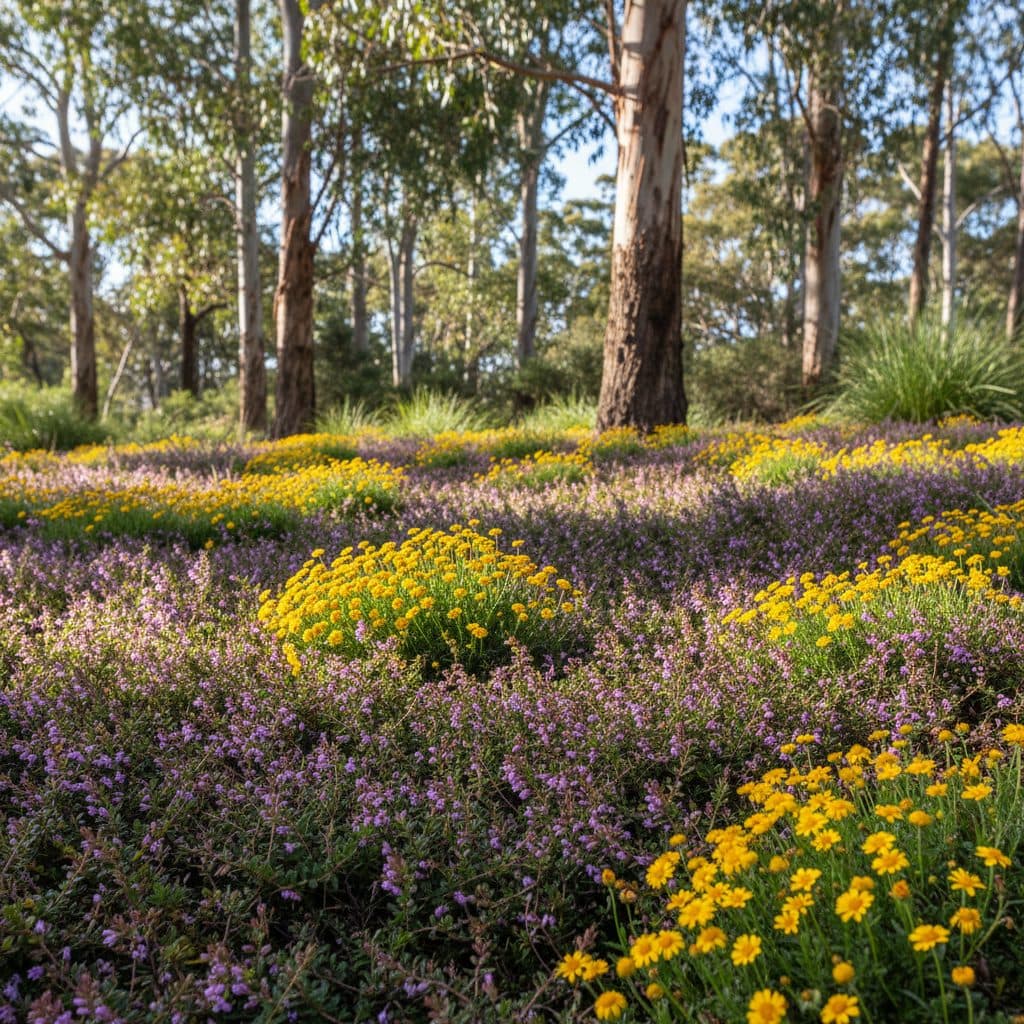
Key takeaways
- Native Australian ground covers suppress weeds, reduce soil surface evaporation, and prevent hydrophobic crusting in hot summers.
- Use creeping boobialla (Myoporum parvifolium) and coastal pigface (Carpobrotus) for dense weed-smothering carpets in full sun.
- Plant kidney weed (Dichondra repens) and native violet (Viola hederacea) in shaded, moist courtyard areas as soft lawn alternatives.
- Establish edible living mulches like Warrigal greens (Tetragonia tetragonioides) around fruit trees and veggie patches.
- Plant during autumn (March to May) across southern Australia to allow roots to establish before summer heat.
- Space vigorous runners 60 cm to 80 cm apart and clumping species 30 cm to 40 cm apart, and mulch between young plants until the carpet knits together.
Quick answer: The best ground cover plants for Australia include creeping boobialla (Myoporum parvifolium) for full sun and erosion control, kidney weed (Dichondra repens) for shaded lawn alternatives, and native violet (Viola hederacea) for moist borders. These native species conserve soil moisture and outcompete weeds.
Ground cover plants do a lot of quiet work in the Australian landscape. In a climate characterized by intense summer solar radiation, dry winds, and sporadic rainfall, bare soil degrades quickly, forming hard, water-repellent crusts that shed water rather than absorbing it.
By planting dense, low-growing native ground covers, you establish a "living mulch" that cools the soil surface, prevents weed emergence, stabilizes slopes against erosion, and creates habitat for beneficial predatory insects. Whether you are replacing a thirsty grass lawn, carpeting a garden bed, or underplanting your veggie patch, adapted ground covers provide long-term resilience with minimal maintenance.
Benefits of living mulches in Australian gardens
Covering bare soil with living foliage provides functional advantages that exceed traditional bark mulches:
+-------------------------------------------------------------+
|                 LIVING MULCH SOIL BENEFITS                  |
|                                                             |
|   1. Thermal Soil Cooling: Keeps root zone markedly cooler  |
|   2. Moisture Retention: Shields earth from sun evaporation |
|   3. Erosion & Crusting Defense: Breaks driving rain impact |
|   4. Weed Exclusion: Dense green carpet blocks light to seed|
|   5. Living Roots: Exudes carbon sugars to soil microbiome  |
+-------------------------------------------------------------+
During 40°C heatwaves in Melbourne, Adelaide, Sydney, or Perth, bare garden soil surfaces get extremely hot on a 40°C day, killing beneficial mycorrhizal fungi and earthworms. A dense ground cover layer acts as an insulating thermal blanket, keeping the root zone substantially cooler throughout the day.
Living mulches also eliminate the recurring expense of buying truckloads of woodchip mulch every spring. Once established, the dense canopy of leaves shades out weed seeds, preventing troublesome annual grasses and broadleaf weeds from germinating. Furthermore, living roots continuously secrete organic compounds that feed beneficial soil bacteria, improving nutrient cycling naturally.
For broader soil temperature management techniques, review our guide to living mulch for soil cooling.
Best native ground covers for full sun and dry soils
These tough native species handle intense sun, low rainfall, and sandy or clay soils across Mediterranean, temperate, and subtropical Australia.
+-------------------------------------------------------------+
|               SUN-LOVING NATIVE GROUND COVERS               |
|                                                             |
|   CREEPING BOOBIALLA          COASTAL PIGFACE               |
|   - Myoporum parvifolium      - Carpobrotus glaucescens     |
|   - Dense, fine green carpet  - Fleshy succulent leaves     |
|   - White star spring blooms  - Bright pink daisy flowers   |
|   - Outcompetes most weeds    - Saline & coastal tolerant   |
|                                                             |
|   YELLOW BUTTONS              RUNNING POSTMAN               |
|   - Chrysocephalum apiculatum - Kennedia prostrata          |
|   - Silver-grey soft foliage  - Trailing scarlet pea blooms |
|   - Golden clustered buttons  - Beautiful rockery ground hug|
+-------------------------------------------------------------+
Species | Common Name | Growth Habit | Height & Spread | Ideal Climate | Key Features |
|---|---|---|---|---|---|
Myoporum parvifolium | Creeping Boobialla | Prostrate trailing mat | 10 cm high x 2 m wide | Temperate, Mediterranean and semi-arid; unreliable in the humid subtropics | Masses of white flowers, strong weed suppression once established |
Carpobrotus glaucescens | Coastal Pigface | Fleshy succulent runner | 15 cm high x 2 m wide | Coastal, Arid, Subtropical | Magenta blooms, edible reddish fruit |
Chrysocephalum apiculatum | Yellow Buttons | Clumping prostrate herb | 20 cm high x 50 cm wide | Temperate, Arid, Cool | Silvery foliage, long-lasting yellow flowers |
Kennedia prostrata | Running Postman | Creeping ground hugger | 10 cm high x 1.5 m wide | Mediterranean, Temperate | Red pea flowers, attracts native bees |
Scaevola aemula | Fairy Fan Flower | Spreading trailing herb | 15 cm high x 80 cm wide | Subtropical, Temperate | Purple fan-shaped flowers, long flowering |
In coastal gardens, Carpobrotus glaucescens (pigface) stabilizes shifting sand dunes while resisting salt-laden ocean winds. In inland regions where frost and heat alternate, Chrysocephalum apiculatum provides year-round colour with silvery, sun-reflective leaves.
For companion planting arrangements, explore our resource on drought-tolerant plants.
Best ground covers for shade, damp spots, and lawn alternatives
Shaded side passages, courtyard borders beneath tree canopies, and narrow verges often struggle to support conventional turf grass.
1. Kidney Weed (Dichondra repens)
A native perennial with bright green, kidney-shaped leaves that forms a dense, soft carpet 3 cm to 5 cm tall.
- Sunlight: Full sun to heavy shade (thrives in dappled light).
- Lawn Alternative: Tolerates light foot traffic, never requires mowing, and remains lush green in shaded areas where buffalo or couch grass thins out.
- Establishment: Can be established from seed plugs or turf rolls in autumn or spring.
2. Native Violet (Viola hederacea, syn. Erpetion reniforme; much nursery stock is the closely related Viola banksii)
Forms a creeping, emerald-green mat adorned with dainty purple and white two-tone flowers for up to nine months of the year.
- Sunlight: Semi-shade to full shade.
- Requirements: Prefers moist, humus-rich soil; ideal for damp courtyard paths and underplanting ferns or citrus trees.
3. Matted Pratia (Pratia pedunculata / Lobelia pedunculata)
A miniature creeping perennial that hugs the soil tightly, producing a profusion of tiny star-shaped blue or white flowers in spring and summer. Withstands damp conditions along garden edges and stepping stones.
Edible and bush tucker ground covers
Integrating edible ground covers into your landscape turns open ground into a functional food source:
+-------------------------------------------------------------+
|                 EDIBLE BUSH TUCKER COVERS                   |
|                                                             |
|   1. WARRIGAL GREENS (Tetragonia tetragonioides):           |
|  - Sprawling native spinach substitute; blanch before eating|
|   - Thrives in coastal sandy soil & rich compost beds       |
|                                                             |
|   2. MIDYIM BERRY (Austromyrtus dulcis):                    |
|   - Spreading 40 cm shrub with sweet, speckled white berries|
|   - Aromatic leaves and bronze new growth                   |
|                                                             |
|   3. RIVER MINT (Mentha australis):                         |
|   - Spreading herb with intense peppermint-eucalyptus scent |
|   - Ideal for moist borders and tea infusions               |
+-------------------------------------------------------------+
Warrigal greens work well as a living mulch in home veggie patches. As the broad triangular leaves sprawl between tomato plants or under fruit trees, they prevent weed germination while providing fresh greens for harvest. Blanch the leaves in plenty of boiling water for one to two minutes and tip the water away — discarding the water is what removes the oxalates. People prone to kidney stones should eat them sparingly regardless.
For soil cover strategies on sandy plots, see sandy soil cover crops.
Planting, spacing, and establishment guide
Establishing a solid, weed-free ground cover carpet requires proper site preparation:
- Clear existing weeds: Thoroughly dig out perennial grass roots (like couch or kikuyu) before planting.
- Aerate and amend: Fork in well-rotted compost to improve moisture holding capacity in sandy soil or loosen dense clay.
- Spacing: Space vigorous species (Myoporum, Carpobrotus) 60 cm to 80 cm apart. Space smaller species (Dichondra, Chrysocephalum) 30 cm to 40 cm apart.
- Mulch between plants: Apply a 5 cm layer of organic bark or straw mulch between the newly planted tubes. This suppresses weeds while the ground cover runners grow and knit together.
- Watering during establishment: Water twice a week for the first four to six weeks. Once runners root at leaf nodes along the ground, reduce watering to occasional deep soakings during prolonged dry spells.
Long-term maintenance and rejuvenating older plantings
Native ground covers require very little maintenance once established, but occasional care maintains a tidy appearance:
- Edge trimming: Trim wandering runners away from lawn edges, garden paths, and small delicate shrubs once or twice a year using hand shears.
- Pruning woody centres: After several years, species like Myoporum or Chrysocephalum may develop woody or sparse central patches. Lightly shear the foliage back by one-third in early spring (September) and apply a seaweed tonic to stimulate vigorous new basal shoots.
- Spot-weeding: Inspect the green carpet every few months to remove any airborne weed seedlings (such as dandelions or sow thistles) before they establish deep taproots.
By selecting adapted native ground covers for your sun and soil conditions, you can replace high-maintenance turf, suppress weeds permanently, and keep your garden soil cool and productive throughout the Australian summer.