secondary
Lilly pilly
Syzygium smithii
International hardiness
- USDA 9-11
- RHS H3
- AU: Subtropical, Tropical, Warm temperate, Cool temperate
Where it grows — regional guide
| Zones / rating | Regional notes |
|---|---|
USDA 9-11 | Grown in frost-free regions of coastal California, southern Florida, and Hawaii; makes an excellent drought-tolerant privacy screen. |
| Zones / rating | Regional notes |
|---|---|
H3 (-5 to 1C) | Cultivated as an ornamental specimen in sheltered, frost-free gardens in Cornwall and coastal Ireland, or grown in unheated conservatories. |
| Zones / rating | Regional notes |
|---|---|
Subtropical, Tropical, Warm temperate, Cool temperate | Native to coastal rainforests from northern Queensland to Victoria; one of Australia's premier native hedge and windbreak plants. |
| Zones / rating | Regional notes |
|---|---|
USDA 9-11 (USDA scale) Canada uses its own zone system; Canadian zones run roughly one lower than USDA. | No region-specific data yet |
| Zones / rating | Regional notes |
|---|---|
No region-specific data yet | No region-specific data yet |
Lilly pilly (Syzygium smithii, widely known by its botanical synonym Acmena smithii) is an evergreen rainforest tree in the myrtle family (Myrtaceae). Commonly referred to as the common lilly pilly, creek satinash, or monkey apple, the species is one of the most ubiquitous and cherished native hedge and amenity plants in Australia. In wild rainforest gullies and riverbanks along the eastern coast from northern Queensland down through New South Wales into eastern Victoria, it forms a handsome canopy tree reaching up to 20 m (65 ft). In domestic horticulture, however, it is prized as a versatile, fast-growing screening tree and formal hedge that responds magnificently to regular pruning.
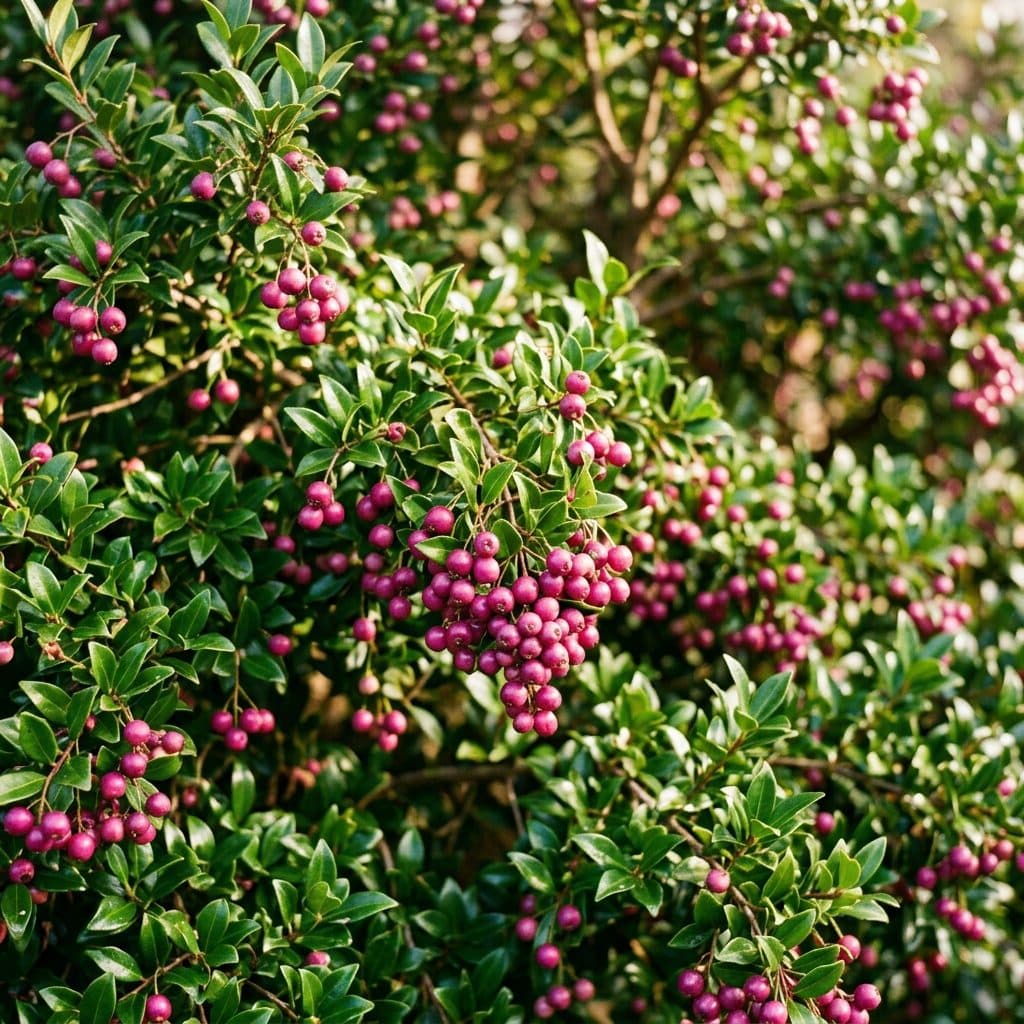
Belonging to the vast genus Syzygium, lilly pilly shares close botanical kinship with tropical fruiting trees like the Indian jamun. In homestead permaculture and food forests, Syzygium smithii fulfills several roles. Planted on property boundaries alongside windbreak companions such as white mulberry or fruit trees like Eureka lemon, a dense lilly pilly hedge provides effective acoustic buffering, privacy screening, and shelter from desiccating winds. The delicate fluffy white flowers attract honeybees and native solitary bees in late spring, followed in autumn by heavy crops of globular pink, magenta, or white berries that feed native parrots and honeyeaters.
Beyond its ornamental value, lilly pilly provides an abundant harvest of traditional bush tucker. The crisp, spongy berries have a refreshing, slightly resinous, tart apple-like flavour. When picked fresh, they can be eaten raw out of hand or simmered with raw sugar to produce magenta jellies, chutneys, sauces, and sparkling cordials.
Growing lilly pilly
Lilly pilly demonstrates remarkable ecological resilience, growing successfully across tropical, subtropical, warm-temperate, and protected cool-temperate climates. Established specimens endure light winter frosts down to -2 °C (28 °F), though young growth is easily scorched by freezing weather. In cool, frost-prone districts, plant in the shelter of a north-facing wall or beneath high tree canopies.
The species adapts to an extensive range of soil conditions, from deep sandy coastal dunes to heavy clay loams, provided water does not pool stagnantly around the roots. It performs best in fertile, moisture-retentive soils with a slightly acidic to neutral pH of 5.5 to 6.5. Incorporating generous amounts of garden compost into the planting hole accelerates root establishment and leaf production.
For optimal foliage density and heavy berry production, plant lilly pilly in full sun. While trees tolerate moderate shade, shaded specimens develop a looser, more open framework with reduced flowering and sparse berries.
Water young plants deeply once or twice weekly during their first growing season to encourage deep root expansion. Once established, Syzygium smithii possesses admirable drought tolerance, surviving extended dry spells on minimal supplemental water. In hot summer weather, a deep monthly irrigation maintains leaf turgor and plumps ripening berries. Mulch the root zone with 7.5 to 10 cm (3 to 4 in) of bark chips or forest litter to conserve soil moisture.
Propagation is straightforward from fresh seed or semi-hardwood cuttings. Sow cleaned seeds immediately after harvest in trays of seed-raising mix, pressing them 1 cm (0.4 in) deep; germination occurs in 20 to 40 days at 20 to 25 °C (68 to 77 °F). Semi-hardwood cuttings taken in late summer root reliably within six to eight weeks when treated with rooting hormone and kept under mist.
When planting a formal lilly pilly hedge, space specimens 80 cm to 1.2 m (32 to 48 in) apart depending on the cultivar. For an informal screening border or individual specimen tree, allow 2.5 to 4 m (8 to 13 ft) between plants. Popular compact cultivars include 'Minor' and 'Hedgemaster', which maintain a manageable height of 2 to 3 m (6.5 to 10 ft) with tight, dense foliage.
Pruning can be carried out throughout the warmer months. To establish a dense hedge, tip-prune young plants frequently during their first two years to force low lateral branching. Mature hedges can be clipped two to three times annually to maintain formal lines. If berry harvest is desired, delay hedging until after the autumn fruit has finished, pruning in late winter before spring growth begins.
Harvest and uses
Lilly pilly berries ripen from late summer through autumn, typically between March and June in Australia. Ripeness is indicated by a colour shift from pale green or white to vibrant mauve, magenta, pink, or deep purple. The fruit should feel plump and yield slightly to thumb pressure.
Harvest berries by clipping whole fruit clusters from the branches with secateurs, or pick individual fruits by hand. Berries keep in a sealed container in the refrigerator for seven to ten days. They also freeze cleanly for up to twelve months without losing their tart acidity.
Raw berries have a crisp texture similar to a miniature water apple. In culinary preparation, whole berries are simmered with sugar and citrus juice to extract their pectin and colour, yielding a firm, glistening magenta jelly that pairs with roast lamb, pork, and poultry. Berries can also be infused into gin, blended into tart fruit smoothies, or baked into muffins and puddings.
Identifying lilly pilly
Syzygium smithii is identified by several characteristic botanical features:
- Habit: Evergreen tree reaching 8 to 20 m (26 to 65 ft) in wild rainforests, but typically 3 to 6 m (10 to 20 ft) in garden cultivation, forming a dense, rounded, leafy canopy with smooth or finely flaky grey-brown bark.
- Leaves: Opposite, simple, ovate to broadly elliptic, measuring 4 to 10 cm (1.6 to 4 in) long and 1.5 to 4 cm (0.6 to 1.6 in) wide. Leaves are dark glossy green above and paler beneath, with a prominent tapering drip tip (acuminate apex) and tiny translucent oil dots visible when held to light. Young spring growth emerges in bronze to copper-pink tones.
- Flowers: Creamy-white or pale yellow fluffy blossoms measuring 4 to 6 mm (0.16 to 0.24 in) across, arranged in terminal or axillary panicles 5 to 10 cm (2 to 4 in) wide during late spring and summer. Showy stamens give the inflorescence a delicate, powder-puff appearance.
- Fruit: Globular or slightly flattened fleshy berries measuring 10 to 20 mm (0.4 to 0.8 in) in diameter, crowned with a small circular calyx remnant at the apex. Colour ranges from white and pale pink to mauve, magenta, and purple.
- Flesh and seed: Crisp, spongy white to pale pink flesh surrounding a single, hard central seed.
Syzygium smithii is distinguished from the brush cherry (Syzygium australe) by its fruit, which has a circular apical cavity where the calyx lobes have withered away, whereas Syzygium australe retains prominent persistent fleshy calyx lobes at the fruit apex. Furthermore, Syzygium smithii is naturally resistant to lilly pilly psyllid leaf distortion.
Cautions
Growers cultivating lilly pilly should observe several practical and biosecurity caveats:
- Pavement staining: Ripe berries drop in profusion when mature. On hard paved surfaces, stone pathways, or driveways, crushed berries leave slippery residues and stubborn dark purple stains. Plant screening hedges well back from pedestrian walkways or patio paving.
- Seed ingestion: The central seed within each berry is hard and contains trace amounts of cyanogenic compounds. While accidental swallowing of whole seeds poses minimal risk, seeds should never be chewed or crushed. Strain out seeds when preparing jams and jellies.
- Environmental weed potential: In areas outside its native range with mild, wet climates—such as parts of New Zealand, South Africa, and Hawaii—Syzygium smithii has escaped cultivation. Its bird-dispersed seeds germinate readily, forming dense understorey thickets that suppress native seedling regeneration. Do not plant near sensitive native forest reserves in those regions.
- Myrtle rust (Austropuccinia psidii): While more resilient than some relatives, lilly pilly can be infected by myrtle rust during warm, humid weather. The fungus produces bright yellow powdery pustules on soft new shoots and flowers, causing leaf distortion and dieback. Inspect new growth and prune off infected twigs immediately.
- Psyllids and scale: While Syzygium smithii exhibits natural resistance to the common lilly pilly psyllid (Trioza eugeniae) compared to other species, plants under stress may occasionally host scale insects and sooty mold. Promote vigorous growth with compost and balanced watering.
Sources
- Royal Botanic Gardens, Kew. Syzygium smithii (Poir.) Nied. Plants of the World Online.
- Australian Native Plants Society (Australia). Syzygium smithii
- Plants For A Future. Syzygium smithii - (Poir.) Nied.