secondary
Soursop graviola
Annona muricata
International hardiness
- USDA 10-12
- RHS H1b
- AU: Tropical, Subtropical
Where it grows — regional guide
| Zones / rating | Regional notes |
|---|---|
USDA 10-12 | Confined to USDA Zones 10b to 11 in South Florida and Hawaii; defoliates at 5 °C (41 °F) and suffers fatal root and stem damage under frost. |
| Zones / rating | Regional notes |
|---|---|
H1b (10 to 15C) | No region-specific data yet |
| Zones / rating | Regional notes |
|---|---|
Tropical, Subtropical | Grown in frost-free tropical Queensland and the Top End; requires shelter from dry, drying winds and consistent moisture during fruit expansion. |
| Zones / rating | Regional notes |
|---|---|
USDA 10-12 (USDA scale) Canada uses its own zone system; Canadian zones run roughly one lower than USDA. | No region-specific data yet |
| Zones / rating | Regional notes |
|---|---|
No region-specific data yet | India:Cultivated in warm coastal regions of southern India; fruit is harvested when skin changes from dark green to slightly yellowish-green and yields to touch. |
Soursop graviola (Annona muricata), known widely in Spanish-speaking regions as guanábana and in Brazil as graviola, is a slender, low-branching evergreen fruit tree in the custard apple family (Annonaceae). Native to the tropical lowlands of Central America, northern South America, and the Caribbean, soursop has been distributed across the humid tropics of Asia, Africa, and the Pacific. The tree is celebrated for its large, heart-shaped or oval syncarpous fruits covered in soft, curved spines, enclosing an intensely aromatic, snow-white pulp that combines the bright acidity of pineapple with the luscious sweetness of strawberry and banana.
In tropical permaculture and syntropic agroforestry, Annona muricata occupies the sub-canopy or secondary tree layer. With a compact mature stature and moderate shade tolerance, it slots comfortably beneath tall emergent legumes and palms, thriving in the filtered light of multi-strata food forests. Its glossy evergreen foliage emits an aromatic resinous scent that deters many generalist insect pests, while its fallen leaves provide protective mulch around companion species like custard apple or papaya. Despite its outstanding culinary virtues, the plant contains potent bioactive neurotoxins that demand strict medical awareness.
Growing soursop graviola
Soursop is strictly a warm tropical and frost-free subtropical tree, hardy in USDA Zones 10b through 12 and rated RHS H1b. It is exceptionally sensitive to cold conditions: vegetative growth halts when temperatures fall below 15 °C (59 °F), leaves defoliate at 5 °C (41 °F), and temperatures near 0 °C (32 °F) cause fatal stem and root damage. The tree thrives in warm, humid coastal lowlands from sea level up to 1,000 m (3,300 ft), flourishing where annual rainfall ranges between 1,500 and 3,000 mm (60 to 120 in). Extended dry seasons cause premature fruit drop unless supplemental irrigation is maintained.
Soil requirements focus on drainage and organic fertility. The tree performs best in rich, loose sandy loams, well-aerated alluvial soils, or porous volcanic loams with a pH between 5.5 and 6.5. It is completely intolerant of standing water or waterlogged root zones, which trigger rapid asphyxiation and collar rot (Phytophthora species). Soursop tolerates partial shade when young but requires abundant sunlight to produce heavy blooms and properly ripen fruit. Protection from strong, drying winds matters: desiccating winds shred the large leaves, dry out stigmas during pollination, and cause heavy fruit drop.
The tree maintains a modest size, growing 4 to 9 m (13 to 30 ft) tall with an open, spreading crown 3 to 6 m (10 to 20 ft) wide. Propagation is readily achieved by seed, which germinates in twenty to thirty days when sown fresh. Seedlings display vigorous juvenile growth and begin bearing fruit within three to five years. For commercial consistency and early bearing, elite cultivars are propagated via shield budding, cleft grafting, or veneer grafting onto soursop or mountain soursop (Annona montana) rootstocks, fruiting in two to three years. In orchard settings, space trees at 4 by 4 m (13 by 13 ft) to 5 by 5 m (16 by 16 ft).
Harvest and uses
A mature soursop tree yields 20 to 50 fruits annually, producing a total harvest of 30 to 80 kg (66 to 176 lb). Soursop produces the largest fruit in the Annonaceae family, with individual specimens measuring 15 to 35 cm (6 to 14 in) long and weighing from 1 to 4 kg (2.2 to 8.8 lb).
Harvest timing is critical. Fruit must be picked when fully grown but still firm, indicated by a subtle shift in skin colour from dark shiny green to dull yellowish-green, accompanied by a softening and spreading of the fleshy spines. If allowed to soften completely on the tree, the heavy fruit drops to the ground and splatters. Harvested firm fruit softens at room temperature within three to five days.
The ripe fruit is prized for beverage and dessert preparation. The tender skin peels away easily, exposing creamy, fibrous, glistening white segments surrounding hard, dark brown seeds. The pulp is pressed through a sieve or blended with water or milk to extract delicious juice, known throughout Latin America as champola or jugo de guanábana. The pulp is also crafted into refreshing sorbets, ice creams, yoghurts, jams, and fruit jellies.
In traditional Caribbean and South American ethnobotany, the aromatic leaves and bark have been steeped as herbal teas to treat insomnia and nervousness. However, modern scientific evaluations have uncovered serious neurotoxic hazards associated with these preparations, cautioning against routine or concentrated medicinal consumption.
Identifying soursop graviola
Annona muricata is recognised by several clear botanical characteristics:
- Leaves: Alternate, simple, evergreen, glossy dark green above and paler beneath, obovate to oblong-elliptic, measuring 8 to 16 cm (3 to 6 in) long and 3 to 7 cm (1.2 to 2.8 in) wide. When crushed, the leaves emit a pungent, pleasant, spicy-resinous aroma.
- Bark and form: The trunk is slender, covered with smooth, greyish-brown bark that becomes shallowly fissured with age. Branches are smooth and spreading, often forming a symmetrical, conical or rounded crown.
- Flowers: Large, solitary, fleshy flowers emerging along small branchlets or older woody stems. The flowers measure 3 to 5 cm (1.2 to 2 in) across, featuring three thick, triangular, leathery outer petals that are pale yellow-green, and three smaller, overlapping, pale yellow inner petals enclosing a dense cluster of stamens and pistils.
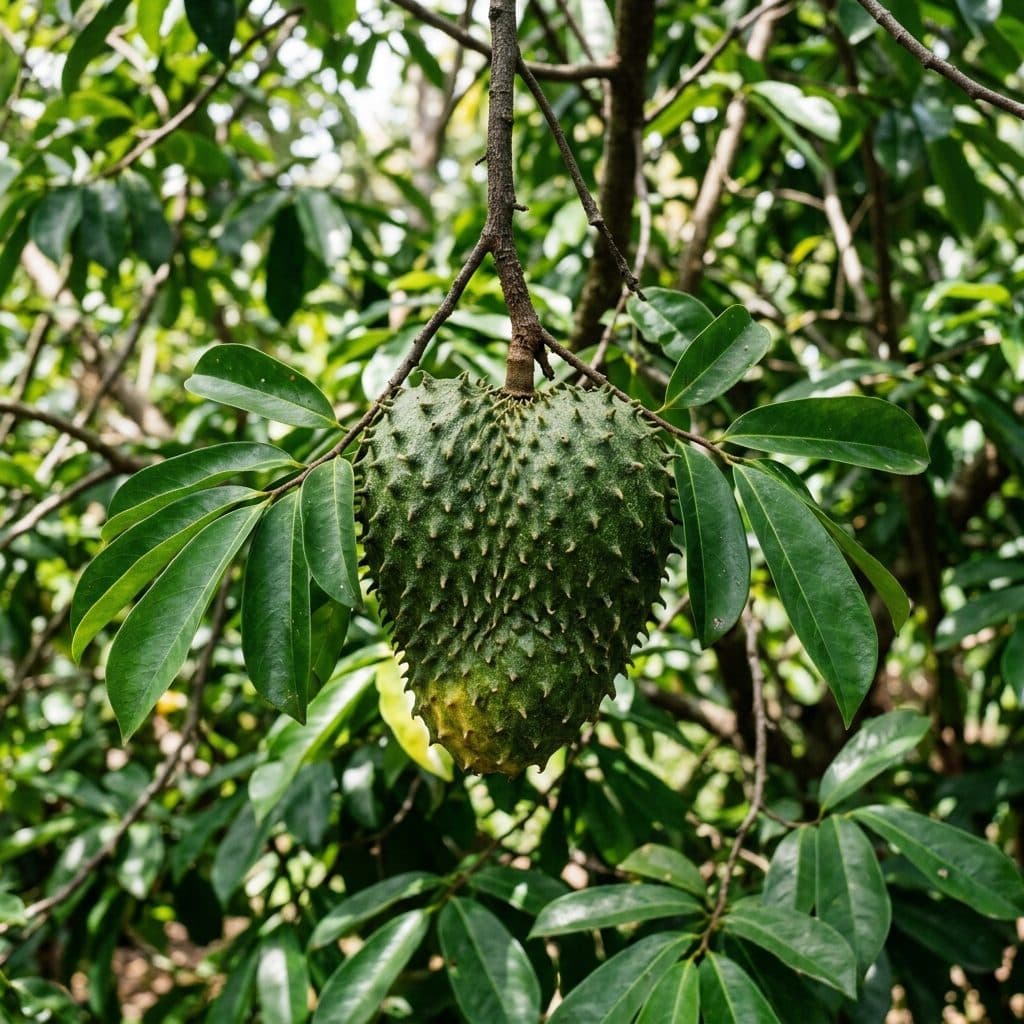
- Fruit: Large, heart-shaped, kidney-shaped, or irregular oval syncarps covered in a leathery, dark green skin studded with soft, pliable, curved fleshy spines 3 to 5 mm (0.12 to 0.2 in) long. The interior contains juicy, fibrous white pulp arranged in edible segments, each containing a hard, smooth, dark brown or black seed measuring 1.5 to 2 cm (0.6 to 0.8 in) long.
It is easily distinguished from custard apple (Annona squamosa), which has smaller, round, segmented fruits covered with rounded tubercles rather than soft spines, and from cherimoya (Annona cherimola), which has velvety leaves and smooth, fingerprint-patterned skin.
Cautions
Before planting Annona muricata, growers and consumers must heed several significant physiological and medical warnings:
- Neurotoxicity of annonacin: All parts of the plant—especially the seeds, leaves, bark, and to a lesser degree the fruit pulp—contain potent neurotoxic annonaceous acetogenins, principally annonacin. Research in the French West Indies demonstrated that chronic, long-term consumption of soursop fruit and traditional leaf teas is strongly linked to atypical parkinsonism, tauopathy, and progressive neurodegenerative motor dysfunction resistant to levodopa therapy. Soursop leaf teas and concentrated commercial extracts should be avoided, and daily heavy consumption of the fruit is not recommended.
- Seed toxicity: The dark seeds contain concentrated levels of annonacin and toxic alkaloids. Seeds must never be chewed, blended into smoothies, or swallowed. Always separate and discard seeds when preparing juices or processing fruit pulp.
- Extreme cold susceptibility: The tree cannot tolerate frost or prolonged chilly temperatures. Temperatures below 5 °C (41 °F) cause severe leaf shedding and flower abortion, while freezes kill trees outright. Plant only in reliably warm, frost-free regions.
- Fragility of harvested fruit: Ripe fruit softens rapidly and bruises with the slightest pressure, fermenting within forty-eight hours at ambient tropical temperatures. Fruit must be consumed or processed immediately upon softening.
Sources
- Royal Botanic Gardens, Kew. Annona muricata L. Plants of the World Online.
- USDA PLANTS Database. Annona muricata L. - Soursop
- Purdue University Center for New Crops & Plant Products. Soursop: Annona muricata
- Missouri Botanical Garden. Annona muricata
- Plants For A Future. Annona muricata - L.