Key takeaways
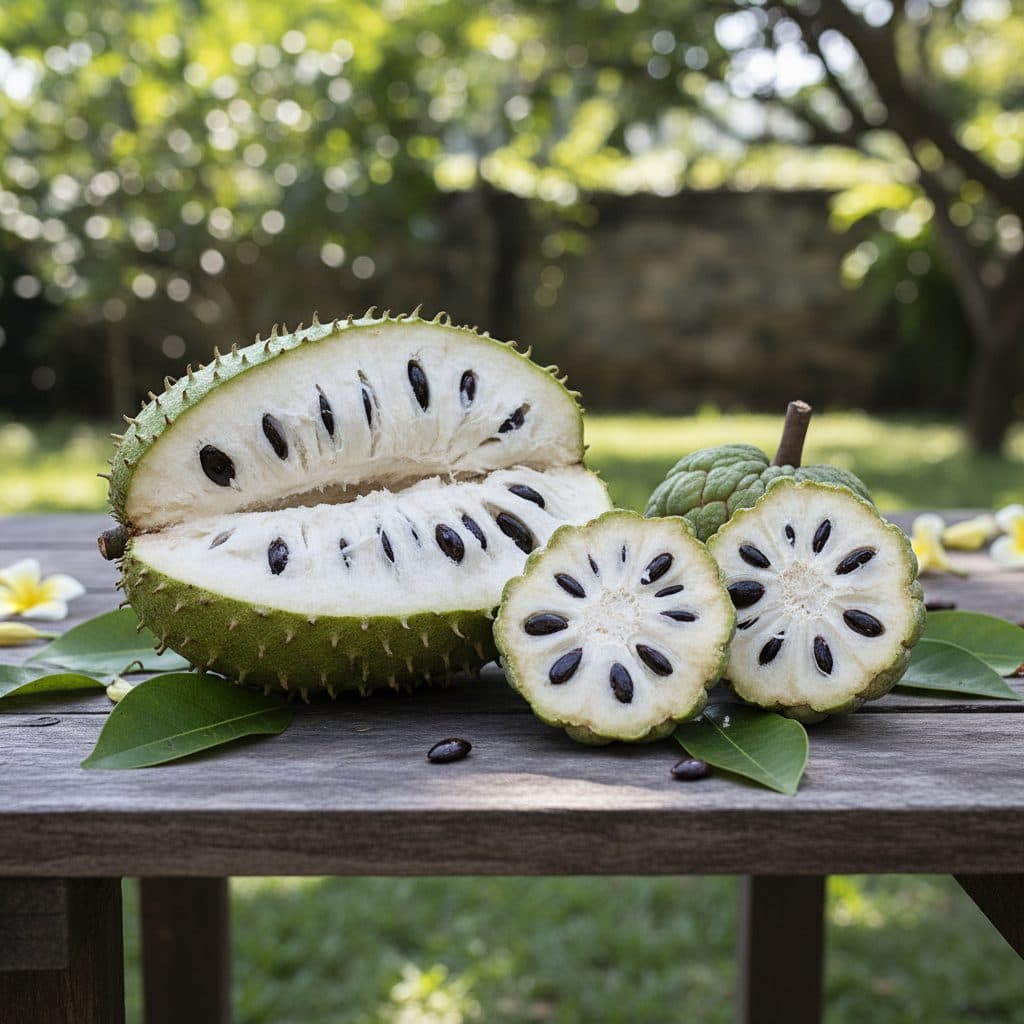
- Soursop (Annona muricata) and sugar apple (Annona squamosa) are close botanical relatives belonging to the custard apple family (Annonaceae).
- Soursop is the largest cultivated Annona fruit, weighing 1 to 4 kg (2.2 to 8.8 lbs) with a soft-spined green rind and a tart, refreshing, citrus-pineapple flavor.
- Sugar apple is compact, weighing 150 to 450 g (5.3 to 15.9 oz) with distinct knobby, segmented scales and an intensely sweet, granular vanilla-custard pulp.
- Soursop requires humid, frost-free tropical lowlands, whereas sugar apple demonstrates greater tolerance for seasonal drought and arid subtropical heat.
- Seeds of all Annona species contain toxic annonacin compounds and must never be chewed, crushed, or ingested.
Quick answer: The main difference between soursop and sugar apple is fruit size, rind texture, and flavor profile. Soursop is large, oblong, and covered in soft spines, containing fibrous, juicy white pulp with a tart, citrusy flavor. Sugar apple is small, round, and covered in knobby segments that pull apart when ripe, containing sweet, custardy white pulp.
The genus Annona, belonging to the ancient custard apple family (Annonaceae), contains some of the most luscious, aromatic fruits in the tropical and subtropical world. However, overlapping common names (such as sweetsop, custard apple, guanábana, and sitaphal) often cause confusion among fruit tree enthusiasts and food forest designers.
Understanding the distinctions in soursop vs sugar apple biology, fruit morphology, culinary applications, and climatic tolerances ensures you choose the right tree crop for your landscape and kitchen.
From the large, fibrous, thirst-quenching pulp of lowland soursop to the rich, sugary segments of drought-hardy sugar apple, each species fills a distinct ecological and culinary niche.
+-----------------------------------------------------------------+
|              ANNONA SPECIES COMPARISON MATRIX                   |
|                                                                 |
|   FEATURE          SOURSOP                  SUGAR APPLE         |
|   -------          -------                  -----------         |
|   Botanical Name   *Annona muricata*        *Annona squamosa*   |
|   Common Aliases   Guanábana, Graviola      Sweetsop, Sitaphal  |
|   Avg Weight       1-4 kg (2.2-8.8 lb)      0.15-0.45 kg        |
|   Exterior Rind    Dark green, soft spines  Pale green knobby   |
|   Flesh Texture    Fibrous, juicy, tart     Granular, creamy    |
|   Flavor Profile   Tangy citrus-pineapple   Intensely sweet     |
|   Cold Tolerance   Very low (<5°C / 41°F)   Low (<0°C / 32°F)   |
+-----------------------------------------------------------------+
What are the botanical origins and physical differences?
Both species originated in the tropical Americas (the Caribbean, Central America, and northern South America) and were distributed across global tropical belts centuries ago.
Fruit size and skin architecture
- Soursop (Annona muricata): Produces large, heart-shaped or oblong fruits typically measuring 15 to 35 cm (6 to 14 in) in length and weighing 1 to 4 kg (2.2 to 8.8 lbs), with exceptional specimens reaching 5 kg (11 lbs). The skin is leathery, dark green, and covered in soft, pliable, curved fleshy spines that do not prick the fingers.
- Sugar Apple (Annona squamosa): Produces compact, spherical or conical fruits measuring 6 to 10 cm (2.4 to 4.0 in) in diameter and weighing 150 to 450 g (5.3 to 15.9 oz). The exterior consists of thick, rounded, knobby segments (tubercles) coated in a pale blue-green or grey waxy bloom. As the fruit ripens, these segments spread apart, revealing the creamy white pulp beneath.
+-------------------------------------------------------------+
|              EXTERIOR MORPHOLOGY COMPARISON                 |
|                                                             |
|   SOURSOP (*A. muricata*):                                  |
|   [ Oblong / Heart-shaped ] + [ Soft, Curved Spines ]       |
|                                                             |
|   SUGAR APPLE (*A. squamosa*):                              |
|   [ Round / Conical ]       + [ Knobby Segmented Scales ]   |
+-------------------------------------------------------------+
To establish young tropical saplings with strong root crowns, follow our foundational steps on how to plant a fruit tree correctly.
How do their flavors and culinary uses compare?
The culinary roles of soursop and sugar apple reflect their differing moisture contents and sugar-to-acid balances.
+-----------------------------------------------------------------+
|              CULINARY CHARACTERISTICS                           |
|                                                                 |
|   TRAIT            SOURSOP                  SUGAR APPLE         |
|   -----            -------                  -----------         |
|   Pulp Consistency Soft, juicy, fibrous     Velvety, custardy   |
|   Sugar-Acid Ratio High acid, moderate sugarVery high sugar     |
|   Primary Use      Juices, smoothies, ices  Eaten fresh by hand |
|   Seed Separation  Embedded in fibrous pulp Separates easily    |
+-----------------------------------------------------------------+
1. Soursop: The refreshing citrus-cream staple
Soursop pulp is dense, fibrous, and juicy. Its flavor combines the acidity of lemon and lime with undertones of strawberry, pineapple, and banana.
- Because of its high liquid volume and fibrous structure, soursop is rarely eaten with a spoon directly out of hand.
- Instead, the pulp is pressed through a sieve to extract rich, creamy juice used worldwide for refreshing beverages, smoothies, sorbets, ice creams, and yogurts.
2. Sugar apple: The decadent dessert fruit
Sugar apple pulp is delicate, velvety, and divided into individual segments surrounding each dark seed.
- It contains almost zero acidity, offering an intensely sweet, floral flavor reminiscent of traditional egg custard or vanilla cream with a pleasant granular texture near the skin.
- Sugar apple is enjoyed fresh: ripe fruits are pulled apart by hand, and the sweet flesh is eaten directly, discarding the smooth black seeds.
Important toxicity notice
All members of the genus Annona contain high concentrations of annonacin, a neurotoxic acetogenin, inside their hard black seeds and leaf extracts. While the mature white fruit pulp is safe to consume, seeds must never be chewed, crushed, blended into smoothies, or swallowed. Always separate and discard seeds when processing pulp.
How do other common Annona relatives fit into the family?
Gardeners frequently encounter two other close relatives in the Annona genus:
1. Custard Apple / Bullock's Heart (Annona reticulata)
Often called ramphal in South Asia, this medium-sized, symmetrical heart-shaped fruit weighs 300 to 700 g (10.6 to 24.7 oz). The skin is smooth and patterned with faint, net-like polygonal reticulations, turning brownish-red or dull yellow when ripe. The flesh is sweet, creamy, and less aromatic than sugar apple.
2. Cherimoya (Annona cherimola)
Native to the high-elevation Andean valleys of Peru and Ecuador, cherimoya has a reputation as one of the best-tasting fruits in the world. It features smooth skin with overlapping fingerprint-like indentations. Unlike its lowland tropical cousins, cherimoya requires cool subtropical highland conditions and tolerates light frost down to -2°C (28°F), but fails to set fruit in hot, humid tropical lowlands.
+-----------------------------------------------------------------+
|              THE EXTENDED ANNONA FAMILY                         |
|                                                             |
|   SPECIES         COMMON NAME       CLIMATIC NICHE              |
|   -------         -----------       --------------              |
|   *A. muricata*   Soursop           Hot, humid tropical lowlands|
|   *A. squamosa*   Sugar Apple       Tropical lowlands & arid    |
|   *A. reticulata* Custard Apple     Warm tropical lowlands      |
|   *A. cherimola*  Cherimoya         Cool subtropical highlands  |
+-----------------------------------------------------------------+
What are the climate and growing requirements for each tree?
Understanding the climatic tolerances of each species ensures successful establishment in orchards and multi-layered food forests:
In tropical lowland climates:
- Soursop (Annona muricata) thrives under warm, humid conditions with annual rainfall between 1,000 and 2,500 mm (39 to 98 in). Trees suffer cold injury when temperatures drop below 5°C (41°F) and defoliate completely near freezing. Plant soursop in deep, rich, moisture-retentive loam protected from strong coastal winds.
In subtropical and semi-arid climates:
- Sugar Apple (Annona squamosa) is a smaller, more drought-hardy tree (reaching 3 to 6 m / 10 to 20 ft tall) that handles dry seasons by shedding its leaves. It thrives in well-drained rocky or sandy soils and tolerates summer heatwaves up to 42°C (108°F), provided roots receive occasional irrigation during flowering and fruit set.
Both species establish easily from seed or cleft grafting. For fast fruit tree establishment techniques, explore our guide on how to grow papaya at home, and compare multi-purpose tropical canopies in our guide to moringa vs neem. To design multi-tiered understory layers beneath fruit canopies, see our principles on what is a food forest.