secondary
Cherimoya
Annona cherimola
International hardiness
- USDA 9-11
- RHS H3
- AU: Warm temperate, Subtropical
Where it grows — regional guide
| Zones / rating | Regional notes |
|---|---|
USDA 9-11 | Flourishes along the coastal belt of Southern California (USDA 9b–10b); intolerant of searing desert heat and desiccating Santa Ana winds. |
| Zones / rating | Regional notes |
|---|---|
H3 (-5 to 1C) | Commercially cultivated along the Mediterranean Costa Tropical of southern Spain; protected valleys provide ideal frost-free, moderate temperatures. |
| Zones / rating | Regional notes |
|---|---|
Warm temperate, Subtropical | Suited to elevated, temperate-to-subtropical coastal hills in New South Wales and southern Queensland; avoid frost pockets and scorching inland heat. |
| Zones / rating | Regional notes |
|---|---|
USDA 9-11 (USDA scale) Canada uses its own zone system; Canadian zones run roughly one lower than USDA. | No region-specific data yet |
| Zones / rating | Regional notes |
|---|---|
No region-specific data yet | No region-specific data yet |
Cherimoya (Annona cherimola), frequently called custard apple or chirimoya, is a subtropical, semi-deciduous fruit tree in the Annonaceae family. Native to the cool, elevated inter-Andean valleys of Ecuador, Peru, and southern Colombia at altitudes between 1,400 and 2,200 m (4,600 and 7,200 ft), the species was famously described by author Mark Twain as "the most delicious fruit known to men". Celebrated for its luscious, velvety white flesh with a sublime tropical flavour resembling a blend of banana, pineapple, papaya, and vanilla cream, cherimoya is a luxury orchard fruit that commands high market esteem.
In agroecological homestead design, Annona cherimola acts as a valuable secondary sub-canopy tree. Adapted to mild, maritime microclimates, it thrives on sloping topography where cool air drains freely, preventing frost accumulation. Its large, velvety leaves catch morning dew and cast medium shade, sheltering lower-tier perennial companions like fig or pomegranate. Because natural insect pollinators are absent outside its native Andean habitat, successful cultivation requires an intimate partnership with the grower through deliberate hand pollination.
Growing cherimoya
Cherimoya occupies a unique climatic niche: it is a subtropical highland plant that demands mild, frost-free winters combined with cool, humid summers. It performs well in USDA Zones 9b through 11 and is rated RHS H3. Unlike its lowland tropical cousins, cherimoya requires a modest winter chilling period of 50 to 100 hours between 5 and 15 °C (41 and 59 °F) to break winter dormancy and promote uniform spring bud break. However, it cannot tolerate severe cold: temperatures below -2 °C (28 °F) kill young shoots, while -4 °C (25 °F) causes catastrophic limb mortality. Conversely, extreme summer heat exceeding 30 °C (86 °F), coupled with low humidity, desiccates stigmas, sterilises pollen, and triggers massive fruit drop.
Soil must be free-draining and aerated. Cherimoya thrives in sandy loams, gravelly decomposed granites, and medium alluvial silts with a pH between 6.5 and 7.5. It is acutely intolerant of poorly drained, heavy clay soils or standing water; root suffocation and crown rot (Phytophthora species) occur swiftly in waterlogged ground. Plantings on south- or west-facing slopes in maritime valleys provide the essential balance of warmth, solar interception, and rapid drainage.
Trees attain heights of 5 to 9 m (16 to 30 ft) with an open, spreading crown spanning 4 to 7 m (13 to 23 ft). While seedlings grow quickly, they vary unpredictably in fruit quality, yield, and flavour, taking four to six years to produce. Homesteaders should plant grafted or chip-budded cultivars (such as 'Fino de Jete', 'White', 'Pierce', or 'El Bumpo') worked onto seedling cherimoya rootstocks, which bear fruit within two to three years. In orchards, space trees at 6 by 6 m (20 by 20 ft) to allow access for manual pollination.
Hand pollination is standard practice to achieve commercial yields. Cherimoya flowers exhibit protogynous dichogamy: the flowers open as receptive females in the early afternoon, remain receptive through the evening, and shed pollen as males the following afternoon. In late afternoon, collect shedding pollen from male-phase flowers using a small container. The following afternoon, use a soft camel-hair artist's brush to transfer the pollen into newly opened female-phase flowers. Hand-pollinated flowers reliably set large, symmetrical, high-quality fruits, whereas unpollinated flowers produce sparse, stunted, deformed yields.
Harvest and uses
An established, hand-pollinated cherimoya tree yields 30 to 80 fruits annually, producing 15 to 40 kg (33 to 88 lb) of fruit. Individual fruits weigh between 250 and 800 g (0.55 and 1.76 lb), occasionally exceeding 1 kg (2.2 lb).
Harvesting takes place during winter and early spring. Fruits are picked when the skin colour lightens from dark green to a pale, yellowish-green, and the raised edges of the skin indentations soften slightly. Harvesters cut the stem with clippers, leaving a short stub attached to prevent fungal rot at the fruit base. Harvested fruit must be held at room temperature, softening to a custard-like consistency within five to eight days.
Cherimoya is predominantly enjoyed fresh as an exquisite dessert fruit. The ripe fruit is chilled, sliced in half lengthwise, and scooped out with a spoon, discarding the hard black seeds. The texture is exquisitely melting and creamy, evoking natural custard. The flesh can also be blended into gourmet milkshakes, fruit mousses, sorbets, and tarts.
The wood of Annona cherimola is soft, light, and brittle, holding minimal structural or timber value. The fallen leaves decompose into pleasant organic mulch that feeds topsoil biology.
Identifying cherimoya
Annona cherimola is distinguished by several characteristic botanical features:
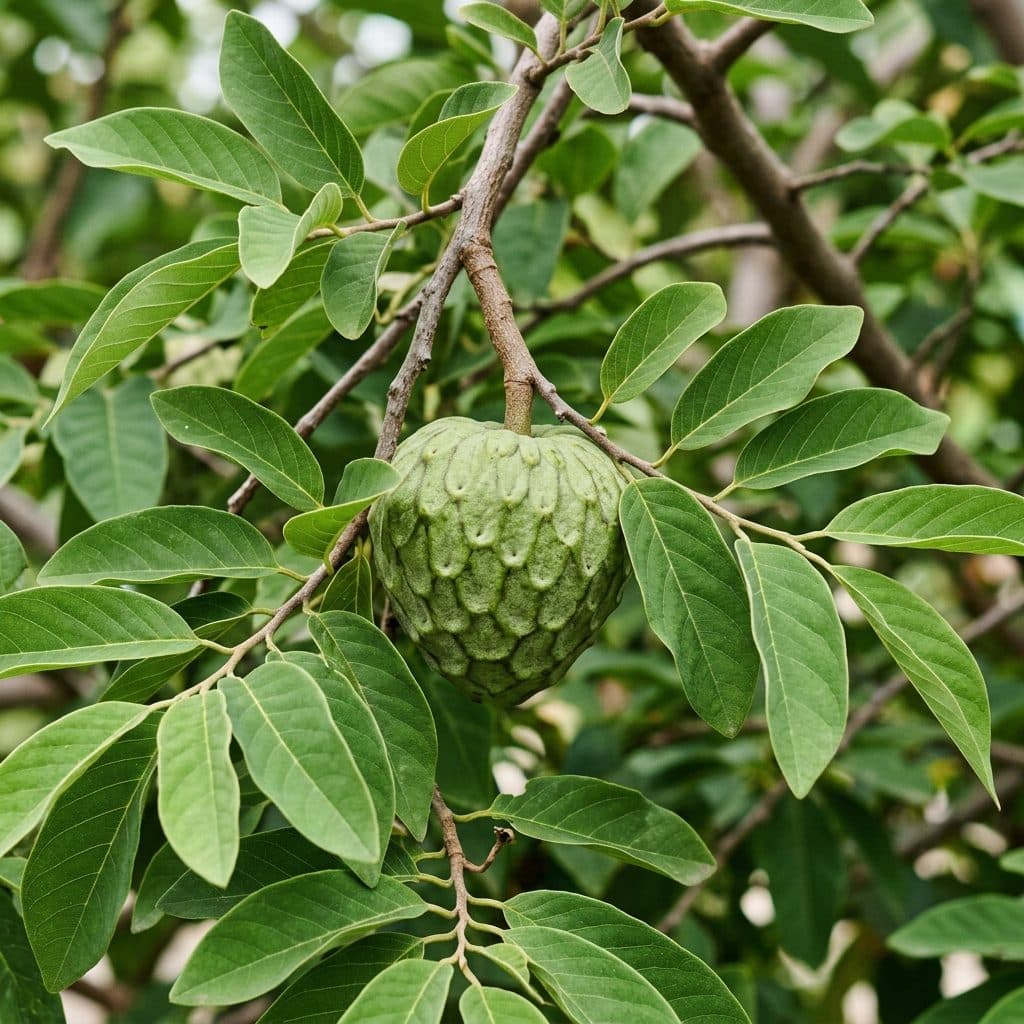
- Leaves: Alternate, simple, ovate to elliptic leaves measuring 10 to 20 cm (4 to 8 in) long and 5 to 10 cm (2 to 4 in) wide. The upper leaf surface is dull green with sunken veins, while the underside is densely clothed in soft, velvety, brownish-grey pubescence.
- Bark and branches: The trunk has smooth, greyish bark that develops shallow ridges on mature specimens. Young branchlets are covered with a fine, rust-coloured, velvety felt.
- Flowers: Fragrant, solitary or paired nodding flowers borne on short, downy stalks in leaf axils. Each flower measures 2.5 to 3.5 cm (1 to 1.4 in) long, consisting of three long, fleshy, oblong greenish-brown outer petals with a velvety exterior, and three tiny, scalelike inner petals enclosing a conical receptacle. Flowers emit a delicate fruity fragrance reminiscent of fermented melon.
- Fruit: Conical, heart-shaped, or rounded syncarps measuring 10 to 20 cm (4 to 8 in) long. The thin green skin is patterned with overlapping, U-shaped depressions resembling fingerprints pressed into clay or reptilian scales. The interior contains white, custardy pulp containing numerous hard, glossy, dark brown or black bean-shaped seeds.
Cherimoya is readily distinguished from soursop (Annona muricata), which has glossy hairless leaves and prickly fruits with soft curved spines, and from sugar apple (Annona squamosa), which has fruits composed of loosely adhering, easily separated rounded carpels.
Cautions
Growers intending to plant Annona cherimola should evaluate the following safety and management constraints:
- Toxicity of seeds: The hard, glossy seeds contain toxic acetogenins and isoquinoline alkaloids. If chewed, crushed, or ingested, seeds cause acute gastroenteritis, severe vomiting, abdominal pain, and ocular irritation. Always instruct consumers to spit out or spoon around whole seeds. Keep seeds away from small children and domestic pets.
- Hand pollination requirement: Without active manual hand pollination, fruit set is exceedingly low, resulting in few, small, asymmetrical fruits. Homesteaders unable to perform daily hand pollination during the late spring bloom will find yields disappointing.
- High post-harvest perishability: Once softened, ripe cherimoya fruit bruises instantly and begins fermenting within forty-eight hours at room temperature. Refrigeration below 10 °C (50 °F) causes chilling injury, skin blackening, and flavour loss.
- Intolerance to extreme heat and frost: Do not plant cherimoya in hot, arid inland desert valleys or locations subject to repeated winter freezes.
Sources
- Royal Botanic Gardens, Kew. Annona cherimola Mill. Plants of the World Online.
- USDA PLANTS Database. Annona cherimola Mill. - Cherimoya
- Purdue University Center for New Crops & Plant Products. Cherimoya: Annona cherimola
- Royal Horticultural Society. Annona cherimola
- Plants For A Future. Annona cherimola - Mill.