Key takeaways
- Longan (Dimocarpus longan) and lychee (Litchi chinensis) are closely related subtropical fruit trees belonging to the Soapberry family (Sapindaceae).
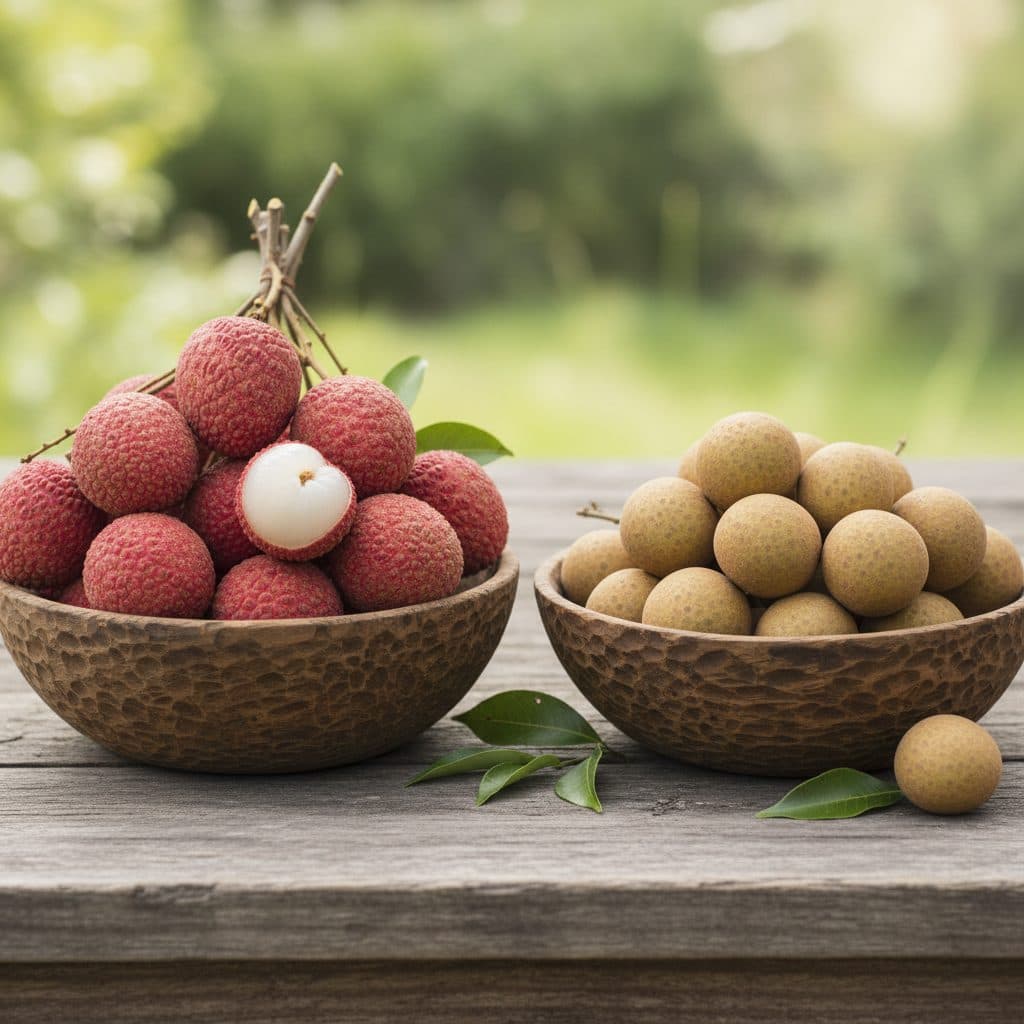
- Lychee has a bumpy, rough, reddish-pink rind with a floral, rose-scented, sweet-tart juicy flesh.
- Longan has a smooth, brittle, yellowish-tan shell with a musky, honey-sweet, cantaloupe-like flavour profile.
- Longan translates as "Dragon Eye" due to its jet-black central seed with a distinct white basal scar resembling an iris and pupil.
- Longan trees are slightly hardier against brief cold snaps (tolerating -3.3°C to -2.2°C / 26°F to 28°F) than lychee trees (which sustain leaf damage below -2.2°C to -1.1°C / 28°F to 30°F).
- Both species require deep, acidic, well-drained soils and benefit from a brief cool, dry winter resting period to trigger prolific floral bud emergence.
Quick answer: While both belong to the Sapindaceae family, lychee fruit has a rough, bright red bumpy shell and floral, sweet-tart juicy flesh, whereas longan fruit has a smooth tan brittle shell and musky, honey-sweet flesh. Longan trees are slightly more cold-tolerant and initiate flowers more readily than lychees in mild subtropical winters.
Across the subtropical and tropical growing belts of the world, including southern China, Southeast Asia, Florida, Hawaii, coastal Queensland, and northern India, the three best-known cultivated Sapindaceae fruits are lychee, longan, and rambutan.
When choosing between longan and lychee, growers need to account for differences in climate needs, seasonal bearing, and flavour. While both evergreen trees produce clusters of translucent aril fruits, their rind morphology, chilling requirements, and cold tolerances differ.
This guide compares the botanical characteristics, flavour profiles, cold hardiness limits, and orchard management practices for both species.
+-------------------------------------------------------------+
|              LONGAN VS LYCHEE BOTANICAL COMPARISON          |
|                                                             |
|   TRAIT               LYCHEE (*L. chinensis*)  LONGAN (*D. longan*) |
|   -----               --------------------  ------------------- |
|   Fruit Rind          Bumpy, bright red/pink Smooth, tan/brown  |
|   Flesh Flavour       Floral, rose-perfumed Musky, honey-sweet  |
|   Seed Appearance     Glossy dark brown oval Jet black with eye |
|   Cold Hardiness      -2.2°C to -1.1°C      -3.3°C to -2.2°C    |
|                       (28°F to 30°F)        (26°F to 28°F)      |
|   Winter Chill Need   Cool spell < 20°C     Shorter, milder     |
|                       for several weeks     cool spell          |
|   Bearing Stability   Both alternate-bear; longan flowers       |
|                       more readily in mild winters              |
+-------------------------------------------------------------+
What are the botanical differences between lychee and longan?
Both species are long-lived, dense evergreen canopy trees native to the subtropical and tropical forests of southern China and Southeast Asia.
+-------------------------------------------------------------+
|              FRUIT ANATOMY CROSS-SECTION                    |
|                                                             |
|         LYCHEE                           LONGAN             |
|                                                             |
|     /''' Bumpy Red '''\             /''' Smooth Tan '''\    |
|    |  [ Translucent ]  |           |  [ Translucent ]   |   |
|    |  [ Floral Aril ]  |           |  [ Honey Aril  ]   |   |
|    |   (Dark Oval)     |           |   (Black 'Eye')    |   |
|     ................/              ................../    |
+-------------------------------------------------------------+
1. Lychee (Litchi chinensis)
- Foliage and canopy: Reaches heights of 9 to 15 m (30 to 50 ft) with a rounded, dense umbrella-shaped canopy. Leaves are pinnate, glossy, and dark green with a leathery texture. New vegetative flushes emerge with an attractive bronze-pink hue.
- Fruit morphology: The fruit is round to heart-shaped, measuring 3 to 4 cm (1.2 to 1.6 in) in diameter. The outer pericarp (rind) is thin, tough, and densely covered with small pyramidal bumps. As it ripens, the shell transitions from green to brilliant strawberry red or crimson pink.
- The seed: Houses an elongated dark brown seed surrounded by a juicy, translucent-white fleshy aril that separates cleanly from the seed coat in superior cultivars.
- Pest and biosecurity caveat: Before buying, check whether lychee erinose mite (Aceria litchii) is present or under quarantine in your area; it deforms new flushes and flower panicles and is the main reason to source certified, inspected nursery stock rather than imported cuttings.
2. Longan (Dimocarpus longan)
- Foliage and canopy: Grows into a large, graceful evergreen tree reaching 9 to 12 m (30 to 40 ft) with slightly more open, sprawling branches.
- Fruit morphology: Fruits are spherical, measuring 1.5 to 2.5 cm (0.6 to 1.0 in) across, borne in heavy, pendulous clusters of 30 to 50 fruits. The outer shell is thin, leathery, smooth, and yellowish-tan to pale brown.
- The "Dragon Eye" name: The Chinese name longan (龍眼) translates directly as "dragon's eye." When the translucent flesh is peeled back, the gleaming jet-black seed with its circular white basal mark precisely resembles an animal iris and pupil.
How does rambutan fit into the family?
- Rambutan (Nephelium lappaceum): The third major Sapindaceae fruit. Unlike lychee and longan, rambutan is ultra-tropical and cannot tolerate any chill below 10°C (50°F). Its exterior is bright crimson-orange and covered with soft, pliable, hair-like spines (spinterns).
To evaluate these species alongside other Sun Belt choices, review our guide to subtropical fruit trees for home orchards.
How do the flavour profiles and culinary uses compare?
Although both fruits offer refreshing, gelatinous translucent flesh, their flavour profiles and aromatic compounds are distinct.
+-------------------------------------------------------------+
|              FLAVOUR & AROMATIC COMPARISON                  |
|                                                             |
|   ATTRIBUTE          LYCHEE FRUIT           LONGAN FRUIT    |
|   ---------          ------------           ------------    |
|   Juiciness          Very High (Brimming)   Moderate (Firm) |
|   Sweetness / Brix   16 to 20° Brix         18 to 22° Brix  |
|   Acidity            Balanced Tartness      Low / Sub-Acid  |
|   Aromatics          Geraniol / Rose Petal  Musky Honeycomb |
|   Drying Quality     Turns dark, fermented  Dries sweet (Guiyuan)
+-------------------------------------------------------------+- Lychee taste profile: Exceptionally juicy and bright. The flavour is a refined balance of natural sweetness and light citric acidity, dominated by strong floral aromatics reminiscent of rose petals and Muscat grapes.
- Longan taste profile: Denser, firmer aril texture with less free-flowing juice. The sweetness is intensely concentrated (often exceeding 20° Brix), with warm, earthy, musky undertones resembling cantaloupe melon, maple syrup, and honeycomb.
- Preservation and drying: Dried longan (Guiyuan in traditional Chinese herbalism) shrinks into sweet, chewy, dark brown morsels used extensively in tonics, herbal teas, and broths. Dried lychee (lychee nuts) develops a richer, fermented smoky note.
What are the climate, temperature, and chilling requirements?
Matching these trees to your local climate pattern determines whether they flower consistently each year.
+-------------------------------------------------------------+
|              TEMPERATURE & CHILLING THRESHOLDS              |
|                                                             |
|   METRIC                LYCHEE              LONGAN          |
|   ------                ------              ------          |
|   Mature Cold Limit     -2.2°C (28°F)       -3.3°C (26°F)   |
|   Young Tree Threshold  -0.5°C (31°F)       -1.6°C (29°F)   |
|   Floral Initiation     Cool spell < 20°C   Shorter, milder |
|                         for several weeks   cool spell      |
|   Drought Tolerance     Moderate            High (Deep root)|
+-------------------------------------------------------------+
Regional climate management
In cool temperate climates: Neither tree can survive prolonged winter ground freezes outdoors. They must be grown in high-clearance, heated glasshouses or large wheeled containers brought into protected winter atriums before temperatures dip below freezing.
In subtropical and tropical climates: Both species flourish in the ground:
- Floral initiation triggers: Lychees require four to six weeks of temperatures consistently below 20°C (68°F), ideally 10°C to 15°C (50°F to 59°F), alongside a dry spell that stops vegetative flushing during late autumn and early winter (November to January in the northern hemisphere, May to July in the southern hemisphere) to stop vegetative flushing and initiate flower buds.
- Longan adaptability: Longan initiates flowers at milder temperatures than lychee, so it blooms more often in warm subtropical winters where lychee skips years, but both species bear irregularly, and longan is notorious enough for alternate bearing that commercial growers in Southeast Asia force flowering with potassium chlorate.
To design canopy layers in multi-tier systems, consult what is a food forest and learn tree structural training in how to prune fruit trees.
What are the soil, watering, and nutrient requirements?
- Soil pH and drainage: Both species demand acidic to neutral, well-draining sandy loam or volcanic soils with a pH between 5.5 and 6.5. Saturated, waterlogged soils cause rapid root rot (Phytophthora). In heavy clay soils, construct 30 to 45 cm (12 to 18 in) raised planting mounds.
- Irrigation management: Provide deep, regular watering from late spring flowering through summer fruit sizing. Taper off irrigation during late autumn and early winter to induce water stress, which helps trigger flower spike emergence. For heatwave management, follow protecting fruit trees during a heatwave.
- Wind sensitivity: Both trees have brittle wood. High winds cause branch breakage and drop immature fruit. Plant on the sheltered lee side of tall evergreen windbreak belts.
+-------------------------------------------------------------+
|              POPULAR GLOBAL CULTIVARS                       |
|                                                             |
|   SPECIES    TOP CULTIVARS          HARVEST CHARACTERISTICS |
|   -------    -------------          ----------------------- |
|   Lychee     'Mauritius' / 'Kwai    Early, heavy producer;  |
|              May Pink' / 'Brewster' juicy floral red fruit  |
|   Longan     'Kohala' / 'Biew Kiew' High flesh-to-seed ratio|
|              / 'Diamond River'      sweet honeyed aril      |
+-------------------------------------------------------------+
Which tree should you choose for your garden?
- Choose lychee if: You live in a defined subtropical climate with cool, frost-free winters, prioritize intense floral juiciness, and have sheltered, wind-protected acidic soil.
- Choose longan if: You live in a warmer or slightly colder subtropical zone with variable winter chilling, prefer honey-sweet cantaloupe flavours, and want a resilient tree that flowers more readily in mild winters than lychee.
Understanding the botanical traits, chilling requirements, and growth habits of longan and lychee helps determine which species is better suited to your local growing conditions.