secondary
Star fruit carambola
kamrakh (کمرکھ)
Averrhoa carambola
- sindh coast
International hardiness
- USDA 10-12
- RHS H1b
- AU: Tropical, Subtropical
Where it grows — regional guide
| Zones / rating | Regional notes |
|---|---|
USDA 10-12 | Flourishes in South Florida and Hawaii (USDA 10–11); leaves defoliate at 0 °C (32 °F) and mature branches suffer lethal dieback below -2 °C (28 °F). |
| Zones / rating | Regional notes |
|---|---|
H1b (10 to 15C) | No region-specific data yet |
| Zones / rating | Regional notes |
|---|---|
Tropical, Subtropical | Thrives in tropical Queensland, the Northern Territory, and warm coastal New South Wales; shelter from salt spray and cold southern winds. |
| Zones / rating | Regional notes |
|---|---|
USDA 10-12 (USDA scale) Canada uses its own zone system; Canadian zones run roughly one lower than USDA. | No region-specific data yet |
| Zones / rating | Regional notes |
|---|---|
Sindh coast | Pakistan:Grown as kamrakh in frost-free orchards in coastal Sindh and southern Punjab; requires windbreak protection and consistent watering in dry summer months. India:Commonly planted across India for snacks, chutneys, and pickles; strictly contraindicated for individuals with kidney disease due to neurotoxic caramboxin. |
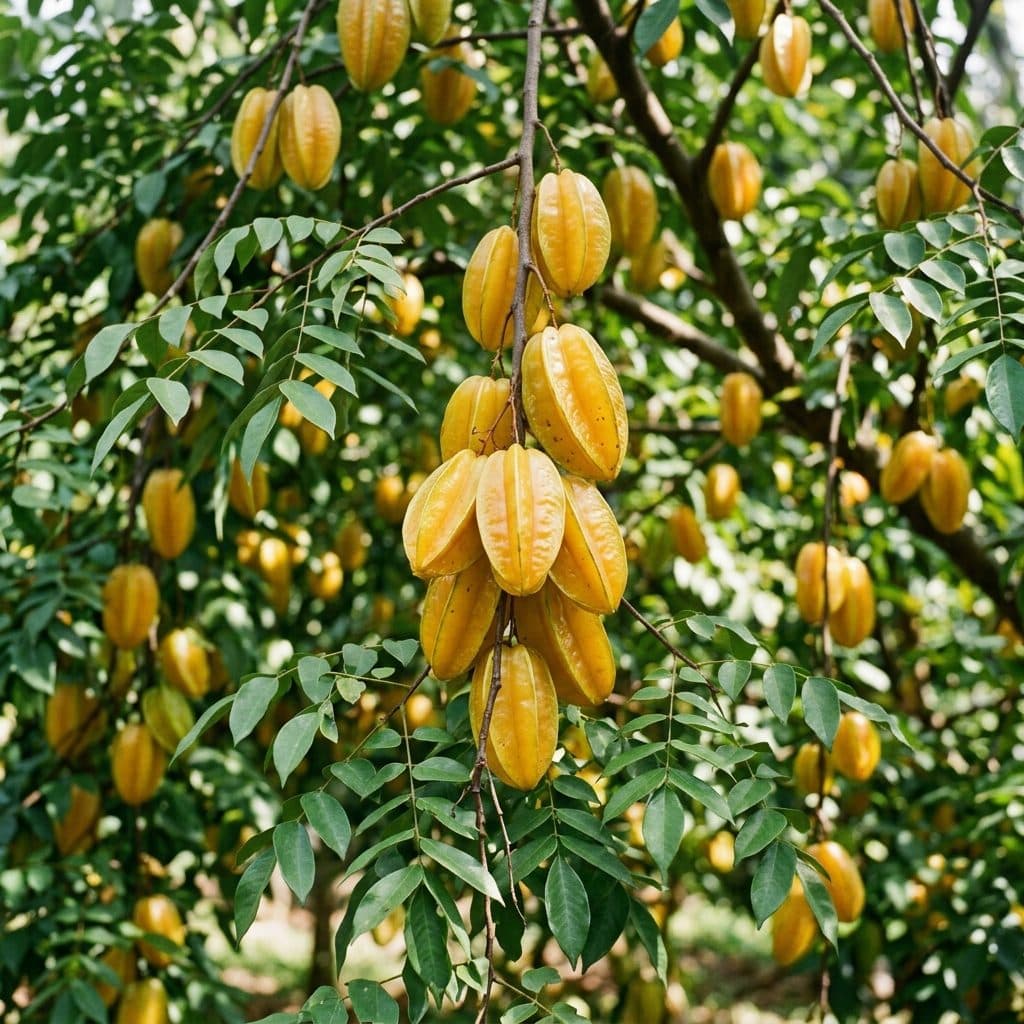
Star fruit carambola (Averrhoa carambola), known across South Asia as kamrakh, is a handsome, small to medium-sized evergreen fruit tree in the wood sorrel family (Oxalidaceae). Believed to have originated in tropical Southeast Asia, specifically the Malaysian archipelago and Indonesia, carambola has been cultivated for centuries throughout the humid tropics. Famous for its distinctive five-angled, translucent fruit that produces perfect five-pointed stars when sliced crosswise, the tree combines heavy ornamental appeal with prolific agricultural yields of crisp, thirst-quenching fruit.
In syntropic agroforestry and homestead permaculture, Averrhoa carambola is a productive secondary sub-canopy tree. Its compact stature and bushy, rounded canopy fit neatly into intermediate orchard layers beneath tall emergent nitrogen-fixing or timber trees. The delicate pinnate foliage displays sensitive nyctinastic movements, folding inward during twilight or under moisture stress to conserve water. When interplanted alongside compatible orchard trees such as guava or jamun, carambola provides multiple fruit flushes throughout the year, filling homestead baskets when other trees are dormant.
Growing star fruit carambola
Carambola prospers in warm tropical and frost-free subtropical climates, hardy across USDA Zones 10 through 12 and rated RHS H1b. The tree is sensitive to freezing conditions: young saplings are killed at -1 °C (30 °F), while mature trees suffer severe leaf loss and branch dieback at -2 °C (28 °F). Optimal vegetative development and fruit set occur between 22 and 32 °C (72 and 90 °F). It requires an annual rainfall of 1,500 to 2,500 mm (60 to 100 in) evenly distributed throughout the year, demanding supplemental drip irrigation during seasonal dry spells to prevent fruit drop.
Soil requirements demand good aeration and fertility. Star fruit thrives in deep, well-drained sandy loams, alluvial silts, or slightly acid clay loams rich in decomposed organic matter with a pH between 5.5 and 6.5. In calcareous soils with a pH above 7.0, trees develop severe micro-nutrient deficiencies, specifically iron, zinc, and manganese chlorosis, requiring chelated foliar sprays. The species is completely intolerant of flooded or waterlogged soils; stagnant water for more than twenty-four to forty-eight hours induces rapid root rot and tree death.
Wind protection is vital. Carambola wood is brittle and branches split easily under heavy gusty winds. Furthermore, strong winds cause severe fruit scarring and premature fruit drop. Plant trees in sheltered hollows or construct sturdy windbreak rows around the orchard perimeter. Full sun is necessary for maximum flowering and sugar accumulation, though light afternoon shade is tolerated in scorching subtropical desert margins.
Trees attain heights of 5 to 10 m (16 to 33 ft) with a rounded crown spreading 4 to 8 m (13 to 26 ft). While seed propagation is possible, seedlings vary greatly in fruit sweetness, yield, and acidity, taking four to six years to bear. Quality horticultural cultivars—categorised into sweet types (such as 'Arkin', 'Kary', 'Fwang Tung', and 'Sri Kembangan') and tart types—are propagated via veneer grafting, cleft grafting, or air layering onto seedling rootstocks. Grafted trees begin bearing fruit in just one to two years. Space orchard trees at 5 by 5 m (16 by 16 ft) to 6 by 6 m (20 by 20 ft).
Harvest and uses
Carambola is exceptionally prolific, often producing three to five blooming and fruiting flushes per year in frost-free regions. A healthy mature tree yields 50 to 150 kg (110 to 330 lb) of fruit annually.
Harvesting takes place when the fruit turns from pale green to translucent golden-yellow or deep orange-yellow, with only a trace of green along the outer ribs. Star fruit does not increase in sugar content after harvest, so it must be picked fully ripe for optimal sweetness. Harvesters clip fruits carefully by hand, as the crisp, waxy skin bruises easily.
The entire fruit is edible, including the thin, waxy skin and tiny, flat seeds. When sliced crosswise, each slice forms a star shape, making carambola popular for decorating salads, cocktails, and fruit platters. The flesh is crisp, juicy, and refreshing, with a sweet-tart flavour reminiscent of green apples, white grapes, and citrus. Tart cultivars contain higher concentrations of oxalic acid and are traditionally stewed with raw sugar, pickled in spiced brine, juiced into refreshing sour cordials, or cooked into chutneys.
The fine-grained, whitish wood turns reddish-brown with age. While used occasionally in local carpentry for light tools and craftwork, it is not durable in exterior settings. The flowers provide an abundant nectar source for honeybees and native solitary bees during multiple seasonal bloom cycles.
Identifying star fruit carambola
Averrhoa carambola is identified through several distinctive botanical characteristics:
- Leaves: Alternate, odd-pinnately compound leaves measuring 15 to 30 cm (6 to 12 in) long, bearing 5 to 11 ovate to ovate-lanceolate leaflets. Leaflets measure 3 to 8 cm (1.2 to 3.1 in) long, increasing in size toward the terminal leaflet. The leaflets are smooth, medium green above, and slightly glaucous beneath, folding downward in response to mechanical shock, darkness, or intense heat.
- Flowers: Small, fragrant, bell-shaped flowers measuring 6 to 10 mm (0.24 to 0.4 in) across, arranged in panicles in leaf axils or on bare older branches. The flowers have five rose-pink to lilac petals with dark violet centres.
- Fruit: Large, fleshy, star-shaped oblong berries measuring 7 to 15 cm (3 to 6 in) long and 5 to 9 cm (2 to 3.5 in) in diameter, featuring five (rarely six) prominent, sharp longitudinal ribs. The skin is thin, waxy, and translucent, turning from lime green to rich golden-yellow or apricot-orange upon ripening. The interior flesh is crisp, watery, translucent yellow, containing 2 to 12 small, flat, brown seeds.
It is distinguished from its close relative the bilimbi (Averrhoa bilimbi), which has cylindrical, unribbed green fruits borne directly in dense clusters on the main trunk and much more acidic, non-star-shaped flesh.
Cautions
Before cultivating or consuming Averrhoa carambola, several critical health and safety warnings must be observed:
- Severe neurotoxicity and nephrotoxicity in kidney disease: Star fruit contains high concentrations of soluble oxalic acid and a potent neurotoxin named caramboxin. In healthy individuals with normal renal function, caramboxin is rapidly cleared by the kidneys with no ill effect. However, in individuals with chronic kidney disease (CKD), reduced renal filtration, or kidney failure, caramboxin accumulates in the bloodstream and crosses the blood-brain barrier. Ingestion of even half a star fruit or a small glass of juice by a kidney patient induces intractable hiccups, severe vomiting, mental confusion, motor agitation, epileptic seizures, coma, and death. Star fruit must be strictly avoided by anyone with impaired renal function.
- Formation of kidney stones: Due to its high oxalate content, regular or heavy consumption of star fruit by individuals prone to calcium oxalate kidney stones significantly increases the risk of stone recurrence.
- Branch brittleness: The wood of Averrhoa carambola is brittle and subject to structural failure when heavy fruit clusters coincide with strong winds. Prune annually to maintain short, sturdy scaffold branches.
- Sensitivity to chilling: In marginal zones, winter temperatures near freezing cause complete defoliation, blossom drop, and root damage. Provide overhead frost blankets or plant exclusively against sheltered southern walls.
Sources
- Royal Botanic Gardens, Kew. Averrhoa carambola L. Plants of the World Online.
- USDA PLANTS Database. Averrhoa carambola L. - Carambola
- University of Florida IFAS Extension. Carambola Growing in the Florida Home Landscape
- Missouri Botanical Garden. Averrhoa carambola
- Plants For A Future. Averrhoa carambola - L.