climax
Longan tree
longan (لونگن)
Dimocarpus longan
- punjab plains
- sindh coast
International hardiness
- USDA 9-11
- RHS H2
- AU: Subtropical, Warm temperate
Where it grows — regional guide
| Zones / rating | Regional notes |
|---|---|
USDA 9-11 | Flourishes in South and Central Florida, Southern California, and Hawaii (USDA 9b–11); mature trees endure light frosts down to -3 °C (26 °F). |
| Zones / rating | Regional notes |
|---|---|
H2 (1 to 5C) | No region-specific data yet |
| Zones / rating | Regional notes |
|---|---|
Subtropical, Warm temperate | Established in subtropical Queensland and northern New South Wales; thinning heavy fruit clusters prevents branch breakage and alternate bearing. |
| Zones / rating | Regional notes |
|---|---|
USDA 9-11 (USDA scale) Canada uses its own zone system; Canadian zones run roughly one lower than USDA. | No region-specific data yet |
| Zones / rating | Regional notes |
|---|---|
Punjab plains, Sindh coast | Pakistan:Grown experimentally in frost-free areas of southern Sindh and lower Punjab; requires well-drained loamy soil and protection from extreme desert winds. India:Cultivated in parts of West Bengal and southern India; trees require a dry resting period in winter to initiate flowering panicles in spring. |
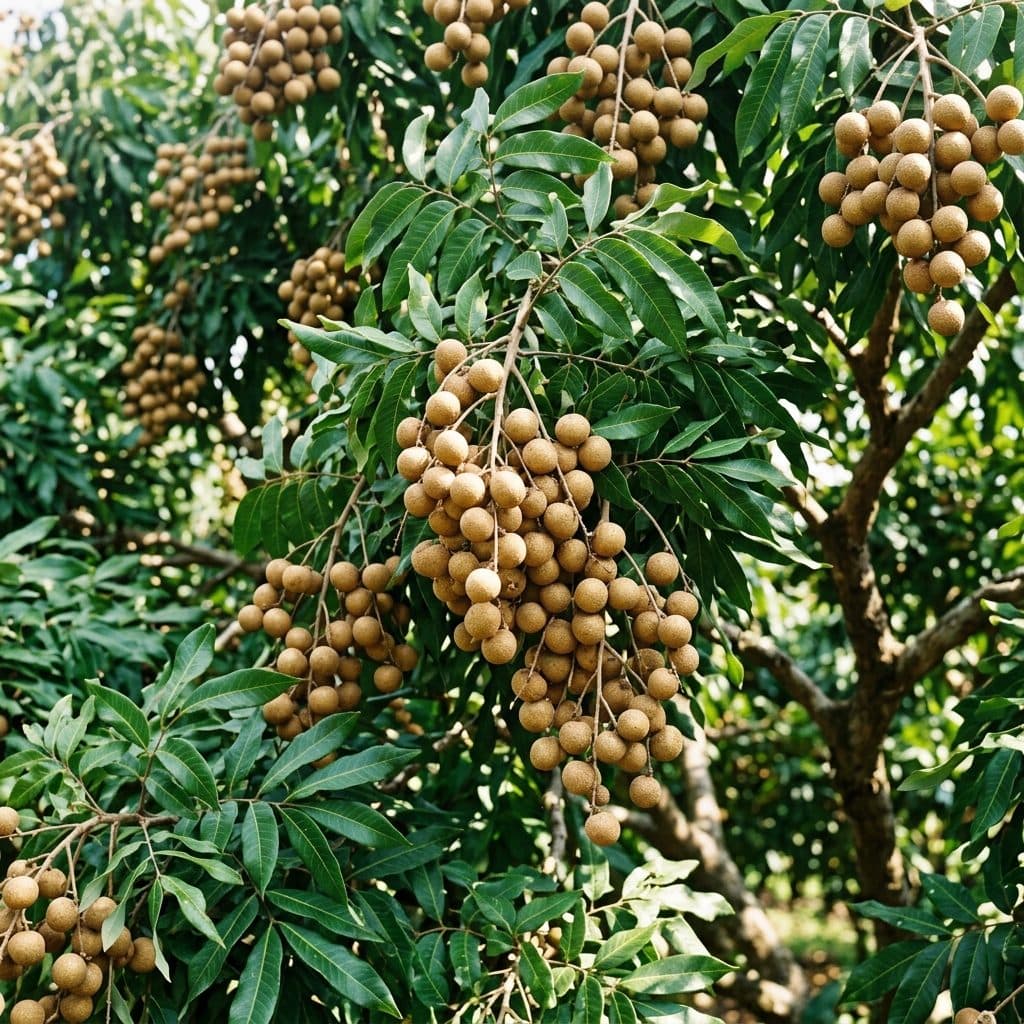
Longan tree (Dimocarpus longan), celebrated across East Asia as the "dragon eye" fruit (long yan), is a stately, medium to large subtropical evergreen fruit tree in the soapberry family (Sapindaceae). Native to the lowland forests and foothills of southern China, Myanmar, Thailand, and the Indochina peninsula, longan has been cultivated for centuries alongside its botanical sibling, the lychee. The heavy, drooping clusters of round, yellowish-tan fruits contain sweet, translucent arils around a glossy black seed, and longan is a reliable, high-yielding subtropical orchard species.
In agroecological permaculture and multi-tier homestead plantings, Dimocarpus longan occupies the long-lived climax canopy layer. More resilient to short-term drought, light frost, and wind exposure than the lychee, the longan forms a broad, umbrella-like crown of lustrous, leathery foliage that shelters understorey fruit trees like mango or jamun. Its root system associates with beneficial soil mycorrhizae, recycling nutrients efficiently in sandy and gravelly soils. With proper cluster thinning and structural pruning, an established longan tree provides sustained fruit abundance, shade, and microclimate moderation for generations.
Growing longan tree
Longan thrives in subtropical and warm tropical climates characterised by distinct seasons. It performs reliably across USDA Zones 9b through 11 and is rated RHS H2. The tree requires warm, humid summers for vegetative growth and fruit enlargement, followed by a cool, relatively dry winter dormancy period of two to three months with temperatures between 10 and 18 °C (50 and 64 °F) to stimulate flower panicle initiation. Mature longan trees display superior cold hardiness compared to lychees, tolerating brief winter freezes down to -3 °C (26 °F) with only minor leaf scorch. However, young saplings require protection below -1 °C (30 °F). Prolonged warm, humid winters suppress floral induction, causing trees to produce leafy flushes instead of flowers.
Soil adaptability is broad, provided drainage is flawless. Longan prospers in rich alluvial loams, deep sandy soils, and calcareous soils over limestone, thriving in a pH range from 5.5 to 7.5. It exhibits moderate tolerance to short-term drought once its taproot anchors into subsoil reserves, although regular irrigation during fruit swell is essential to maximise fruit size and prevent premature drop. The species cannot tolerate waterlogged soils or stagnant high water tables; standing water around the collar causes rapid feeder root decay and tree death. Full sun exposure is necessary to develop strong floral panicles and sweet fruit.
Trees reach mature heights of 9 to 14 m (30 to 45 ft) with a dense, spreading crown 8 to 12 m (26 to 40 ft) wide. Propagation from seed is easy, but seedlings take six to eight years to bear, show wide genetic variation, and produce inconsistent crops. Homesteaders should propagate elite named cultivars (such as 'Kohala', 'Biew Kiew', 'Diamond River', and 'Edau') via air layering (marcottage), cleft grafting, or veneer grafting onto seedling rootstocks. Air-layered trees begin bearing fruit within two to three years. In orchards, space trees at 7 by 7 m (23 by 23 ft) to 8 by 8 m (26 by 26 ft).
A vital management practice in longan cultivation is floral and fruit thinning. Left unmanaged, longan trees tend toward severe alternate bearing and limb breakage under the weight of hundreds of fruits. When fruitlets reach 5 to 10 mm (0.2 to 0.4 in) in diameter, clip out 30 to 50 percent of each hanging cluster using hand shears. Thinning redirects energy into the remaining fruits, significantly increasing individual fruit size, sugar content, and market value while preventing biennial yield collapse.
Harvest and uses
A mature, well-thinned longan tree yields 50 to 150 kg (110 to 330 lb) of fruit annually. The harvest window typically falls in midsummer to early autumn, ripening several weeks after the main lychee season.
Longans ripen in large, heavy clusters resembling bunches of grapes. Harvesting occurs when the leathery shell turns yellowish-tan or light brown, the fruit attains its full size (2 to 3 cm / 0.8 to 1.2 in diameter), and the pulp reaches peak sweetness. Unlike bananas, longans do not ripen after being severed from the tree; fruit picked green remains sour and bland. Harvesters cut entire panicles from the branches using pole pruners, handling bunches carefully to avoid crushing the shells.
The fruit is primarily consumed fresh. The brittle, leathery tan rind is cracked open between the fingers, popping out the glistening, translucent white aril. The pulp is firm, juicy, and intensely sweet, carrying a rich, musky-tropical flavour with subtle hints of honey and cantaloupe. In East Asia, immense quantities of longans are dehydrated in ovens or under the sun. Dried longan pulp, known in herbal markets as gui yuan, develops a dark amber colour, leathery texture, and rich date-like flavour, used in traditional tonic soups, herbal teas, and dessert porridges.
The heartwood of Dimocarpus longan is dense, hard, fine-grained, and reddish-brown. It polishes to a high sheen and is harvested for fine Asian cabinetry, decorative carving, and agricultural tool handles. Pruned branches provide high-heat firewood and premium charcoal. The flowering panicles provide an outstanding nectar source for honeybees, producing deep amber, richly flavoured honey.
Identifying longan tree
Dimocarpus longan is distinguished by several characteristic botanical features:
- Leaves: Alternate, pinnately compound leaves measuring 20 to 40 cm (8 to 16 in) long, bearing 4 to 10 pairs of leaflets. Leaflets are oblong-lanceolate, measuring 6 to 15 cm (2.4 to 6 in) long and 2.5 to 5 cm (1 to 2 in) wide, leathery, dark green and glossy above, with wavy margins and prominent light green veins on the paler underside.
- Bark and form: The trunk has rough, corky, greyish-brown bark that flakes into small irregular plates with age. The tree develops an expansive, rounded canopy with heavy, spreading branches.
- Flowers: Small, pale yellowish-brown flowers measuring 4 to 6 mm (0.16 to 0.24 in) across, arranged in large, branched, rust-coloured pubescent panicles at branch terminals. Flowers have five petals and emit a delicate, sweet fragrance.
- Fruit: Round to slightly oval berries measuring 2 to 3 cm (0.8 to 1.2 in) in diameter, borne in dense hanging clusters. The thin, leathery, brittle shell is light tan, yellowish-brown, or greyish-tan, with a slightly pebbled or rough surface. The interior contains a translucent, succulent white aril surrounding a single shiny, dark brown to jet-black seed with a circular white scar at its base, creating the striking appearance of a pupil within an eye (the "dragon eye").
Longan is easily distinguished from lychee (Litchi chinensis), which has rough, tuberculate, strawberry-red skin and floral-scented flesh, and from rambutan (Nephelium lappaceum), which has long, soft pliable spines on its bright crimson fruit.
Cautions
Growers intending to plant Dimocarpus longan should observe several agricultural and cultural precautions:
- Severe alternate bearing and branch breakage: Longan has a pronounced tendency toward biennial bearing. If a heavy fruit set is not aggressively thinned by 30 to 50 percent during early summer, the tree exhausts its carbohydrate reserves, resulting in zero floral initiation the following spring. Furthermore, the immense weight of unthinned fruit clusters frequently causes large scaffold branches to split and shatter.
- Floral induction failure in warm winters: The species requires a cool winter resting period 10 to 18 °C (50 to 64 °F) with low soil moisture to initiate flower buds. In continuously warm, humid tropical zones, trees produce lush foliage but fail to bloom. In commercial regions, growers occasionally use potassium chlorate soil drenches to induce flowering, but this chemical technique requires strict dosage control to avoid tree damage.
- Longan witches' broom disease: The species is susceptible to longan witches' broom (Longan witches' broom-associated virus), a devastating disease transmitted by the lychee stink bug (Tessaratoma papillosa) and eriophyid mites. Infected trees develop clustered, brush-like broom growths on shoots, distorted leaves, and sterile floral panicles that set no fruit. Prune out affected shoots and control insect vectors promptly.
- Predation by fruit bats and birds: Ripe longan clusters are heavily targeted by flying foxes, crows, and parrots. Install protective canopy exclusion netting over trees as fruits begin turning tan.
Sources
- Royal Botanic Gardens, Kew. Dimocarpus longan Lour. Plants of the World Online.
- USDA PLANTS Database. Dimocarpus longan Lour. - Longan
- University of Florida IFAS Extension. The Longan in Florida
- Missouri Botanical Garden. Dimocarpus longan
- Plants For A Future. Dimocarpus longan - Lour.