climax
Lychee tree
litchi (لیچی)
Litchi chinensis
- punjab plains
- pothohar
International hardiness
- USDA 9-11
- RHS H2
- AU: Subtropical, Warm temperate
Where it grows — regional guide
| Zones / rating | Regional notes |
|---|---|
USDA 9-11 | Flourishes in South and Central Florida and Hawaii (USDA 9b–11); requires well-drained, acidic to neutral soil and wind protection for tender new flushes. |
| Zones / rating | Regional notes |
|---|---|
H2 (1 to 5C) | No region-specific data yet |
| Zones / rating | Regional notes |
|---|---|
Subtropical, Warm temperate | A major horticultural crop across coastal Queensland and northern New South Wales; netting is essential to protect ripening fruit from flying foxes and birds. |
| Zones / rating | Regional notes |
|---|---|
USDA 9-11 (USDA scale) Canada uses its own zone system; Canadian zones run roughly one lower than USDA. | No region-specific data yet |
| Zones / rating | Regional notes |
|---|---|
Punjab plains, Pothohar | Pakistan:Cultivated successfully in the sub-Himalayan belt and northern Punjab valleys (Haripur, Khanpur, Lahore); needs protection from dry May-June heatwaves. India:Extensively grown in Bihar and West Bengal; irrigate regularly to avert skin cracking, and never consume unripe fruit on an empty stomach. |
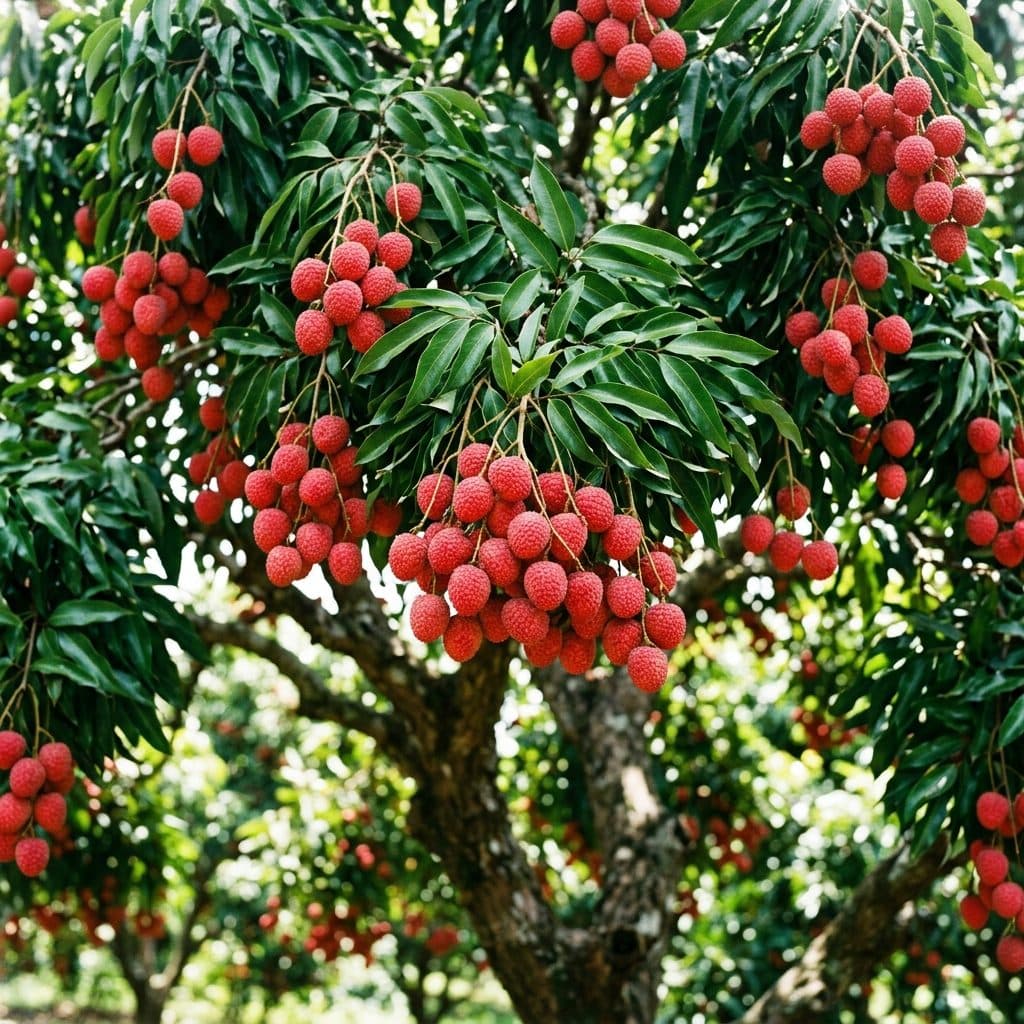
Lychee tree (Litchi chinensis), also spelled litchi or lichee, is a long-lived, handsome subtropical evergreen fruit tree in the soapberry family (Sapindaceae). Native to the warm, low-elevation river valleys of southern China (provinces of Guangdong and Fujian) and northern Vietnam, lychee has been cultivated for over two thousand years. Revered by emperors and poets, the tree produces dense pendant clusters of rough, bright strawberry-red fruits containing juicy, translucent, perfumed arils. With its compact, dark-green canopy and exquisite fruit quality, lychee is a prized subtropical fruit tree.
In syntropic agroforestry and homestead orchards, Litchi chinensis is a durable, long-lived climax canopy tree. Its dense, dome-shaped crown of leathery leaves provides exceptional windbreak protection for delicate understorey crops and prevents soil evaporation during scorching early summer days. It forms beneficial mycorrhizal partnerships that improve nutrient absorption in native soils. When planted in diverse guild arrangements alongside companion species such as mango or eureka lemon, lychee creates a resilient, high-value orchard framework that can remain productive for more than a century.
Growing lychee tree
Successful lychee cultivation demands a precise subtropical climate balance: warm, humid summers with abundant rainfall to support vegetative flushes and fruit development, followed by a cool, relatively dry winter period to trigger floral induction. The species is hardy across USDA Zones 9b through 11 and rated RHS H2. Mature trees tolerate brief cold snaps down to -2 °C (28 °F) without structural damage, but young saplings are killed at -1 °C (30 °F). To initiate flower panicles, mature trees require approximately 100 to 200 hours of winter temperatures between 5 and 15 °C (41 and 59 °F), accompanied by minimal nitrogen fertiliser and modest water stress. If winter temperatures remain overly warm and moist, trees produce vegetative leaf flushes instead of flower panicles, resulting in crop failure.
Soil requirements emphasise deep drainage, organic matter, and mild acidity. Lychee flourishes in deep alluvial sandy loams, silts, or riverbank clays with a pH between 5.5 and 6.5. In alkaline or calcareous soils with a pH above 7.0, trees suffer iron and zinc chlorosis, requiring regular foliar micronutrient applications. The tree is intolerant of poorly drained, waterlogged ground, which induces Phytophthora root rot. Constant, uniform soil moisture is essential from flower bloom through fruit maturation: irregular watering during fruit swell causes catastrophic fruit skin cracking. Full sun is mandatory for high floral initiation and red fruit colouration.
Lychee trees grow into compact, rounded specimens 10 to 15 m (33 to 50 ft) tall with a dense canopy spreading 8 to 12 m (26 to 40 ft). While seed propagation is botanically possible, seedling trees take ten to fifteen years to bear, rarely come true to type, and often yield small fruits with large seeds. The universal method of vegetative propagation is air layering (marcottage), performed in spring on mature branch wood 1 to 2 cm (0.4 to 0.8 in) in diameter. Air-layered cultivars (such as 'Mauritius', 'Brewster', 'Sweetheart', and 'Hak Ip') establish strong independent roots and begin bearing fruit in three to five years. In orchard settings, space trees at 7 by 7 m (23 by 23 ft) to 9 by 9 m (30 by 30 ft).
Harvest and uses
A mature, well-managed lychee tree produces 50 to 150 kg (110 to 330 lb) of fruit annually. Harvesting takes place in late spring to midsummer, depending on regional temperature accumulation.
Fruits mature in large hanging panicles containing 10 to 30 fruits each. The fruit is ready for harvest when the rough, bumpy pericarp turns bright strawberry-red or pinkish-red, the tubercles flatten slightly, and the flesh develops full sweetness. Lychees do not ripen further once picked; fruit harvested green remains sour and unpalatable. Harvesters snap or clip entire panicles with shears, as pulling individual fruits tears the skin at the stem attachment, causing rapid spoilage.
The fruit is predominantly enjoyed fresh. Peeling the crisp, leathery red skin reveals the succulent, glistening white aril surrounding a shiny dark brown seed. The flesh is sweet, aromatic, and refreshing, with delicate floral notes evoking rose water and muscat grapes. In Chinese and Asian cuisine, lychees are also canned in light syrup, frozen, or dehydrated with their skins intact. Dried lychees, known as "lychee nuts", develop a leathery, raisin-like texture and rich, smoky-sweet flavour that keeps for months.
The dense heartwood of Litchi chinensis is hard, fine-grained, heavy, and deep reddish-brown. It is prized in high-end Asian cabinetry and wood turning, though trees are seldom felled because of their perpetual fruit value. The blossoms provide an exceptional nectar flow for honeybees, producing clear, fragrant, high-grade monofloral honey.
Identifying lychee tree
Litchi chinensis can be identified with precision through several botanical characteristics:
- Leaves: Alternate, even-pinnately compound leaves 10 to 25 cm (4 to 10 in) long, bearing 2 to 4 pairs of opposite or sub-opposite leaflets. Leaflets are oblong-lanceolate to elliptic, measuring 6 to 15 cm (2.4 to 6 in) long and 2.5 to 4 cm (1 to 1.6 in) wide, with smooth margins and an acuminate tip. The upper surface is glossy dark green and leathery, while the underside is glaucous pale greyish-green. New vegetative flushes emerge with a striking copper-red to bronze hue before turning emerald green.
- Bark and form: The trunk is short, with smooth, greyish-brown bark that becomes rough and dark with age. The tree forms a dense, symmetrical, low-branching crown that casts heavy shade.
- Flowers: Small, apetalous, greenish-white to yellowish flowers borne in large, branched terminal panicles up to 30 cm (12 in) long. The flowers are functionally male, female, or hermaphroditic, emitting a light sweet aroma that attracts diverse pollinating insects.
- Fruit: Oval, heart-shaped, or sub-globose drupe-like berries measuring 3 to 4 cm (1.2 to 1.6 in) long and 3 cm (1.2 in) in diameter. The outer pericarp is thin, leathery, and covered with prominent, sharp-pointed tubercles, turning bright red, pinkish-red, or rose-purple when ripe. The interior contains a fleshy, translucent white aril enclosing an oval, smooth, dark brown seed. In prized "chicken tongue" cultivars, the seed is aborted and shrivelled, maximising edible pulp.
Lychee is distinguished from its close relative the longan (Dimocarpus longan), which has smooth or pebbled tan-brown fruit with a sweet musky flavour, and from the rambutan (Nephelium lappaceum), which has longer, soft hair-like spines on the fruit rind.
Cautions
Growers cultivating Litchi chinensis must manage several important health, pest, and cultural risks:
- Toxic hypoglycaemic syndrome from unripe fruit: Unripe lychee fruits contain high concentrations of the non-protein amino acids hypoglycin A and methylenecyclopropylglycine (MCPG). Ingesting quantities of unripe lychees on an empty stomach severely blocks fatty acid beta-oxidation and hepatic gluconeogenesis. In malnourished or fasting children, this triggers catastrophic nocturnal hypoglycaemia, metabolic acidosis, seizures, encephalopathy, and death (a condition documented medically in northern India and Southeast Asia). Only fully ripe lychees with sweet pulp should be consumed, and fruit should never be eaten as a meal replacement on an empty stomach.
- Fruit cracking from uneven watering: Lychee skin is fragile during late fruit development. If trees experience dry conditions followed by sudden heavy rain or irregular overhead watering, the pulp expands faster than the leathery skin, causing wide, jagged fruit splitting that invites fungal infection and insect pests. Maintain consistent drip irrigation during fruit swell.
- Erinose mite and bat damage: The lychee erinose mite (Aceria litchii) attacks young leaves and shoots, inducing thick, velvety, reddish-brown galls that stunt branch growth. Ripening fruit is heavily targeted by fruit bats (flying foxes) and birds, making orchard netting essential in regions like Australia.
- Chilling requirements: In regions lacking a distinct cool winter resting period, trees fail to flower consistently, producing lush foliage with zero fruit yield.
Sources
- Royal Botanic Gardens, Kew. Litchi chinensis Sonn. Plants of the World Online.
- USDA PLANTS Database. Litchi chinensis Sonn. - Lychee
- University of Florida IFAS Extension. The Lychee in Florida
- Missouri Botanical Garden. Litchi chinensis
- Plants For A Future. Litchi chinensis - Sonn.