climax
Avocado
magarmachh nashpati (مگرمچھ ناشپاتی)
Persea americana
- punjab plains
- pothohar
International hardiness
- USDA 9-11
- RHS H2
- AU: Subtropical, Warm temperate
Where it grows — regional guide
| Zones / rating | Regional notes |
|---|---|
USDA 9-11 | Extensively grown in California, Florida, and Hawaii; exclude horses and grazing pets from groves due to lethal persin cardiotoxicity. |
| Zones / rating | Regional notes |
|---|---|
H2 (1 to 5C) | Cultivated in frost-free coastal regions of southern Spain and the Mediterranean; plant on mounds or ridges to avert winter root saturation. |
| Zones / rating | Regional notes |
|---|---|
Subtropical, Warm temperate | A major commercial and homestead orchard crop across Australia; keep groves fenced from horses and livestock due to lethal persin toxicity. |
| Zones / rating | Regional notes |
|---|---|
USDA 9-11 (USDA scale) Canada uses its own zone system; Canadian zones run roughly one lower than USDA. | No region-specific data yet |
| Zones / rating | Regional notes |
|---|---|
Punjab plains, Pothohar | Pakistan:Grown in frost-free pockets of northern Punjab and the citrus belt; young saplings must be shielded from scorching summer sun and desiccating winds. |
Avocado (Persea americana), also known historically as alligator pear or aguacate, is an evergreen, subtropical to tropical fruit tree in the laurel family (Lauraceae). Native to the highland cloud forests and warm lowlands of Mexico and Central America, the species has been domesticated for over five thousand years. The fruit is nutrient-dense and buttery, loaded with heart-healthy monounsaturated fatty acids, dietary fibre, and fat-soluble vitamins, and avocado is among the most commercially valuable fruit trees in global agriculture.
In homestead food forests and syntropic orchards, Persea americana is an expansive upper-storey or sub-canopy climax tree. Its broad evergreen crown provides continuous leaf turnover, depositing thick layers of organic mulch that protect delicate feeder roots and nourish beneficial fungal mycelium. The tree associates closely with endomycorrhizae to extract phosphorus from native soils. When interplanted alongside compatible orchard species such as bitter orange, eureka lemon, or mango, avocado anchors the productive middle and upper layers of a subtropical food system, providing sustained dietary energy for generations.
Growing avocado
Avocado performance depends closely on climate and the selection of appropriate ecological races. The species is hardy across USDA Zones 9 through 11 and rated RHS H2. Horticultural cultivars belong to three primary botanical races: Mexican (Persea americana var. drymifolia), Guatemalan (P. americana var. guatemalensis), and West Indian (P. americana var. americana). Mexican cultivars display distinctive anise-scented leaves and superior cold tolerance, withstanding brief winter frosts down to -6 °C (21 °F). Guatemalan selections tolerate light frosts to -2 °C (28 °F), while West Indian cultivars are strictly tropical, suffering chilling injury below 4 °C (39 °F).
Soil drainage is the single most critical cultural requirement for Persea americana. The shallow, fibrous feeder root system requires high oxygen levels and cannot tolerate saturated soil. In heavy clays, compacted subsoils, or low-lying ground where water pools, trees rapidly succumb to Phytophthora root rot. Soils must be loose, highly porous, well-aerated sandy loams or decomposed granites with a pH between 5.5 and 7.0. On marginal sites, growers must construct raised mounds or ridges 50 to 90 cm (20 to 35 in) high to ensure positive drainage away from the root flare. Full sun is required for heavy flowering, but young trunks must be painted with diluted white latex paint to prevent devastating sunscald on green bark.
Avocado trees grow into spreading specimens 9 to 18 m (30 to 60 ft) tall with a canopy width of 6 to 12 m (20 to 40 ft). Seedlings take seven to ten years to bear fruit and rarely resemble their parent cultivar, making vegetative propagation essential. High-performing cultivars are propagated by whip-and-tongue or cleft grafting onto clonal, Phytophthora-tolerant rootstocks (such as 'Dusa' or 'Duke 7'). Grafted trees begin fruiting in three to four years.
Understanding avocado floral biology is vital for fruit production. The species exhibits synchronous protogynous dichogamy, dividing cultivars into Type A and Type B flowering patterns. Type A flowers open as receptive females on the morning of day one, close at midday, and reopen as pollen-shedding males on the afternoon of day two. Type B flowers open as females on the afternoon of day one and reopen as males the following morning. Planting at least one Type A cultivar (such as 'Hass' or 'Gwen') alongside a complementary Type B cultivar (such as 'Fuerte', 'Zutano', or 'Bacon') ensures overlapping male and female stages, substantially boosting fruit set. In orchard rows, space trees at 6 by 6 m (20 by 20 ft) to 8 by 8 m (26 by 26 ft).
Harvest and uses
Avocado is botanically unusual because the fruit never ripens while attached to the tree. The tree acts as a natural storage vault, holding mature fruit on branches for several months until harvested. Harvesting begins when the fruit achieves its mature size, the glossy skin dulls or changes colour, and the fruit stem develops a slight yellowish cast. Once clipped with hand shears, fruit softens within seven to fourteen days at room temperature.
The edible portion is the buttery, yellow-green mesocarp surrounding the single central seed. High in oleic acid, potassium, and vitamins E and K, the pulp is eaten fresh in salads, mashed into guacamole, spread over artisan bread, or blended into chilled culinary soups. In tropical regions, ripe avocado is also blended with chilled milk, lime, and raw cane sugar to create refreshing beverages.
The wood of Persea americana is soft, light, and pale reddish-brown. While brittle and prone to rotting quickly in outdoor exposure, it is used locally for rustic crates, small wood carving, and light homestead firewood when seasoned thoroughly. The fallen leaves break down into nutrient-dense leaf mould that recycles potassium back into the topsoil.
Identifying avocado
Persea americana is distinguished by several reliable botanical markers:
- Leaves: Alternate, spirally arranged, evergreen leathery leaves 10 to 25 cm (4 to 10 in) long and 4 to 10 cm (1.6 to 4 in) wide, elliptic to lanceolate. The upper surface is dark glossy green, while the underside is glaucous pale green with prominent pinnate venation. Crushed leaves of Mexican-race cultivars emit a powerful, sweet liquorice or anise fragrance, whereas Guatemalan and West Indian leaves lack this aroma.
- Bark and wood: The trunk possesses thick, greyish-brown bark with shallow vertical fissures. Young scaffold branches and twigs remain bright green and photosynthetic for several years before developing rough woody bark.
- Flowers: Small, pale yellow-green flowers measuring 5 to 8 mm (0.2 to 0.3 in) across, arranged in dense, pubescent terminal panicles. Each flower contains three sepals, three petals, and nine functional stamens with nectar glands at their base.
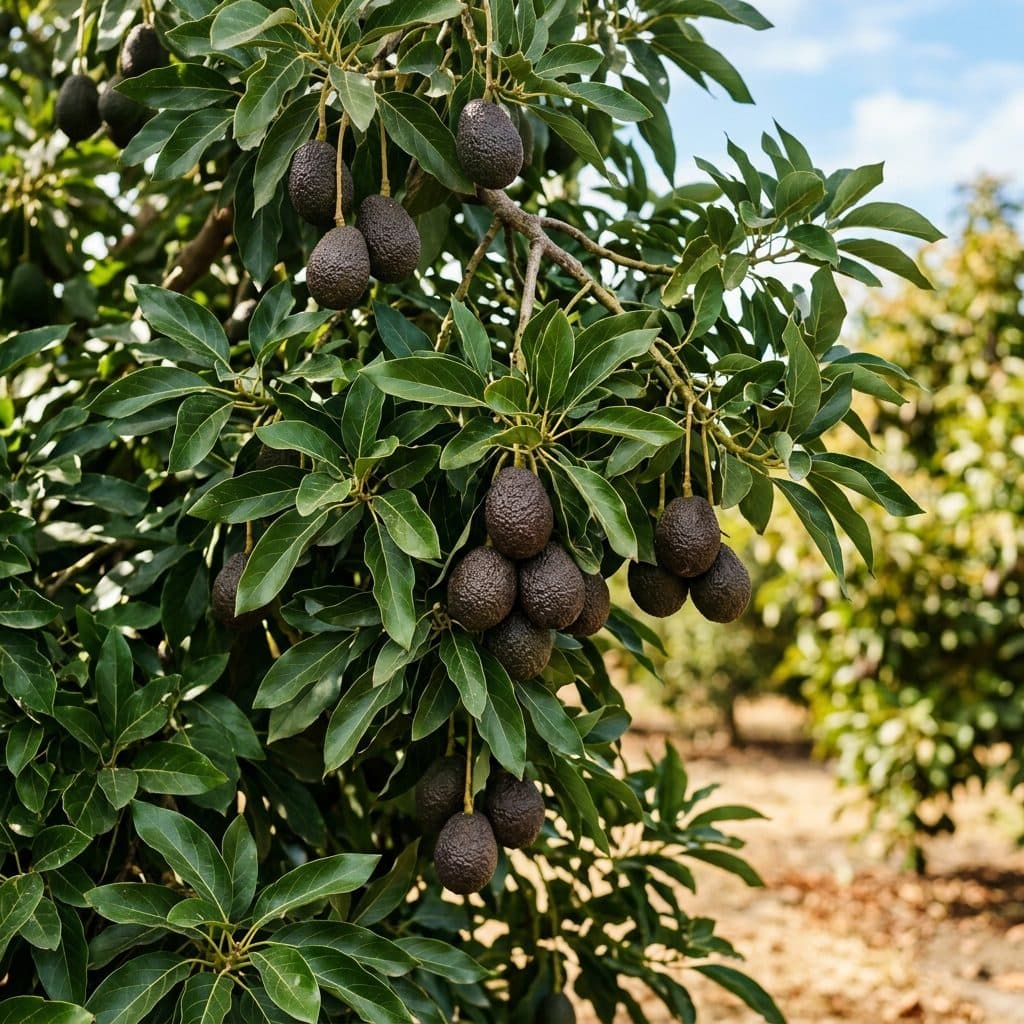
- Fruit: Large, fleshy single-seeded berries varying from round to pyriform (pear-shaped) or oval, measuring 7 to 20 cm (3 to 8 in) long and weighing 150 to 1,000 g (0.33 to 2.2 lb). The skin ranges from thin and smooth green (West Indian and Mexican) to thick, rough, pebbled, and purplish-black (Guatemalan and 'Hass'). The interior contains creamy pale-green flesh encasing a single large, conical or round seed.
The tree is distinguished from wild laurel species by its characteristic large pear-shaped fruit, fleshy mesocarp, and typical A/B floral behaviour.
Cautions
Before planting Persea americana, growers must account for severe veterinary and horticultural hazards:
- Severe toxicity to domestic animals: All parts of the avocado plant (specifically leaves, green bark, immature fruit skin, and the pit) contain the fungicidal fatty acid derivative persin. While completely harmless to human beings, persin is highly toxic and frequently lethal to domestic animals. Horses, cattle, goats, sheep, rabbits, guinea pigs, and pet birds (canaries, parrots) are exceptionally vulnerable. Ingestion causes acute myocardial necrosis, pulmonary oedema, fluid accumulation around the heart, respiratory distress, and death within twenty-four to forty-eight hours. Dogs and cats suffer severe gastroenteritis, vomiting, and pancreatitis. Never locate avocado trees inside livestock paddocks or where grazing animals can reach overhanging branches or fallen windfalls.
- Phytophthora root rot: The species is exceptionally vulnerable to Phytophthora cinnamomi, a devastating soil-borne water mould. Once infected in saturated soils, fine feeder roots blacken and rot away, leading to leaf chlorosis, canopy dieback, and eventual tree death. Preventative cultural controls (specifically planting on raised berms, applying heavy coarse gypsum, maintaining woodchip mulch, and selecting certified Phytophthora-tolerant clonal rootstocks) are mandatory.
- Extreme wind brittleness: Avocado branches have soft, brittle wood and heavy, dense foliage. Strong winds easily snap large limbs laden with fruit. Plant sturdy windbreak hedges on exposed orchard borders.
Sources
- Royal Botanic Gardens, Kew. Persea americana Mill. Plants of the World Online.
- USDA PLANTS Database. Persea americana Mill. - Avocado
- University of California Agriculture and Natural Resources. Avocado Information - UC ANR
- Missouri Botanical Garden. Persea americana
- Plants For A Future. Persea americana - Mill.