pioneer
Black alder
Alnus glutinosa
International hardiness
- USDA 3-7
- RHS H7
- AU: Cool temperate, Warm temperate
Where it grows — regional guide
| Zones / rating | Regional notes |
|---|---|
USDA 3-7 | Naturalised in wetland habitats across the Northeast, Upper Midwest, and Pacific Northwest; can invade native marshes and exclude native willows. |
| Zones / rating | Regional notes |
|---|---|
H7 (below -20C) | Native keystone species across RHS H7; ideal for damp woodlands and riverbanks, but source disease-free stock to prevent Phytophthora alni dieback. |
| Zones / rating | Regional notes |
|---|---|
Cool temperate, Warm temperate | No region-specific data yet |
| Zones / rating | Regional notes |
|---|---|
USDA 3-7 (USDA scale) Canada uses its own zone system; Canadian zones run roughly one lower than USDA. | Planted for wet-site windbreaks and land reclamation in Eastern Canada; monitor stream corridors to prevent encroachment on native alder thickets. |
| Zones / rating | Regional notes |
|---|---|
No region-specific data yet | No region-specific data yet |
Black alder (Alnus glutinosa), also known as common alder or European alder, is a medium-sized deciduous hardwood tree belonging to the birch family (Betulaceae). Native across Europe, western Asia, and northern Africa, the tree is an ecological keystone pioneer of riparian corridors, marshes, riverbanks, and wet woodland fens. Black alder is valued for its affinity for saturated, low-oxygen soils, its actinorhizal nitrogen-fixing symbioses, and its rot-proof timber under water, making it a key species for wet-ground permaculture and ecological land restoration.
The ecological role of Alnus glutinosa is defined by its ability to thrive where other broadleaf hardwoods suffocate and drown. In waterlogged soils, it develops specialised adventitious roots and porous surface bark lenticels that allow oxygen diffusion into root tissues. Its roots associate with actinorhizal filamentous bacteria (Frankia alni), forming heavy nodules that convert atmospheric nitrogen into bioavailable soil nutrients at rates of 100 to 200 kg per hectare annually, enriching wet sites alongside hardy moisture lovers like grey mangrove in coastal zones or west himalayan fir in upland catchments. For homesteaders, planting black alder provides high-velocity windbreaks and fast-growing coppice firewood on swampy ground while stabilising fragile riverbanks against flood scour.
Growing black alder
Black alder is an ultra-hardy, cold-tolerant tree adapted to temperate and boreal environments, fully winter-hardy in USDA Zones 3 to 7/8 and rated RHS H7. Established specimens survive severe winter minimums down to -35 °C (-31 °F). The species requires cool to temperate summers and regular moisture, languishing in hot, arid subtropical regions.
Soil moisture dictates the species' success. Black alder is uniquely adapted to heavy clays, wet alluvial silt, waterlogged peat bogs, and riverbanks subject to seasonal flooding and standing water. It thrives across soil pH levels ranging from strongly acidic (pH 4.5) to neutral and mildly alkaline (pH 7.5). However, it possesses very low tolerance for dry, sandy upland soils with deep water tables: in dry soils without accessible groundwater, growth stalls and trees suffer severe crown dieback.
Full sun to light partial shade is required. As an early-successional pioneer, black alder colonises bare, flood-scoured silt and wet gravel banks rapidly. In full sun, juvenile trees grow with extraordinary speed, adding 1 to 1.5 m (3.3 to 5 ft) of height annually during their first ten years, reaching a mature height of 15 to 25 m (50 to 80 ft) with a narrow crown and a trunk diameter of 40 to 60 cm (16 to 24 in).
Propagation is accomplished by seed or dormant hardwood cuttings. Seeds mature in autumn within woody, cone-like structures and are naturally dispersed by wind and water. Because nutlets possess narrow, air-filled lateral wings, they float on water for weeks without losing viability. For nursery propagation, sow fresh seeds in moist seedbeds in autumn or provide two months of cold stratification before spring sowing. Seeds germinate readily on moist mineral soil exposed to light.
In wet windbreaks, space trees 1.5 to 2.5 m (5 to 8 ft) apart. The species responds exceptionally well to rotational coppicing. Cut down to a low stump during winter dormancy on a seven- to twelve-year cycle, a single stool produces straight, vigorous poles that regenerate a dense canopy in two seasons.
Harvest and uses
Black alder possesses a fascinating and diverse range of utilitarian applications:
- Rot-proof underwater timber: When freshly cut, black alder wood is soft, light, straight-grained, and pale yellow-white, rapidly oxidising upon exposure to air to a distinctive bright reddish-orange. While the wood decays rapidly if exposed to alternating damp and dry conditions, it exhibits supreme durability when continuously submerged under water. It hardens over time under water and resists rot for centuries. Black alder timber famously formed the underwater foundation pilings for Venice and the historical docks of Amsterdam. In modern carpentry, the timber is prized for electric guitar bodies (celebrated for balanced acoustic resonance), cabinet interiors, turnery, and wooden clogs.
- High-yield coppice firewood and charcoal: Managed coppice stools yield heavy harvests of uniform firewood poles. The wood splits effortlessly, seasons quickly (often drying in four to six months), and burns with an intense, clean flame without spitting sparks. Alder charcoal was historically the premier fuel for gunpowder manufacture and remains prized for metal smelting and meat smoking.
- Riparian bank stabilisation and windbreaks: The fibrous root network binds saturated riverbank soil, physically preventing bank collapse during flood events. Sited around wet orchard perimeters, black alder forms dense shelterbelts that lift cold winds while fertilising neighbouring crops with fixed nitrogen via leaf litter and root turnover.
- Wildlife support: The small woody cones persist on bare winter branches, opening in cold weather to release seeds that provide an essential winter food source for native songbirds, particularly siskins, redpolls, and goldfinches.
Identifying black alder
Alnus glutinosa is definitively identified by the following botanical features:
- Habit: A medium-sized deciduous tree reaching 15 to 25 m (50 to 80 ft) in height with a conical crown when young, becoming irregular and rounded with age. The bark is dark greyish-brown, smooth and green-tinged on young trunks, developing deep rectangular fissures and scaly plates with age.
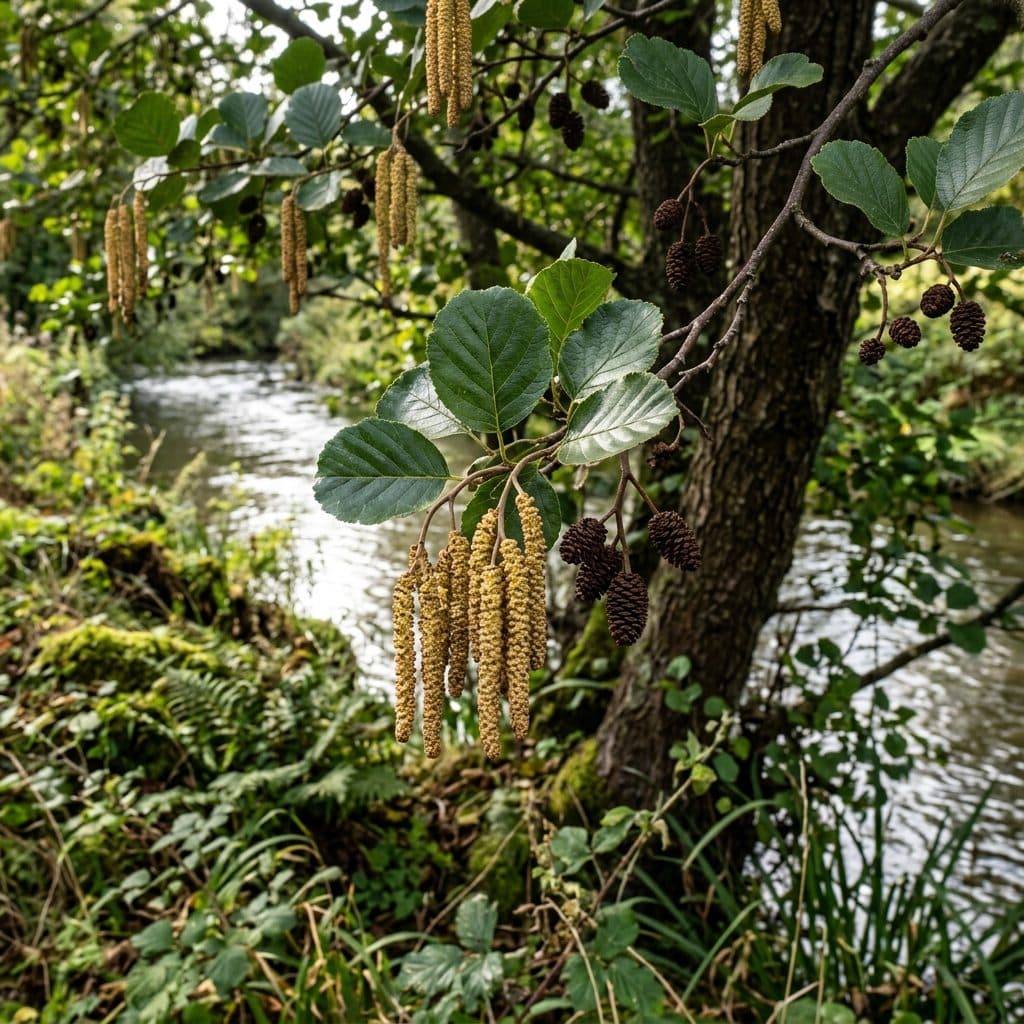
- Leaves: Alternate, simple, obovate to rounded leaves 4 to 10 cm (1.5 to 4 in) long and broad, supported by petioles 1 to 3 cm (0.4 to 1.2 in) long. The leaf apex is highly diagnostic: it is broadly notched or truncate (emarginate), never pointed. Leaf margins are wavy and coarsely doubly-serrate. The upper surface is glossy dark green, and young emerging leaves are distinctly clammy or glutinous to the touch.
- Flowers: Monoecious; flowers appear in late winter (February to April) before leaves emerge. Male flowers form long, pendulous catkins 5 to 10 cm (2 to 4 in) long that turn from purple-brown to golden-yellow as they release pollen. Female flowers form small, upright, reddish-brown catkins 3 to 5 mm long.
- Fruit: Female catkins mature in autumn into persistent, woody, oval cone-like structures measuring 1 to 2 cm (0.4 to 0.8 in) long. The woody scales open to release small, reddish-brown nutlets, and black cones remain attached to winter twigs long after leaf drop.
The species is distinguished from grey alder (Alnus incana), which features pointed leaf tips, smooth grey bark, and unnotched leaves, and from hazel (*Corylus avellana*), which has pointed leaves and edible nuts.
Cautions
Land managers cultivating Alnus glutinosa should observe several ecological and health caveats:
- Invasiveness in North American wetlands: Outside its native Eurasian range, Alnus glutinosa has naturalised aggressively in wetland ecosystems across the Northeast, Upper Midwest, and Pacific Northwest of North America. Its water-buoyant seeds travel long distances downstream, colonising open marshes and lake shores. Its rapid growth and heavy shade outcompete native riparian shrubs like speckled alder (Alnus incana subsp. rugosa) and native willows (Salix species), altering natural wetland hydrology. Check local watershed guidelines before planting black alder in non-native watersheds.
- Vulnerability to Alder dieback (Phytophthora alni): In Europe and parts of North America, black alder is vulnerable to alder dieback caused by the virulent water-borne oomycete pathogen Phytophthora alni. Infected trees display sparse, chlorotic foliage, dead crown branches, and bleeding black cankers on the lower trunk, frequently resulting in tree death. Avoid sourcing planting stock from nurseries located near infected river basins.
- Severe early-spring pollen allergen: In late winter and early spring, mature male catkins shed vast clouds of wind-borne pollen. Alder pollen is a potent allergen, causing acute seasonal allergic rhinitis (hay fever) and triggering asthma in sensitive individuals. Avoid planting extensive stands in close proximity to residential homes.
- Intolerance of dry uplands: Do not plant black alder in well-drained, dry sandy upland soils where lack of accessible moisture leads to chronic stunting and early death.
Sources
- Royal Botanic Gardens, Kew. Alnus glutinosa (L.) Gaertn. Plants of the World Online.
- Plants For A Future. Alnus glutinosa - (L.) Gaertn.
- Missouri Botanical Garden. Alnus glutinosa
- USDA Forest Service. Alnus glutinosa (L.) Gaertn. - European Alder
- Woodland Trust. Alder (Alnus glutinosa)