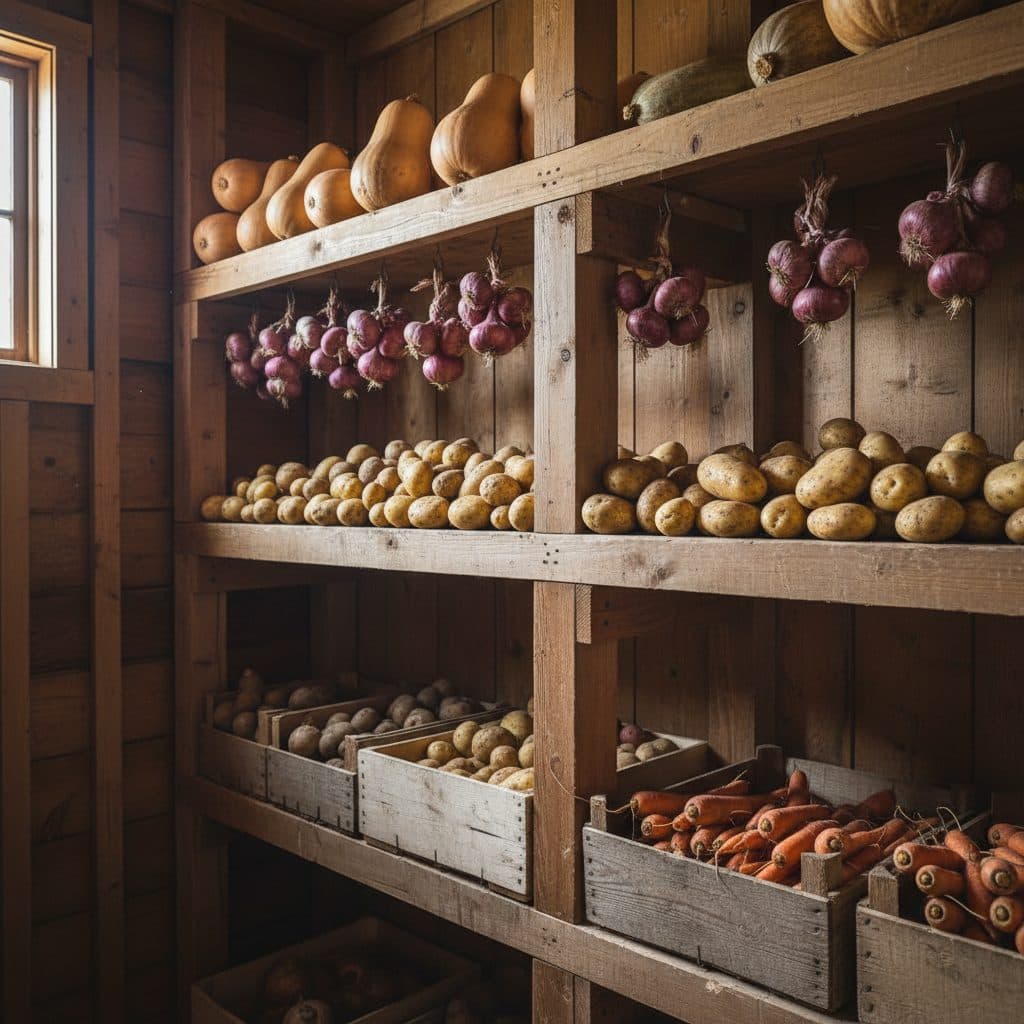
Key takeaways
- Plan storage crops at spring sowing time by selecting specific long-keeping cultivars with thick skins and dense dry matter.
- Group crops into two distinct storage microclimates: cold and moist (root vegetables) versus cool and dry (winter squash, alliums).
- Cure winter squash, pumpkins, onions, and garlic in warm, dry areas to harden outer skins and seal stem scars.
- Pack root crops like carrots, beets, and parsnips into damp sand or sawdust to maintain 90% to 95% humidity.
- Keep ethylene-emitting fruits separated from root vegetables to prevent premature sprouting and bitterness.
Quick answer: The best vegetables for winter storage include long-keeping winter squash (Butternut, Waltham), storage onions (Copra, Patterson), late potatoes (Kennebec, Russet Burbank), and root crops packed in damp sand (carrots, beets, parsnips). These hardy crops keep for four to eight months in unheated cold rooms without electricity.
Achieving year-round food self-reliance in Canada requires looking beyond the summer abundance and planning for the long winter months ahead. While canning, freezing, and dehydrating provide valuable food preservation channels, nothing compares to the efficiency and nutritional value of whole, raw vegetables held in dormant winter storage.
Choosing the best vegetables for winter storage begins at seed-buying time in late winter. Not all carrots, cabbages, or onions are created equal; fresh summer salad varieties contain delicate cell structures and high moisture content that break down within weeks, whereas dedicated storage cultivars develop dense starch reserves, low water content, and thick protective rinds that resist fungal decay.
Understand each crop family's storage requirements, follow proper curing protocols, and keep separate microclimates in your cold room or root cellar, and you can enjoy crisp, home-grown produce from October through to May.
The two critical winter storage microclimates
Different vegetable groups possess incompatible temperature and humidity requirements. Storing high-moisture root crops alongside dry onions in the same enclosed space will cause both to rot prematurely.
+-----------------------------------------------------------------------------------------------+
|                                  WINTER STORAGE CLIMATE ZONES                                 |
|                                                                                               |
|   ZONE A: COLD & MOIST (0°C to 4°C / 32°F-39°F | 90% to 95% Humidity)                         |
|   --> Crops: Carrots, Beets, Parsnips, Rutabagas, Winter Cabbage                              |
|   --> Storage: Root cellar, cold room, packed in damp sand/sawdust                            |
|                                                                                               |
|   POTATOES: 4°C to 10°C (7°C to 10°C if they will be fried or roasted) | 90% to 95% humidity   |
|   | total darkness                                                                            |
|   --> Storage: Dark wooden bins or crates in cold room/cellar                                 |
|                                                                                               |
|   ZONE B: COOL & DRY (10°C to 15°C / 50°F-59°F | 50% to 65% Humidity)                          |
|   --> Crops: Winter Squash (Butternut, Hubbards), Pumpkins                                    |
|   --> Storage: Unheated basement shelf, cool closet, spare bedroom                             |
|                                                                                               |
|   SWEET POTATOES: cure 5 to 7 days at 29°C to 32°C and 85% to 90% humidity, then store at     |
|   13°C to 16°C and 85% humidity. Never below 12°C.                                            |
|                                                                                               |
|   ZONE C: COLD & DRY (0°C to 4°C / 32°F-39°F | 60% to 70% Humidity)                           |
|   --> Crops: Cured Onions, Garlic, Shallots                                                   |
|   --> Storage: Slatted wooden crates, mesh hanging bags in dry cold room                       |
+-----------------------------------------------------------------------------------------------+
For practical guidance on constructing and maintaining zero-electricity storage spaces, explore our guide on root cellaring no power storage.
Top long-keeping vegetables and proven storage cultivars
Selecting the right genetic varieties ensures your harvest remains firm, sweet, and mold-free over long winter months.
+-------------------+---------------------------+-----------------------------------------------+-------------------------------------------+
| Vegetable Crop    | Recommended Varieties     | Storage Life                                  | Ideal Storage Medium                      |
+-------------------+---------------------------+-----------------------------------------------+-------------------------------------------+
| Winter Squash     | Waltham Butternut, Blue   | Waltham Butternut 2-4 months; Sweet Dumpling  | Open slatted shelves; 10°C-15°C; 60% RH   |
|                   | Hubbard, Sweet Dumpling   | ~3 months; Blue Hubbard 5-6 months            |                                           |
| Storage Onions    | Patterson, Copra, Stuttg. | 6 to 9 months                                 | Hanging mesh bags; 0°C-4°C; dry air       |
| Maincrop Potatoes | Kennebec, Russet Burbank, | 5 to 7 months                                 | Dark wooden bins; 4°C-10°C; 90% RH        |
|                   | Yukon Gold, German Butter |                                               |                                           |
| Winter Carrots    | Bolero, Napoli, Danvers   | 5 to 7 months                                 | Damp sand or peat moss; 0°C-2°C; 95% RH   |
| Parsnips & Beets  | Hollow Crown, Detroit Dark| 6 to 8 months                                 | Damp sand; sweetest after frost in ground |
| Storage Cabbage   | Storage No. 4, Lennox     | 4 to 6 months                                 | Wrapped in paper on slatted shelves; 0°C  |
| Rutabagas/Turnips | Laurentian, Gilfeather    | 5 to 7 months                                 | Damp sand or waxed roots; 0°C-2°C; 95% RH |
+-------------------+---------------------------+-----------------------------------------------+-------------------------------------------+
1. Winter squash and pumpkins
Winter squash are among the most rewarding storage crops because they thrive in standard household conditions without requiring high-humidity root cellars.
- Waltham Butternut: A reliable choice for winter keeping. Its smooth tan skin and thick neck resist rot, holding in good culinary condition for three to four months at 10°C to 15°C.
- Hubbards and Kabochas: Cultivars like Blue Hubbard and Sweet Mama feature dense, dry flesh and ultra-hard rinds that protect them from winter dehydration.
2. Maincrop storage potatoes
Avoid thin-skinned early red potatoes for winter storage; use dense late-season maincrops with sturdy skin sets.
For foundational potato cultivation, planting depth, and harvest techniques, consult our comprehensive guide on how to grow potatoes. If tubers suffer mechanical damage during harvest, process bruised specimens immediately using canning potatoes techniques — potatoes are low-acid and must be pressure-canned, never water-bath canned — rather than putting them into the cellar where rot spreads.
3. Storage alliums (onions and garlic)
Pungent, yellow-skinned storage onions like Patterson and Copra contain high sulfur compounds and tight outer wrappers that suppress sprouting throughout winter. Sweet Spanish onions, by contrast, contain high water and low sulfur, breaking down within six to eight weeks.
Curing protocols: hardening rinds and sealing stems
Proper curing is the single most critical step between harvesting and storage. Curing allows exterior wounds to heal, thickens skins, and drives off excess surface moisture that would otherwise host fungal decay.
+-----------------------------------------------------------------------------------------------+
|                               CROP CURING TEMPERATURE & DURATION                              |
|                                                                                               |
|   Squash & Pumpkins:   25°C to 30°C (77°F-86°F) | 10 to 14 days (Sunny/Warm)                  |
|   Onions & Garlic:     20°C to 27°C (68°F-80°F) | 2 to 3 weeks (Dry/Breezy)                   |
|   Potatoes:            15°C to 18°C (60°F-65°F) | 10 to 14 days (Dark/Humid)                  |
|   Root Crops (Carrots):NO CURING; trim tops, do NOT wash, pack unwashed into barely-damp sand |
+-----------------------------------------------------------------------------------------------+- Squash and Pumpkins: Cut with at least 5 cm (2 in) of woody stem attached. Cure in a warm greenhouse, sunny porch, or heated room at 25°C (77°F) for ten to fourteen days. Wounds calluse over, and skins turn rock-hard.
- Onions and Garlic: Harvest when tops flop over naturally. Spread in a single layer on slatted racks in a shaded, well-ventilated barn, garage, or porch for two to three weeks until outer wrappers are papery and the neck tissue is dry.
- Potatoes: Cure in total darkness at 15°C to 18°C (60°F to 65°F) with high humidity for ten days. This sub-curing phase thickens the periderm (skin) and heals surface scuffs.
Packing root crops in damp sand
Carrots, beets, parsnips, and rutabagas quickly become rubbery and limp if exposed to dry cellar air because their thin skins allow internal moisture to evaporate.
Packing them in damp sand mimics natural subterranean ground conditions:
- Harvest roots in late autumn after one or two light frosts, which converts starches into protective natural sugars.
- Twist or cut off foliage cleanly 1 cm (0.4 in) above the root shoulder to prevent leaves from drawing moisture out of the root core. Do not wash the roots; gently brush off loose dry soil.
- Line a wooden box or plastic bin with 3 cm (1 in) of slightly damp builder's sand, coir, or clean sawdust (it should hold its shape when squeezed without dripping water).
- Arrange roots in a single layer, ensuring no two roots touch. Cover with another 3 cm layer of sand and repeat until the container is full.
- Store the container in the coldest corner of the cellar (0°C to 3°C / 32°F to 37°F).
For maintaining long-term seed stocks alongside stored food, check our guide on seed saving storage viability.
Essential cellar management rules
- The Ethylene Rule: Never store apples, pears, or ripening tomatoes in the same enclosed room as potatoes or carrots. Ripening tree fruit releases ethylene gas, which causes potatoes to sprout prematurely and makes carrots taste bitter.
- Darkness: Keep potatoes in total darkness. Light exposure triggers chlorophyll and toxic solanine production, turning potato skins green and inedible.
- Weekly Inspection: Inspect storage bins every week. Remove any softening, rotting, or sprouted specimens immediately to prevent fungal spores from spreading to adjacent crops.