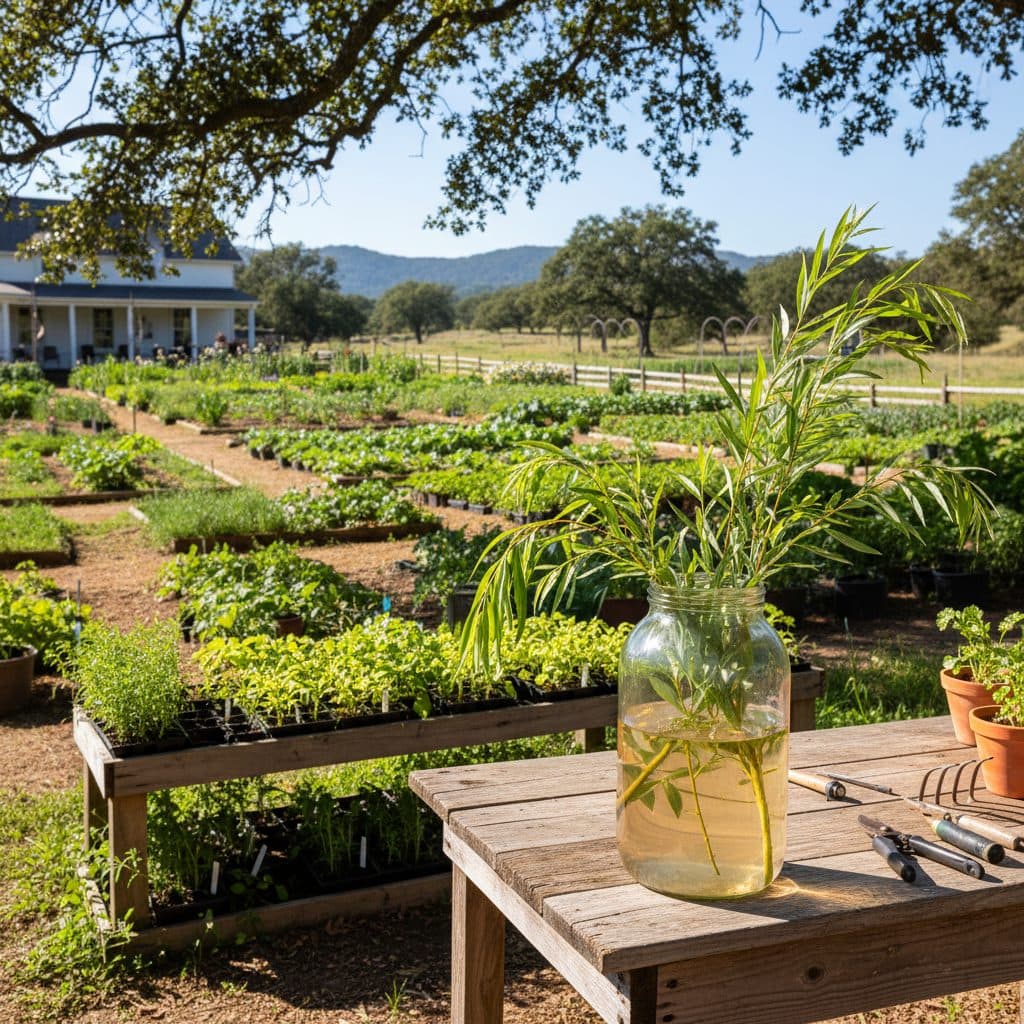
Key takeaways
- Willow water is a traditional rooting aid, long used by gardeners though not well supported by controlled trials.
- Native US willow species like Black Willow (Salix nigra) and Pussy Willow (Salix discolor) are excellent choices for brewing.
- Harvest willow branches sustainably, taking no more than 20% from a single plant to ensure its health.
- Two primary methods exist: a cold brew (24-48 hours) or a hot brew (24 hours), both effective for extracting beneficial compounds.
- Use willow water to soak cuttings for 12-24 hours or as a regular drench for lings and young plants.
- Willow water is best used fresh — a few days at room temperature, or up to about two weeks refrigerated in a sealed jar.
Quick answer: Willow water is a traditional rooting aid made by steeping willow branches in water, which draws out salicin and related compounds. It’s used to soak plant cuttings for 12-24 hours or as a drench for seedlings, though the evidence for its effect is mostly anecdotal.
In the humid growing regions of the Southeast, from USDA zone 7 to 9, many experienced growers understand the value of self-sufficiency. One overlooked resource, abundant across much of the United States, is the native willow. These fast-growing trees offer more than just shade or streambank stabilization; their branches contain natural compounds that can be extracted to create a potent, free rooting hormone. This simple brew costs nothing but your time, and it gives you a repeatable way to treat cuttings using material you can cut yourself.
For decades, gardeners have recognized willow’s ability to encourage root development. The process is straightforward, requiring only willow branches, water, and a little patience. By understanding which native species to select, how to harvest them responsibly, and the best brewing techniques, you can produce a consistent supply of this valuable rooting aid right at home. Understanding species selection, harvesting, and brewing methods helps you prepare and use willow water when starting seeds or rooting cuttings on a homestead.
Why willow water works for plant propagation
Willow trees, found in nearly every US state and thriving especially well in USDA zones 2 through 9, possess unique properties that make them excellent for plant propagation. Their branches and bark contain natural compounds that stimulate root growth and help protect cuttings from disease. These substances, including certain auxins and salicylic acid, help initiate and develop new roots on plant cuttings. Research in 2002 characterized 14 willow clones for their growth and water use, documenting their growth rates and regeneration [2].
The science behind the brew
When you steep willow branches in water, these beneficial compounds leach out, creating a solution that acts much like a commercial rooting hormone, but without the added cost or synthetic ingredients. Willow bark is rich in salicin, which yields salicylic acid in water. Gardeners have long believed willow extract also carries root-promoting auxins, though that part has never been well established. Salicylic acid is a plant defense signal in intact plants; whether a dilute willow soak meaningfully protects a detached cutting has not been established. Gardeners have used willow water this way for generations, but reports of its effect are largely anecdotal and controlled comparisons against plain water are scarce.
- Stimulates rapid root development in cuttings.
- May help protect the cut surface, though the evidence for that is thin.
- Improves overall cutting survival rates.
- Reduces reliance on synthetic chemicals.
- Offers a cost-free propagation solution.
Identifying native US willow species
Any willow will brew, and native species like black willow are the easiest to find growing wild. Whatever you cut, dry or compost the spent stems rather than dumping them near water — willow strikes root readily from discarded pieces. The USDA Natural Resources Conservation Service provides current information on native US willow species, useful for identification in 2024. For example, Black Willow (Salix nigra) is common in the eastern and central US, often reaching heights of 30 to 60 feet. Pussy Willow (Salix discolor), found across the northern half of the country, is another excellent choice, typically growing as a large shrub or small tree up to 20 feet tall. Both species are hardy and contain high concentrations of the desired rooting compounds.
Common species to look for
When identifying willows, look for their characteristic long, slender leaves, typically 2 to 6 inches in length, and their often reddish or yellowish young stems. Many willows prefer moist soil conditions, frequently found along riverbanks, wetlands, or in low-lying areas. Get the landowner’s permission before cutting, and check local rules — streambank and wetland vegetation is often on public land or inside a protected riparian buffer. While Weeping Willows (Salix babylonica) are well-known, they are not native to North America, though they were established in New England by 1927 [4]. Focusing on native species like Sandbar Willow (Salix interior) or Pacific Willow (Salix lucida) in their respective regions ensures you’re working with plants adapted to local conditions and supporting native biodiversity. Always confirm your identification before harvesting, perhaps by consulting a local extension office or field guide for your specific USDA zone, which can range from zone 2 to zone 9 for various native willows.
- Look for long, narrow leaves with fine serrations.
- Observe young stems for reddish or yellowish hues.
- Check for growth near water sources like streams or ponds.
- Confirm species with a local plant guide or expert.
- Any willow species will brew; native species are simply the easiest to find growing wild.
How to harvest willow branches responsibly
Sustainable harvesting maintains a continuous supply of willow branches without harming the parent plant. Take young stems in spring and early summer, when growth is active and the compounds you want are concentrated in the new wood. This period allows the plant to recover effectively and minimizes stress. You’ll want young, pencil-thick stems from the past season’s growth, along with their green tips — young tissue is where a plant’s own growth compounds are concentrated. Skip old, thick, corky wood. Using clean, sharp pruning shears or loppers makes clean cuts, which helps the willow heal quickly and prevents disease entry, such as the Water Mark Disease that affected willows as early as 1940 [1].
Tools and techniques for collection
When harvesting, aim to take no more than 20% of the branches from any single willow plant. This ensures the plant has enough foliage and energy reserves to continue thriving. Make your cuts at a slight angle, just above a bud or a branch collar, to encourage healthy regrowth. For larger trees, consider using a pole pruner to reach higher branches safely. After cutting, immediately remove any leaves, as they can draw moisture away from the valuable stems and potentially introduce unwanted organic matter into your brew. A 10-foot long branch can yield enough material for several batches of willow water, providing ample rooting solution for your seed starting efforts.
- Harvest young stems in spring and early summer, when growth is active.
- Select branches 0.5 to 1 inch in diameter.
- Use clean, sharp pruning shears for precise cuts.
- Take no more than 20% of the plant’s branches.
- Remove all leaves from harvested stems immediately.
Brewing your own willow water
There are two primary methods for brewing willow water: the cold brew method and the hot brew method. Both are effective, but they differ slightly in preparation time and compound extraction. For either method, use about 1 pound of cut willow stems for every gallon of water. Begin by cutting your harvested willow branches into small pieces, about 1 to 2 inches long. This increases the surface area, allowing for better extraction of the beneficial compounds. Using harvested rainwater or distilled water is ideal, as it avoids chlorine and other chemicals found in tap water that could interfere with the rooting process.
Hot brew vs. cold brew methods
For the cold brew method, place the cut willow pieces into a non-reactive container, such as a glass jar or food-grade bucket. Cover them completely with water and let them steep for 24 to 48 hours at room temperature, ideally between 65°F and 75°F. For the hot brew method, bring your water to a boil, then remove it from the heat. Add the willow pieces to the hot water and let them steep as the water cools, covering the container. Allow it to sit for a minimum of 24 hours. Some growers prefer to let it steep for up to 48 hours for a stronger brew, as described in contemporary discussions about ‘Strong Willow Bark Brew’ in 2024 [5]. After steeping, strain out the willow pieces using a fine mesh sieve or cheesecloth. The resulting liquid is your willow water.
- Use about 1 pound of willow stems per gallon of water.
- Cut willow into 1-2 inch pieces for maximum surface area.
- Choose rainwater or distilled water for best results.
- For cold brew, steep for 24-48 hours at room temperature.
- For hot brew, steep in cooling boiled water for 24-48 hours.
Using willow water effectively
Once brewed, willow water is ready for immediate use in your propagation efforts. The most common application is to soak cuttings before planting. For most species, a soak of 12 to 24 hours is sufficient. Simply place the bottom 1 to 2 inches of your cuttings into the willow water. This allows the beneficial compounds to be absorbed directly into the plant tissue, preparing them for root development. Tomato cuttings root readily on their own, so they are a poor test of any rooting aid; save the soak for material that is slower to strike.
Application techniques and storage
Beyond soaking, willow water can also be used as a regular drench for newly planted cuttings or seedlings. Instead of plain water, use willow water for the first few waterings to provide a continuous boost to root growth and disease resistance. This is particularly useful for delicate seedlings or plants recovering from transplant shock. Store any leftover willow water in a sealed container in a cool, dark place, such as a basement or refrigerator. Use it fresh — within a few days at room temperature, or up to about two weeks refrigerated in a sealed jar. Discard it as soon as it smells sour or grows a film, because an unsterilized plant extract is a growth medium in its own right. You can even freeze it in ice cube trays for individual applications, providing a convenient 1-ounce dose per cube.
- Soak cutting bases for 12-24 hours before planting.
- Use as a drench for seedlings and newly planted cuttings.
- Apply weekly for the first three weeks after transplanting.
- Use it within a few days if you are storing it at room temperature.
- Refrigerate for up to about two weeks, or freeze in ice cube trays for longer storage.
Willow water vs. commercial rooting hormones
Feature | Willow Water | Commercial Hormone |
|---|---|---|
Cost | Free (from native plants) | Typically $5-$20 per bottle |
Ingredients | Natural plant compounds | Synthetic auxins (e.g., IBA, NAA) |
Availability | Seasonal, requires harvesting | Year-round, store-bought |
Shelf Life | Days at room temp, about 2 weeks refrigerated | 1-2 years (unopened) |
Ease of Use | Requires brewing time (24-48 hours) | Ready to use instantly |
Cost Savings: Willow water costs nothing but the time to cut and steep it, which keeps propagation spending down.
Potency: About 1 pound of willow stems per gallon of water, steeped 24 to 48 hours, gives a usable brew.
Frequently asked questions
What kind of willow should I use for willow water?
Focus on native US willow species like Black Willow (Salix nigra) or Pussy Willow (Salix discolor), which are abundant in many regions from USDA zone 2 to 9. Avoid non-native varieties like Weeping Willow (Salix babylonica) to support local ecosystems, and always confirm identification with a local guide.
How long does willow water last?
Freshly brewed willow water is best used within a few days at room temperature. Refrigerated in a sealed container it will keep about two weeks; discard it once it smells sour or grows a film.
Can I use willow water for all types of cuttings?
Willow water is effective for a wide range of plant cuttings, including many woody and herbaceous species. Reports are largely anecdotal, and results vary by species and by batch.
Is hot brew or cold brew better for willow water?
Both hot and cold brew methods are effective. The cold brew method, steeping for 24 to 48 hours, is gentler and extracts compounds slowly. The hot brew method, using cooling boiled water for 24 hours, can extract compounds more rapidly, and some growers prefer its perceived strength.
How much willow water should I use per cutting?
For soaking cuttings, you only need enough willow water to submerge the bottom 1 to 2 inches of the stem. For drenching seedlings, use it as you would regular water to ensure the soil is thoroughly moistened, typically 1/2 to 1 cup per small seedling pot.
What are the active ingredients in willow water?
Willow water contains naturally occurring auxins, which are plant hormones that stimulate root growth, and salicylic acid, a plant defense compound that helps protect cuttings from fungal and bacterial infections. These compounds are the basis for willow water’s reputation, though controlled evidence for the effect is thin.
References
- The Willow Wood Wasp and Water Mark Disease of Willows (1940). [The Willow Wood Wasp and Water Mark Disease of Willows](https://doi.org/10.1016/s0372-5545(17)34806-x).
- Characterising willows for biomass and phytoremediation: growth, nitrogen and water use of 14 willow clones under different irrigation and fertilisation regimes (2002). [Characterising willows for biomass and phytoremediation: growth, nitrogen and water use of 14 willow clones under different irrigation and fertilisation regimes](https://doi.org/10.1016/s0961-9534(02)00067-3).
- Control of Willow Leaf Beetle on Willows, 1979 (1980). Control of Willow Leaf Beetle on Willows, 1979.
- The first weeping willow in England: Weeping willows in New England (1927). The first weeping willow in England: Weeping willows in New England.
- Strong Willow Bark Brew (2024). Strong Willow Bark Brew.