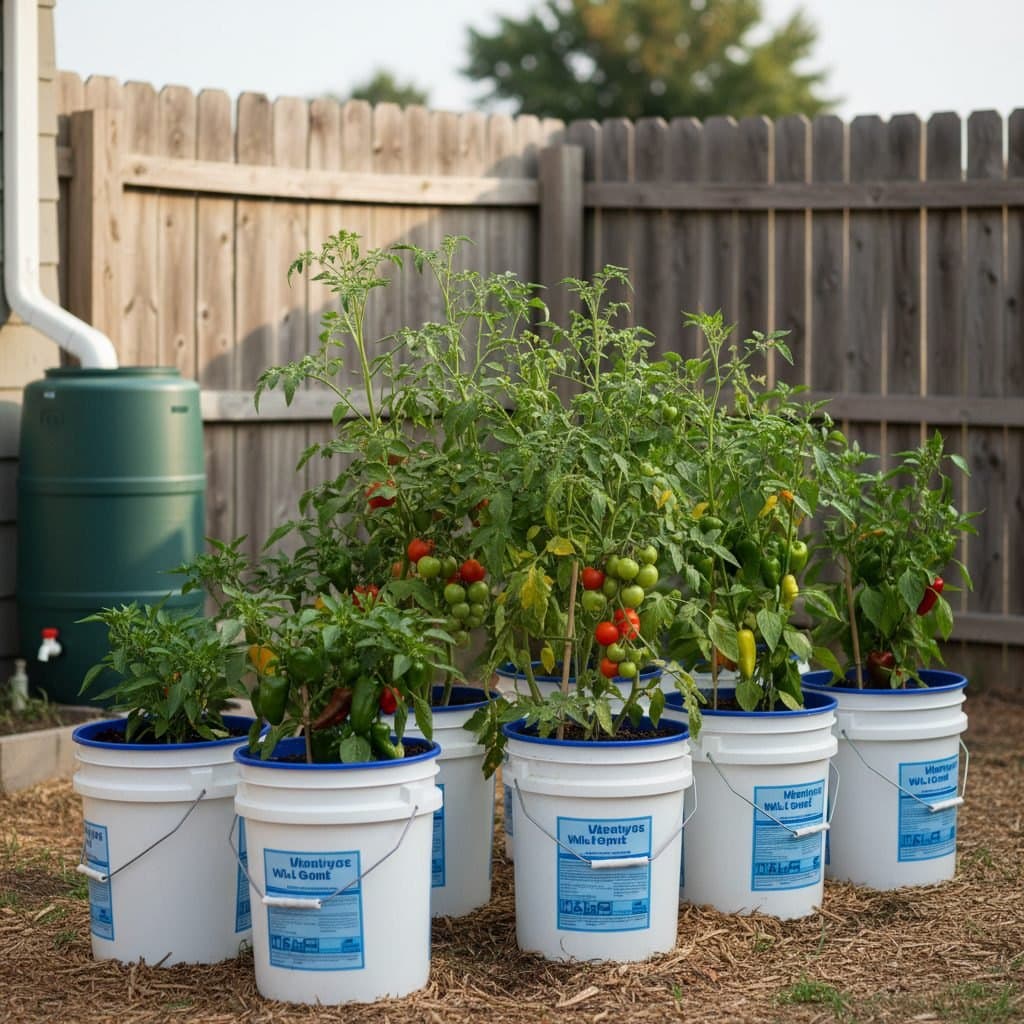
Key takeaways
- SIPs can reduce water use by 50% compared to traditional container gardening methods.
- Consistent moisture from a SIP promotes stronger root development and healthier plant growth.
- Building a SIP requires two 5-gallon buckets, a drill, PVC pipe, and appropriate growing medium.
- Proper drainage and wicking action are essential for preventing root rot and ensuring plant access to water.
- SIPs are suitable for a wide range of crops, including tomatoes, peppers, and leafy greens.
- Maintenance involves periodic reservoir refills and nutrient additions, typically every 2-3 weeks.
Quick answer: A self-watering planter (SIP) can be built using two 5-gallon buckets, a drill, PVC pipe, and a suitable growing medium. This system allows plants to draw water from a reservoir below the soil, significantly reducing watering frequency and promoting healthier plant growth.
In many parts of the United States, particularly in arid regions like the Southwest, water conservation is a necessity. Even in areas with ample rainfall, like the Southeast, efficiently managing water resources can reduce utility bills and promote healthier plants. Traditional container gardening, which often requires daily watering, can lead to significant water loss through evaporation and runoff, sometimes wasting up to 50% of the water applied. A sub-irrigated planter, or SIP, offers a practical solution, allowing plants to draw water from a reservoir below the soil, the same way capillary action works in nature.
This article will guide you through constructing a simple, effective self-watering planter using two common 5-gallon buckets. This system can dramatically reduce your watering frequency and improve plant vigor, especially for thirsty crops like tomatoes or cucumbers that can demand 1 to 1.5 gallons of water per day during peak growing season in USDA zones 7-9. By building your own SIP, you are taking a concrete step towards more resilient and productive gardening practices, conserving water resources one bucket at a time.
Why choose a self-watering planter
Self-watering planters offer several distinct advantages over conventional container gardening, particularly in terms of water efficiency and plant health. Research from organizations like Sustainable Agriculture Research & Education (SARE) indicates that SIPs can reduce water consumption by as much as 50% compared to top-watered containers, a significant saving for any gardener [3]. This efficiency matters most in regions experiencing drought conditions, or for gardeners looking to minimize their environmental footprint and water bills.
Consistent moisture, healthier plants
The core benefit of a SIP lies in its ability to provide a consistent moisture level directly to the plant roots. Unlike traditional pots where water often drains quickly, a SIP maintains a steady supply, preventing the feast-or-famine watering cycle that stresses plants. This consistent hydration promotes stronger root systems, as plants do not need to constantly seek out water. For instance, a tomato plant in a SIP in USDA zone 6 might show 20% more vigorous growth and a higher yield than one in a regularly watered pot. The reservoir also helps to keep soil temperatures more stable, which is beneficial for root development, especially during hot summer months when soil in dark containers can reach over 100°F. This method also reduces nutrient leaching, as water and dissolved nutrients are drawn upwards by capillary action rather than washed away. You will also notice a substantial reduction in watering frequency, often needing to refill the reservoir only once every two to three weeks, depending on plant size and weather conditions. This makes SIPs ideal for busy gardeners or those who travel frequently.
- Reduces water usage by up to 50%
- Promotes stronger, healthier root systems
- Stabilizes soil temperature for optimal growth
- Minimizes nutrient runoff and leaching
- Decreases watering frequency significantly
What you will need: two 5-gallon buckets and more
Building a 5-gallon bucket SIP is a straightforward project that requires only a few common materials and tools. The primary components are two food-grade 5-gallon buckets, which are readily available from hardware stores or even local bakeries for a few dollars each. It is important to use food-grade buckets to avoid potential chemical leaching into your plants and soil, especially if you plan to grow edible crops. For instance, many home improvement stores sell new 5-gallon buckets for around $5-$7.
Essential components for a robust SIP
Beyond the buckets, you will need a section of PVC pipe, typically 1.5 to 2 inches in diameter and about 12 to 18 inches long, to serve as your water fill tube. A drill with various bits is essential: a 1/4 inch bit for drainage holes, and a 2-inch hole saw for creating the openings for the fill pipe and wicking chamber. You will also need a fine mesh screen, such as window screen material, to prevent soil from falling into the water reservoir while allowing water to wick up. Approximately 1 square foot of screen is usually sufficient for one SIP. The growing medium itself is crucial; a good mix might be 3 parts high-quality compost to 1 part perlite or vermiculite, ensuring good drainage and aeration while retaining moisture. This blend provides the necessary structure and nutrients for plants to thrive. It also helps maintain a healthy root zone across USDA zones 5-10. Consider using an expandable hose with a 7-pattern spray nozzle for easy filling of your SIP reservoir.
- Two food-grade 5-gallon buckets
- 1.5 to 2 inch diameter PVC pipe (12-18 inches long)
- Drill with 1/4 inch bit and 2 inch hole saw
- Fine mesh screen (approx. 1 square foot)
- Growing medium (e.g., 3:1 compost to perlite)
Assembling your SIP
Once you have gathered all your materials, the assembly process for your 5-gallon bucket SIP is relatively quick, often taking less than 30 minutes. The first step involves preparing the outer bucket, which will serve as the water reservoir. Drill several 1/4 inch drainage holes around the side of this bucket, about 1 inch from the bottom. These overflow holes are critical; they prevent the plant roots from sitting in stagnant water and becoming waterlogged, which can lead to root rot. Without these holes, heavy rainfall or overfilling could drown your plants, especially in humid climates like Florida or Louisiana.
From two buckets to a functional planter
Next, prepare the inner bucket. This bucket will hold your growing medium and sit inside the outer bucket. Use a utility knife or a saw to cut the inner bucket down to a height of about 4 to 6 inches from its bottom. This creates the platform for your soil and leaves a substantial water reservoir below. Drill numerous 1/2 inch holes across the bottom and sides of this cut-down inner bucket, spaced about 1 inch apart. These holes allow water to wick up into the soil and provide aeration. Cut a 2-inch hole in the bottom of the inner bucket for the PVC fill pipe. Insert the 1.5 to 2 inch PVC pipe into this hole, ensuring it extends about 12 to 18 inches above the top of the inner bucket for easy filling. Place a piece of mesh screen over the bottom of the inner bucket to prevent soil from falling into the reservoir. Finally, place the inner bucket into the outer bucket, ensuring it sits securely. This creates the wicking chamber and drainage reservoir system. Fill the inner bucket with your prepared growing medium, pressing it firmly into the fill pipe and around the screen to establish good wicking action. This entire process, when done correctly, ensures optimal soil aeration and water delivery to your plants.
- Drill 1/4 inch overflow holes 1 inch from the bottom of the outer bucket.
- Cut the inner bucket to 4-6 inches high and drill 1/2 inch holes in its bottom and sides.
- Cut a 2-inch hole in the inner bucket bottom for the PVC fill pipe.
- Insert the 1.5-2 inch PVC pipe (12-18 inches long) into the inner bucket.
- Place mesh screen over the bottom of the inner bucket and then place it into the outer bucket.
Planting your crops and ongoing care
With your SIP assembled, it is time to plant your chosen crops. Almost any plant that thrives in a container can do well in a SIP, from herbs like basil and mint to larger vegetables such as tomatoes, peppers, and even small squash varieties. For example, a single determinate tomato plant can be very productive in a 5-gallon SIP, yielding 10-15 pounds of fruit over its season in USDA zone 7. Ensure your plant is well-established before transplanting it into the SIP.
Maximizing yield with proper care
After planting, thoroughly water the topsoil until water begins to drain from the overflow holes. This initial top-watering helps to establish the wicking action from the reservoir to the plant roots. After this initial saturation, you will primarily water by filling the reservoir through the PVC pipe. Monitor the water level every few days, especially during hot periods when plants like cucumbers can transpire 1 gallon of water daily. Refill the reservoir when it is empty, which might be every 5-7 days for small plants, or every 2-3 weeks for mature, thirsty plants. For optimal nutrient delivery, consider adding a liquid fertilizer to the reservoir every few weeks, following the product’s instructions for dilution, or incorporate a slow-release granular fertilizer into the top 2-3 inches of soil at planting. Regular inspection for pests and diseases is still necessary, even with the benefits of consistent moisture. For larger scale operations, consider integrating a drip system with garden PE irrigation hose for automated reservoir filling across multiple SIPs. USDA Natural Resources Conservation Service (NRCS) emphasizes the importance of consistent moisture for plant health, noting that irregular watering can reduce yields by up to 35% in some crops [1].
- Thoroughly top-water after planting to establish wicking.
- Refill the reservoir via the PVC pipe every 1-3 weeks.
- Apply liquid fertilizer to the reservoir or granular to the soil as needed.
- Monitor plants for pests and diseases regularly.
- Consider automated irrigation for multiple SIPs.
Beyond buckets: scaling up passive irrigation
While 5-gallon bucket SIPs are excellent for small-scale gardening, the principles of passive irrigation extend to much larger systems. Wicking beds, for example, are essentially scaled-up SIPs, often built from wooden frames or repurposed livestock troughs, capable of holding hundreds of gallons of water and supporting dozens of plants. These larger systems can reduce water usage by 30-50% compared to traditional in-ground gardens, especially in dry climates like Arizona or New Mexico [4].
Integrating SIP principles into larger gardens
Another ancient, yet highly effective, passive irrigation method involves using clay ollas. These unglazed clay pots are buried in the soil near plants and filled with water. The porous clay slowly releases water directly into the root zone through osmosis, minimizing evaporation and delivering water precisely where it is needed. Ollas can reduce water consumption by 15-25% for individual plants, and a single olla can irrigate a 2-3 foot diameter area for several days [1]. Combining these passive systems with rainwater harvesting can create a highly sustainable and resilient garden. For instance, a 1,000-gallon rainwater tank can collect enough water from a 1,000 square foot roof to sustain a significant wicking bed system for weeks, even during dry spells in USDA zone 8. The EPA encourages rainwater harvesting as a way to reduce stormwater runoff and conserve potable water supplies [2]. These methods, from simple bucket SIPs to extensive wicking beds, represent a practical approach to efficient water management in agriculture, following practices the USDA National Agroforestry Center also recommends [5].
- Wicking beds scale SIP principles for larger garden plots.
- Clay ollas provide targeted, slow-release irrigation directly to plant roots.
- Rainwater harvesting can supply water for passive irrigation systems.
- These methods significantly reduce water waste and irrigation frequency.
- They support resilient gardening in various climates and scales.
Water Savings: SIPs can reduce water usage by up to 50% compared to traditional container gardening, saving hundreds of gallons annually for a small garden [3].
Yield Increase: Consistent moisture from SIPs can lead to 20% greater plant vigor and higher yields for crops like tomatoes in USDA zones 6-9.
Reduced Watering: A 5-gallon SIP reservoir can sustain a mature plant for 1 to 3 weeks, significantly cutting down on daily watering tasks.
Browse water harvesting articles
Frequently asked questions
What kind of plants grow best in a 5-gallon bucket SIP?
Many common garden vegetables and herbs thrive in 5-gallon SIPs. Tomatoes, peppers, eggplants, cucumbers, bush beans, and various leafy greens like lettuce and spinach are excellent choices. A single large plant, such as a determinate tomato, can produce 10-15 pounds of fruit in a SIP.
How often do I need to refill the water reservoir?
The refill frequency depends on the plant’s size, the weather, and the specific crop. Smaller plants in cooler weather might only need refilling every 2-3 weeks, while a large, fruiting tomato plant in hot summer weather (e.g., 90°F) might need water every 5-7 days. Always check the reservoir level, especially during peak growth.
Can I use regular garden soil in my SIP?
It is generally not recommended to use heavy garden soil in a SIP. Garden soil can compact too much, hindering the wicking action and reducing aeration, which can lead to root problems. A lighter, well-draining potting mix, ideally with a 3:1 compost to perlite ratio, is best for optimal performance and plant health, ensuring good capillary action.
What are the key benefits of a SIP compared to traditional pots?
SIPs offer several key benefits: they reduce water consumption by up to 50%, provide consistent moisture to plant roots for healthier growth, minimize nutrient leaching, and significantly decrease watering frequency. This makes them ideal for busy gardeners or those in drought-prone regions like California, where water conservation is critical.
How do I prevent mosquitoes from breeding in the water reservoir?
To prevent mosquito breeding, ensure your SIP’s overflow holes are correctly placed, allowing excess water to drain and preventing stagnant water at the very top of the reservoir. You can also add a small amount of mosquito dunks (Bacillus thuringiensis israelensis) to the reservoir, which are safe for plants and kill mosquito larvae for up to 30 days.
References
- USDA Natural Resources Conservation Service (2024). USDA Natural Resources Conservation Service.
- EPA — Soak Up the Rain (2024). EPA — Soak Up the Rain.
- SARE — Sustainable Agriculture Research & Education (2023). SARE — Sustainable Agriculture Research & Education.
- ATTRA / NCAT Sustainable Agriculture (2023). ATTRA / NCAT Sustainable Agriculture.
- USDA National Agroforestry Center (2023). USDA National Agroforestry Center.