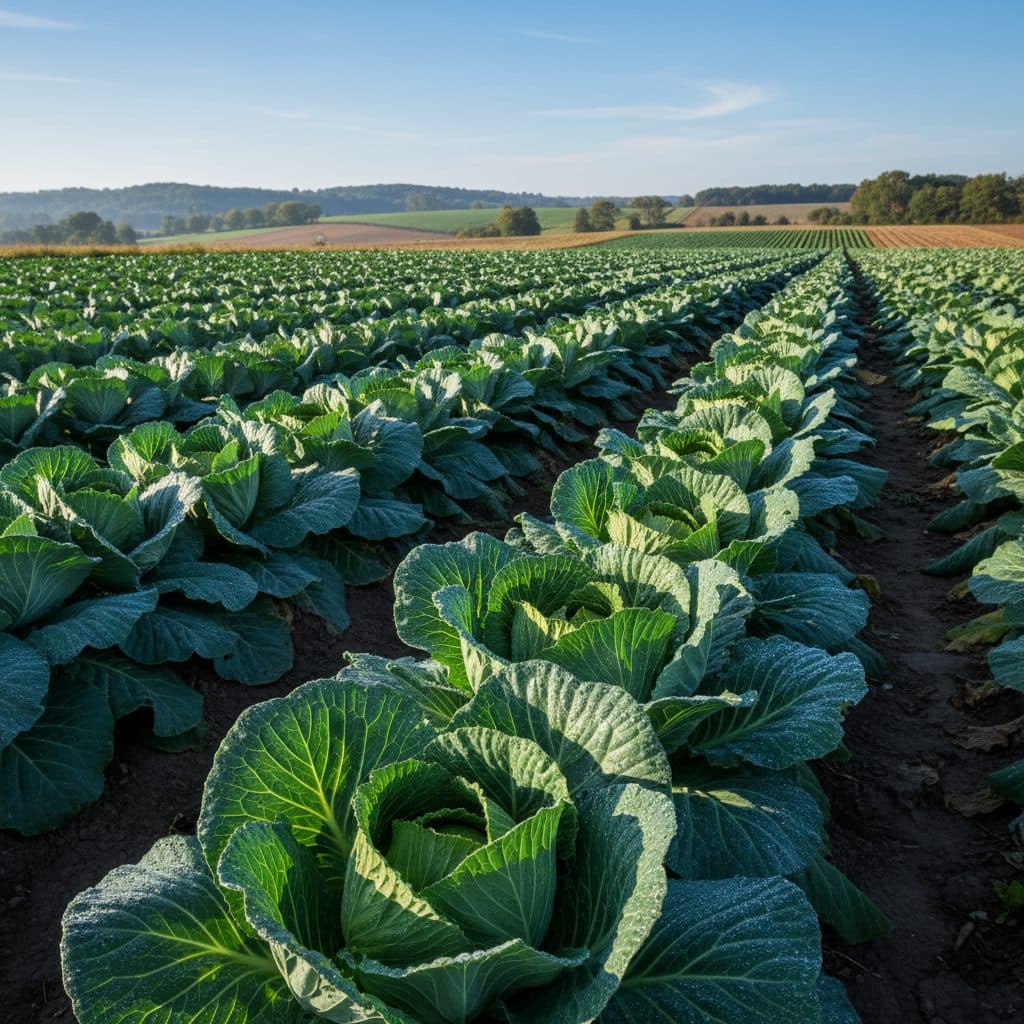
Key takeaways
- Cabbage head formation, or heading, is an important growth stage, often occurring 60-90 days after transplanting for many varieties.
- Preventing head splitting requires consistent soil moisture and avoiding sudden changes in water availability, especially after dry periods.
- Bolting, or premature flowering, is triggered by stress factors like temperature fluctuations or extended cold spells below 50°F.
- Proper nutrient management, particularly balanced nitrogen and potassium, supports steady growth and reduces susceptibility to problems.
- Selecting appropriate Brassica varieties for your specific USDA zone can significantly mitigate risks of bolting or poor heading.
- Monitoring soil pH, aiming for 6.0-7.0, helps maintain nutrient uptake and overall plant health in brassicas.
Quick answer: Managing brassica growth stages for optimal yield requires consistent soil moisture, moderate temperatures, and balanced nutrition. These practices prevent issues like bolting and head splitting, ensuring healthy cabbage development.
In the fertile fields of California’s Central Valley, where 70% of US fresh market broccoli is grown, growers know that understanding plant growth stages supports a profitable harvest. This holds true for all brassicas, from the common head cabbage to specialty Chinese varieties. Navigating the specific needs of these crops through their development, from initial leaf expansion through heading, can mean the difference between a bumper crop and a disappointing yield.
For growers in USDA zones 5 through 9, managing issues like head splitting and premature bolting is a constant challenge. These problems can reduce marketable yields by 20% or more in a bad season, directly impacting the bottom line. By focusing on consistent care and proactive management, growers can help ensure brassica crops reach their full potential and deliver quality produce to market.
The heading phase in cabbage
Cabbage heading is the process where the plant’s inner leaves begin to fold inward, forming the dense, edible head we harvest. This stage typically commences 60 to 90 days after transplanting for many common varieties like ‘Flat Dutch’ or ‘Copenhagen Market’. The formation of a firm, compact head is a primary goal for commercial growers, as it directly influences market value and storage potential. Research indicates that the initiation of head formation in Brassica oleracea involves complex genetic and environmental interactions, with specific genes regulating leaf folding and compaction [4].
Optimal conditions for heading include consistent temperatures between 60°F and 70°F, along with steady soil moisture. A lack of water during this period can stunt head development, leading to loose, unmarketable heads. Conversely, too much water can contribute to other issues. For instance, in USDA zone 7, where spring temperatures can fluctuate, maintaining a consistent environment is important. Adequate nutrient availability, particularly nitrogen and potassium, also plays a significant role in supporting the rapid growth required for a solid head. A balanced fertilizer application, perhaps incorporating a product like fermented soybean meal organic fertilizer, can provide a steady supply of these essential elements.
Environmental factors influencing head formation
- Consistent soil moisture: Aim for 1 to 1.5 inches of water per week, especially during head development.
- Moderate temperatures: Ideal range is 60°F to 70°F for most heading cabbages.
- Adequate sunlight: At least 6 hours of direct sun daily promotes vigorous growth.
- Balanced nutrition: Sufficient nitrogen for leaf growth and potassium for overall plant health.
- Proper spacing: 18 to 24 inches between plants allows for full head development without competition.
Understanding and preventing head splitting
Head splitting is a common issue in mature cabbage, where the outer leaves rupture, making the head unmarketable. This problem is primarily caused by a sudden influx of water after a dry period, leading to rapid internal growth that the outer leaves cannot accommodate. For example, a heavy rain event of 2 inches following two weeks of drought in a field in Iowa can trigger widespread splitting. The inner cells expand quickly, exerting pressure that literally bursts the head open [3].
Preventative measures focus on maintaining consistent soil moisture, especially as heads approach maturity. In regions like USDA zone 8, where late spring rains can be unpredictable, implementing drip irrigation can provide a steady water supply, preventing the feast-or-famine cycle that causes splitting. Some growers also practice root pruning (cutting a few roots on one side of the plant with a spade) to slow water uptake and growth, though this is a labor-intensive method. Harvesting heads promptly once they reach a desirable size and firmness is another effective strategy, as older, larger heads are more susceptible to splitting. Varieties with a longer harvest window, such as ‘Storage No. 4’, can offer some flexibility but are not immune.
Strategies to minimize cabbage head splitting
- Consistent watering: Provide 1.5 inches of water weekly to avoid dry-wet cycles.
- Timely harvest: Pick heads as soon as they are firm and mature, typically 85-95 days after planting.
- Appropriate variety selection: Choose varieties known for split resistance, like ‘Blue Vantage’, for your growing conditions.
- Avoid over-fertilization: Excessive nitrogen can promote rapid, soft growth more prone to splitting.
- Shading: In very hot, sunny conditions, temporary shading can reduce stress and slow growth.
Bolting: when brassicas go to seed too soon
Bolting refers to the premature flowering and seed stalk development in brassicas, which renders the leafy parts bitter and unmarketable. This physiological response is often triggered by environmental stress, primarily temperature fluctuations. For example, a cold snap where temperatures drop below 50°F for more than 10 days, followed by a sudden warm spell, can induce bolting in many cabbage varieties in USDA zone 6. This stress signals the plant to complete its life cycle rapidly by producing seeds instead of continuing vegetative growth [1].
While bolting is a natural process for biennial plants like cabbage, it’s undesirable in a commercial setting. Factors contributing to bolting include prolonged exposure to cold temperatures during early growth, extended periods of drought, or even transplant shock. To prevent bolting, growers should select bolt-resistant varieties suitable for their local climate, such as ‘Caraflex’ for spring planting. Planting at the correct time, ensuring seedlings are not exposed to cold stress for too long, is also important. For example, in the Pacific Northwest, planting too early in spring can expose young turnip or cabbage plants to unseasonably cold nights, increasing bolting risk. Consistent watering and nutrient management help reduce overall plant stress, making the plants less likely to bolt. Crop rotation, perhaps following a legume cover crop like sesbania, can also improve soil health and reduce stress.
Key factors contributing to brassica bolting
- Temperature stress: Prolonged cold (below 50°F) followed by warm temperatures.
- Day length: Some varieties are sensitive to increasing day length, triggering flowering.
- Transplant shock: Stress during transplanting can sometimes induce bolting.
- Nutrient deficiency: Lack of essential nutrients can stress plants, leading to early flowering.
- Variety selection: Non-bolt-resistant varieties are more susceptible to environmental triggers.
Nutrient management and variety selection for brassicas
Effective nutrient management is foundational for healthy brassica growth and resistance to issues like splitting and bolting. Brassicas are heavy feeders, requiring a balanced supply of macro and micronutrients. For example, a soil test revealing a pH of 5.5 in a field in North Carolina would indicate a need for liming, as brassicas thrive in a pH range of 6.0 to 7.0 [6]. This optimal pH ensures efficient uptake of nutrients like nitrogen, phosphorus, and potassium. A typical cabbage crop can remove 150-200 pounds of nitrogen, 50-70 pounds of phosphorus, and 150-250 pounds of potassium per acre over a growing season.
Beyond pH, the choice of brassica variety is paramount. Selecting varieties specifically bred for your USDA zone and anticipated growing season can dramatically reduce plant stress. For instance, ‘Early Jersey Wakefield’ is a good choice for early spring planting in cooler climates (USDA zones 4-7) due to its relative bolt resistance, while ‘Late Flat Dutch’ is better suited for fall planting and storage. When considering various brassicas, from toria to canola, their specific environmental tolerances vary. Always consult local extension services for recommended varieties. Furthermore, ensuring adequate boron is important for brassicas, as a deficiency can lead to hollow stems and poor head formation, impacting up to 15% of a crop in some regions.
Essential nutrient considerations for brassicas
- Soil pH: Maintain 6.0-7.0 for optimal nutrient availability.
- Nitrogen: Important for leafy growth; apply 150-200 lbs/acre over the season.
- Phosphorus: Important for root development; apply 50-70 lbs/acre.
- Potassium: Supports disease resistance and overall vigor; apply 150-250 lbs/acre.
- Micronutrients: Boron, molybdenum, and calcium are necessary; test soil regularly for deficiencies.
Common cabbage varieties: characteristics and suitability
Variety name | Typical days to maturity | Bolt resistance | Splitting resistance | Best use/notes |
|---|---|---|---|---|
Early Jersey Wakefield | 60-70 days | Good | Moderate | Early spring crop, pointed heads, good for small gardens. |
Copenhagen Market | 70-80 days | Moderate | Moderate | Standard round head, widely adapted to USDA zones 3-9. |
Flat Dutch | 90-100 days | Moderate | Good | Large, flat heads, excellent for sauerkraut and storage. |
Storage No. 4 | 100-110 days | High | High | Very firm heads, excellent for long-term storage, often grown in USDA zone 5. |
Caraflex | 60-70 days | High | Good | Pointed, compact heads, good for spring and fall, sweet flavor. |
Optimal pH Range: Brassicas generally perform best in soil with a pH between 6.0 and 7.0, ensuring over 90% nutrient availability.
Water Requirement: Cabbage crops need 1 to 1.5 inches of water per week, especially during the 3-4 week heading phase.
Frequently asked questions
What is the primary cause of cabbage head splitting?
Head splitting is most often caused by a sudden increase in water uptake after a dry period, leading to rapid internal growth that the outer leaves cannot contain. This can occur, for example, after a heavy 2-inch rainfall following a two-week drought.
How can I prevent my brassicas from bolting?
Prevent bolting by selecting bolt-resistant varieties, planting at the correct time to avoid prolonged cold exposure below 50°F, and maintaining consistent soil moisture and nutrients to reduce plant stress. Timely harvesting also helps.
What is the ideal soil pH for growing cabbage?
Cabbage and most brassicas prefer a slightly acidic to neutral soil pH, ideally between 6.0 and 7.0. A pH of 6.5 is often considered optimal for nutrient availability and steady plant growth.
How much water does a cabbage plant need per week?
During its active growth and heading phase, a cabbage plant typically requires 1 to 1.5 inches of water per week. Consistent watering is more important than sporadic heavy irrigation to prevent issues like splitting.
When should I harvest cabbage to avoid splitting?
Harvest cabbage heads as soon as they are firm and solid, typically 80-100 days after transplanting for most varieties. Delaying harvest increases the risk of splitting, especially if weather conditions become erratic.
References
- CHINESE CABBAGE (Brassica pekinensis, B. chinensis)Cabbage (Brassica pekinensis, B. chinensis) (2023). CHINESE CABBAGE (Brassica pekinensis, B. chinensis)Cabbage (Brassica pekinensis, B. chinensis).
- Comparative Transcriptome Analysis between Broccoli (Brassica oleracea var. italica) and Wild Cabbage (Brassica macrocarpa Guss.) in Response to Plasmodiophora (2016). Comparative Transcriptome Analysis between Broccoli (Brassica oleracea var. italica) and Wild Cabbage (Brassica macrocarpa Guss.) in Response to Plasmodiophora .
- The Technology of Storage Chinese Cabbage (Brassica Rapal) (2024). The Technology of Storage Chinese Cabbage (Brassica Rapal).
- Exploration of the leafy head development in cabbage (Brassica oleracea) (2023). Exploration of the leafy head development in cabbage (Brassica oleracea).
- Cabbage, Chinese—Brassica campestris L. (Pekinensis group), Brassica campestris L. (Chinensis group) (2003). Cabbage, Chinese—Brassica campestris L. (Pekinensis group), Brassica campestris L. (Chinensis group).
- USDA Natural Resources Conservation Service (2024). USDA Natural Resources Conservation Service.